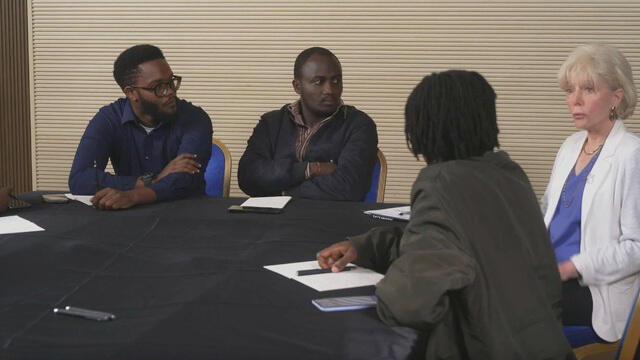
LESLEY STAHL:
00:00:06
What if we told you that after natural disasters, some of those who descend on hard-hit communities with offers to help--
COMMUNITY:
00:00:14
Reclaim America--
LESLEY STAHL:
00:00:16
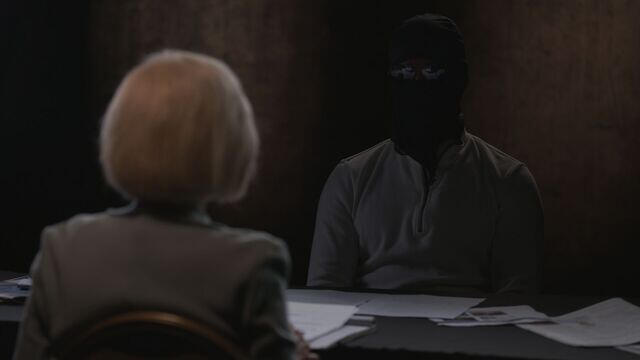
--are anti-government conspiracists and White nationalists. Their motive, recruit, soften their image, and-- Going to a disaster relief is directly helping our people. You're going to help White people. Yeah. [TICKING]
ANDERSON COOPER:
00:00:35
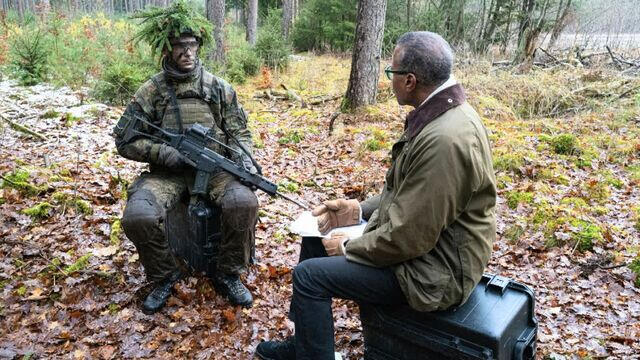
Once in a while, we get to travel so far off the beaten track, there's hardly a track at all. For decades, this pristine forest in Western Colombia was a no go area because of armed conflict. But that allowed hundreds of species of birds to thrive. Oh, that's-- Yeah, look at that. Look at that.
ANDERSON COOPER:
00:00:54
Some of which you can't find anywhere else on Earth. Oh, look at that. Oh my God, look at that huge thing.
CECILIA VEGA:
00:01:03
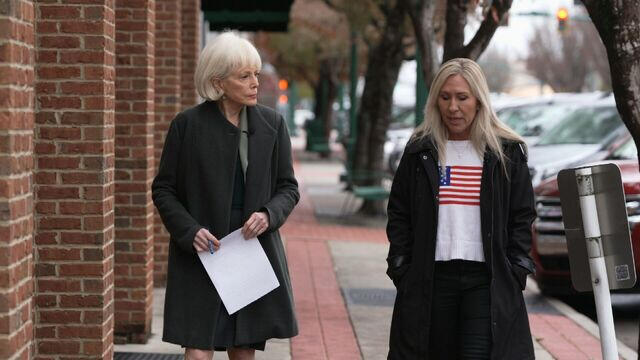
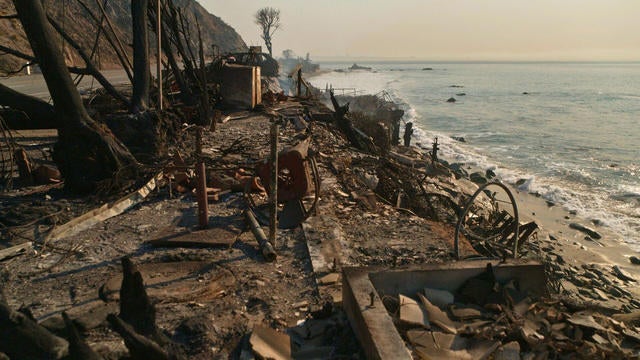
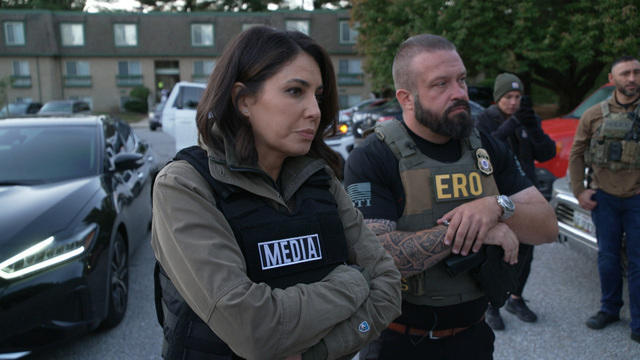
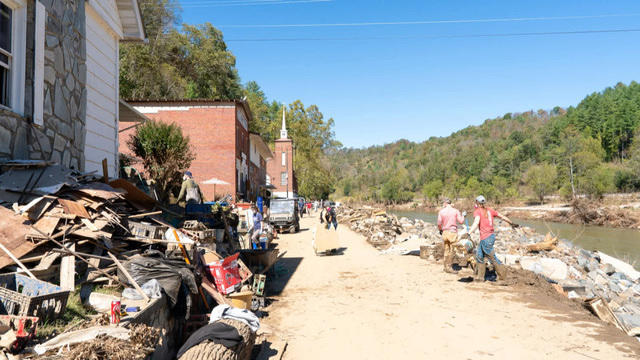
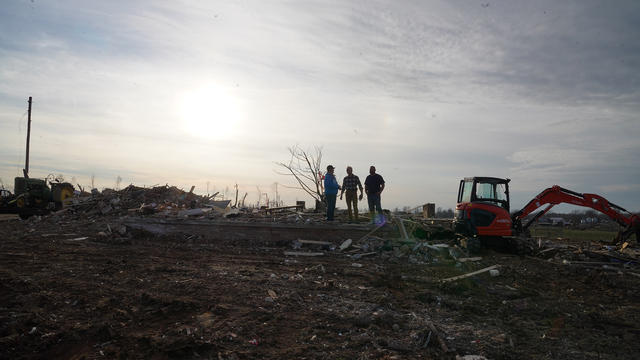
This is the Rose centifolia cultivated in row after pink row. It is a flower worthy of a serenade. Piano notes play over speakers. The vibrations are said to help the buds bloom evenly. 12 of these roses go into a bottle of Chanel number 5, all grown here in the French town of Grasse, where century old traditions are used to develop scents for some of the world's most famous perfumes. How do you know when it's right? It's instinct it's like music. [TICKING] I'm Lesley Stahl. I'm Scott Pelley. I'm Bill Whitaker. I'm Sharyn Alfonsi. I'm Jon Wertheim. I'm Cecilia Vega. I'm Anderson Cooper. Those stories. And in our last minute, a forgotten breakthrough in American history. Tonight on 60 Minutes. [TICKING] A surge of tornadoes tore across a large swath of the country in April, carving a path of destruction. Over 200 tornadoes hit over 20 states closely clustered in the last couple of weeks, and hurricane season is just around the corner. Our story tonight is about what happens after these natural disasters. A pattern has emerged in recent years in which militias, conspiracists, and White supremacists show up to hard-hit communities, as they did last week in Texas, offering help. But they've been called disaster tourists who are out to sow doubt in government, soften their own image and gain followers. September 2024 Hurricane Helene barreled through North Carolina with forces so powerful it nearly wiped the town of Bat Cave off the map, lifting homes and toppling trees. Imagine taking in a box of toothpicks and dumping them on your kitchen counter.
LESLEY STAHL:
00:03:12
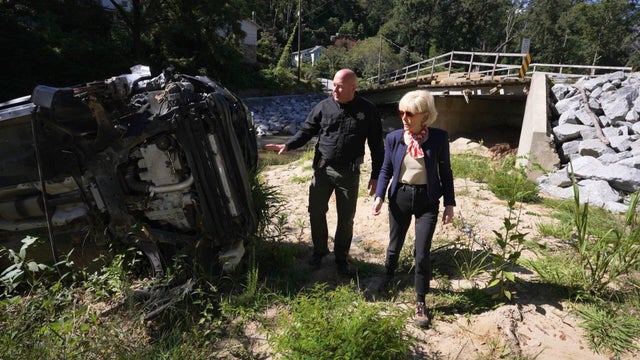
Sheriff Lowell Griffin faced a daunting rescue task. We had already experienced days of heavy rain, and then the hurricane comes through. Like a triple whammy? Yes, yes.
LESLEY STAHL:
00:03:27
Then another whammy. Outsiders started pouring into North Carolina. So we got a lot of work to get done. If you're--
LESLEY STAHL:
00:03:34
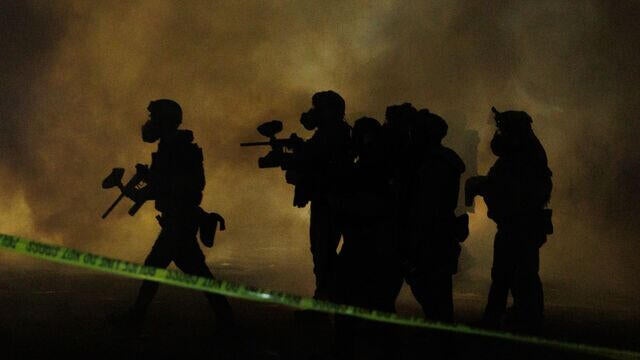
Including an influx of anti-government, far-right groups. These folks that we're talking about, they were in the minority. However, that minority can create chaos. And that's what we ran into. Did some of these outsiders launch their own rescue operations? We had some folks wanting to act as a militia coming in to take over to, in their mind, brings some self-deployed law and order to the area.
LESLEY STAHL:
00:04:06
With weapons? Yes, ma'am. So that's like taking your time from the real rescue to deal with them? It is. It is.
LESLEY STAHL:
00:04:15
The Sheriff himself didn't see all the groups. But we know among those to show up were members of White nationalist group Active Club. Going to a disaster relief is directly helping our people. You're going to help White people? Yeah.
LESLEY STAHL:
00:04:32
Robert Rundo co-founded Active Club in 2020 as a place for disgruntled young White men to work out together while sharing their ideology with nearly 90 chapters. It's been described by watchdogs as one of the country's fastest growing White supremacist networks that are anti-Semitic, anti-immigrant and anti-democracy. They also hold mixed martial arts tournaments. We get together with the boys. We box. We travel. Do you think of it as fun? Of course, there's fun and fascism.
LESLEY STAHL:
00:05:08
Fun and fascism?
ROBERT RUNDO:
00:05:10
I'm a nationalist. What does that mean? A nationalist?
LESLEY STAHL:
00:05:13
Yeah. Means I put my people first. Would you say White supremacist? No, I think that's a slanderous term. But my people are White people-- European White people. Right and there's plenty of organizations that are geared towards other ethnic groups. If we don't look out for ourselves, who is? I know that your organization has gone to floods, fires, hurricanes. What if you came upon someone who wasn't White but is suffering because of the flood? Like if there was a guy on fire, would I give him water? Yeah, I'd probably give him some water. When you go into these areas, are you recruiting? We hand out flyers. If somebody wants to contact us later, that's fine. But just us showing up changes somebody's opinion, someone's mind. So the next time when they put something out and they say, these evil guys, they say, wait a second. That's the guy who came when my house was on fire and helped me out.
LESLEY STAHL:
00:06:09
Many of these outside groups want to build, as one of their post states, a pro-white parallel system.
GROUP:
00:06:17
Reclaim America.
LESLEY STAHL:
00:06:20
One of the more prominent White supremacist groups that showed up in North Carolina was Patriot Front. They cut down trees and handed out bread. Are you sure just one loaf?
LESLEY STAHL:
00:06:32
But Freddy Cruz from the Western states center, a hate group watchdog, says these white nationalists go to disasters primarily to build a following. These people come in, they hand out water, they help clean up the debris. Whatever their ideology, they're doing something positive, aren't they? What we're seeing is actually these groups will show up and generate a whole bunch of social media content. We're dubbing it disaster tourism. And then they leave? That's generally what we see.
LESLEY STAHL:
00:07:04
That's unlike veterans relief groups like Team Rubicon, or religious organizations like Samaritan's Purse that come in after disasters, coordinate with authorities and stay a while. When you go into an area that's distressed, do you coordinate in any way with the local law enforcement, with the sheriff? Absolutely not. They would probably do everything they can to prevent us. What do you say to people who argue that you go in-- the purpose is to have some video shot of you handing out some water, and then you leave? And the whole point was to get that video so that you could post it by saying that-- That sounds like what everyone does. That's what a president does. When he goes into a community, they have the cameras there. So is that bottle of water actually being handed out? Absolutely it is. Does our guys actually care and feel for the people they are helping out? Absolutely. Do we also video it and put it out there to show another side of us? Absolutely.
LESLEY STAHL:
00:08:08
These extremist groups put out videos after floods. Patriot Front is here continuing efforts in Central Texas.
LESLEY STAHL:
00:08:15
They put out videos during fires. We are here in Santa Monica Pier collecting donations for victims of the wildfires.
LESLEY STAHL:
00:08:24
They figured out that videos about natural disasters can reach a whole new large audience. I think white nationalists are interested in natural disasters because everybody is interested in natural disasters.
LESLEY STAHL:
00:08:38
John Kelly heads Graphika, a firm analyzing how content spreads online. There are very few things that bring the public's attention to focus on one thing in unison and natural disasters is one of those. These groups through natural disasters are trying to change their image. They're trying to say we're wholesome. That's one of the things that characterizes the current groups-- is that they've decided to leave the more triggering iconography in the closet and try to appeal to a more mainstream audience. Not to do things that turn people off the way that marching around with swastikas would turn people off. A lot of mainstream media, how they depict us, they like to show a guy who's in camo trucker hat, maybe overweight, face tattoos, something like this. What I wanted to do was to create something positive for young guys like myself.
LESLEY STAHL:
00:09:32
The more macho, wholesome image Robert Rundo thinks gives young men permission to adopt his fascist philosophy. Another guy who appeals to young men is online influencer Dan Bilzerian, with nearly 30 million followers on Instagram. He peddles anti-Semitism. I believe that Jewish supremacy is the greatest threat to America. And I think it's the greatest threat to the world today. I truly believe that.
LESLEY STAHL:
00:09:59
Some of these ideas are seeping into mainstream politics. Bilzerian is running for Congress in Florida. In a group chat, young Republican leaders praised Hitler. And then there's Nick Fuentes, the online hatemonger, who's even more explicit. And I was thinking, what is it about Hitler that's cool? Why does it tickle? Because kids love Hitler. Kids love Hitler. Young men see the--
LESLEY STAHL:
00:10:27
While more people are advocating these ideas in the open, the young men of active club hide their faces when they post pictures from natural disasters. Our people come first.
LESLEY STAHL:
00:10:39
Rundo is their spokesman, even though he himself hasn't gone to disasters. For the past few years, he was out of pocket, so to speak. Why were you in prison? Which time? Oh, boy. I was in prison twice.
LESLEY STAHL:
00:10:57
The 36-year-old from New York was first incarcerated as a teen for a gang fight. Did you stab somebody? Allegedly. Well, yeah. Well, he had a weapon, too. It wasn't like I just randomly showed up on somebody. And the second time? Second time is for what I'm most known for.
LESLEY STAHL:
00:11:17
In 2017, he got into a series of fights with anti-Trump protesters at rallies. That's him pounding and pounding. He was on the lam when he got this idea to launch a more clean-cut white pride group. But it's just a new image. We're ultranationalist, far-right, fascist. I mean, this is I'll lean a little bit into these terms. Is your ultimate goal to turn America into a completely white Christian nation? I would also add a more militant nation as well. Military rule. Like having a military person run the country? Well, just, again, based more of democracy. But what did you mean democracy and of terrible? Because it's just such a scam democracy I believe. It's politicians that get lobbied. They never have the interest. Anything that's important, do they ever ask us? No. But if you have a military, you'll never decide anything. They'll decide. We don't decide anything right now.
LESLEY STAHL:
00:12:29
Going to natural disasters like Hurricane Helene also gives these groups an opportunity to slam the government. Government didn't help whatsoever.
LESLEY STAHL:
00:12:39
Their videos claimed the government did a lousy job in the rescue, saying it was chaotic, clueless, and corrupt. And I am disgusted.
LESLEY STAHL:
00:12:49
The criticisms got more outsiders to descend. These militiamen from Virginia came to clear houses. When the government fails, the people come together.
MAN:
00:13:00
This is a staging area that--
LESLEY STAHL:
00:13:02
An Arizona vigilante conspiracist group, veterans on patrol, came to organize supplies. But according to law enforcement, they created chaos and did more harm than good. Just look at this car. Sheriff Griffin in North Carolina says many of these disaster tourists spread conspiracies and misinformation to help their videos go viral. The misinformation took a bad situation and actually complicated a bad situation. But, Sheriff, they're coming in because they think the government isn't doing anything. So what I would say for all of these outside folks that are really wanting to help, they need to get their information from official sources and not from TikTok or Facebook or whatever the flavor of the day is with social media. What was some of the misinformation that was being spread? That there were people that were still stranded, that there were bodies floating in the river, that FEMA was rationing supplies and seizing supplies. None of that was true.
LESLEY STAHL:
00:14:20
FEMA, the federal agency on the ground in natural disasters, is a main target of these outside groups. During Helene, FEMA rescuers had to back away for a few days when there were fears that militias were coming to hunt them. Also, a wild rumor spread that the government actually created Hurricane Helene using weather monitoring towers as a weather weapon. Now, this is a directed energy weapon utilized to manipulate the weather. These are weapons of mass destruction. So basically, the rumor was that the government controls the weather and that this was a direct attack on the area. Is this usual now in disasters, one, that there are these false rumors, conspiracies being spread, and two, that outside groups stream in and make it more difficult for law enforcement? So what I'm afraid of is-- from what I've seen-- this will be the new normal. [TICKING]
ANNOUNCER:
00:15:31
How China tries to exploit natural disasters in the US. Taking narratives that portray the US government as being ineffective and boosting those narratives.
ANNOUNCER:
00:15:41
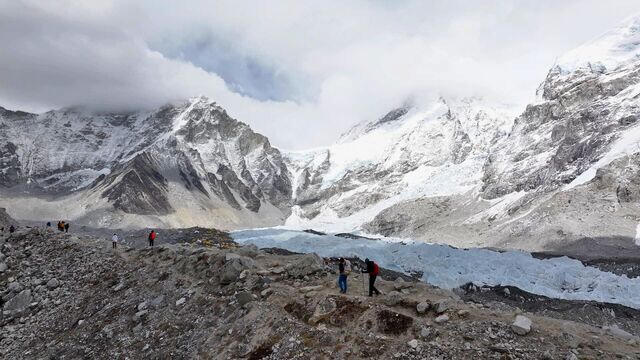
At 60minutesovertime.com. Once in a while we get to travel so far off the beaten track, there's hardly a track at all. That was the case last year when we went to the mountains of Western Colombia. There are some 2,000 species of birds in that South American country, more than anywhere else on Earth, partly because of its diverse geography, but also, surprisingly, because of war. Decades of fighting among the Colombian government, left-wing guerrillas, right-wing paramilitaries and narco traffickers made some areas so dangerous few people could go there. Preserving the birds habitat. But since 2016, when Colombia's government signed a peace deal with the FARC, the largest left-wing guerrilla group, it's gotten safer to travel. And all those species of birds and untouched forests have become an important part of a growing ecotourism industry. It brings in millions of dollars to Colombia's economy. And birdwatchers, birders, as they're known, are flocking there, hoping to catch even a fleeting glimpse of species you can't find anywhere else on Earth. [BIRDS CHIRPING] On the western slope of the Andes mountains, in an area with few roads in or out lies Tatama National Park, a vast stretch of lush rainforest punctuated by powerful rivers. Delicate flowers blossom in the rain-soaked forest, and the sound of birds fills the humid air. This is one of the wettest places on Earth. We set off before dawn in a four-wheel drive vehicle through untouched forest. Hidden in the lush vegetation were all kinds of birds, some shy, others curious. Their colors as vivid as their names-- the blue-gray tanager, the cinnamon flycatcher, the purple-throated woodstar. OK, check it out. Check it out. This one, mate.
ANDERSON COOPER:
00:17:49
Diego Calderón-Franco knows them all. He's one of Colombia's most famous birding guides. DIEGO CALDERÓN-FRANCO: Go above the light.
ANDERSON COOPER:
00:17:56
Oh, yeah, yeah, yeah. DIEGO CALDERÓN-FRANCO: The violet tells you this is the female. This little one right there. The little one actually. Oh, that's the stuff. Oh, look at that. DIEGO CALDERÓN-FRANCO: Look at the tail.
ANDERSON COOPER:
00:18:06
That tail is so beautiful. Diego's enthusiasm is infectious. DIEGO CALDERÓN-FRANCO: This is the star here. This thing. Velvet-purple coronet. There you are.
ANDERSON COOPER:
00:18:16
Wow! Those colors are incredible. Nearby, we spotted some drama between two hummingbirds. Is that a family? One of them is just sitting there on a branch. The others seem to be darting about. DIEGO CALDERÓN-FRANCO: Actually, they are both empress brilliants males. So they're actually probably two males fighting a little bit about territory. Hummingbirds they look cute, but they are real warriors. They will fight for resources. Really hummingbirds do? All day long. All day long.
ANDERSON COOPER:
00:18:43
The pink right underneath the-- DIEGO CALDERÓN-FRANCO: In the throat.
ANDERSON COOPER:
00:18:45
--the throat is incredible. Birding may sound dull to some but in the forest there's always something to watch out for. Whoa! Watch out. Jesus. This is dangerous. Diego has studied the species here so closely. He does their calls the way some people hum music. Something like that I can-- That's a wren? That would be like a wood wren in the forest. There is one here where that is called the munchique wood wren that lives in the highlands. And it's like [CHIRPING] but it's much happier. It has a different tone. So it's more like [CHIRPING] much, much of a, yeah, cooler vibe. You've said that being a bird guide in Colombia is like being an explorer during the Victorian age? DIEGO CALDERÓN-FRANCO: It is. How so? It is because all these explorers from the Victorian age, they were circumnavigating the globe and exploring and finding new species everywhere. And because of our troubled past, you can still be in Colombia, look at an isolated mountain range. And you might find a new species for bird, for science. Are there still bird species out there that haven't been discovered? Absolutely. We tend to think that we have explored all, that we know every corner of the planet, and it's not the case. This area was a no go area for a long time. Indeed. The fact that there were illegal armed groups in this area for so long prevented just people coming and slashing and burning the habitats. No one could disturb the birds, but no one could go see them really either. Yeah, exactly, exactly.
ANDERSON COOPER:
00:20:18
More than 450,000 people were killed, most of them unarmed civilians, during decades of fighting between armed groups and government forces in Colombia. 50,000 people were kidnapped. Diego Calderón-Franco was one of them. In 2004, as a graduate student, he and two colleagues were on an expedition in the mountains of Northern Colombia when they were seized by the FARC, Colombia's largest Marxist guerrilla group. And they didn't believe that we were bird watchers, that we were biologists.
ANDERSON COOPER:
00:20:50
While Diego and his colleagues were held hostage in this remote hideaway, and others, birders around the world called for his release. Unlike 99% of all the other kidnappings in Colombia, it became monetary. It became like, OK, let's ask for a ransom to your families. I was 88 days, three months up there. How did you stay sane? Birds I would say. You were being held prisoner. But we could see and hear nature.
ANDERSON COOPER:
00:21:18
He scribbled notes about what he saw on these scraps of cigarette paper. And I remember I saw for the first time one bird that is called slaty brushfinch, and I even made a little drawing and a little note like, wow, this is my first slaty brushfinch kidnapped up there in the Perijá Mountains.
ANDERSON COOPER:
00:21:35
His father finally scraped together about $30,000 to free him, and three years after his release, Diego started a business leading birding tours. This was one of his favorite places to stay. A farm at the entrance to Tatama National Park. It's owned by Michelle Tapasco and her family. She says they moved here in the 1990s to escape violence by right-wing militias in Eastern Colombia. Not realizing the left-wing FARC was active here.
TRASLATOR:
00:22:09
After we got here, we realized that it was the flip side of the coin. The guerrilla strike started. There were a lot of confrontations near here between the military, the police, and the guerrillas.
ANDERSON COOPER:
00:22:26
In 2008, she says the FARC kidnapped and killed her partner. She had five daughters to support and thought about leaving, but decided to stay and build a business, providing lodging for the occasional visitor. When you started this business, did some people tell you, oh, this is never going to work?
TRASLATOR:
00:22:44
Oh, in fact, they would tell me I was crazy. No one would give me a single peso for my project.
ANDERSON COOPER:
00:22:53
Now, thanks to birders, she's fixed the place up and rebranded it as the Montezuma Rainforest Ecolodge. Much of the food for guests is grown on the premises, and the Michelle makes sure there's plenty of nourishment for Tatama's hard working hummingbirds. Colombia is home to more than 160 species of these fast moving fliers. DIEGO CALDERÓN-FRANCO: These guys are the very only group of birds in the world that can fly not only forward, normal, but up, down, and backwards. How fast are they moving their wings? How fast you think? How many times per second is?
ANDERSON COOPER:
00:23:29
Per second 10. 80 times per second. You cannot wrap this idea on your brain.
ANDERSON COOPER:
00:23:36
10 years ago, the Colombian government reached a peace agreement with the FARC and nearly 10,000 fighters gave up their guns, but for peace to work, they needed new ways to make a living. So Diego decided to introduce his former captors to birding, thinking some of them might make good forest guides. What was it like to go birding with people who had been in FARC, who had been combatants? We totally forgot who we were. They weren't thinking like, oh, this is the guy we kidnapped 15 years ago. Birds connect you so much, and I think that's why they have this healing power.
ANDERSON COOPER:
00:24:11
Marcos Guevara was once a FARC guerrilla. Now he's a photographer. Diego helped him get his first job. When he joined us at Tatama, he captured this video of a green and black fruiteater building a nest. Did you know anything about birding before you met Diego? -
TRANSLATOR:
00:24:30
No, I didn't know anything at all. That was really my introduction to birds. Diego gave us the chance to attend workshops and training sessions. Birdwatching became a doorway for us, not just into conservation and preservation, but also as a way to generate income for ourselves.
ANDERSON COOPER:
00:24:52
Colombia still has plenty of problems. While we were busy birding, bombs went off in Cali and a presidential candidate was assassinated in Bogotá. Eight days ago, 20 people were killed in an explosion. Officials blamed on a faction of the FARC that refused to disarm. Peace here remains fragile, but more tourists are coming than ever before. At Michelle's lodge, we ran into Gary George and Joseph Brooks of Los Angeles. We bonded over a large bird that surprised us one morning. Look at that. Oh my God, look at that huge thing. Yeah.
ANDERSON COOPER:
00:25:28
Did you see this. It's right there. Oh, look.
GARY GEORGE:
00:25:32
There's another vulture. The black vulture.
ANDERSON COOPER:
00:25:34
Like many serious birders, they have what's called a life list. A count of how many of the roughly 11,000 species of birds in the world they've seen or heard. Some people collect salt and pepper shakers, but we collect bird sightings, so we go around the world to do that. How many birds have you seen? We're very close to 8,000. 8,000. So you've seen the majority of birds. Majority of the birds. Like 4/5 of the world's birds.
ANDERSON COOPER:
00:25:58
If you didn't notice, those tattoos on Brooke's arms are some of his feathered favorites. He says there's about 50 birds tattooed all over his body. This is a satin bowerbird from Australia. This is a red crowned crane we saw in Japan. Our first trip.
ANDERSON COOPER:
00:26:14
On this trip, they were searching for the ever elusive charmy antpitta. In two prior trips here, they'd never gotten a glimpse of one. But this time they finally heard its call. Let's try.
ANDERSON COOPER:
00:26:28
And then it darted right past them so fast our camera couldn't catch it. It's like finding a jewel, like a prize. And being in that moment, everything else goes away. You're not worrying about anything else in your life. You're only present in that moment. Oh, great.
ANDERSON COOPER:
00:26:49
Most birds don't have it as good as those here at Tatama National Park. Worldwide, 60% of bird species are declining in population. Victims of logging, agricultural expansion, and economic development. At Montezuma Lodge, Michelle Tapasco told us she's working to buy more land to preserve for the birds. And now her daughters are pursuing careers in biology, forestry, birding, and conservation. When you think about it, I mean, did the birds save you?
TRANSLATOR:
00:27:21
Yes, they have given me everything I have, everything I am, everything my daughters are today. Two of your daughters got married. Are they married to birders? [SPANISH]. I never thought of birds as matchmakers, but it seems like here maybe they are.
TRANSLATOR:
00:27:40
I believe so.
ANDERSON COOPER:
00:27:43
On our last day birding, we got to glimpse a species that only lives in this part of the Andes Mountains. The gold ring tanager. That's the bird of this place. That's what birders come to see. This type of bird is like Keystone for dispersion of seeds. They will chew on the berries, they will travel away from the parental plants, and they will defecate. And then they plant those seeds.
ANDERSON COOPER:
00:28:08
A little later, we got an even better look. The Tanager may not be the most colorful bird in these forests, but just seeing it did feel like an accomplishment. We knew we'd probably never have the chance to see it again. Oh, wow! That's great. Now you belong to a higher court of mortals, for you have seen the gold ring Tanager. [TICKING] In 15 century France, the medieval town of Grasse had a problem-- it reeked of dead animals from its booming leather trade. Then came a clever idea to mask the stench. A pair of gloves infused with the scent of local flowers. It sparked a new industry. Flowers were planted, techniques invented, and what began as a coverup grew into an art form. Establishing Grasse as the perfume capital of the world. In 1921, when Coco Chanel wanted to create a signature scent for her fashion house, she went to this town in the South of France, where fields once bloomed in abundance but have faded over the decades. Now a revival is underway. And that's where our story begins tonight in Grasse, where flowers for the world's most famous perfume have been grown and gathered for more than 100 years. This is the Rose centifolia, nicknamed the May Rose because it blooms in spring. Cultivated in row after pink row, it is a flower worthy of a serenade. [MUSIC PLAYING] Piano notes play over speakers. Farmers say the vibrations help the buds bloom evenly. [MUSIC PLAYING] 12 of these roses go into a bottle of Chanel number 5. But the real star is this tiny white flower, Jasmine. It opens at night and is harvested as the sun comes up. 1,000 Jasmine flowers go into a bottle of number 5, giving it the floral scent that has sat on grandmothers dressers for generations. We all have a great nose. I don't know about that. At Chanel's annual Jasmine harvest, we met Olivier Polge, where he spends many of his working days in the fields of grass sourcing flowers. He is Chanel's master perfumer. In the fragrance world, he's known simply as a nose. What should I call you-- a perfumer, a nose? I prefer perfumer because people always think that my nose is very special. Is it not? And I don't smell things that you don't. The work of perfumer is not to smell things that nobody smells, but it is to identify the scents.
CECILIA VEGA:
00:31:04
His job is to create new fragrances for Chanel and make sure the classics smell as they always have. It is part art, part science. A sommelier of scent polls can detect thousands of smells with a sniff. Do you have a favorite smell. I love the scent of iris. Ummh. Violet-powder, slightly woody. I have to tell you, I was very self-conscious getting ready this morning, putting my perfume on, thinking you were going to smell it immediately and judge it. Did you when we met? No, but you forgot that we are surrounded with such strong sense of flowers. This is over overpowering. Phew! OK, good. According to Chanel, five bottles of number 5 are sold somewhere in the world every minute. Fitting since it's named after Coco Chanel's lucky number. The iconic designer came to Grasse during its Golden age, searching for the world's finest and most expensive perfume ingredients. But over the decades, farms began to shut down as the French Riviera became a luxe real estate market and cheaper flowers were grown abroad in places such as India and Egypt. Would Chanel number 5 really smell that differently if you sourced the Jasmine from elsewhere? Yes, it would definitely have an impact. Far from me, the idea to say one is better than the other, but you have to recognize their differences.
CECILIA VEGA:
00:32:31
So what exactly does it smell like? Well, this is admittedly tough to convey on TV since we're doing the smelling. This is the just now from Grasse. OK. Oh, wow! Grasse jasmine is grassy and fruity with a note of green tea. Delicate like the flower itself. In the early 1900s, Grasse had about 12,000 acres of flower fields. Today, only 124 acres remain, and where nearly 2,000 tons of Jasmine were once harvested each year, now there are fewer than 15 grown mostly by one family. Since the 1800s, for six generations, the Mul's have farmed this land. What has it been like to watch the decline here in Grasse?
TRANSLATOR:
00:33:21
It's very sad. It was a pity to see this evolution, but we couldn't do anything about it. It's how it went. So we had to hang in there for many years.
CECILIA VEGA:
00:33:32
Joseph Mul is the 87-year-old patriarch. How often are you in the fields?
TRANSLATOR:
00:33:37
Every morning, 7:00 AM. Is he still the boss?
TRANSLATOR:
00:33:41
Yes. He'll always be the boss. Joseph's daughter, Colette, runs the office. Her husband, Fabrice, oversees the fields. Who's done the most picking here? TRANSLATOR 1: We all picked Jasmine. TRANSLATOR 2: We had to help. In my case, it was my grandparents. And they would tell us if you wish to go and swim in the sea. first you have to help us pick flowers. So every morning-- No fun. Pick first. TRANSLATOR 2: That's exactly what we did.
CECILIA VEGA:
00:34:14
They say their Jasmine has a distinct scent because like grapes used in wine, it matters where it's grown. Here, in the hills where the Mediterranean meets the Southern Alps, in a cool climate and rich soil. TRANSLATOR 2: You can't put burgundy in a bottle of Bordeaux because people will tell you, no, that's not Bordeaux. For the fragrances we do here for Chanel, it's exactly the same thing.
CECILIA VEGA:
00:34:42
That's why in 1987, Chanel offered the Mul's a deal to grow and sell flowers exclusively to them. The first time a luxury brand partnered directly with Grasse farmers. They say even the birds smell good here in Grasse. Thank you very much. I think so.
CECILIA VEGA:
00:35:00
It's the kind of partnership Grasse Mayor Jérôme Viaud says helped revive the region. A lot of people thought the perfume industry here was over. Yes, a lot of people say it's the end of the perfume. Why did you think you could make a difference? Because we have the knowledge and we have the weather, and we have everything to get success. So we think it's possible, and we are working on it every day.
CECILIA VEGA:
00:35:28
Since taking office in 2014, the mayor has filled the streets with thousands of pink umbrellas, a tribute to the rose, and a picture perfect backdrop for the two million tourists who visit Grasse each year. He also helped designate Grasse a United Nations cultural heritage site, recognizing its centuries old perfume making traditions, and he blocked development on 170 acres of land so that new flower fields can be cultivated. A lot of mayors want the development to come to their town. What was your fear with that development? We want development, but we want to choose our development. You want it to be specific to the perfume industry. Definitely, yes. Is there a Renaissance in the perfume business underway right now? I think so. You saw it.
CECILIA VEGA:
00:36:18
We did. It's hard to miss. Over the past decade, major luxury houses have invested in Grasse by tying their brand to its reputation. Lancôme built what looks like a BarbieDream House on a farm, where it grows roses for its fragrances. Downtown, an abandoned perfumery became a workshop for Louis Vuitton, and Christian Dior's former estate was restored, preserving the gardens that inspired the designer's first scent. It's nice to smell. Everywhere I go, I put my nose. You do? I smell everything.
CECILIA VEGA:
00:36:55
Honorine Blanc is a master nose for one of the world's largest fragrance companies, creating perfumes for brands such as Valentino and Gucci. Yes, and smell it. It's patchouli. People don't realize how much work there is behind creating a fragrance. Sometimes I need 20,000 trials. 20,000 is how long it's taken you sometimes? How do you know when it's right? I would say there's two ways. Your clients say stop. This is impractical. Or it's instinct. It's like music.
CECILIA VEGA:
00:37:30
As part of the Grasse revival, her company, DSM-Firmenich, opened Villa Botanica five years ago, a private retreat for its top perfumers to discover new smells. The good-- It's very clean.
CECILIA VEGA:
00:37:44
And the bad. What can you do with this? Smell like feet, feet. There's an undiscovered world of scent out there still? I believe so. I think there are plenty of new odors to discover. Plenty of new plants to discover. For perfumery, it's heaven. Does Grasse still hold the same significance that it did to the perfume industry? Yes, and I think even more than ever. You know why? Because we're going back to authenticity. What does that mean when you're talking about perfume authenticity? For me, when I come to Grasse, it's a place where I can slow down and smell the value of an ingredient because everything is speed, speed, speed, speed.
CECILIA VEGA:
00:38:26
Today, fine fragrance is a more than $20 billion a year industry, largely built on synthetics bottled in a lab. Blanc says man made scents are essential to modern perfumery. You create perfection by balancing notes that are unpleasant with note that are pleasant. If your apple is too perfect, you say, oh my God, it's not organic. It's not natural. So the imperfection and this off-note are very important for your fragrance. So it's like baking. You have to put a little bit of salt in the cake mix. Yes.
CECILIA VEGA:
00:39:01
Chanel also uses synthetic scents created in a lab. We can't tell you exactly what's in a bottle of number 5. Olivier Polge told us the secret formula is kept in a safe in Paris. I've heard that Chanel No. 5 has more than 80 separate scents. Yes. How many of those roughly are from Grasse? The most important are from Grasse.
CECILIA VEGA:
00:39:26
Which brings us back to the Jasmine. Starting at dawn, when Jasmine flowers are at their most fragrant, each one is picked by hand. Too delicate for machines. The harvest ends before the midday heat can damage the petals, which are kept covered in wet cloth to stay cool. Workers line up to weigh what they've picked for 1,000 Jasmine flowers equal just 1 pound. The blooms are then rushed to an on-site factory, where their fragrance is extracted using a 150-year-old technique developed in Grasse. You have to work really fast?
OLIVIER POLGE:
00:40:06
Yes.
CECILIA VEGA:
00:40:07
Because what happens when they get brown? The smell changes.
OLIVIER POLGE:
00:40:10
Yes. It smells a bad fruit like a ripe fruit.
CECILIA VEGA:
00:40:15
Crate after crate of Jasmine is layered into this vat and steeped overnight like tea. Then the flowers are removed. They leave behind withered petals and a liquid that cools into a thick wax. It took 35 million Jasmine flowers to get this 22 pounds tub. The wax is turned back into a liquid. Oh, wow! So strong. And filtered again into the most concentrated form of Jasmine. So this will be sent up to our factory near Paris, and a few drops will go in each bottle of number 5. Does the Jasmine today smell like the Jasmine originally used in number 5? I think so. I think this is why we are very careful in maintaining the way we harvest the Jasmine, the way we extract the Jasmine. And we do it exactly as it was at the beginning. [TICKING]
ANNOUNCER:
00:41:19
The last minute of 60 Minutes is sponsored by United Healthcare, coverage you can count on for your whole life ahead. The summer will see many celebrations marking the 250th anniversary of American independence. But historian Jill Lepore is reflecting on another breakthrough in 1776. Our very system of law is founded on what I think of as the philosophy of Amendment, the idea that we can always make things better. We amend state constitutions all the time, mostly by referendums on election day. But I worry that at this point we've all but forgotten that the federal Constitution can be amended too. That hasn't even really happened in any meaningful way since 1971, when the voting age was lowered from 21 to 18. It wasn't 1776, even before the United States declared independence, that written constitutions were invented in the states where the people said, we govern ourselves, and they did that by writing down the rules and making sure that we, their descendants, could change those rules. Some people might say, oh, the US Constitution doesn't need to be amended because it's perfect, but you'd have to concede that the US Constitution is being amended all the time, not by the people, but by the Supreme Court. Is that what Americans want? I think the 250th anniversary of the first Constitution's in the United States, those state constitutions from 1776, is an excellent time to ask that question. I'm Anderson Cooper. We'll be back next week with another edition of 60 Minutes. [TICKING] The only way to get a 360 degree understanding of America is to get out there in America. So I get out there to try to talk to people about what matters to them. And I am reassured that anything that's wrong with America can be fixed by what's right in America.