BIR:
00:03:50
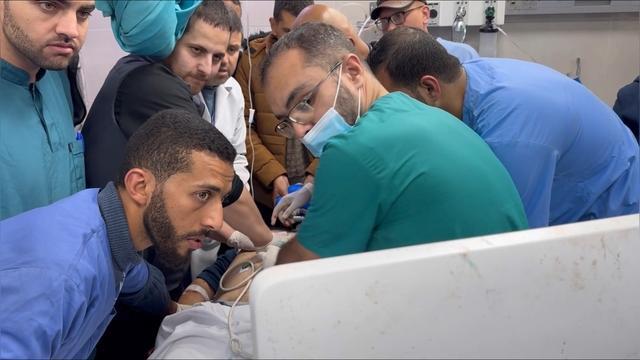
See the difference? Pelley: Yes. It's three times faster, and struck with more than twice the force. The shockwave of the ar- 15 bullet blasted a large cavity in the gel, unlike the bullet from the handgun. Wow. There's an enormous difference. You can see it right away. BIR: Yeah, exactly. There's fragments in here. There's-- it kind of took a curve and came out. You can see a much larger area, in terms of the fractures that are inside. Pelley: Now watch from above. On top, the handgun. At bottom, the ar- 15. It's just exploded. BIR: It's exploded and it's tumbling. So what happens is, this particular round is designed to tumble and break apart. Pelley: The 9 millimeter handgun round has a larger bullet, but this ar- 15 round has more gunpowder, accelerating its velocity. Both the round and the rifle were designed in the 1950s for the military. The result was the m- 16 for our troops, and the ar- 15 for civilians. BIR: There's going to be a lot more damage to the tissues, both bones, organs, whatever gets kind of even near this bullet path. The bones aren't going to just break, they're going to shatter. Organs aren't just going to kind of tear or have bruises on them, they're going to be-- parts of them are going to be destroyed. Pelley: That fairly describes the wounds suffered by 29- year- old Joann ward. At Sutherland springs Baptist church, she was shot more than 20 times while covering her children. Ward was dead, her daughters mortally wounded, as assistant fire chief rusty Duncan made his way from the back of the sanctuary. Duncan: As I got a couple of rows up, Ryland's hand reached out from under his step- mom and grabbed my pant leg. I wouldn't even known he was alive until he did that. I didn't even see him under her. Well, that's where me and him made eye contact for the first time. Pelley: Joann ward's five- year- old step- son Ryland ward was hit five times, and was nearly gone when he reached trauma surgeon Lillian Liao at San Antonio's university hospital. How much of Ryland's blood do you think was lost before he came to you? Lillian Liao: At least half. Pelley: This is Ryland's E. R. X- ray. Liao: You see the two bullet fragments that are in him. Pelley: The x- ray shows you the solid fragments of the shrapnel and the bullets, but it doesn't tell you much about the damage to the soft tissue. Liao: No, and it doesn't tell you what's on the inside. I mean, a bomb went off on the inside, and our job is to go in there and cleap. Pelley: A bomb went off on the inside because of the shockwave from these high- velocity rounds. Liao: Correct. Pelley: Ryland endured 24 surgeries to repair his arm, leg, pelvis, intestines, kidney, bladder and hip. Liao: At some point, it's like putting humpty dumpty back together again. Pelley: What do you mean? Liao: Well, his organs are now in different pieces, and you have to reconstruct them. The arm was missing soft tissue, skin, muscle, and part of the nerves were damaged. The bowel has to be put back together. Some of the areas of injury has to heal itself, so you can see that he can walk around like a normal child and behave as normal as possible. Pelley: With the ar- 15, it's not just the speed of the bullet, but also how quickly hundreds of bullets can be fired. The ar- 15 is not a fully automatic machine gun. It fires only one round with each pull of the trigger. ( Gunfire ) But in Las Vegas, it sounded like a machine gun. That's an ar! ( Gunfire ) Go, go, go! Pelley: A special add- on device, called a bump stock, allowed the killer to pull the trigger rapidly enough to kill 58 and wound 489. Let's go! Come to me, hands up! Pelley: In other mass killings, the ar- 15 was fired without a bump stock, but even then, it can fire about 60 rounds a minute. ( Gunfire ) Ammunition magazines that hold up to 100 rounds can be changed in about five seconds. Maddy Wilford: I remember hearing the gunshots go off and being so nervous and scared, and all of the sudden, I felt something hit me. Pelley: You'd been shot how many times? Wilford: Four times. Pelley: How many surgeries? Wilford: Three. For my arm, my stomach and my ribs and lung. Pelley: In February of 2018, 17- year- old Maddy Wilford was at school-- Marjorie Stoneman Douglas high school in parkland, Florida. ( Crying ) 17 were murdered, 17 wounded. Wilford: And I just remember thinking to myself... " There's no way ," like, " Not me, please, not me. I don't want to go yet ." Laz Ojeda: Her vital signs were almost nonexistent. She looked like all the bloodhad gone out of her body. She was in a state of deep shock. Pelley: Paramedic laz Ojeda saved Maddy Wilford, in part, because Broward county E. M. S. Recently equipped itself for the battlefield wounds that the ar- 15 inflicts. Ojeda: We carry active killer kits in our rescues. Pelley: Active killer kits? Ojeda: Yes. Pelley: What is that? Ojeda: That is a kit that has five tourniquets, five decompression needles, five hemostatic agents, five emergency trauma dressings. Pelley: Dr. Peter antevy, Broward county medical director, told us today's wounds demand a new kind of training. Peter Antevy: If I take you through one of our ambulances or take you through our protocols, almost everything we do is based on what the military has taught us. We never used to carry tourniquets. We never used to carry chest seals. These were things that were done in the military for many, many years. Pelley: When did all of that change? Antevy: It really changed, I think, after sandy hook. Pelley: After sandy hook elementary school, where 20 first graders and six educators were killed with ar- 15 rounds, a campaign called " Stop the bleed" began nationwide. Antevy and doctors including Lillian Liao in San Antonio, are training civilians who are truly the first responders. There have been more than 45, 000 classes like this in the last four years. Antevy: You have to go the second wrap to actually stop the bleeding here. Does it hurt? Yeah, her face-- you can undo it now. The day after the shooting, my kids, they're waking up, and they're, " Time to go to school ." And my son heard, kind of heard what happened the night before, when I was on the scene, and he looked at me with the fear of god that he had to go to school that day. My first instinct was, " He needs a bleeding kit ." My son today has a bleeding kit on his person. Pelley: How old is he? Antevy: 12 years old. Here it is. This is it. We, we, I've given him this, and I've taught him how to use it. Pelley: You believe that these mass casualty events have become so common-- Antevy: Absolutely. Pelley: -- That it is important for everyone in this country to be prepared? Antevy: Everyone. Pelley: That's where we are in America today? Antevy: That's where we are. Pelley: Ryland ward survived the church massacre because firefighter rusty Duncan used his belt as a tourniquet. Therapist: Look where you're going. Pelley: For over a year, Ryland worked, often six days a week. Therapist: Slow but controlled. Pelley: Learning to sit... Therapist: All right, we're loosening up all your muscles. Pelley: ... Stand, and walk again. Ryland Ward: Am I strong? Therapist: You're very strong. You're very strong, yes! Ward: I'm going to see if this actually goes in the hospital, yep. Pelley: Did you meet some new people in the hospital? You were there for a long time. Ward: How do you know? Pelley: They told me. I talked to some of the people who helped you. Ward: Like who? Pelley: There was doctor... Ward: Liao? Pelley: Dr. Liao, yes. Liao: Oh, how are you? Ward: I'm good. Liao: Yeah, how's your arm? Ward: Good. Liao: Let me see. Pelley: He has his strength back. Its remarkable, really. But healing from the loss of his stepmother and sisters won't be as quick. Nichiporenko: How was your day? Pelley: Maddy Wilford is also moving forward. Like many who suffer physical trauma, her interests have turned to medicine. And an internship... Nichiporenko: Maddy, come here. Pelley: ... Where she is studying the kind of surgeries that saved her. Everybody out, out, out, out! Pelley: Not long ago, many communities assumed that mass murder would never come to them. Where's she hit? Where's she hit? Where's she hit? What's wrong with that girl right there? Pelley: Today, all Americans are being asked to prepare for the grievous wounds... Oh, my god! Pelley: ... Of high velocity rounds. Tourniquet!