NARRATOR:
00:00:01
60 Minutes Rewind. Over 200 times a second, half a billion times a month, somebody clicks on Wikipedia. It's the greatest argument settler wrought by man, or at least the fastest, perfectly suited to our era of instant gratification. When it debuted 14 years ago, the online encyclopedia was a novelty, its accuracy hit or miss. Now, it's one of the world's busiest websites. Its reliability vastly improved but not quite perfect. What's more, it's a charity, a nonprofit where a devoted army of unpaid authors collaborate. Articles about everything you can imagine. Who are they and how does it all work? Ask Mr. Wikipedia himself, Jimmy Wales. In general, I would say we're a lot of geeks, a lot of tech geeks, a lot of people who are really passionate about information. What on Earth is wiki? Wiki, so the word is from wikiwiki, which is a Hawaiian word. If you go to Maui, at the airport you take the Wikiwiki Bus, and the word wikiwiki means quick. So the idea of wiki software is quick collaboration. It's a tool to allow people to come together and quickly edit things.

MORLEY SAFER:
00:01:27
And once a year, a band of hardcore contributors to Wikipedia come together from the four corners of the Earth for what you might call the dance of the geeks, meeting this time in London. (SINGING) When my son ran--
MORLEY SAFER:
00:01:42
The entertainment is, shall we say, eclectic. (SINGING) And be the moon.
MORLEY SAFER:
00:01:47
And so is the crowd. They call it Wikimania. 2,000 showed up for the event. Some are buttoned down. Some are rock and roll. The articles they write and edit cover everything from aardvarks to ZZ Top, and they're all true believers in Wikipedia's power. But it is the fantastic attempt to really be The Hitchhiker's Guide to the Galaxyof real world.
MORLEY SAFER:
00:02:17
Wikipedians take to these pages in a never-ending, worldwide cyber conversation to write articles, add or subtract from the work of others, post comments, and argue about what's worthy of notice and what needs fixing. There are 12,000 new pages created every day, a grand total of 35 million articles in 288 different languages. The end result of that is really rich, really complex, and mostly reliable and credible. So you get one of those things.
MORLEY SAFER:
00:02:50
Sue Gardner spent seven years as Jimmy Wales' lieutenant, running the website day to day and sizing up the people who do the writing. It's about 100,000 people around the world, every political persuasion, every religion, no religion, from 7 years old to 75 years old. The one characteristic all Wikipedians have in common is that they are all incredibly smart. They are really, really smart. Smart and passionate. Yet and persnickety, right? They are fussy people. They are a little OCD. They are careful, and they're cautious, and they are serious, and it matters to them that things are right. They're persnickety people.
MORLEY SAFER:
00:03:29
And how does it work? We enlisted the help of Amanda Levendowski, a recent law-school graduate who's worked on dozens of articles. I do the editing because I love it, particularly with regards to articles about the law. Well, what is the reward? You have the satisfaction of feeling like you participated in something. But for Wikipedia in particular, there's another whole benefit because you have the opportunity to help other people find information stuff you're into. Now, one of the other neat things you can do is--
MORLEY SAFER:
00:04:00
Anybody can do it. We'll go to Edit.
MORLEY SAFER:
00:04:03
You hit the Edit button, and you type. But your information has to have a legitimate source and some degree of notability. No love letters to yourself. Three times a second, 12,000 times an hour, someone, somewhere makes an edit, small or large, and the articles keep piling up. There is no limit, in a certain way, correct? Oh, I think that the growth could be infinite, yeah. Billions upon billions of areas. Possibly, yeah.
MORLEY SAFER:
00:04:34
There are Wikipedians in residence at places like the National Archives, a goldmine of historical detail. At the Frick Museum in New York, these Wikipedians get their kicks from studying antique clocks. Do you know, roughly, what is it? What is it about? It's about a Hindu goddess.
MORLEY SAFER:
00:04:53
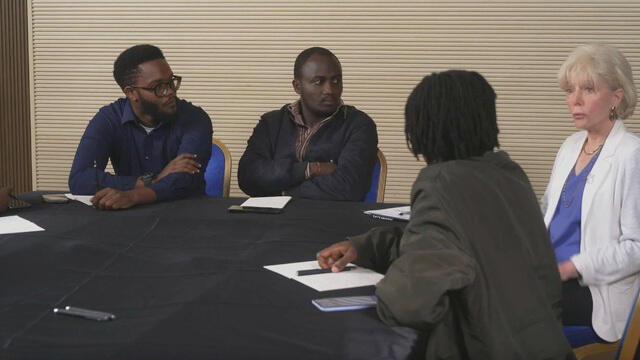
It's truly an international movement. There were Egyptian Wikipedians at this year's gathering, a delegation of school kids from Kazakhstan in central Asia, where the website has over 200,000 articles in the Kazakh language. You're the real bright spot in your region. All of your neighboring countries maybe are not so good.
MORLEY SAFER:
00:05:15
And in South Africa, this man is Mr. Wikipedia, Dumi Ndubane. Just remember that voltage drops.
MORLEY SAFER:
00:05:23
Back home in Johannesburg, when he's not at his real job as an electrical engineer, Ndubane and his colleagues work overtime to get South Africa into the Wikipedia world. It was built in 1905.
MORLEY SAFER:
00:05:39
They contribute entries about notable landmarks. This Catholic school originally a convent. Do we have the history on the school? Yes. Then that becomes a section.
MORLEY SAFER:
00:05:50
He's written about the house in Johannesburg where Mahatma Gandhi once lived. The idea of tolerance, really, and passive resistance was born here in this house.
MORLEY SAFER:
00:06:01
He's written about the Soweto uprising by high-school students in 1976, the spark for the eventual downfall of apartheid. And he encourages today's students to translate Wikipedia articles into their native languages.
DUMI NDUBANE:
00:06:17
What language are you? [INAUDIBLE] Venda. Tonga. Zulu Zulu. [INAUDIBLE]
DUMI NDUBANE:
00:06:24
And we need all those languages on Wikipedia. We need them.
MORLEY SAFER:
00:06:30
The website's headquarters are in San Francisco. There's a staff of about 200 working in typically laid-back techie style. And then you could do function.
MORLEY SAFER:
00:06:41
Of prime importance, developing rules and computer code to eliminate as many errors as possible. Executive Director Lila Tretikov. We've had numerous studies that showed that as a body of knowledge, it's more accurate than other encyclopedias in existence in the past. So it's never 100%, but it's very high quality.
MORLEY SAFER:
00:07:06
There are computer programs that scour the site for vandalism and vulgarities, striking them out almost instantly. Wikipedians worldwide also act as fact checkers, looking for personal attacks and manipulation by PR people. But Wales admits you can't catch them all. Our biggest problems with bias and things that are wrong that stay for a long time are actually on very obscure topics, a topic that not many people are interested in and not many people are looking at. And so if something's wrong, it can persist for quite some time. That's brilliant.
MORLEY SAFER:
00:07:43
And because it's a nonprofit, unlike virtually every other major website, there's one thing you won't find at Wikipedia central, internet zillionaires. You created one of the most successful websites in the world, and yet you chose to make it the least profitable. [LAUGHTER] It just felt right that we should be a charity, free knowledge for everyone. So that's always been our philosophy.
MORLEY SAFER:
00:08:10
The money to pay the staff and keep the site up and running comes from donations, large and mostly small. Last year, people from around the world gave $51 million in 70 different currencies. I think they give to Wikipedia out of affection. I think it's that simple.
MORLEY SAFER:
00:08:31
Which means the main preoccupation at other websites, advertising, isn't even on the radar. If we were ad supported, we would always be thinking about, well, gee, look at all these people reading about Elizabethan poetry. There's nothing to sell them. Let's try to get them to read about hotels in Las Vegas or something like this, and we don't. We just don't care.
MORLEY SAFER:
00:08:51
In a sense, it was probably in the stars that Jimmy Wales, the kid from Huntsville, Alabama, would become the internet's most famous knowledge broker. His mother taught school, and the World Book Encyclopedia in the living room was a constant presence. He was a first-generation geek, 10 years old, when personal computers hit the market in the mid-'70s. His first internet site was Bomis, a place where guys could compare notes on guy things, cars, sports, and babes. Bomis failed, but it got Wales thinking about the possibilities of mass collaboration on the internet, which led eventually to Wikipedia. How does Wikipedia fundamentally work?
MORLEY SAFER:
00:09:35
Rank-and-file Wikipedians today are still mainly men, reflecting the tech world at large. Women are less likely to kind of geek out at their computer for 10, 20, 40 hours. I mean, there's a reason that the stereotype of the hacker is a guy in a filthy T-shirt eating Doritos, right? Like, that's hard. A woman is less likely to get social permission to be in a dirty T-shirt eating Doritos.
MORLEY SAFER:
00:10:00
The gender imbalance was at the heart of a significant internal dispute at Wikipedia. When William and Kate got married, the royal wedding, someone created an entry about Kate Middleton's dress. And somebody nominated it for deletion. And some of the arguments were, effectively, this is stupid. It's just a dress. How can you have an encyclopedia entry about a dress?
MORLEY SAFER:
00:10:21
Wales intervened, pointing out that there are thousands of articles about computers and software programs. And we don't think anything about that because we're a bunch of computer geeks. So we decided to keep it, but there was an interesting moment in that debate where people were saying, oh, I don't know about this. Therefore, it's not important. And that is bias, and that is something that we have to be really careful about. Careful.
MORLEY SAFER:
00:10:43
When he's not on the road, Wales lives mainly in London. His wife, Kate, worked for former British Prime Minister Tony Blair. And Wales himself is already an elder statesman in the internet world-- I started talking about the limits of the social media to--
MORLEY SAFER:
00:11:00
--moving in influential circles, making a comfortable living from speaking engagements. We are really, really powerful.
MORLEY SAFER:
00:11:07
But though he passed up billions by making Wikipedia a nonprofit, he clearly doesn't suffer from that Silicon Valley condition known as Zuckerberg envy. Do you ever wonder or get wistful about, gosh, if I only had a billion, think of all the good things I could do? No, not really. I mean, how many bankers are there in the world who earn fabulous salaries but whose lives are incredibly boring compared to mine? I mean, I have a fantastic, amazing life where my work feels meaningful to me in a way that almost nothing else could. So yeah, it's great. Don't worry about me. (SINGING) Happy birthday to you.
MORLEY SAFER:
00:11:53
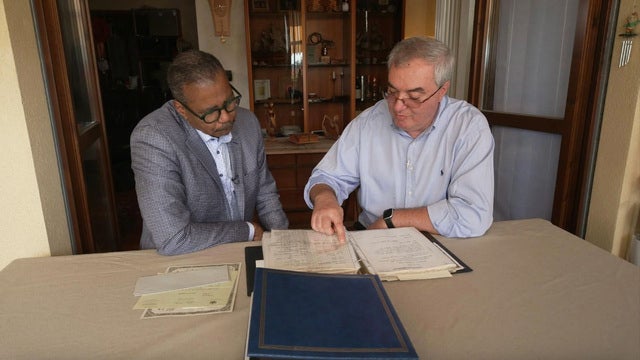
A final burning question Wikipedians have debated over the years. What day is Jimmy Wales' birthday? I have this really funny situation where the reliable source of my birth certificate is wrong.
MORLEY SAFER:
00:12:09
It says August 8, but his mother says that's an error. He was born August 7. I trust my mother. She was there.
MORLEY SAFER:
00:12:17
So his Wikipedia entry says the seventh, but just to be safe, his persnickety followers sang "Happy Birthday" twice. (SINGING) Happy birthday to you. [CLOCK TICKING]