NARRATOR:
00:00:01
60 Minutes Rewind. 10 years ago tonight, US special forces prepared to land in Afghanistan to answer the attack on America. The Taliban fell in just six weeks. And with that swift victory, America began a war that doesn't seem to end. In the last few months, US casualties have reached some of their highest levels. While America's relationship with the critical ally, Pakistan, has sunk to new lows. Why are we still in Afghanistan? What's the plan? No one knows the answers better than the two men that President Obama has just charged with running the war. [HELICOPTER ROTORS] Over the forbidding landscape of Central Afghanistan, the new American ambassador, Ryan Crocker, is returning out of retirement to a diplomatic career shaped by Islamic terrorism. His partner, Marine Corps General John Allen, is a warrior scholar. Four stars, three master's degrees, a combat commander who was Dean of students at the Naval Academy. The pair arrived three months ago, called in by the president, because they're the same team that helped end the insurgency in Iraq. What's your plan to get us out of here? Well, the plan is to win. The plan is to be successful, and the United States is going to be here for some period of time.
SCOTT PELLEY:
00:01:26
That's the message General Allen wanted friends and enemies to hear. The US is scheduled to hand security over to Afghanistan in 2014, the 13th year of the war. But he told us that won't be the end of it. You're talking about US forces being here after 2014? Yes, there will be.
SCOTT PELLEY:
00:01:46
How many? We don't know. That's to be determined. Some analysts have suggested 20, 25,000 Does that sound about right? Too early. It's too early to tell. Are we talking about fighting forces? We're talking about forces that will provide an advisory capacity. And we may even have some form of counterterrorist force here to continue the process of developing the Afghans counterterrorism capabilities, but if necessary, respond ourselves. What you're saying is that the United States isn't leaving Afghanistan in the foreseeable future? Well, that's an important message.

SCOTT PELLEY:
00:02:17
A message that might surprise people who remember that a third of our troops are scheduled to be withdrawn next September. And to the enemy that believes that they can wait, perhaps in Pakistan until 2014. It's a bad narrative. They're wasting their time.
SCOTT PELLEY:
00:02:33
After the withdrawal in September, America will still have almost 70,000 troops here. So far, the war has claimed 1,800 American lives and cost half a trillion dollars. It runs about $2 billion a week. Still, Ambassador Crocker told us there will be no rush to the exits. Is it going to be an uh-oh moment for the American people? I don't think so. Who are hoping that the US involvement in Afghanistan can be wrapped up. Again, I think the American people understand what's at stake here. This is where 9/11 came from. General. Good morning sir. How are you?
SCOTT PELLEY:
00:03:14
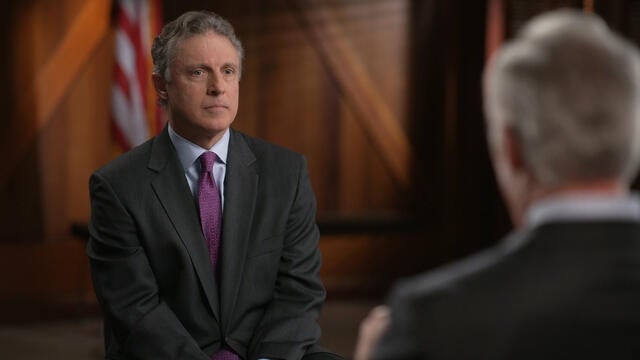
No diplomat understands like Ryan Crocker. He was there at the beginning, the first time Islamic terrorists struck America in 1983, the US embassy in Lebanon. Crocker, age 33, a junior officer, emerged from the wreckage in a bloodstained shirt. Later, he became ambassador to Lebanon, and Kuwait, Syria, Pakistan, and Iraq. When you left as ambassador of Iraq, you retired from the foreign service, and you promised your wife you would never go to a war zone again. What are you doing here? When the commander in chief asks you to serve in a time of war, there is only one right answer. You say yes. And I believe that with the right resources and the right approach, we can stabilize this country to the extent that there never again is a 9/11 that comes at us from Afghan soil. I flew into New York that morning.
SCOTT PELLEY:
00:04:13
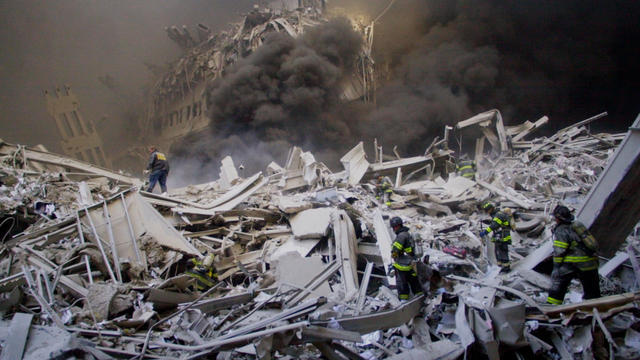
On 9/11? On 9/11, I was one of the last planes to land at LaGuardia. I was stuck in traffic on the Queensboro Bridge. When both towers went down, I watched it happen.
SCOTT PELLEY:
00:04:23
Five weeks after it happened, US forces landed here with the goal of defeating two enemies, al-Qaeda and the Taliban government that harbored the terrorists. The US believes that there are only about 50 al-Qaeda left here, 50. And we were surprised by Allen's estimate of Taliban fighters. It's probably in the low thousands. Low thousands?
JOHN ALLEN:
00:04:48
Yes. 10,000? Again--
SCOTT PELLEY:
00:04:50
Fewer? Fewer. Much fewer.
SCOTT PELLEY:
00:04:53
The US has 98,000 troops here, plus 40,000 from NATO. Around a third of them are combat forces. And you can add to that 300,000 Afghan troops. Help me understand the order of battle. If there are 400,000 coalition troops and 10,000 Taliban, why can't we mop that up in a week? Well, let's be precise now as well. The ANSF, the entire ANSF has yet to become operationally committed, which are both the police and the army, and it requires a relatively large footprint in order for us to dominate and prevent the Taliban fighters from re-entering the population. So it's not just a matter of hunting down these 10,000 enemy troops and killing them? It's not just a hunter-killer mission that our troops are on. And we do deal with the insurgents, and we deal with them very kinetically when they choose to fight, but they don't choose to fight on a regular basis. And when you say kinetic, that's war college talk for shooting them? Well, it's marine talk for shooting them as well, frankly.
SCOTT PELLEY:
00:05:54
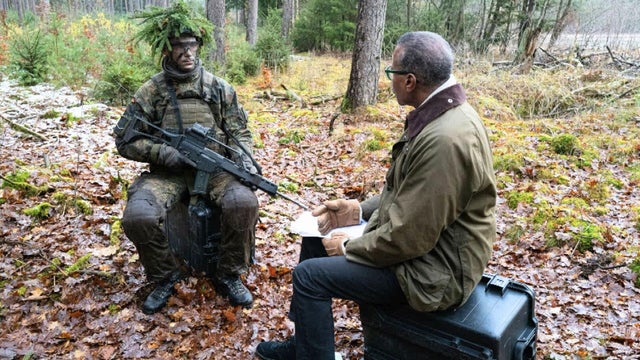
How can a few thousand Taliban tie up the world's strongest military? We went to find out in the home of the Taliban Kandahar province. [GUN SHOTS] Here, the third brigade combat team of the 10th Mountain Division is fighting its way into territory no American has occupied. The brigade came in April, led by Colonel Patrick Frank. Your casualties so far? We have lost in third brigade combat team, 28 soldiers. And how many wounded? We've had over 300 soldiers wounded.
SCOTT PELLEY:
00:06:28
Colonel Frank showed us how the war has changed. For starters, because of the enemy's preferred weapon, we traveled in the new mine resistant trucks that are such an improvement for the troops. How often do you have contact with the enemy? On a given day, 20 to 25 contacts with the enemy.
SCOTT PELLEY:
00:06:49
Now, nearly all of Frank's casualties come from mines and roadside bombs. They found 52 of them in this area in just the last three weeks and destroyed them.
SOLDIER:
00:07:00
Fire in the hole!
SCOTT PELLEY:
00:07:01
They're not standing and fighting you? They do not. They know that when we are able to identify their location, they'll be met with overwhelming firepower.
SCOTT PELLEY:
00:07:09
Overwhelming firepower took this ground. It doesn't look like much, but here, Colonel Frank gets a sparkle in his eye. It's the hometown of Mullah Omar, the fugitive leader of the Taliban. This is the American strategy at work. Clear the enemy, hold the ground, and build roads, schools, markets, even this playground, so that Afghans will move toward their government. The enemy does what he can to disrupt that. [GUN SHOTS] What do you got, colonel? Some small arms fire appears to be from the South.
SCOTT PELLEY:
00:07:47
Enemy fire forces US troops to build forts, to hold on to what they've gained. This ground was captured by Captain Dennis Call's men. This piece of ground that you're building on now cost you what? 32 American soldiers. We had 25 wounded, and we sustained seven killed in action here in [INAUDIBLE] area. And so the cost has been America's most precious commodity. And that is the American soldier.
SCOTT PELLEY:
00:08:19
The forts provide security for improvements like this school built by Colonel Frank soldiers. But on the day we dropped in, the children were teaching. [NON-ENGLISH SPEECH]
SCOTT PELLEY:
00:08:32
The adults had run away after a Taliban warning. The enemy likes to tell villagers that the Americans will leave and the Taliban will come back. Thank you very much.
SCOTT PELLEY:
00:08:44
That's why Afghanistan demands so much in time, treasure, and troops. It takes a platoon to convince a village that the school is safe. And only the whisper of a threat to shut it down. And to make matters worse, the school is 75 miles from the border of Pakistan. Pakistan is supposed to be America's ally. But to hear General Allen tell it, Pakistan is a big part of the problem. Carry on. Have a seat.
SCOTT PELLEY:
00:09:13
Does the enemy enjoy a safe haven in Pakistan? Yes, he does. The enemy can move back and forth across that border, essentially at will. It can. Yes.
NARRATOR:
00:09:24
The story will continue after this. [CLOCK TICKING]
SCOTT PELLEY:
00:09:29
Pakistan not only tolerates the enemy. US officials tell us that Pakistani intelligence has a relationship with the terrorist group that is staging the most violent attacks today. A group called the Haqqani network. [BLAST] This was the scene in Kabul last month, as fighters from the Haqqani network dramatically upped the ante with a 20-hour attack on general Allen's headquarters and Ambassador Crocker's embassy. You're the one who was under fire.
RYAN CROCKER:
00:10:00
Yeah. Personally, they were shooting at you. And I was pretty damn mad about it. If you want to talk about hostility, an attack on an American embassy in a third country that emanates from the soil of Pakistan is about as hostile as you can get.
SCOTT PELLEY:
00:10:16
It was just days before that attack that General Allen went to Pakistan to try to stop a Haqqani bomb that US intelligence knew was coming. I understand that you had intelligence, that there was a truck bomb heading from Pakistan to attack your troops, and that you personally took that information to the head of the Pakistani army, General Kayani, and asked him to stop it. I did. I asked him for help in that regard, and knowing of course, that there has been a relationship through the intelligence service with the Haqqanis, I would ask anyone for help to try to stop that truck bomb from getting into Kabul, which is what we believed it was trying to do. What became of that truck? We think it ultimately exploded against the outer wall of one of our combat outposts. How many of your troops were injured? 77 were wounded that day. By a truck bomb that you told the Pakistanis was coming? Yes, that's correct. How did you feel about that? I was emotional over the issue. I brought this up to the Pakistani foreign minister the other day. She told me, "well, if you knew the truck was coming, why didn't you stop it?" We were trying to stop it. And we will ask for help to try to stop it from those who we think might be able to help us and ultimately went off against an American position. That's unacceptable. And again, I'll deal with the Haqqanis as they come across the border.
SCOTT PELLEY:
00:11:41
If those safe havens haven't been closed up in 10 years. Why should you have any hope that it's going to happen now? I think the pressure has clearly been ratcheted up. [GUN SHOTS]
SCOTT PELLEY:
00:11:53
That's the lesson Crocker and Allen learned in putting down the insurgency in Iraq. Pressure the safe havens, hit them on the battlefield, but offer the enemy a way to join the government. Their experience in Iraq made us wonder what might be going on here that no one has heard about. Is the United States negotiating with the Taliban? We talked to a whole range of people. I learned that in Iraq. But have US officials spoken directly with Taliban representatives? Again, we talked to the whole range of people. Anybody who will talk to us and I'll let you draw your own conclusions. Sounds like a yes. As I said, you can draw your own conclusions. The US is spending $300 million a day in Afghanistan. Over the last couple of years, about 250,000 teachers have been laid off back home. And there are a lot of folks who don't believe this is worth it. This is worth it. They can be proud of what we've accomplished here. They can be proud of what we will accomplish here.
SCOTT PELLEY:
00:13:01
It will take vision to see what can be accomplished. America's new leadership in Afghanistan is faced with building a peaceful society among people much more accustomed to war. [CLOCK TICKING]