Watch CBS News

NASA's journey to the far side of the moon

More than 50 years after NASA's last human mission to the moon, four astronauts, three Americans and a Canadian, are set for the 10-day Artemis II mission to the far side of the moon.
Feb 2 (13:12)

TRANSCRIPT FOR: “INSIDE NASA'S JOURNEY TO THE FAR SIDE OF THE MOON WITH ARTEMIS II | 60 MINUTES”

BILL WHITAKER:
00:01:45

Reed Wiseman is the mission commander. His crew includes pilot Victor Glover and two mission specialists, Jeremy Hansen and Christina Cook. This is a monument to the fact that we, as humans, decided to pour resources into sending people off the planet. And that's just an amazing thing to me, an amazing thing to be a part of.

BILL WHITAKER:
00:02:07

Cook, Wiseman, and Glover have all experienced the wonders of space on board the International Space Station. Hanson, an experienced fighter pilot from our longtime space partner, Canada, has never before gone into orbit. I wonder, what is that really going to look like? And what is that going to feel like? I have this sense that it can't not touch your soul to see the Earth from the perspective of the moon. So if all goes according to plan, you are going to be the first astronauts to travel to the moon in more than half a century. What's going through your mind? Don't screw it up. I'm joking, but partly not joking. But I think the real thing today is what it took to get that rocket out to the pad. And so I hope our team is celebrating this, because it's a big part of the next thing to come. The United States has been to the moon several times. Why is it important for us to go back? So many countries right now are realizing the value in what we can bring back by going to the moon. The industry gains, the knowledge gains, the scientific gains, the inspiration gains-- there's so much to gain that I'm happy that we are leading the way back.


BILL WHITAKER:
00:03:24

Artemis II is meant to lay the groundwork for future Artemis missions that will put Americans back on the moon and establish a lunar space station. The four Artemis II astronauts will sling around the far side of the moon in the Orion capsule, just about 5,000 miles above its surface, before heading back home. This mission is to test whether the rocket, life support systems, and crew controls work as designed. For the crew, this has been almost three years in the making. They trained in simulators.

NASA ENGINEER:
00:04:00

We launch in 10 seconds.

BILL WHITAKER:
00:04:02

And learn to live and work inside the cramped Orion capsule.

NASA ENGINEER:
00:04:07

And liftoff of Artemis I.

BILL WHITAKER:
00:04:09

Artemis I, which flew in 2022 without a crew, was a full system test flight to prove the rocket and capsule are mission-ready for humans to travel around the moon and back.

NASA ENGINEER:
00:04:22

Splashdown.

BILL WHITAKER:
00:04:23

It splashed down safely in the Pacific, but on inspection, engineers found the heat shield was damaged on re-entry, though the interior of the capsule was not. Is there a level of concern about the heat shield on this one? You're hitting Earth's atmosphere at roughly 39 to 40 times the speed of sound. There's concern. We're going to modify our entry trajectory. We're actually going to come in a little bit hotter, a little bit faster than Artemis I. And based on the issues that we have with the heat shield, that will keep us safe. I know you expect that everything is going to go according to plan, but what are your concerns? I'm sorry, Bill. Was that a joke that everything goes to plan?

BILL WHITAKER:
00:05:07

According to lead flight director, Jeff Radigan, a flawless mission is NASA's neverending quest. I expect things will go very well. And I also expect there's going to be something unexpected. I think every space mission we've flown, something has come up, and we've had to deal with it.

BILL WHITAKER:
00:05:23

Radigan told us he has great confidence in the Artemis II mission and crew. NASA's challenge is what comes next-- getting Artemis III astronauts from lunar orbit to the moon's surface. To do that, NASA, in 2021, awarded a nearly $3 billion contract to Elon Musk's SpaceX for the lunar lander version of its Starship, the biggest, most powerful launch vehicle ever built. Made of two components, the lunar lander will sit atop the reusable Super Heavy booster. After several spectacular failures and explosions, Starship rebounded with successful launches this past August and October. But the setbacks and technical complexity have contributed to the delay in America's return to the moon's surface. NASA's target for putting American astronauts back on the moon is now 2028. Are we going to make that? I think there's a lot of things that need to happen to make that successful. First step, fly Artemis II. And I'll tell you, I spend most of my time on this mission. But we're going to need our space partners to get a lander out there for us and get back down to the surface of the moon.

NASA ENGINEER:
00:06:39

T-minus 60 seconds.

BILL WHITAKER:
00:06:40

Artemis may be Apollo's mythological twin, but upcoming missions with SpaceX bear little resemblance. For example, the massive SpaceX lander that will rendezvous with the crew in lunar orbit has to be refueled in space, a complex process requiring the launch of 10 or more fuel tankers. Nothing like this has ever been done before. Elon Musk says it's needed to propel deep space exploration. And we want to have epic, futuristic spaceships with lots of people in them traveling to places we've never been to before.

BILL WHITAKER:
00:07:20

But first, he has to get Starship to the moon. With the complexity and delays, NASA has doubts SpaceX can meet the president's time frame and is seeking a plan B. The purpose of this hearing is, are we going to be able to get to the moon first?

BILL WHITAKER:
00:07:37

Jim Bridenstine was NASA administrator in President Trump's first term and launched the Artemis program. This past September, he told Congress America's moon landing system has since grown too complicated. It is extraordinarily complex. In some cases, it hinges on me saying here today that it is highly unlikely that we will land on the moon before China. What would it mean if China were to put humans back on the moon first? Of course, it would be massively embarrassing.

BILL WHITAKER:
00:08:15

Scott Pace was executive Secretary of the National Space Council during the first Trump administration and helped NASA develop the Artemis program. He says establishing a presence on the moon is important. Who gets there first this century is not. I don't downplay the embarrassment and bad headlines and everything else that would come from the Chinese returning to the moon before we're able to do so. That said, from a longer term, strategic approach, that is a relatively short news story, whereas who sets the rules for the space domain, who is there permanently-- that's a story for the next century.

BILL WHITAKER:
00:09:00

Pace told us the competition with China should force NASA to rethink what he calls an unwieldy and expensive approach. The agency spends more than $2 billion on each single-use SLS rocket, while private companies, he says, are pursuing a more sustainable path with reusable components like SpaceX has demonstrated for a decade. He encourages commercial competition, which is intensifying among cosmic one-percenters. After NASA called for a backup lander plan, Musk's SpaceX posted that it is assessing a simplified mission architecture. On Friday, Jeff-Bezos-owned Blue Origin announced at least a two-year pause of its space tourism flights to focus on moon missions. In November, Blue Origin sent its powerful New Glenn rocket into orbit and return the booster to a platform in the Atlantic-- a first for Blue Origin. To bring back that first stage was game-changing, because like an airplane, you're now able to reuse that vehicle. John Koulouris is Senior Vice President of Lunar Permanence at Blue Origin. NASA tapped the company to develop a human lunar lander for future missions. With the Artemis program behind schedule, NASA is pressing contractors to pick up the pace. So it's public knowledge that NASA asked all the Artemis vendors on how can we accelerate our efforts.

BILL WHITAKER:
00:10:36

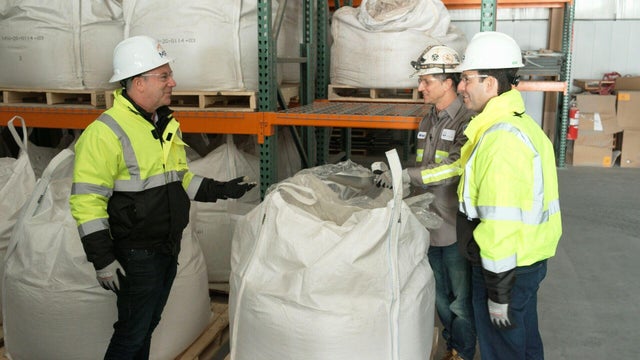
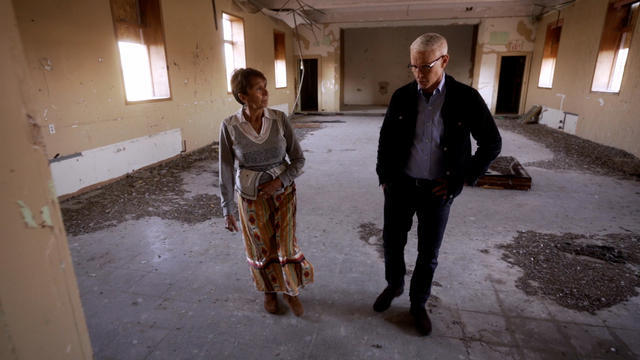
Koulouris showed us the first and smaller iteration of Blue Origin's lander, the Mark I. This unmanned cargo lander will be the company's first vehicle to land on the moon. So this vehicle will be the largest and heaviest lander to ever land on the moon.

BILL WHITAKER:
00:10:55

The almost 30-foot-tall lander is wrapped in gold colored insulation to protect it from solar heat and radiation. Until now, the Lander has been kept under wraps. Our cameras were the first allowed to see it. Koulouris told us, later this year. Blue Origin's New Glenn rocket will carry the Mark I into space to descend to the South Pole of the moon. The reason for that is there's ice there. So we can take that ice and create water to sustain humans, to break that water down into propellants to then fuel future vehicles that then can go from the moon to anywhere else in the solar system. What do you think about this moment? It's incredible. Artemis II represents that first effort in decades of deep space exploration of humans. I can't wait for them to go.

BILL WHITAKER:
00:11:51

The Artemis II astronauts could fly deeper into space than any humans ever-- about 250,000 miles from Earth. And once the spacecraft goes behind the moon, the astronauts will be out of all contact with Earth for about 40 minutes. Flight director Jeff Radigan told us he'll be counting the seconds. If something should go awry, you've got the lives of four astronauts on your hands. I do. It's a heavy weight, and I think about that every day. My job is to bring Reed, Victor, Christina, and Jeremy home safely. These are my colleagues. These are my friends, and they're my responsibility. There will be a period of about 40 minutes when you will be out of contact with the Earth. That's when we will be closest to the moon, farthest from the Earth. But it also is a human moment. And I would love for us to have a moment of togetherness for humans to just go, hey, there's a part of humanity that's not in touch with the rest of us. And let's just get them all back. And then we can go back to the hustle and bustle. But I hope that that inspires folks to just have a moment of togetherness. [CLOCK TICKING]

Videos
View CBS News In
CBS News App Open
Chrome Safari Continue