Watch CBS News

Artist Amy Sherald: The 60 Minutes Interview

Amy Sherald spent years painting in obscurity, and almost died from a rare heart condition. Now 52, the artist behind Michelle Obama's official portrait is one of America's most celebrated painters.
Jul 26 (13:15)

TRANSCRIPT FOR: “ARTIST AMY SHERALD: THE 60 MINUTES INTERVIEW”

ANDERSON COOPER:
00:01:55

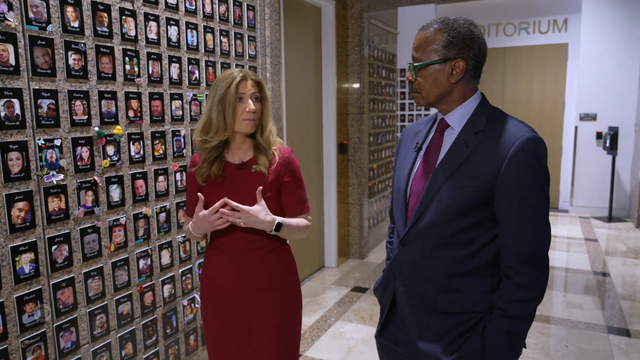
Amy Sherald's work hangs in the most prestigious museums in America and in the rooms of major collectors and some smaller ones, including me. Last summer, she gave us a private tour of her show American Sublime,while it was at the Whitney Museum of American Art in New York, home to some of the greatest artists of the 20th and 21st centuries. Sherald had been dreaming of having a show here for years.

AMY SHERALD:
00:02:21

I would sit in my studio every day, and I would meditate and visualize myself in this space. How does it compare to the fantasy? It's exactly like it. Is it? Yeah, it's perfect.

ANDERSON COOPER:
00:02:31

Her paintings are portraits, but not in the traditional sense. The people in them are real, but their names are rarely used. She's cast them in a visual story all her own.

AMY SHERALD:
00:02:43

The process starts with a photograph. After I randomly come across some person that I, like to say, my energy recognizes their energy or there's something there, right? And just kind of hold it like-- They come to the studio and either I already have a vision in my head of what I want to create, or they are the walking vision of what I want to make. And I photograph them.

ANDERSON COOPER:
00:03:08

She's used friends, models, dancers, strangers she's seen on the street. The clothes they wear are often thrift store finds. Sherald has racks of them in her studio. I've had this for probably five years, just waiting for the right person.

ANDERSON COOPER:
00:03:22

There were only two paintings in Sherald's show of people whose names were used. This is her portrait of a very alive Breonna Taylor, painted after she was shot to death by police in 2020, in a botched raid on her apartment. And this is Sherald's most famous work, the former First Lady, titled Michelle LaVaughn Robinson Obama. Unveiled in 2018, it made headlines around the world. Did you know how important this was going to be for your career? Yes. Did you think about that? I think, in the moment, I wasn't thinking about that. Because if I did, I probably would have just freaked out. I just stayed out of my head and stayed in the painting. What stands out to you? When I look at it now?

ANDERSON COOPER:
00:04:10

Yeah. The dress. Like, I'm deeply in love with this dress. Just the red, the pink, the yellow, and then the black and gray. I wanted the dress to also have some kind of symbolism and almost be a painting in and of itself.

ANDERSON COOPER:
00:04:24

Before coming to the Whitney, American Sublimewas at the San Francisco Museum of Modern Art. We build a model.

ANDERSON COOPER:
00:04:31

Sarah Roberts was the show's curator. I wasn't sure we could do Amy Sherald for 60 Minutes, because I'm not sure that cameras really capture the work. It's a very different experience to see it in person. There's a luminescent quality to it. There's a quality to the color that is impossible to catch on camera. They have a majesty and a tactility when you see them in person, that they lose in reproduction. How does she do that? She's an incredible painter. I mean, just the-- That's what it comes down to. --technical skill.

ANDERSON COOPER:
00:05:03

Sherald's style of painting is called American Realism.

SARAH ROBERTS:
00:05:08

It's a way of depicting the ordinary in American life. It has meant slightly different things to the different painters it's been applied to. And she is creating images that say something about America right now. Ideas of freedom, ideas of individualism, freedom of expression, and a lot of Americana ideas. There's the cowboy and the beauty queen and the white picket fence. She's reimagining them and redeploying them to make sure that idea of America includes everyone. Everybody has a seat at the table. A place on a museum wall.

ANDERSON COOPER:
00:05:45

It was this painting on a museum wall that Amy Sherald says changed her life. She saw it on a class trip to the city art museum in Columbus, Georgia, when she was a teenager. It was painted by an American artist named Bo Bartlett.

AMY SHERALD:
00:05:59

There was a figure in it that was an image of a Black man. And I realized in that moment that I had never seen a Black person in a painting before. In any painting, you had not seen? In any painting. What did you think? I thought, I want to do this too. You knew in that moment, you thought that, I want to do this. 100%. It turned on the light.

ANDERSON COOPER:
00:06:21

Her parents, Amos and Geraldine Sherald, hoped she'd be a doctor. But in college, she broke the news to them. She was going to devote her life to art. She spent more than a decade painting by day and waiting tables at night. Did you ever think this is not going to work out? Yeah, but I couldn't give up. Like I always say, the world is full of quitters, and most people don't want the discomfort, and most people don't want the risk. So, if I kept at it, then eventually something would have to happen.

ANDERSON COOPER:
00:06:51

What happened was not what she expected. Sherald, an avid runner, was training for a triathlon in 2004 when she was diagnosed with a rare heart condition.

AMY SHERALD:
00:07:01

My doctor said, you're lucky to be alive. He basically said, don't do anything to get your heart rate up because you could have a tachycardic episode, and you could die.

ANDERSON COOPER:
00:07:10

She nearly did eight years later. She collapsed in a drugstore and spent months in the hospital before receiving a heart transplant. She was 39 years old. The donor was a young woman named Kristen Lin Smith. Does it feel different to have somebody else's heart? It doesn't anymore, but it does, I'd say, for the first five years. Wow. For five years. Yeah. You think about it a lot. I have moments where I think of her, and usually when I'm doing something that I wouldn't have been able to do. So whenever that happens, I have on my Instagram account, ♪ I hashtag it, ♪ AdventuresofKristinandAmy, so that I can mark all the big moments and include her in those moments. And when I sign my name, I put a little heart on the end for her. So she lives in all your paintings. She does. Yeah.
ANDERSON COOPER:
00:08:07

Amy Sherald's studio is in this warehouse in New Jersey. She makes about a half dozen new paintings here a year. In a closet, there's a wall full of paints in colors she's mixed herself. This is the grayscale that I paint from when I'm doing the skin.

ANDERSON COOPER:
00:08:24

Skin color in her portraits is something Sherald has given a lot of thought to. If you hadn't noticed, she doesn't use brown or Black. She paints her subjects skin in shades of gray. Now, we're in the mid-tone phase, where I'm still shaping the face.

ANDERSON COOPER:
00:08:41

At first, she says she just liked the way the gray looked. It reminded her of old family photographs she grew up with. This one is of her maternal grandmother. You want somebody to see the humanity in your subject. I think that's where it starts. That's why I chose to use the grayscale, instead of brown skin. I think that it offers the viewer an opportunity to pause and consider something else before we get to that. If they had brown skin in your painting, would that be the first thing that people noticed? I think so. I mean, I think, we still look at each other through our phenotypes, anyway. Phenotypes is what? Phenotypes are your eyes, your nose, your lips. You can look at somebody and say like, oh, what could this person is probably, Caucasian and this person is probably, not Caucasian. But they look Black. I can't take Blackness away from them. But the lack of color allows for a different entry point. When did you realize that? When I became afraid to paint brown people because I was afraid that the work would be marginalized and not be able to be in conversation with other artists. Just, it'd be put in the Black corner.

ANDERSON COOPER:
00:09:58

That certainly seems unlikely, now. At auctions, her paintings have sold for as much as $4 million and are often compared to work by the masters of American Realism-- Edward Hopper, Andrew Wyeth, even Norman Rockwell. Does that make sense to you, in any way?

AMY SHERALD:
00:10:15

It's technically what I wanted as a Black woman, artist, American, for people to be like, yeah, Amy Sherald, Norman Rockwell, Edward Hopper. Like, I'm in the room with the guys. And so, I think, I'm OK with it. Yeah, I think I'm OK. Not a bad room to be in. No. Yeah.

ANDERSON COOPER:
00:10:33

Before we left her studio, Sherald showed us this model made in preparation for the canceled exhibition of American Sublimeat the Smithsonian's National Portrait Gallery. You get to see how it flows, and then what kind of story it's telling as the viewer walks through.

ANDERSON COOPER:
00:10:50

She told us she backed out of the show last July after learning Smithsonian officials were concerned about this painting of a trans person posing as the Statue of Liberty, and wanted to display it alongside a video they said would, in their words, "contextualize the piece." The Trump administration had for months been criticizing the Smithsonian as being too woke and promised to review its exhibitions. When Sherald canceled, the White House applauded, calling the painting, quote, "divisive and ideological."

AMY SHERALD:
00:11:22

There were conversations about the work being censored. The show is American Sublime. It was a whole narrative, and a trans woman is a part of that narrative, for me. Any kind of contextualization around the work would have been unacceptable, and it would have deviated from how the work was originally conceived. And because of that, I felt like my only choice was to pull out. Do you see your work as political? Today, I do. I don't think that it's in its true nature from where it comes from inside of me, political, but it lives in the world and therefore, can be art on Monday and political on Tuesday. It's like the pinnacle for me.

ANDERSON COOPER:
00:12:06

Sherald's paintings weren't hidden away for long. After she canceled the show in Washington, the Baltimore Museum of Art offered to exhibit American Sublime. It's now at the High Museum in Atlanta. Do you consider the work patriotic?

AMY SHERALD:
00:12:21

Yes. I don't think there's anybody more patriotic than a Black person. How so? I mean, we've been here since the inception of this idea of what American is. We are deeply ingrained in the fabric of this country. This country would not be if it was not for us. So I have to claim that patriotism. Otherwise, I'm just handing it over to somebody, to give me the definition of what it means to be American. But, I know what the definition of what it means to be American is, and I'm the definition of an American. [AUDIO LOGO] So I've had three--

ANNOUNCER:
00:13:03

Amy Sherald on her triptych Ecclesia-- This is the exclamation point of this exhibition. It's like the pinnacle for me.

ANNOUNCER:
00:13:11

--at 60minutesovertime.com.

Videos
View CBS News In
CBS News App Open
Chrome Safari Continue