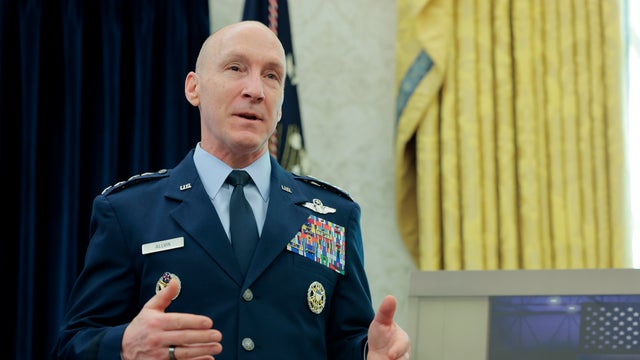
David Allvin, top Air Force general, to retire early
Air Force chief of staff Gen. David Allvin announced he will retire in November, just two years into what is usually a four-year term as Air Force Chief of Staff.
Watch CBS News
Air Force chief of staff Gen. David Allvin announced he will retire in November, just two years into what is usually a four-year term as Air Force Chief of Staff.
The Pentagon is responding to reports that its internal watchdog detected details from a classified email in Defense Secretary Pete Hegseth's communications on Signal about a strike against Yemen. The chat became controversial after an Atlantic reporter was mistakenly added to a top official chain on the matter. CBS News' Charlie D'Agata reports.
Justin Fulcher started at the Defense Department as a member of DOGE. He was later promoted to a post as senior adviser to Defense Secretary Pete Hegseth.
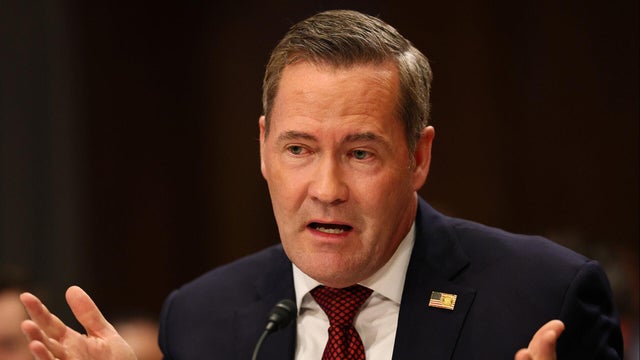
Mike Waltz was on Capitol Hill Tuesday for his confirmation hearing to be U.S. ambassador to the United Nations. CBS News congressional correspondent Nikole Killion has more.
In a rare moment of bipartisanship, Democratic Sen. Elizabeth Warren of Massachusetts and Republican Sen. Tim Sheehy of Montana are partnering on a bill that would change the way the military repairs equipment. CBS News congressional correspondent Caitlin Huey-Burns spoke with the pair about why the issue has them crossing party lines.
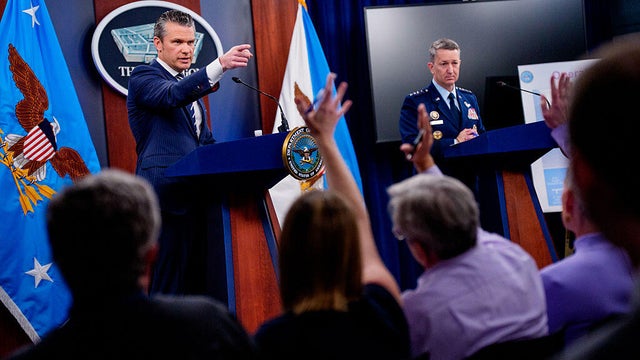
Defense Secretary Pete Hegseth pushed back against an initial intelligence assessment that differed from President Trump's announcement on the results of his strikes against some of Iran's key nuclear sites. Hegseth held a press conference at the Pentagon with Chairman of the Joint Chiefs of Staff General Dan Caine, where he attempted to dispel early notions of the operation's results. CBS News' Courtney Kealy and Taurean Small report.
The USNS Harvey Milk is being renamed the USNS Oscar V. Peterson in honor of a Navy chief watertender who died in World War II.
Gen. Dan Caine, chairman of the Joint Chiefs of Staff, released video of the tests of the type of "bunker-buster" bombs that were dropped on Iranian nuclear facilities over the weekend as he and Defense Secretary Pete Hegseth sought to illustrate the severity of the strikes amid the leak of an initial intelligence report. Charlie D'Agata reports. Imtiaz Tyab has more from Tehran.
The Trump administration is defending its strikes on Iranian nuclear facilities as a complete success, even as some key questions remain. CBS News' Eleanor Watson, Nikole Killion and Willie James Inman have the latest reporting.
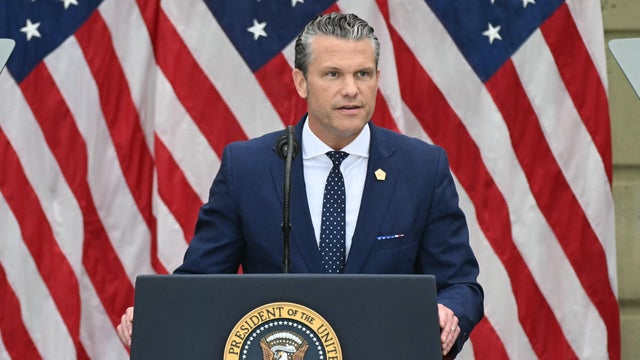
Defense Secretary Pete Hegseth lambasted journalists at a news conference Thursday, championing the U.S. airstrikes against Iran's nuclear sites and pushing back on a leaked intelligence report that raised questions about the attack's effectiveness. CBS News Pentagon reporter Eleanor Watson has more.
Secretary of Defense Pete Hegseth and other Pentagon officials shared new details about the U.S. strikes on Iranian nuclear targets during a contentious news conference Thursday morning. CBS News White House reporter Olivia Rinaldi has more.
Defense Secretary Pete Hegseth and other Pentagon officials held a news conference Thursday to defend the success of last weekend's U.S. strikes on Iranian nuclear facilities. CBS News' Charlie D'Agata and Olivia Rinaldi have more.
Defense Secretary Pete Hegseth pushed back against reports about preliminary intelligence assessments regarding the strikes against Iran's nuclear sites. CBS News' Olivia Gazis and Willie James Inman have more.
Defense Secretary Pete Hegseth said leaker of initial intel assessment wanted to "make it look like this historic strike wasn't successful."
Defense Secretary Pete Hegseth slammed leaks of initial intelligence assessments regarding President Trump's strikes against Iranian nuclear sites. CBS News' Sam Vinograd and Olivia Rinaldi have the latest.
The Pentagon provided more details on the mission to strike several of Iran's nuclear sites approved by President Trump. The details were made public during a press conference with Defense Secretary Pete Hegseth and Chairman of the Joint Chiefs of Staff General Dan Caine. Mark Cancian, a senior adviser at the Center for Strategic and International Studies, joins CBS News with more.
President Trump is praising Secretary of Defense Pete Hegseth after he held a press conference where he railed against the press and the initial intelligence assessment on the strikes against some of Iran's nuclear sites. CBS News' Taurean Small reports.
Defense Secretary Pete Hegseth pushed back against initial reports about President Trump's strikes against several Iranian nuclear sites. CBS News' Charlie D'Agata reports.
Secretary of Defense Pete Hegseth spoke briefly at a press conference at the NATO summit to comment on discrepancies over the reported level of damage that U.S. strikes caused to Iran's nuclear sites.
The Trump administration claimed it "obliterated" Iran's key nuclear sites, but CBS News is learning that may not be the case. A preliminary intel assessment finds U.S. strikes on three Iranian facilities over the weekend only set back the country's nuclear program by a few months. CBS News' Nancy Cordes and Charlie D'Agata have the latest.
Operation Midnight Hammer included seven B-2 Spirit bombers, 125 total aircraft and more than 75 precision-guided weapons, the Joint Chiefs chairman said.
The U.S. military operation in Iran over the weekend, dubbed "Operation Midnight Hammer," included seven B-2 Spirit bombers, 125 total aircraft and more than 75 precision-guided weapons, Pentagon officials said. Here's what we know about the "highly classified" mission.
Senior Pentagon officials said the U.S. mission in Iran, dubbed "Operation Midnight Hammer," included seven B-2 Spirit bombers that flew east from their base in Missouri to Iran. Watch CBS News' special report for the latest details.
Senior Pentagon officials on Sunday morning shared new details about the U.S. military operation to strike Iran's three key nuclear sites, calling it the "largest B-2 operational strike in U.S. history." Watch the full briefing.
In a televised address on Wednesday, Iran's Supreme Leader, Ayatollah Ali Khamenei, responded to President Trump's call for Iran's "unconditional surrender." CBS News' Holly Williams and Charlie D'Agata have the latest.