Trump says U.S. is "in charge" of Venezuela, Maduro jailed in New York after U.S. military operation
Follow live updates on Venezuela for Monday, Jan. 5, here. See earlier developments below.
What to know about the U.S. military attack on Venezuela
- Former Venezuelan President Nicolás Maduro and his wife were captured and brought to the U.S. They will appear in federal court at noon on Monday, according to a spokesperson for the U.S. District Court in the Southern District of New York.
- President Trump said in a Saturday press conference that the U.S. would "run" Venezuela temporarily during the transition, and "get the oil flowing." He said Sunday the U.S. was "in charge" of Venezuela.
- Secretary of State Marco Rubio signaled on Sunday the U.S. doesn't plan to directly govern Venezuela, but will continue to enforce an "oil quarantine" as part of a plan to influence policy.
- Maduro and his wife landed in New York on Saturday hours after being captured during a U.S. military operation in Caracas. They are being held at the Metropolitan Detention Center in Brooklyn and will face federal charges related to drug trafficking and working with gangs designated as terrorist organizations, which Maduro denies.
- The U.S. Army's Delta Force, an elite special forces unit, carried out the operation to capture Maduro, officials told CBS News.
- The operation followed months of U.S. military buildup in the region, with the USS Gerald R. Ford aircraft carrier and numerous other warships positioned in the Caribbean, and a series of deadly strikes on more than 30 boats the administration says were carrying drugs.
Venezuelan opposition leader Gonzalez says U.S. hasn't gone far enough
Leading Venezuelan opposition figure Edmundo Gonzalez Urrutia said in a video on social media Sunday that the U.S. removal of Maduro was "an important step but not enough."
"The normalization of the country can only be achieved after the release of all political prisoners," said Gonzales, who was recognized by the U.S. as the winner of the last election in 2024 despite Maduro's claim of victory.
"Once the will of the people is respected without ambiguity — which was expressed by the majority of the people on July 28 2024 — only then can a real process of democratic transition can really begin," he said.
Fellow opposition leader María Corina Machado released a statement Saturday morning addressing the nation after Maduro's capture calling for Gonzalez to be recognized as the legitimately elected president of Venezuela and for him to assume power over the government and military.
"That's enough now!" says Greenland's prime minister after Trump's latest threats
"That's enough now," Greenland Prime Minister Jens Frederik Nielsen said on social media late Sunday after repeated threats from President Trump to annex the autonomous Danish territory.
"No more pressure. No more insinuations. No more fantasies of annexation. We are open to dialogue. We are open to discussions. But this must happen through the proper channels and with respect for international law," he wrote.
Since returning to White House a year ago, Mr. Trump has repeatedly claimed that making Greenland part of the United States would serve U.S. national security interests, given its strategic location in the Arctic. Greenland is also rich in key critical minerals used in high-tech sectors.
Washington's military intervention in Venezuela has reignited fears about Greenland. In an interview with The Atlantic magazine published Sunday, Mr. Trump reiterated his interest: "We do need Greenland, absolutely. We need it for defense," he told the magazine.
Sunday night aboard Air Force One, he told reporters, "We need Greenland from the standpoint of national security, and Denmark is not going to be able to do it."
-- CBS/AFP
Iran says Maduro's capture "nothing to be proud of"
Iran called for Maduro's release Monday, according to French news agency AFP, which quoted foreign ministry spokesman Esmail Baqaei as saying at a weekly press conference that, "The president of a country and his wife were abducted. It's nothing to be proud of; it's an illegal act. As the Venezuelan people have emphasized, their president must be released."
He also said Tehran's relations with Venezuela, a close ally, remain unchanged. "Our relations with all countries, including Venezuela, are based on mutual respect and will remain so. We are in contact with the Venezuelan authorities."
Iran condemned the attack on Saturday, calling it a "flagrant violation of the national sovereignty and territorial integrity of" Venezuela, AFP reported.
Colombian president to Trump: "Stop slandering me"
Colombian President Gustavo Petro is rejecting threats from President Trump, who accused him of being a drug trafficker.
Speaking to reporters on Air Force One on Sunday night, Mr. Trump threatened military action against Colombia like the U.S. took against Venezuela, saying Colombia is "very sick too" and "run by a sick man who likes making cocaine and selling it to the United States. He has cocaine mills and cocaine factories and is not going to be doing it very long."
When asked whether military intervention similar to Venezuela was on the cards for Colombia, Mr. Trump said, "It sounds good to me."
Petro rebuffed the accusations, saying his "name does not appear in court records."
"Stop slandering me, Mr. Trump," Petro said on social media. "That's not how you threaten a Latin American president who emerged from the armed struggle and then from the people of Colombia's fight for Peace."
Petro has harshly criticized the Trump administration's military action in the region and accused Washington of abducting Maduro "without legal basis."
-- AFP
32 Cubans killed during U.S. operation in Venezuela, Cuban government says
The Cuban government said Sunday that 32 Cubans, including military or intelligence personnel, were killed during the U.S. operation to capture Venezuelan President Nicolás Maduro.
In a statement, Cuba said they were "killed in combative actions," and that they were "serving missions on behalf of the Revolutionary Armed Forces and the Ministry of the Interior, at the request of counterpart bodies of the South American country."
"Our compatriots fulfilled their duty dignifiedly and heroically and fell, after fierce resistance, in direct combat against the attackers or as a result of the bombing of the facilities," Cuba said.
President Trump acknowledged their deaths aboard Air Force One on Sunday night, telling reporters, "A lot of Cubans were killed yesterday."
Trump says he hasn't spoken with Delcy Rodriguez, but that she's cooperating with U.S.
Speaking with reporters aboard Air Force One on Sunday night, President Trump said he has not spoken directly with Venezuela's acting leader, Vice President Delcy Rodriguez, but she was cooperating with the U.S.
Mr. Trump insisted the U.S. is "in charge" of Venezuela following the capture of President Nicolás Maduro, and said the U.S. had been prepared for further military action in Venezuela but it hadn't been needed so far, adding that could change "if they don't behave."
The president said he's spoken with several U.S. oil companies about commitments to rebuilding Venezuela's infrastructure, saying they "wanna go in so bad."
Mr. Trump also alluded to possible action against Colombian President Gustavo Petro, saying Colombia is "very sick too, run by a very sick man." Mr. Trump said he felt Petro is "not going to be doing it for very long," and when asked if he would carry out a military operation there as well, the president responded, "Sounds good to me."
Venezuela's acting leader says Venezuela seeks "peace and peaceful coexistence"
Venezuelan Vice President Delcy Rodriguez, who is serving as acting leader following President Nicolás Maduro's capture, said in a statement Sunday night that Venezuela seeks "peace and peaceful coexistence."
"Our country aspires to live without external threats, in an environment of respect and international cooperation," Rodriguez said. "We believe that global peace is built by guaranteeing the peace of each nation first."
Rogriguez said she hopes to have a "balanced and respectful" relationship with the U.S. "based on sovereign equality and non-interference."
"We extend the invitation to the U.S. government to work together on a cooperation agenda, oriented to shared development, within the framework of international legality and strengthen a lasting community coexistence," she added.
"President Donald Trump: our peoples and our region deserve peace and dialogue, not war."
Retired Lt. Gen. H.R. McMaster shares insight on U.S. strategies in Venezuela
Retired Lt. Gen. H.R. McMaster, who had served as national security adviser during President Trump's first term, says the capture of Maduro is just the first step in U.S. intervention in Venezuela.
Asked by "CBS Evening News" anchor Tony Dokoupil on Sunday about why the U.S. left many of Maduro's lieutenants in place despite capturing the former Venezuelan president and his wife and striking military targets, McMaster said, "The point was to bring [Maduro] to justice and to take what is a very complicated first step to replacing the Maduro regime with a legitimate regime."
McMaster also said the action both increases pressure on the regime and is "mainly focused on drying up their cash flow."
"That's what you see in the interdiction of the oil tankers and the destruction of the boats, cutting off his access to the narcotics funds," he said.
Noting the differences between Venezuela and past U.S. military involvement in toppling the regimes in Iraq and Afghanistan, McMaster said, "Venezuelans ultimately have to do this themselves, but of course, what Maduro's been very good at is crushing any opposition."
Congress to be briefed Monday on Venezuela
Trump administration officials will give some members of Congress a classified briefing on Venezuela at 5:30 p.m. Monday, according to multiple sources.
Those invited include chairs and ranking members from the Senate Foreign Relations, Senate Armed Services, House Foreign Affairs and House Armed Services committees, as well as the so-called Gang of Eight — the chair and ranking member of the House and Senate intelligence committees and the four leaders of the House and Senate.
The briefing is set to be delivered by Secretary of State Marco Rubio, Defense Secretary Pete Hegseth, Attorney General Pam Bondi, CIA Director John Ratcliffe and Joint Chiefs Chair Gen. Dan Caine, according to an administration official.
At least 4 Americans still detained in Venezuela
There are at least four detained Americans being held in Venezuela, according to a hostage advocate familiar with the situation. The U.S. government is aware that some Americans who had been detained in Venezuela prior to the holidays remain in custody there.
Asked by "Face the Nation" moderator Margaret Brennan about reports of previously detained Americans still being held in Venezuela, Sen. Chris Van Hollen said, "I've not gotten an update from the administration on those detained Americans. But certainly, my view is we should work to bring back every American who is wrongfully detained overseas."
He added: "My view is that the administration should designate as wrongfully detained any Americans that the Venezuelan Government has seized wrongfully."
Protesters gather outside Brooklyn jail where Maduro is held
Protesters opposing the U.S. military strikes against Venezuela and the capture of President Nicolás Maduro gathered outside the Metropolitan Detention Center in Brooklyn on Sunday, calling for his release.
Demonstrators barricaded a portion of the sidewalk across from where Maduro and his wife, Cilia Flores, were being held on narcoterrorism charges since arriving in New York on Saturday night.
"As people of the United States, we have to oppose this action because what's stopping Trump from doing this to other countries?" said Zoe Alexandra of ANSWER Coalition, an anti-war and anti-racism protest group formed after 9/11.
Others who spoke out against Sunday's demonstration say they believe if Maduro had not been captured, change wouldn't have come for the Venezuelan people for a number of years.
"I saw families, entire families, eating from the garbage," Zulimar Mendoza, who left her family in Venezuela in 2018 and has been working a lot to send them money, told CBS New York. "It's a sacrifice, yes, but it's necessary in this case, because we are stuck. We don't have solutions."
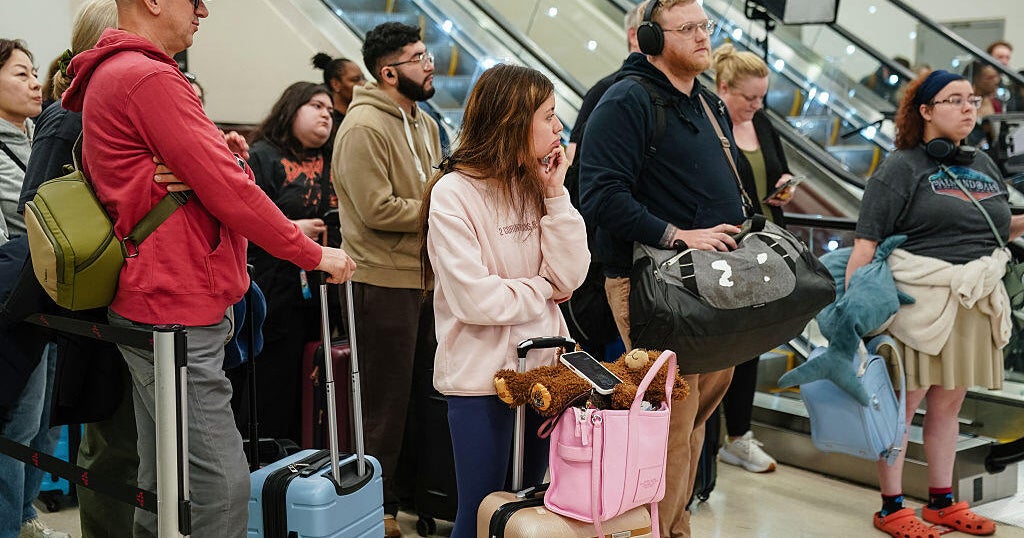
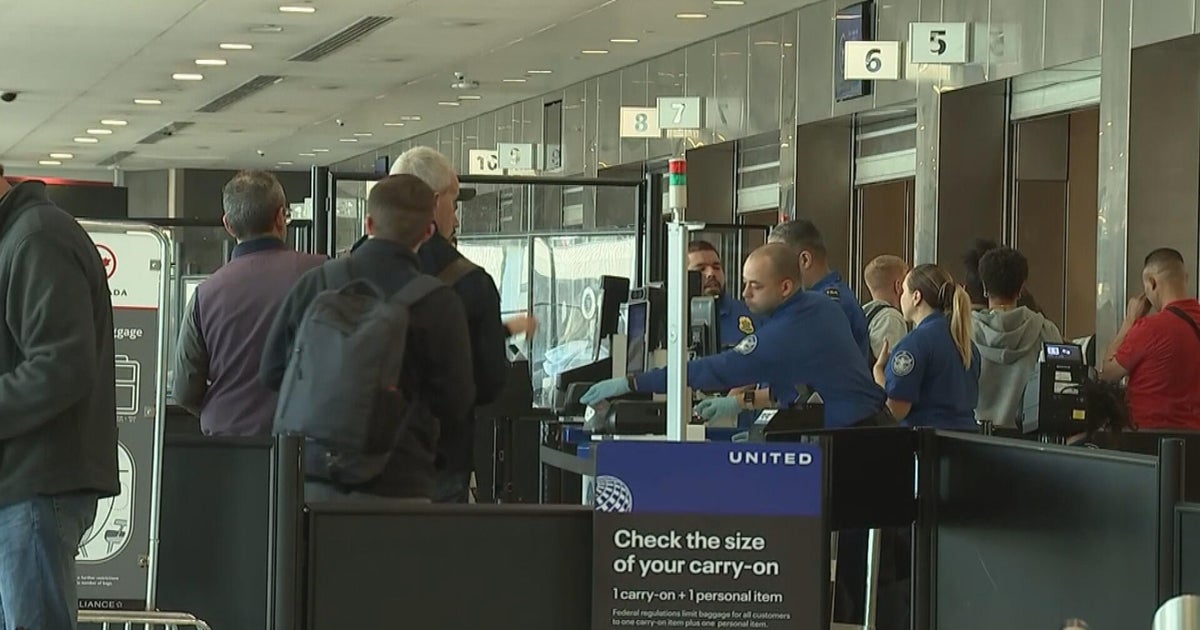
U.S. airlines resume flights to the Caribbean
Several U.S. airlines announced Sunday they were resuming flights to the Caribbean after the Federal Aviation Administration lifted restrictions around the region's airspace overnight.
United said it added 14 flights on Sunday to accommodate passengers whose travel was disrupted. American Airlines said it was adding nearly 5,000 seats to and from the Eastern Caribbean.
JetBlue said it plans to resume normal operations.
"We understand this is a busy travel weekend for many customers, and we're doing everything possible to support those affected by the disruption. We will continue working to rebook customers on available flights and, where possible, by adding extra flights," the airline said in a statement.
Delta said it was adding 2,600 seats to its Caribbean flight network on Monday and that it was working to ensure all affected customers are reaccommodated by Tuesday, Jan. 6."
A major challenge for the airlines is capacity, as there is likely not enough gate space in some airports to accommodate the number of flights that would cover all the ones that were canceled on Saturday.
-Kris Van Cleave and Sarah Ploss contributed to this report.
Venezuela's military recognizes Vice President Delcy Rodriguez as acting leader after Maduro's capture
Venezuela's military said it recognizes Vice President Delcy Rodriguez as the country's acting leader after Nicolas Maduro was extracted from Caracas by U.S. forces on Saturday.
Defense Minister Vladimir Padrino Lopez issued a statement endorsing a Supreme Court ruling that appointed Rodriguez as acting president for 90 days.
Rodriguez, who is next in the presidential line of succession, served as Maduro's vice president since 2018, overseeing much of Venezuela's oil-dependent economy as well as its feared intelligence service. On Saturday, Venezuela's high court ordered her to assume the role of interim president.
-CBS/AFP
Rep. Jim Himes says Maduro capture is "clearly illegal under international law"
Rep. Jim Himes, the top Democrat on the House Intelligence Committee, said the operation to capture Maduro is "clearly illegal under international law," while pointing to broader implications.
"Think of what Russia and China just learned," Himes said on "Face the Nation with Margaret Brennan." "Russia and China just learned that all you need to do if you want to go into Estonia is to say that the leader of Estonia is a bad person. You don't even need to make a particularly good case."
Himes said "there's no national security expert saying that Venezuela was a mortal threat to the United States three weeks ago."
"So what China and Russia just learned is that the beacon of liberty and rule of law in the world has now green lighted snatch and grab operations in Estonia, in Taiwan, wherever Xi and Putin decide they want to go next."
The Connecticut Democrat added that it's also "clearly not legal under the Constitution, because though presidents of both parties have argued against this, the Constitution is really pretty clear that the representatives of the people get to be consulted and ultimately approve military activity."
"That has not happened here at all," Himes said.
Himes said he was "delighted to hear that Tom Cotton, chairman of the Senate Intelligence Committee, has been in regular contact with the administration," saying he's had "zero outreach" and isn't aware of any other Democrats who have received outreach either.
"So apparently, we're now in a world where the legal obligation to keep the Congress informed only applies to your party, which is really something," he added.
Himes pointed to the reaction from Republican lawmakers and other officials so far, saying "we're in the euphoria period of acknowledging across the board that Maduro was a bad guy and that our military is absolutely incredible."
"This is exactly the euphoria we felt in 2002 when our military took down the Taliban in Afghanistan," Himes said. "In 2003 when our military took out Saddam Hussein, and in 2011 when we helped remove Muammar Qaddafi from power in Libya."
Himes said "what we learned the day after the euphoria phase is it's an awful lot easier to break a country than it is to actually do what the president promised to do, which is to run it."
Maduro to appear in New York federal court on Monday
Maduro and his wife will appear in federal court at noon on Monday, according to a spokesperson for the U.S. District Court in the Southern District of New York.
Maduro and his wife landed in New York on Saturday night and are being held at the Metropolitan Detention Center in Brooklyn. They face federal charges related to drug trafficking and working with gangs designated as terrorist organizations, which Maduro has denied.
Marco Rubio says "the president always retains optionality" to occupy Venezuela
Secretary of State Marco Rubio said Mr. Trump always has options around what comes next in Venezuela. Asked to clarify that there is no plan for U.S. occupation of Venezuela, Rubio said "the president always retains optionality on anything and on all of these matters."
"He certainly has the ability and the right under the Constitution of the United States to act against imminent and urgent threats against the country," Rubio said on "Face the Nation with Margaret Brennan."
Expanding on whether Mr. Trump could put boots on the ground in Venezuela, Rubio said "he does not feel like he is going to publicly, you know, rule out options that are available for the United States, even though that's not what you're seeing right now."
"What you're seeing right now is an oil quarantine that allows us to exert tremendous leverage over what happens next," Rubio said.
Schumer on Venezuela operation: "You don't treat lawlessness with other lawlessness"
Senate Minority Leader Chuck Schumer, asked on ABC's "This Week" whether it's a good thing that Maduro has been removed from office, said "look, Maduro's a horrible, horrible person, but you don't treat lawlessness with other lawlessness, and that's what's happened here."
Schumer said the American people are "scratching their heads in wonderment and in fear of what the president has proposed — the United States will run Venezuela."
"We have learned through the years, when America tries to do regime change and nation building in this way, the American people pay the price in both blood and in dollars," Schumer said.
The New York Democrat said the administration doesn't have the authority for the operation, saying "they did not just do ships off the water, they went inside Venezuela, bombed civilian as well as military places, and it's a violation of the law to do what they did without getting the authorization of Congress."
Schumer said Senate Democrats will force a vote on a war powers resolution this week, saying "if it is voted positively in both houses, then the president can't do another thing in Venezuela without the OK of Congress." Previous efforts to limit the president's authority to strike Venezuela have fallen short in recent months.
"The American people are worried that this is creating an endless war," Schumer said. "The very thing that Donald Trump campaigned against over and over and over again was no more endless wars, and right now we're headed right into one, with no barriers, with no discussion. This is reckless."
Cotton says "there's no such implication" of a swap in which Russia abandons Venezuela for U.S. to abandon Ukraine
Sen. Tom Cotton, the chair of the Senate Intelligence Committee, said Sunday that "there's no such implication" that Russia would abandon its support for Venezuela if the U.S. abandoned its support for Ukraine.
"Russia doesn't need any kind of pretext to do so," Cotton said on "Face the Nation with Margaret Brennan." "It's invaded Ukraine twice over the last 11 years. There's no such implication here at all. And this is an operation the United States conducted on our own, without any coordination or cooperation from other countries to advance our national interest, which is to stop the drug trafficking and stop Venezuela from cooperating with countries like Russia and China and Cuba and Iran."
Fiona Hill, a former U.S. national security official on Russia in the first Trump administration, suggested in 2019 testimony that Russia floated the "swap" of support.
A tense calm holds in Venezuela a day after Maduro was deposed by U.S.
A tense calm held in Venezuela on Sunday, one day after President Nicolás Maduro was deposed and captured in an American military operation.
Venezuela's capital, Caracas, was unusually quiet on Sunday with few vehicles moving around. Convenience stores, gas stations and other businesses were mostly closed.
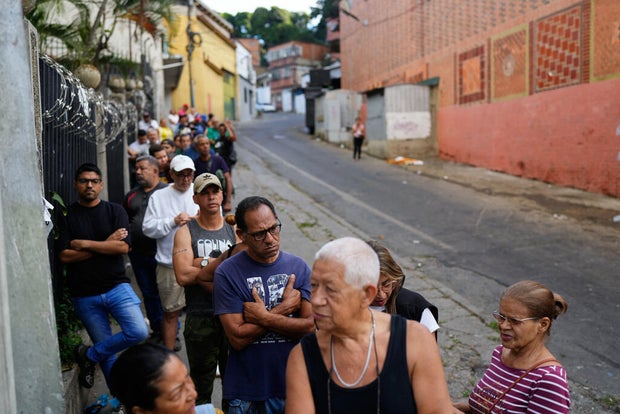
A day before, lines wound through stores and outside gas stations as uncertain Venezuelans stocked up on goods in case turmoil broke out. Roads typically filled with runners and cyclists sat largely empty and Venezuela's presidential palace was guarded by armed civilians and members of the military.
Outside the capital, in La Guira state, families with houses damaged in blasts during the operation that captured Maduro and his wife were still cleaning up debris. Some buildings were left with walls gaping open.
Sen. Tom Cotton says new Venezuelan government cannot "continue Nicolás Maduro's ways"
Sen. Tom Cotton, the chair of the Senate Intelligence Committee, told "Face the Nation with Margaret Brennan" on Sunday that the U.S. has to "make sure the people that are in charge of the apparatus of the Venezuelan government are not going to continue Nicolás Maduro's ways."
President Trump "wants to give them a chance to turn the page in Venezuela and to help America achieve our policy goals there," Cotton said.
The Arkansas Republican reiterated some of Secretary of State Marco Rubio's points about what the Trump administration wants to see in Venezuela's government, which is still composed of Maduro's allies.
"We want them to stop the drug and weapons trafficking," Cotton said. "We want them to kick out the Iranians, the Cubans, the Islamic radicals like Hezbollah and just return to being a normal nation that will help build stability, order and prosperity, not just in Venezuela but in our backyard."
Cotton said he felt that new elections "should be a goal," and he said he hoped the government in place would allow political exiles such as Nobel Peace Prize winner María Corina Machado return.
"In some period of time — it probably is not going to be days or weeks, maybe a number of months — that you can have new elections in Venezuela that are free and fair," Cotton said.
Netanyahu lauds Trump, U.S. after U.S. captures Maduro
Prime Minister Benjamin Netanyahu said Sunday that Israel supported the United States' "strong action" in Venezuela, the day after American forces captured Maduro in a military operation.
"Regarding Venezuela, I wish to express the support of the entire government for the resolute decision and strong action of the United States to restore freedom and justice to that region of the world," Netanyahu said at the opening of a cabinet meeting.
He also congratulated President Trump on social media for his "bold and historic leadership on behalf of freedom and justice" and "the brilliant action of your brave soldiers."
-- CBS/AFP
Pope Leo says Venezuela's independence should be guaranteed
Pope Leo XIV said Sunday that the Venezuelan people's welfare should prevail and that the country's independence should be guaranteed.
Following his Angelus prayer in St. Peter's Square, the first U.S. pope urged "overcoming violence and embarking on paths of justice and peace, guaranteeing the sovereignty of the country, ensuring the rule of law enshrined in the Constitution, respecting the human and civil rights of each and every person, and working together to build a peaceful future of collaboration, stability, and harmony, with special attention to the poorest who are suffering because of the difficult economic situation."
Leo said he's been following the situation in Venezuela with "a soul full of concern," the Reuters news agency reported.
His comments came a day after President Trump said the U.S. would "run" Venezuela and tap its oil reserves.
-- CBS/AFP
North Korea condemns U.S. operation as "serious encroachment of sovereignty"
North Korea denounced the United States' capture of Maduro, calling it a "serious encroachment of sovereignty."
Pyongyang's foreign ministry "strongly denounces the U.S. hegemony-seeking act committed in Venezuela," said a spokesperson in a statement Sunday, carried by official state news agency KCNA, referring to what it was characterizing as a U.S. drive for dominance.
"The incident is another example that clearly confirms once again the rogue and brutal nature of the U.S.," they added.
The raid represents a nightmare scenario for North Korea's leadership, which has long accused Washington of seeking to remove it from power. Pyongyang has for decades justified its nuclear and missile programs as deterrents against alleged regime change efforts by Washington. And it was a vocal backer of Maduro's socialist regime in Caracas.
-- CBS/AFP
Kamala Harris slams raid as "unlawful and unwise"
Former Vice President and Democratic presidential nominee Kamala Harris said on social media Saturday night that the U.S. operation in Venezuela didn't "make America safer, stronger, or more affordable."
"That Maduro is a brutal, illegitimate dictator does not change the fact that this action was both unlawful and unwise," Harris wrote. "We've seen this movie before. Wars for regime change or oil that are sold as strength but turn into chaos, and American families pay the price. The American people do not want this, and they are tired of being lied to. This is not about drugs or democracy. It is about oil and Donald Trump's desire to play the regional strongman.
" ... The President is putting troops at risk, spending billions, destabilizing a region, and offering no legal authority, no exit plan, and no benefit at home."
In an October interview with CBS News partner network the BBC, Harris said she is "not done," leaving the door open for another presidential run.
Starlink offering free broadband in Venezuela through early next month
Starlink says it's "providing free broadband service to the people of Venezuela through February 3, ensuring continued connectivity."
Starlink is a subsidiary of SpaceX, whose founder and CEO is Elon Musk.
Musk and President Trump's once-close relationship publicly ruptured after Musk stepped down last May from leading the administration's Department of Government Efficiency. But the two appear to have at least partially mended fences since then. Asked last month if Musk is back in his circle of friends, Mr. Trump said, "I like Elon a lot."
China calls on U.S. to release Maduro "at once"
China says the U.S. should free Maduro immediately.
The Chinese foreign ministry said in a statement Sunday that it "calls on the U.S. to ensure the personal safety of President Nicolas Maduro and his wife, release them at once, (and) stop toppling the government of Venezuela," according to French news agency AFP.
Beijing also depicted the U.S. strike that captured Maduro as a "clear violation of international law."
Early Saturday, China had said it "strongly condemns" the U.S. operation.
U.S. reopens airspace over Caribbean
Transportation Secretary Sean Duffy says the Federal Aviation Administration has lifted restrictions on airspace over the Caribbean it had imposed early Saturday.
"The original restrictions around the Caribbean airspace are expiring at 12:00am ET and flights can resume," Duffy said on social media late Saturday night. "Airlines are informed, and will update their schedules quickly. Please continue to work with your airline if your flight was affected by the restrictions."
There was no mention of airspace over Venezuela, which the FAA had also restricted.
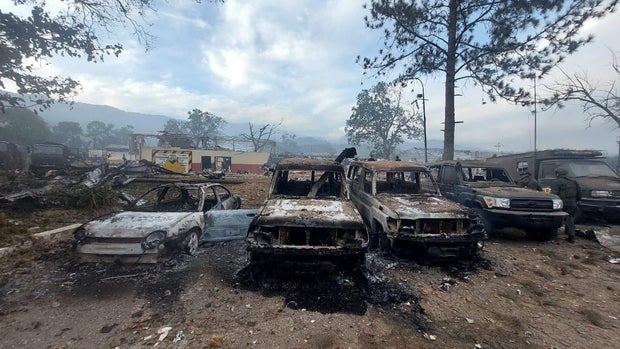
Photos show aftermath of U.S. strikes at Fuerte Tiuna
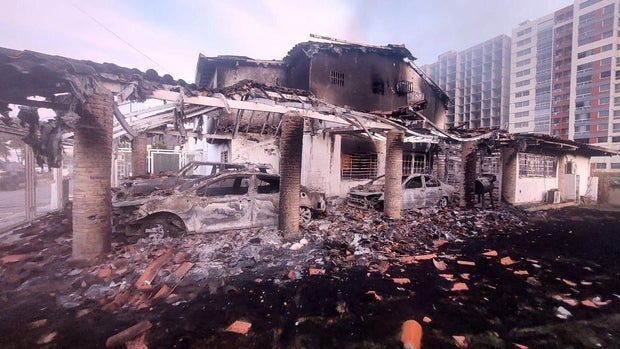
Photos shared with CBS News show the aftermath of the U.S. strikes at Fuerte Tiuna.
Fuerte Tiuna, Venezuela's largest military complex, is where Maduro and his wife were captured at their home, Venezuelan ruling party leader Nahum Fernández said, The Associated Press reported.
The images show charred vehicles and structures that are heavily damaged.

White House account shares video apparently showing Maduro
The White House Rapid Response account shared a video on X that appeared to show Maduro. It included the caption: "Perp walked."
He appears to be walking down a hallway on a carpet that states, "DEA NYD," and is escorted by three men in DEA jackets.
Sen. Warner expresses concerns about precedent
Democratic Sen. Mark Warner, who is the vice chairman of the Senate Intelligence Committee, expressed concerns about the precedent the operation had set.
"Does this mean any large country can indict the ruler of a smaller adjacent country and take that person out?" he told CBS News by phone on Saturday evening. "This would lead to total chaos, this theory of the case."
He also said that in briefings, there had been "no conversation" about Venezuela's Vice President Delcy Rodriguez being a "viable figure" in a post-Maduro scenario.
In "many, many, briefs when we talked about who would take over next — Would it be the military? Would it be the opposition? — There was no conversation about the vice president being a viable figure," he said.
He also said the operation "was extraordinary" and shows "the sophistication of our military."
"But to put our troops in harm's way without a clear mission and what is the next step is really troubling," he said.
Maduro arrives at Brooklyn detention center
Nicolás Maduro arrived at MDC Brooklyn, a detention center in New York City, at about 8:52 p.m. ET on Saturday. He was not slated to be housed in his own wing as of Saturday evening.
MDC has the best capacity of any detention center in the country for handling high-security defendants.
His wife's confinement status is unknown.
Venezuela's Supreme Court orders that Delcy Rodriguez assume presidency
Venezuela's supreme court ordered on Saturday night that Delcy Rodriguez assume the presidency of Venezuela after Nicolas Maduro was taken by the U.S. military to face charges in New York.
The court deemed it was necessary to grant Rodriguez full presidential power to "guarantee the administrative continuity" of the nation amid Maduro's absence.
Rodriguez, Maduro's handpicked vice president, earlier called Maduro's capture "barbaric" and an "illegal and illegitimate kidnapping."
U.S. intervention in Venezuela is "exact opposite" of Iraq, Hegseth says
Defense Secretary Pete Hegseth told "CBS Evening News" that the U.S. intervention in Venezuela and the capture of Nicolás Maduro is the "exact opposite" of the U.S. invasion of Iraq.
"We spent decades and decades and purchased in blood, and got nothing economically in return, and President Trump flips the script," Hegseth told "CBS Evening News" anchor Tony Dokoupil on Saturday.
Hegseth said that through strategic action, the U.S. can ensure it has access to "additional wealth and resources, enabling a country to unleash that without having to spend American blood."
Experts weigh in on what Maduro might expect in federal jail
New York City's federal jails have seen their fair share of high-profile inmates, but none quite like Nicolás Maduro, who until a day ago had access to a presidential palace.
His status likely means protection from the general population in Brooklyn's federal Metropolitan Detention Center, but could also lead to difficulty in obtaining private counsel, experts told CBS News.
Maduro and his wife, Cilia Flores, could be arraigned as soon as Monday, two sources familiar with the matter told CBS News, adding that they're expected to be taken to the Metropolitan Detention Center, or MDC, to be housed.
Marc Fernich represented notorious drug trafficker Joaquín "El Chapo" Guzmán, who was held at a federal jail a few miles away in Manhattan, and other high-profile inmates such as Jeffrey Epstein. He said Maduro may require isolation for his own safety.
"If Maduro is placed in round-the-clock solitary, it will be for his own protection or to guard against suicide," Fernich said. He added that the Brooklyn jail currently houses many members of one of Venezuela's most well-known transnational gangs.
"There's a heavy Tren de Agua population at MDC. That may affect his confinement conditions — where and how he's housed — there," Fernich said.
Jonathan Savella, who represents clients in international drug trafficking cases, said Maduro may face speed bumps assembling a legal team.
"Payment won't be straightforward and no suitable attorney will get involved until that's worked out," Savella said, adding that, at least at first, Maduro might need to rely on court-appointed counsel.
"I assume the big firms that do, or hope to do, business in Venezuela won't touch the case because of conflicts," Savella said.
"President Trump sets the terms" on running Venezuela, Hegseth says
In an interview with Tony Dokoupil on a special edition of the "CBS Evening News," Defense Secretary Pete Hegseth said "President Trump sets the terms" on running Venezuela.
"Ultimately, we're going to control what happens next because of this brave decision. President Trump has shown American leadership," Hegseth said.
Mr. Trump said earlier Saturday that the U.S. is "going to run the country" until there is a "safe, proper and judicious transition" of power in Venezuela, but he provided few details about what that may look like.
Defense Secretary Pete Hegseth praises troops: "They got the job done"
In an interview with Tony Dokoupil on a special edition of the "CBS Evening News," Defense Secretary Pete Hegseth praised the troops involved in the mission to capture Maduro.
"I saw the best of America, I saw men and women dedicating their lives to defending our country and to accomplish in that mission," Hegseth said.
"They got the job done despite any obstacles in front of them."
He said President Trump "gave them a clear mission and they finished it."
U.N. Secretary-General "deeply alarmed" by escalation in Venezuela
A spokesperson for U.N. Secretary-General António Guterres said he is "deeply alarmed by the recent escalation in Venezuela, culminating with today's United States military action in the country, which has potential worrying implications for the region."
In a statement, he called it "a dangerous precedent" and said Guterres is "deeply concerned that the rules of international law have not been respected."
"The Secretary-General calls on all actors in Venezuela to engage in inclusive dialogue, in full respect of human rights and the rule of law," the statement said.
Venezuelan officials condemn Maduro's capture, calling it a "kidnapping"
Hours after Venezuelan President Nicolás Maduro was captured by U.S. forces, top regime figures condemned the military operation in stark terms and suggested they plan to push back on U.S. involvement in the country, posing a potential challenge to President Trump's suggestion that the U.S. will "run" Venezuela.
Maduro's handpicked vice president, Delcy Rodriguez, whom Mr. Trump said was sworn in as president Saturday, called Maduro's capture "barbaric," an "illegal and illegitimate kidnapping" and an attack on Venezuela's sovereignty.
She also called for the "immediate release" of Maduro and his wife, calling him "the only president of Venezuela."
Mr. Trump had said earlier Saturday that he believed Rodriguez was "essentially willing to do what we think is necessary to make Venezuela great again."
Person escorted from Maduro's plane in shackles
A phalanx of law enforcement personnel was seen leading a person in shackles off the plane that carried Venezuelan President Nicolás Maduro to New York state.
The person's identity isn't clear, but Maduro and his wife were transported on the plane.
Rubio said Maduro had "multiple opportunities" to leave Venezuela
Secretary of State Marco Rubio suggested to reporters earlier Saturday that Venezuelan President Nicolás Maduro was given an opportunity to leave Venezuela and avoid U.S. capture.
"Nicolás Maduro had multiple opportunities to avoid this," Rubio told reporters at Mar-a-Lago. "He was provided multiple very, very, very generous offers, and chose instead to act like a wild man."
Rubio did not elaborate on the offers that were floated for Maduro, but he said later: "This guy had multiple opportunities to find his way somewhere else. … He could've been living somewhere else right now, very happy, but instead he wanted to play big boy, and so now he's got other sets of problems on his hands."
Last month, President Trump told reporters it would be "smart" for Maduro to leave power, but "it's up to him what he wants to do."
What to know about Maduro's indictment
Venezuelan President Nicolas Maduro was indicted by a federal grand jury on charges stemming from what prosecutors said was his role in a scheme to import "thousands of tons" of cocaine into the United States and enrich himself, his family and senior members of the Venezuelan government.
The indictment was unsealed Saturday after Maduro and his wife, Cilia Flores, were captured and brought to the U.S. to face criminal charges. Six people are named as defendants, including the former president and his wife, Maduro's son, Venezuela's interior minister, its former interior minister and a leader of the gang Tren de Aragua.
The case was brought in the Southern District of New York, where Maduro and 14 others were first indicted in March 2020, during the first Trump administration.
The superseding indictment alleges that for more than 25 years, "leaders of Venezuela have abused their positions of public trust and corrupted once-legitimate institutions to import tons of cocaine into the United States."
Prosecutors place Maduro at the "forefront of the corruption," and say that he and his associates worked with drug traffickers and narco-terrorists to flood the U.S. with "thousands of tons of cocaine." This drug trafficking, according to the indictment, enriched Maduro, his family and members of Venezuela's political and military elite.
The indictment alleges that Maduro has used his various positions in the Venezuelan government to transport cocaine, including as president and in his previous role as minister of foreign affairs. Prosecutors also said Maduro and his wife used state-sponsored gangs to facilitate and protect their drug-trafficking operation.
U.N. Security Council planning emergency meeting
An emergency meeting of the United Nations Security Council to discuss Venezuela is in the works, diplomatic sources told CBS News. There is an effort underway to hold the meeting Sunday, but it could also take place Monday morning.
Venezuela's envoy to the U.N., Samuel Reinaldo Moncada Acosta, requested an emergency meeting of the Security Council to discuss "acts of aggression perpetrated by the United States of America."
The government of Colombia, which is a temporary Security Council member, also requested a meeting, and Russia, which is a permanent member, backed calls for an emergency meeting.
Special coverage tonight on "CBS Evening News"
Tony Dokoupil anchors a special edition of the "CBS Evening News" with the latest on the U.S. operation in Venezuela and what comes next after the capture of President Nicolás Maduro. Tune in at 6:30 p.m. on CBS.
How Maduro was captured
Mr. Trump gave final approval of the mission to capture Maduro Friday at 10:46 p.m. ET, Joint Chiefs Chairman Gen. Dan Caine told reporters Saturday during the president's news conference at Mar-a-Lago.
Throughout the night, aircraft launched from 20 bases across the Western Hemisphere toward Venezuela. Caine said the mission, named Operation Absolute Resolve, involved more than 150 aircraft.
"As the night began, the helicopters took off with the extraction force, which included law enforcement officers, and began their flight into Venezuela at 100 feet above the water," Caine said.
As the helicopters approached shore, they were protected by other aircraft, including drones, bombers and fighter jets. The U.S. dismantled and disabled Venezuela's air defense systems as the helicopters neared Caracas, according to Caine, who also said they deployed weapons "to ensure the safe passage of the helicopters into the target area."
Mr. Trump said the lights in Caracas had largely gone dark "due to a certain experience that we have."
"As the force crossed the last point of high terrain where they'd been hiding in the clutter, we assessed that we had maintained totally the element of surprise," Caine said.
Once at the compound, the helicopters came under fire but remained operable, Caine said.
U.S. forces and the FBI eventually entered the compound, where Maduro and his wife "gave up" and were taken into custody, Caine said.
Mr. Trump said that Maduro tried to escape during his capture.
"He was trying to get into a safe place," Mr. Trump told reporters. "The safe place is all steel, and he wasn't able to make it to the door because our guys were so fast."
Maduro and his wife arrive in New York to face charges
Ousted Venezuelan President Nicolas Maduro and his wife, Cilia Flores, landed at Stewart Airport just north of New York City on Saturday afternoon, hours after their capture during a U.S. military operation in Caracas overnight.
They were transported to the USS Iwo Jima warship before being flown to New York to face criminal charges.
A superseding indictment filed in the Southern District of New York accuses Maduro, members of his family and his cabinet of conspiracy to commit narco-terrorism and to import cocaine to the U.S.
"They will soon face the full wrath of American justice on American soil in American courts," Bondi said.
GOP Rep. Brian Fitzpatrick: The U.S. should only be "running" the U.S.
Republican Rep. Brian Fitzpatrick of Pennsylvania pushed back after President Trump said the U.S. would temporarily "run" Venezuela.
"The only country that the United States of America should be 'running' is the United States of America," Fitzpatrick said in a statement Saturday.
"The United States should join the international community in monitoring and overseeing a free and fair election in Venezuela, allowing the Venezuelan people a pathway to a true democracy," he added.
GOP Sen. Susan Collins says Congress should have been briefed sooner
Republican Sen. Susan Collins of Maine said the Trump administration should have informed Congress of the operation sooner and that lawmakers need to be "involved as the situation evolves."
Collins said Secretary of State Marco Rubio briefed her on the situation Saturday morning.
"While there is still much we don't know, this mission appears to have been a limited scope operation, run in conjunction with law enforcement, that effectively apprehended an international criminal," she wrote.
President Trump said Congress was not briefed ahead of the mission because lawmakers have "a tendency to leak."
Rubio said the administration called members of Congress "immediately" after the operation, adding that "this is not the kind of mission that you can do congressional notification on."
"It's just not the kind of mission that you can pre-notify because it endangers the mission," Rubio said.
Sen. Tim Kaine planning another war powers vote this week
Democratic Sen. Tim Kaine plans to bring his latest war powers resolution up for a vote this week, calling the military action in Venezuela "an illegal war."
"There is no legal justification in the Constitution, in the history of the Constitution, or an American law that would authorize the president to wage war, to depose President Maduro and seize its oil and run the country of Venezuela without coming to Congress," Kaine told reporters Saturday.
Since October, there have been two failed attempts each in the Senate and House to limit the president's authority to strike Venezuela and the suspected drug-smuggling boats in the region.
Kaine introduced his latest resolution in early December, days after it came to light that the U.S. killed two people who survived the initial blast of a Sept. 2 strike in the Caribbean Sea.
Kaine's measure would require "the removal of United States Armed Forces from hostilities within or against Venezuela that have not been authorized by Congress."
Most Democrats have supported limiting the president's authority, but the efforts have fallen short of the Republican votes needed for passage.
Kaine said Saturday that his Republican colleagues believed President Trump would not follow through on his threats to strike Venezuela and remove Maduro from power.
"Some of my Republican colleagues told me, 'Oh, we think the president's bluffing' or 'This is not really going to happen,'" Kaine said.
"Now my colleagues will see this is not a bluff. And now my colleagues have seen President Trump unable to give a clear explanation about what this is for — narcotrafficking, regime change, seizure of oil," Kaine said. "They've watched the president unable to give a clear description of what it means that the United States will 'run' Venezuela. They've watched the president and secretary of state suggest that Cuba should be next. It's time for Congress to get its ass off the couch and do what the Constitution mandates that we do."
Kaine said he intends to repeatedly force votes on the issue in the coming year.
Duffy confirms FAA restricted airspace in the Caribbean, Venezuela, doesn't say when restrictions will lift
After multiple airlines canceled flights, Transportation Secretary Sean Duffy confirmed the Federal Aviation Administration restricted the airspace in the Caribbean and Venezuela. It's not clear when the restrictions will be lifted.
"Early this morning in support of the Department of War, the FAA restricted the airspace in the Caribbean and Venezuela to ensure the SAFETY of the flying public," he wrote on X. "When appropriate, these airspace restrictions will be lifted. Please work with your airlines directly if your flight has been impacted."
Rubio and Trump hint that Venezuela attack should cause concern for Cuban government
Mr. Trump was asked in the press conference if there's a message in the Venezuela operation for Cuba. He said Cuba is an "interesting" case.
"I think Cuba is going to be something we'll end up talking about, because Cuba is a failing nation right now," Mr. Trump responded. "A very badly failing nation. And we want to help the people."
Rubio said Cuba is run by "incompetent, senile men" and many of the people who helped Maduro were Cubans.
"One of the biggest problems that Venezuelans have is they have to declare independence of Cuba that tried to basically colonize it from a security standpoint," Rubio said. "So yeah look, if I lived in Havana and I was in the government, I'd be concerned, at least, a little bit."
If the U.S. were to attempt a similar operation in Cuba, it would not be the first time. In 1961, President John F. Kennedy launched the Bay of Pigs invasion, a failed effort to overthrow Fidel Castro and his communist government from power.
Schumer, Jeffries call for "immediate" briefing for "Gang of Eight" and briefings for all members of Congress
Senate Minority Leader Chuck Schumer and House Democratic Leader Hakeem Jeffries demanded the Trump administration brief Congress on the Venezuela operation, as they condemned the president's announcement that the U.S. will run Venezuela for now.
"President Trump's announced plan to run Venezuela is unacceptable," they said in a joint statement. "It is critical that the Trump administration provide an immediate Gang of Eight briefing, followed by briefings for all Members of the House and Senate early next week."
The Gang of Eight consists of the top leaders in each chamber, as well as the chairs and ranking members of the House and Senate intelligence committees.
Venezuela's vice president says Maduro is the "only president" of Venezuela
Despite Mr. Trump's statement that Delcy Rodriguez, the vice president of Venezuela, has been sworn into office to replace Maduro and would work with the U.S., Rodriguez said Saturday that Venezuela's "only president" is Maduro.
"Unico presidente Venezuela, el presidente, Nicolás Maduro," Rodriguez said in Spanish.
She was defiant in her first televised appearance since the operation, expressing outrage over the U.S. capture of Maduro and his wife. Rodriguez called for their immediate release.
And she said of the U.S., "What they did to Venezuela today, they can do to anyone. That brutal use of force to bend the will of the people can be done to any country."
-Mia Salenetri contributed to this post.
Tulsi Gabbard previously opposed intervention in Venezuela
During President Trump's first term, Tulsi Gabbard vehemently opposed military intervention in Venezuela. At the time, she was running for president as a Democrat, and John Bolton was the national security adviser. In late 2018, Maduro had won what the U.S. viewed as a "sham election," and top U.S. officials, including Bolton supported the opposition leader's bid to oust him in 2019.
"It's about the oil … again," Gabbard, now the director of national intelligence, wrote on X in January 2019. "Bolton just exposed real motive for intervention in Venezuela: 'We're in conversation with major American companies now...It would make a difference if we could have American companies produce the oil in Venezuela. We both have a lot at stake here.'"
"Throughout history, every time the US topples a foreign country's dictator/government, the outcome has been disastrous," she wrote on X in May 2019. "Civil war/military intervention in Venezuela will wreak death & destruction to Venezuelan people, and increase tensions that threaten our national security."
Venezuela's vice president said she'll work with U.S., Trump says
In his press conference, Mr. Trump said Delcy Rodriquez, the vice president of Venezuela, is ready to work with the U.S. The president indicated that Rubio had spoken with her.
Mr. Trump said Rodriguez indicated "we'll do whatever you need," although he also said she doesn't have another choice.
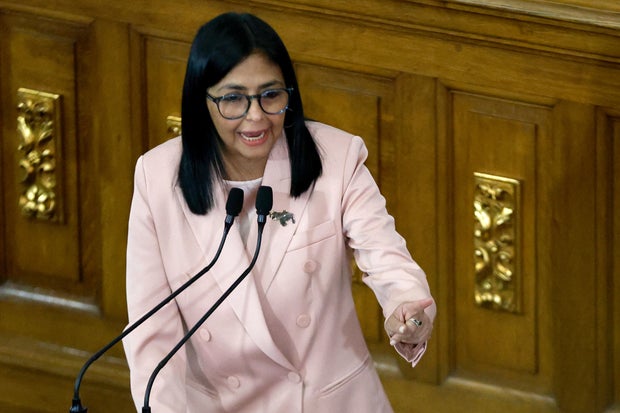
But Rodriguez, speaking on live television called Maduro Venezuela's "only president" and demanded the U.S. release him and his wife, Cilia Flores, according to AFP.
Schumer condemns Trump's claim that the U.S. will "run" Venezuela
Senate Democratic Leader Chuck Schumer joined other Democrats in criticizing Mr. Trump's plan for the United States to "run" Venezuela until a "proper transition" can occur.
"The idea that Trump plans to now run Venezuela should strike fear in the hearts of all Americans," Schumer said in a statement after the president's press conference on the overnight operation in Venezuela. "The American people have seen this before and paid the devastating price."
The New York Democrat accused the Trump administration of attempting to distract from the state of the U.S. economy and its handling of the release of Justice Department files related to the investigation into Jeffrey Epstein.
"Let me be clear: Nicolás Maduro is an illegitimate dictator. But launching military action without congressional authorization and without a credible plan for what comes next is reckless," Schumer said. "The administration has assured me three separate times that it was not pursuing regime change or taking military action in Venezuela. Clearly, they are not being straight with Americans.
Rep. Rick Crawford says a safe America "requires a safe neighborhood"
GOP Rep. Rick Crawford of Arkansas, the chair of the House Intelligence Committee, told CBS News that the operation made Saturday a "great day for Venezuela."
Crawford, like Senate Select Intelligence Chairman Tom Cotton, referred to the attack as a law enforcement operation — one that was executed with the military's assistance — meaning the Trump administration was not required to notify Congress in advance. He said that he and other Congress members were contacted "after the fact" and that he had spoken with Rubio and Hegseth.
He also compared the operation to former President Obama's order for the capture of Anas al-Libi, an al-Qaeda soldier and wanted terror suspect who was arrested in Libya in 2013. Al-Libi was not a government official.
"We're not reinventing the wheel here," Crawford said. "We're basically using a precedent that was set and exercised on under the Obama administration."
When asked what kind of global precedent the Venezuela operation might set, Crawford said he would not engage in hypotheticals and Mr. Trump's move should be seen as a sign of strength. While former President Biden did not recognize Maduro as a legitimate president, he also "didn't have the testicular fortitude to do anything about it," Crawford said.
"That's the difference here. We have a president in office here now that's not playing around," Crawford said. "What we need to understand is if we're going to have a safe America, that requires a safe neighborhood."
Top Democrat says there's "no evidence whatsoever this makes America safer"
Rep. Adam Smith, the top Democrat on the House Armed Services Committee, told CBS News 24/7 that "there's no evidence whatsoever this makes America safer."
"This doesn't seem to have much to do with drugs," Smith said of the Venezuela operation, adding, "it seems what this is about is Trump wants Venezuela's oil."
He's also concerned about what happens next.
"Is his plan to invade?" Smith asked.
Citing past U.S. military action in Iraq and Libya, Smith said that every time, "it always ends badly."
"The notion that the U.S. military can reach in and fix that problem with the use of force? This is what Trump ran against," Smith said.
Rubio had recently assured Congress that intervention in Venezuela wasn't aimed at regime change, Smith said.
"And obviously, it's clear that was the goal," he said.
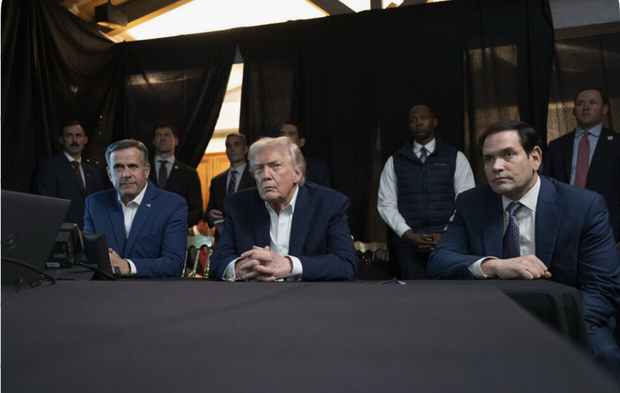
Trump posts images of him and top officials overseeing Venezuela operation from Mar-a-Lago
After Mr. Trump's press conference, his Truth Social account posted multiple images of him and top officials and aides overseeing the overnight operation from Mar-a-Lago.

U.S. service members suffered gunshot wounds, other injuries, but no fatalities
U.S. service members involved in the Venezuela operation suffered non-life threatening gunshot wounds and other injuries, two U.S. officials told CBS News.
It is not clear how many were hurt in the operation, however.
There were no U.S. fatalities.
All of the injured service members are in stable condition.
Trump says U.S. is "in the oil business" and will sell Venezuelan oil
More than once in his press conference, Mr. Trump mentioned Venezuela's oil. The country has the largest proven crude oil reserves in the world.
"In terms of other countries that want oil, we're in the oil business," the president told reporters. "We're going to sell it to them. We're not going to say we're not going to give it to them. In other words, we'll be selling oil, probably in much larger doses, because they couldn't produce very much because their infrastructure was so bad. So, we'll be selling large amounts of oil to other countries — many of whom are using it now — but I would say many more will come."
Mr. Trump said the Venezuelan people will benefit from oil sales — but so will the U.S. It's not clear how the U.S. control of Venezuelan oil operations and sales would work, but the president's interest in Venezuelan oil has already been raised by some lawmakers.
"Previous presidents told us to go to war over WMDs — weapons of mass destruction — that did not exist," Republican Rep. Thomas Massie of Kentucky said on the House floor on Dec. 17. "Now it's the same playbook, except we're told that drugs were the WMDs. If it were about drugs, we'd bomb Mexico, or China, or Colombia, and the president would not have pardoned Juan Orlando Hernandez. This is about oil and regime change."
Trump said he told Maduro "you got to surrender"
Mr. Trump said he had conversations with Maduro and told him "you got to surrender." He did not specify when the conversations occurred.
"And I actually thought he was pretty close to doing so, but now he wished he did," the president added.
Trump on "America First" priorities: "We want to surround ourself with good neighbors"
Mr. Trump, asked how the operation represents his "America First" platform, said, "I think it is because we want to surround ourself with good neighbors."
"We want to surround ourself with energy, we have tremendous energy in that country," he added. "It's very important that we protect it. We need that for ourselves. We need that for the world, and we want to make sure we can protect it."
Rubio says "this was not the kind of mission that you can do congressional notification"
Rubio, amid some criticism from lawmakers who criticized the Trump administration for not informing Congress about the strikes beforehand, said that "this was not the kind of mission that you can do congressional notification on."
"It was a trigger-based mission in which conditions had to be met," Rubio said, adding, "It's just simply not the kind of mission you can call people and say, 'Hey we may do this at some point in the next 15 days.'"
"But it's largely a law enforcement function," Rubio said. "At its core, this was an arrest of two indicted fugitives of American justice, and the Department of War supported the Department of Justice in that jobs."
Rubio acknowledged that there are "broader policy implications here, but it's just not the kind of mission that you can pre-notify, because it endangers the mission."
Mr. Trump added, "Congress has a tendency to leak."
"This would not be good," he said, adding that if the news leaked, it would have been a "maybe a very different result."
Trump says of Venezuela "we're going to be running it with a group"
Asked by reporters about how the country would be run, Mr. Trump replied, "We're going to be running it with a group and we're going to make sure it's run properly."
"We're going to rebuild the oil infrastructure, which will cost billions of dollars, it will be paid for by the oil companies directly," Mr. Trump said. "And we're going to get the oil flowing the way it should be."
Mr. Trump said "we're designating various people."
"It's largely going to be — for a period of time — the people who are standing right behind me," Mr. Trump said, pointing to Hegseth, Rubio and Gen. Dan Caine, the chairman of the Joint Chiefs of Staff. "We're going to be running it, we're going to be bringing it back."
The president, asked by reporters about U.S. troops, said "we're not afraid of boots on the ground," noting that "we had boots on the ground last night."
"We're there now, we're ready to go again if we have to," he added.
Rubio says Maduro "had multiple opportunities to avoid this"
Secretary of State Rubio said Maduro "had multiple opportunities to avoid this, he was provided multiple very, very, very generous offers, and chose instead to act like a wild man, chose instead to play around.""Nicolas Maduro was indicted in 2020 in the United States. He is not the legitimate president of Venezuela," Rubio said. "He is a fugitive of American justice."
Rubio said, "Don't play games with this president," adding, "it's not going to turn out well."
Hegseth says Maduro "effed around and he found out"
Defense Secretary Pete Hegseth, speaking after the president at Mar-a-Lago, praised the U.S. operation, and said of Maduro that he "effed around and he found out."
"Our adversaries remain on notice. America can project our will anywhere, anytime," Hegseth said. "The coordination, the stealth, the lethality, the precision, the very long arm of American justice all on full display in the middle of the night."
"Nicolás Maduro had his chance, just like Iran had their chance, until they didn't and until he didn't," Hegseth said. "He effed around and he found out."
Trump says Maduro was "kingpin of a vast criminal network" trafficking drugs into U.S.
The president called Maduro an "illegitimate dictator" and alleged he "was the kingpin of a vast criminal network responsible for trafficking colossal amounts of deadly and illicit drugs into the United States."
"Maduro and his wife will soon face the full might of American justice and stand trial on American soil," Mr. Trump said. "Right now they're on a ship that will be heading to ultimately New York."
The president said, "Now, Maduro will never again be able to threaten an American citizen or anybody from Venezuela."
"The dictator and terrorist Maduro is finally gone in Venezuela," the president said. "People are free."
Trump says U.S. is ready to conduct second, "much larger attack if we need to do so"
The president said "we are ready to stage a second and much larger attack if we need to do so," saying the U.S. had assumed that a second wave would be necessary, but "now it's probably not."
"The first attack was so successful, we probably don't have to do a second," Mr. Trump said. "But we're prepared to do a second wave — a much bigger wave, actually. This was pinpoint, but we have a much bigger wave that we probably won't have to do."
Mr. Trump also said U.S. oil companies would go into Venezuela and "spend billions of dollars, fix the badly broken infrastructure, the oil infrastructure and start making money for the country."
Trump on Venezuela: "We're going to run the country"
The president said the U.S. will "run" Venezuela on a temporary basis.
"We're going to run the country until such time as we can do a safe, proper and judicious transition," Mr. Trump told reporters.
The president said "we don't want to be involved with having somebody else get in, and we have the same situation that we had for the last long period of years."
"So, we are going to run the country until such time as we can do a safe, proper and judicious transition, and it has to be judicious," he added.
Mr. Trump said "we want peace, liberty and justice for the great people of Venezuela."
The president outlined that "all Venezuelan military capacities were rendered powerless as the men and women of our military, working with U.S. law enforcement, successfully captured Maduro in the dead of night."
The president said Venezuela was in a "ready position," but he said "they were completely overwhelmed and very quickly incapacitated."
"It was an incredible thing to see," he said.
Mr. Trump said no American service members were killed and no U.S. equipment was lost in the operation.
Trump lauds "extraordinary military operation" in Venezuela
The president praised the military operation in Venezuela, speaking at a news conference at his estate at Mar-a-Lago.
"Late last night and early today at my direction, the United States armed forces conducted an extraordinary military operation in the capital of Venezuela," Mr. Trump said, in opening remarks that began at about 11:40 a.m. "Overwhelming military power, air land and sea, was used to launch a spectacular assault, and it was an assault like people have not seen since World War II."
The president said "it was a force against a heavily fortified military fortress in the heart of Caracas to bring outlaw dictator Nicolás Maduro to justice.""This was one of the most stunning, effective and powerful displays of American military might and confidence in American history," Mr. Trump said.
Trump shares photo of Maduro aboard USS Iwo Jima after capture
The president shared a photo on Truth Social with the caption: "Nicolas Maduro on board the USS Iwo Jima."

Mr. Trump said earlier Saturday that Maduro and his wife were aboard the U.S. warship. He said Maduro was being taken to New York after his capture early Saturday.
Maduro expected to arrive today in New York, where he'll be transferred to federal custody
The military plane carrying Maduro is expected to land later today at New York Stewart International Airport, two sources familiar with the matter told CBS News. The airport is located in the Hudson Valley, about 60 miles north of Manhattan.
Maduro, who is in U.S. military custody, is expected to be turned over to federal authorities when he lands, the sources said. He's expected to be arraigned in New York Federal court in the Southern District of New York next week. The case is assigned to U.S. District Judge Alvin K. Hellerstein.
Marjorie Taylor Greene criticizes operation and says it was "what many in MAGA thought they voted to end"
GOP Rep. Marjorie Taylor Greene of Georgia criticized the move to strike Venezuela and capture Maduro. She's set to leave Congress Monday, after announcing her surprise resignation in November amid a major falling out with Trump.
In a lengthy post on X, she said the operation contradicts Mr. Trump's anti-intervention stance and suggested the operation had more to do with regime change than stopping drug trafficking. Greene asked why the Trump administration had not done more to target Mexican cartels and questioned Mr. Trump's controversial pardon of former Honduran president Juan Orlando Hernandez, who was sentenced to 45 years in prison for trafficking cocaine into the U.S.
"Americans disgust with our own government's never ending military aggression and support of foreign wars is justified because we are forced to pay for it and both parties, Republicans and Democrats, always keep the Washington military machine funded and going," Greene wrote. "This is what many in MAGA thought they voted to end. Boy were we wrong."
Opposition leader María Corina Machado: "The time for freedom has come!"
Venezuelan opposition leader María Corina Machado released a statement Saturday morning addressing the nation after Maduro's capture.
"Venezuelans, The time for freedom has come!" she wrote.
She said the ousted leader "will face international justice for the atrocious crimes committed against Venezuelans and against citizens of many other nations" and declared: "The time has come for popular sovereignty and national sovereignty to prevail in our country. We are going to restore order, release the political prisoners, build an exceptional country, and bring our children back home."
She called for Edmundo Gonzalez Urrutia to be recognized as the legitimately elected president of Venezuela and to assume power over the government and military.
Machado was spirited out of the country to accept the Nobel Peace Prize in December, and her team declined to comment on her current whereabouts.
CIA source inside Maduro's government aided U.S. operation
A CIA source inside Venezuela's government helped the U.S. track Maduro's location in the lead-up to his capture, CBS News has learned.
The role of the CIA source was first reported by The New York Times. The source was part of an extensive network of other intelligence inputs, including overhead and signals intelligence, that informed the operation, which was the result of months of meticulous planning and partnership between the CIA and the Department of Defense.
CIA Director John Ratcliffe has previously said the agency would prioritize the recruitment of human sources. It could not be immediately determined when the source was recruited. The U.S. government has offered a $50 million reward for information leading to Maduro's arrest.
Superseding indictment against Maduro appears to mirror 2020 indictment against him
Bondi shared a superseding indictment against Maduro, members of his family and his cabinet in a post on X.
The indictment, prepared by New York U.S. Attorney Jay Clayton, accuses Maduro of conspiracy to commit narco-terrorism and to import cocaine, as well as possession of and conspiracy to possess "Machineguns and Destructive Devices." The charges appear to be the same as those in a 2020 indictment of Maduro and several key aides.
The indictment states: "For over 25 years, leaders of Venezuela have abused their positions of public trust and corrupted once-legitimate institutions to import tons of cocaine into the United States," before alleging that Maduro "is at the forefront of that corruption and has partnered with his co-conspirators to use his illegally obtained authority and the institutions he corroded to transport thousands of tons of cocaine to the United States."
In an indictment filed against the Venezuelan leader in 2020, federal prosecutors alleged that Maduro and other senior Venezuelan government officials collaborated with the Colombian guerrilla group Fuerzas Armadas Revolucionarias de Colombia, or FARC, to traffic cocaine and weapons to the United States.
Miami mayor calls on Trump to reinstate TPS for Venezuelans
Newly-elected Miami Mayor Eileen Higgins urged Mr. Trump to reinstate Temporary Protected Status for Venezuelans living in the United States, saying the instability around Maduro's capture highlights that the country is unsafe for many to return to.
TPS allowed eligible Venezuelans already in the U.S. to live and work legally because of unsafe conditions in their home country. The designation was first granted under the Biden administration and later expanded, citing political instability, humanitarian crises and the lack of basic services in Venezuela. The Trump administration moved to end those protections in 2025. Thousands of Venezuelans could lose work authorizations and face potential deportation once the protections expire, unless TPS is reinstated or extended by the Department of Homeland Security.
Higgins said Venezuelans in Miami have built lives there, contributed to the local economy and deserve protection amid chaos at home.
"This is not just a matter of policy — it is a matter of basic human dignity and safety," Higgins told CBS Miami.
Congressional leaders were notified about strikes after operation began
The Trump administration informed congressional leaders about the strikes only after the Venezuela operation began, congressional sources said. The Gang of Eight, the House and Senate leaders and the chairs and ranking members of the intelligence committees, received the notification.
The chairman of the Senate Select Intelligence Committee, GOP Sen. Tom Cotton of Arkansas, confirmed in an interview with Fox News that he was not told in advance of the strikes. He indicated that he views Maduro's arrest as a law enforcement effort that would not require advance congressional notification.
"Congress isn't notified when the FBI is going to arrest a drug trafficker or a cyber criminal here in the United States," he said. "Nor should Congress be notified when the executive branch is executing arrests on indicted persons X," and he pointed out that "the FBI was part of this operation, part of the arrest of Maduro and his wife, who were indicted here in the United States."
"So, Congress doesn't need to be notified every time the executive the branch is making an arrest, and that's exactly what happened this morning in Venezuela, and now Maduro's going to come to the United States, and he's to going to face justice," Cotton said.
Democratic Sen. Mark Warner of Virginia, the vice chairman of the committee, in a statement referred to Maduro as a "corrupt authoritarian who has repressed his people," but said the Constitution "places the gravest decisions about the use of military force in the hands of Congress for a reason. Using military force to enact regime change demands the closest scrutiny, precisely because the consequences do not end with the initial strike."
He also expressed concern that the U.S. operation would lead authoritarian regimes to take similar action: "If the United States asserts the right to use military force to invade and capture foreign leaders it accuses of criminal conduct, what prevents China from claiming the same authority over Taiwan's leadership? What stops Vladimir Putin from asserting similar justification to abduct Ukraine's president?"
Natalie McCormick contributed to this post.
Trump says Maduro is being taken to New York
The president said on "Fox and Friends" that Maduro is being taken to New York after his capture early Saturday. He said Maduro and his wife were aboard the U..S warship Iwo Jima and headed to New York.
"They'll be heading to New York," Mr. Trump said. "They were indicted in New York."
Attorney General Pam Bondi said earlier in the day that Maduro had been indicted in the Southern District of New York on narco-terrorism charges. Bondi said Maduro and his wife "will soon face the full wrath of American justice on American soil in American courts."
In an indictment filed against the Venezuelan leader in 2020, federal prosecutors alleged that Maduro and other senior Venezuelan government officials collaborated with the Colombian guerrilla group Fuerzas Armadas Revolucionarias de Colombia, or FARC, to traffic cocaine and weapons to the United States. It was not immediately clear whether the nation's top lawyer was referring only to the 2020 charges, or if there would be new or different charges filed in an indictment Saturday.
Trump says Maduro was captured from "highly guarded" protection, says he thinks no U.S. forces killed in operation
Mr. Trump said Maduro was "highly guarded" when he was captured, praising the overnight operation and saying no U.S. forces were killed.
"It was like a fortress, actually," the president said on "Fox and Friends" Saturday morning. "You know that we had nobody killed was amazing. I think we had nobody killed, I have to say, because a couple of guys were hit, but they came back and they're supposed to be in pretty good shape."
The president said the U.S. was going to carry out the Venezuela operation days ago, but the weather was not ideal
"We were going to do this four days ago but the weather was not perfect," Mr. Trump said. "And then all of a sudden it opened up and we said go."
Joy, tears and chants of "freedom" by Venezuelans in South Florida
Venezuelans in South Florida poured into the streets of Doral early Saturday, celebrating the U.S. military action in Venezuela that led to the arrest of President Nicolas Maduro.
Celebrations erupted outside El Arepazo restaurant, a longtime gathering spot for the Venezuelan community, where people hugged, sang and waved flags as the sun came up.
Chants of "Libertad" echoed through the area as crowds sang both the U.S. and Venezuelan national anthems, marking a moment many said they had waited decades to see.
Read more here.
Vice President Vance praises "truly impressive operation"
Vice President JD Vance said that Mr. Trump offered Maduro "multiple off ramps" before the operation in Venezuela.
"Maduro is the newest person to find out that President Trump means what he says," Vance wrote on social media. "Kudos to our brave special operators who pulled off a truly impressive operation."
Vance also said that he did not believe the operation was illegal.
"Maduro has multiple indictments in the United States for narcoterrorism," Vance wrote. Maduro was indicted by federal prosecutors in 2020. "You don't get to avoid justice for drug trafficking in the United States because you live in a palace in Caracas."
Venezuelan opposition leader Maria Corina Machado's spokesperson declines to comment
A spokesperson for Venezuelan opposition leader Maria Corina Machado declined to comment to the Associated Press on the U.S. military operation that led to the arrest of President Nicolas Maduro.
Machado, who has been in hiding since the 2024 presidential elections, was last seen in public last month when she traveled to Norway to receive the Nobel Peace Prize.
Machado told CBS News in mid-December that she was "absolutely" supportive of President Trump's strategy in the country and would welcome "more and more pressure so that Maduro understands that he has to go."
"We, the Venezuelan people, are very grateful to him and to his administration, because I believe he is a champion of freedom in this hemisphere," Machado said on "Face the Nation with Margaret Brennan.
-CBS/AP
Bondi says Maduro and wife will "soon face the full wrath of American justice" on U.S. soil
U.S. Attorney General Pam Bondi said in a social media post on Saturday that captured Venezuelan leader Nicolás Maduro and his wife would "soon face the full wrath of American justice on American soil in American courts."
Maduro has been indicted in a U.S. federal court on at least four charges, including narco-terrorism offenses and possessing weapons "against the United States," Bondi said.
It was not immediately clear whether the nation's top lawyer was referring only to charges contained in an indictment filed against the Venezuelan leader in 2020, or if there would be new or different charges filed in an indictment Saturday.
Bondi said the Maduros were charged in the Southern District of New York, which is the same jurisdiction that handed down the 2020 indictment against the Venezuelan president. His wife, Cilia Flores, was not previously charged.
Bondi, in her post, added her thanks on behalf of the Department of Justice to President Trump, "for having the courage to demand accountability on behalf of the American People, and a huge thank you to our brave military who conducted the incredible and highly successful mission to capture these two alleged international narco traffickers."
European Union calls for restraint, respect for international law
Top European Union diplomat Kaja Kallas said Saturday that she had spoken with U.S. Secretary of State Marco Rubio and the EU's ambassador in Caracas.
She said the EU was "closely monitoring the situation" and noted that it had "repeatedly stated that Mr. Maduro lacks legitimacy."
"Under all circumstances, the principles of international law and the UN Charter must be respected," Kallas wrote on social media. "We call for restraint. The safety of EU citizens in the country is our top priority."
Russia and Iran condemn U.S. strikes on Venezuela
Russia and Iran were among the many nations to react quickly to the U.S. military strikes on Venezuela and President Trump announcing the capture of the Latin American nation's leader, Nicolás Maduro.
Iran condemned the attack, calling it a "flagrant violation of the national sovereignty and territorial integrity of" Venezuela, according to the AFP news agency.
Russia's foreign ministry accused the U.S. of "an act of armed aggression against Venezuela. This is deeply concerning and condemnable" in a statement, according to the Reuters news agency.
"The pretexts used to justify such actions are unfounded," the statement said, adding a call for the prevention of "further escalation," dialogue, and backing other calls for an emergency meeting of the U.N. Security Council.
Maduro's capture comes exactly 36 years after U.S. arrested Panama's Noriega
President Trump announced the capture of Venezuelan President Nicolás Maduro early Saturday morning 36 years to the day after U.S. forces arrested another indicted Latin American leader, the late Panamanian dictator Manuel Noriega.
A onetime U.S. ally and CIA informant, Noriega led Panama for much of the 1980s, but he fell out of favor with Washington toward the end of his reign due to allegations of drug trafficking.
Former President George H.W. Bush ordered the U.S. military to invade Panama in late 1989, leading Noriega to hide out in the Vatican embassy before surrendering to U.S. authorities on Jan. 3, 1990. He was convicted in the U.S. on drug trafficking charges and spent 20 years in an American prison before being sent to France to serve a money laundering sentence, and then to Panama where he was imprisoned on murder and other charges.
Noriega died in Panama in 2017.
Read more here.
GOP senator says Rubio told him "no further action in Venezuela" expected
Republican Sen. Mike Lee of Utah said early Saturday that Secretary of State Marco Rubio had told him he "anticipates no further action in Venezuela now that Maduro is in U.S. custody."
In a post on X, Lee said he spoke with Rubio on the phone. He said he was told Maduro was arrested, "to stand trial on criminal charges in the United States," and "the kinetic action we saw tonight was deployed to protect and defend those executing the arrest warrant."
Maduro was captured with a $50 million U.S. bounty out on him
The U.S. government has sought Maduro's arrest for years. He was indicted by a U.S. court in March 2020, accused along with more than a dozen other individuals of narcoterrorism.
Last summer, the Trump administration doubled the reward for information leading to Maduro's capture to $50 million.
Federal prosecutors alleged in 2020 that Maduro and other senior Venezuelan government officials collaborated with the Colombian guerilla group Fuerzas Armadas Revolucionarias de Colombia, or FARC, to traffic cocaine and weapons to the United States.
At the time, the Justice Department also accused Maduro of leading a criminal ring called Cártel de Los Soles, which the Trump administration designated as a foreign terrorist organization last year.
Some experts have questioned the administration's characterization of Cártel de Los Soles, arguing the term refers to a loosely defined group of corrupt government officials with links to drug trafficking, not a centrally organized group.
Venezuelan vice president demands proof of life for Maduro
Venezuelan Vice President Delcy Rodriguez, speaking on the country's state-run TV, issued a demand on Saturday morning for proof of life and the location of the country's President Nicolás Maduro.
Her remarks, in a telephone interview with the TV network, came soon after President Trump said Maduro had been captured and flown out of Venezuela.
Venezuelan defense minister says military is being deployed
Venezuelan Defense Minister Vladimir Padrino López announced a deployment of military forces across the country in a video posted to social media early Saturday, after the U.S. military conducted strikes on the country.
The defense minister called for a united front of resistance in the face of "the worst aggression" ever against Venezuela. He said all armed forces would be deployed following "Maduro's orders" — but made no mention of Maduro's reported capture.
"They've attacked us but they will not subdue us," he said.
He called for calm and unity, and warned against anarchy and disorder, cautioning: "let's not succumb to the panic the enemy seeks to instill."
The defense minister also said the government had declared a "state of external commotion," effectively a state of emergency.
Maduro captured by Army's Delta Force, sources say
Venezuelan President Nicolás Maduro was captured early Saturday morning by members of Delta Force, the U.S. military's top special mission unit, U.S. officials told CBS News.
The elite Army Delta Force was also responsible for the 2019 mission that killed former Islamic State leader Abu Bakr al-Baghdadi.
Trump says Maduro was captured and flown out of Venezuela
President Trump said in a Truth Social post early Saturday morning that Venezuelan President Nicolas Maduro and his wife were "captured and flown out of the Country," as he confirmed U.S. military strikes in Venezuela.
"The United States of America has successfully carried out a large scale strike against Venezuela and its leader," Mr. Trump wrote. He said U.S. law enforcement was involved, but he didn't specify how or which agencies.
Maduro was indicted in an American court for alleged narcoterrorism in 2020.
Mr. Trump said more details will be offered in a press conference at 11 a.m. ET at Mar-a-Lago.
State Department tells Americans in Venezuela to shelter in place
The State Department warned U.S. citizens in Venezuela to shelter in place early Saturday morning.
In a notice posted on its website, the department said the U.S. Embassy in Bogota, Colombia, was "aware of reports of explosions in and around Caracas, Venezuela."
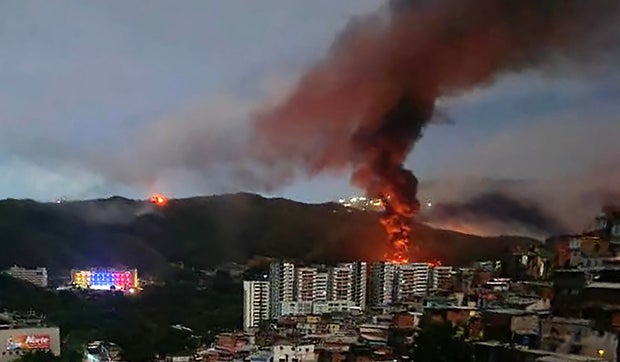
The U.S. has warned its citizens against traveling to Venezuela for months, citing the risk of "wrongful detention, torture in detention, terrorism, kidnapping, arbitrary enforcement of local laws, crime, civil unrest, and poor health infrastructure."
Democratic Sen. Ruben Gallego: "This war is illegal"
Shortly after the U.S. launched strikes in Venezuela, Democratic Sen. Ruben Gallego of Arizona wrote on X: "This war is illegal."
The senator, a U.S. Marine Corps veteran who was deployed in Iraq, called it the "Second unjustified war in my life time."
Republican Sen. Mike Lee of Utah also expressed skepticism, saying in a post on X: "I look forward to learning what, if anything, might constitutionally justify this action in the absence of a declaration of war or authorization for the use of military force."
In recent months, congressional Democrats and some Republicans have pushed back against the Trump administration's military buildup in the region, forcing votes in the House and Senate on measures that would have barred the U.S. from striking Venezuela without congressional approval.
Those measures have been voted down.
Venezuelan government declares state of emergency, tells people to take to the streets
Venezuela's government called on its supporters to take to the streets in the wake of the U.S. military strikes early Saturday.
"People to the streets!" the statement said. "The Bolivarian Government calls on all social and political forces in the country to activate mobilization plans and repudiate this imperialist attack."
The statement said President Nicolás Maduro had "ordered all national defense plans to be implemented" and declared "a state of external disturbance." That state of emergency gives him the power to suspend people's rights and expand the role of the armed forces.
Venezuelan opposition leader has backed Trump's strategy
Venezuelan opposition leader María Corina Machado told CBS News in mid-December she was "absolutely" supportive of President Trump's strategy in the country.
"We, the Venezuelan people, are very grateful to him and to his administration, because I believe he is a champion of freedom in this hemisphere," Machado said on "Face the Nation with Margaret Brennan."
At the time, the president's strategy was limited to attacks on suspected drug boats, the seizure of an oil tanker and economic and diplomatic pressure, but not land strikes.
Asked if she'd welcome U.S. military action in Venezuela, Machado did not rule it out, saying: "I will welcome more and more pressure so that Maduro understands that he has to go."
A former lawmaker who was disqualified from running in Venezuela's 2024 presidential election, Machado was awarded the Nobel Peace Prize this year, and collected the prize in Norway after a risky waterborne exit from Venezuela. She dedicated the prize to Mr. Trump.
Caracas military bases and major Venezuelan port hit by U.S. strikes, political opposition says
David Smolansky, a spokesman for Venezuelan opposition leader Maria Corina Machado, told CBS News the following locations were among those hit:
- Fuerte Tiuna — the main military base in Caracas
- La Carlota — the main airbase in Caracas
- El Volcán — signal antenna
- La Guaira Port — a seaport on the Caribbean coast
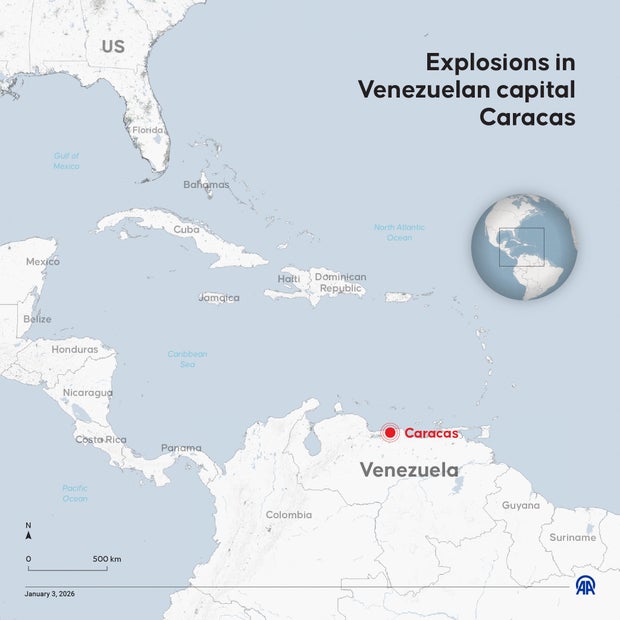
FAA bans commercial flights over Venezuela due to "ongoing military activity"
As the U.S. carries out strikes in Venezuela, the Federal Aviation Administration prohibited U.S. commercial air carriers from operating at all altitudes over Venezuela, citing "safety-of-flight risks associated with ongoing military activity."
The notice was issued at 2 a.m. local time in Caracas (1 a.m. Eastern) on Saturday, and was set to end at 1 a.m. Caracas time on Sunday.
The order does not apply to foreign or military aircraft.