Maps show snow totals, blizzard zone for one of the Northeast's biggest winter storms in years
The winter storm that hit the Northeast early this week was one for the record books, with snow totals piling up to 20, 30 or even 40+ inches in some communities.
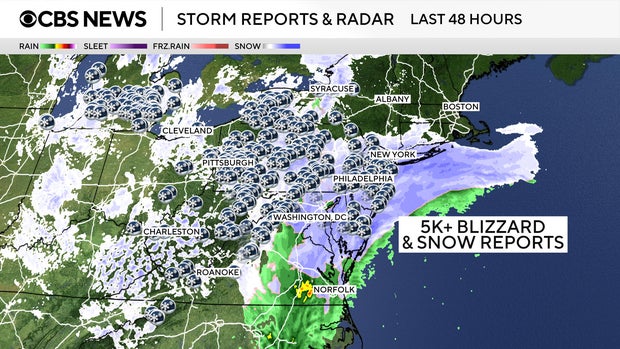
Blizzard warnings, which had been in place for more than 40 million people and stretched from Maryland to Maine, were lifted by Tuesday as communities around the country faced the aftermath of the storm. Governors in eight states and several major cities had declared states of emergency, and at the height of the storm, bans on nonessential travel were in place for New Jersey, the New York City area and parts of Massachusetts.
As cities and towns dig out, hundreds of thousands of homes and businesses remain in the dark from power outages.
Maps show snow totals and blizzard zone
The storm is now the ninth biggest in New York City history, dating back in the record books to 1869, CBS News New York reported.
By Monday afternoon, 19.7 inches of snow had accumulated in Central Park, while parts of Brooklyn and Queens got 20 inches. On Long Island, Central Islip recorded 31 inches of snow and the nearby town of Babylon got more than 29 inches. Multiple towns in New Jersey counted 2 feet or more, and crews at Newark Airport had to dig out from 27 inches of snow.
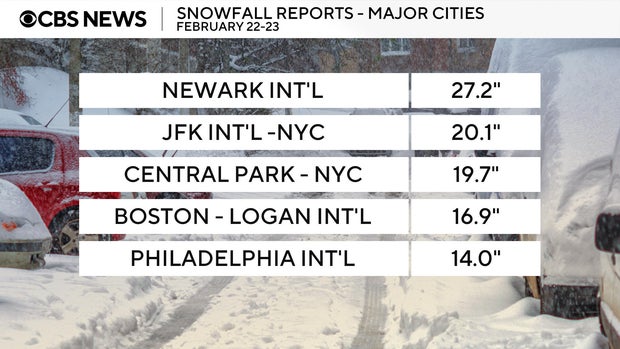
CBS News Boston reports it was the biggest snowstorm in recorded history in Providence, Rhode Island, with 37.9 inches of snow by Monday night.
Snow totals reached 30 inches or more in many communities of southeastern Massachusetts, with Fall River topping the list at 41 inches. The snowfall in Boston hit 17.1 inches, pushing the city's total for the season over 5 feet.
Zoom into the map below to see snow totals in local areas.
This was the first time in nine years that a blizzard warning was issued for New York City, and the first one in four years for parts of Massachusetts and southern New England.
According to the National Weather Service, a storm meets the definition of a blizzard when there is "snow and/or blowing snow reducing visibility to 1/4 mile or less for 3 hours or longer" along with "sustained winds of 35 mph or greater or frequent gusts to 35 mph or greater."
New York City Mayor Zohran Mamdani urged New Yorkers to stay inside and off the roads for the duration of the storm. He canceled school for Monday and declared a state of emergency that included a citywide travel ban, which was lifted around noon Monday. Schools reopen for in-school learning on Tuesday.
"Though the travel ban has lifted, conditions on the road are still icy and dangerous," Mamdani said, encouraging New Yorkers to stay indoors if possible and take public transportation if needed.
Broadway theaters canceled shows on Monday. Travel restrictions were also issued for Long Island and Westchester County but have now been lifted.
New York Gov. Kathy Hochul declared a state of emergency ahead of the nor'easter and activated about 100 members of the National Guard.
"This will be something the likes of which we've not seen in years," Hochul said. "People will be in the dark. Long Island and New York City and lower Hudson are literally in the direct eye of the storm."
New Jersey Gov. Mikie Sherrill also declared a state of emergency, saying she expected "severe blizzard conditions across our state."
A travel ban that was put in place for New Jersey was lifted midafternoon on Monday, but travelers were urged to avoid any unnecessary travel.
Massachusetts Gov. Maura Healey declared a state of emergency on Sunday and deployed 200 members of the National Guard. She issued travel restrictions for the South Coast of Massachusetts Monday, signing an executive order banning nonessential motor vehicle travel in Bristol, Plymouth and Barnstable counties, citing dangerous road conditions. Speed limits on the Mass Pike were also reduced to 40 mph.
Boston Mayor Michelle Wu said schools would be closed Monday and again on Tuesday as the city faced down "yet another winter storm this season and one that is looking like it will be of historic proportions."
Thousands of flights were canceled or delayed due to the storm, and major airlines issued waivers allowing passengers to rebook without extra charge.
More than 250,000 homes and businesses remained the dark in Massachusetts on Tuesday morning, according to PowerOutage.us, while smaller numbers of outages persisted in New Jersey, Delaware and Rhode Island.
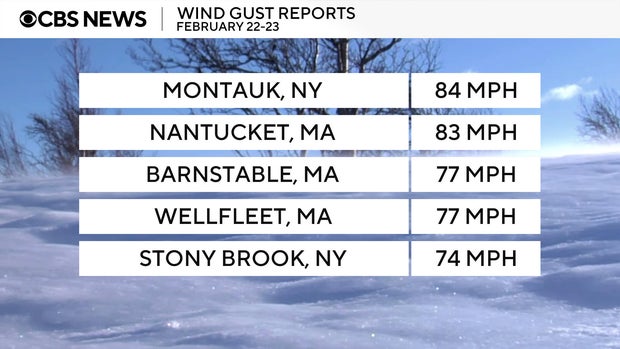
The hazards of the storm were worsened by winds of of 40 mph to 70 mph — or more — which were capable of producing drifting snow, hampering visibility and potentially causing whiteout conditions. Some of the most intense wind gust reports came from coastal places, including Montauk, New York, and Nantucket, Massachusetts, where wind speeds topped 80 mph. For comparison, hurricane-force winds start at 74 mph.
Officials in Atlantic City, New Jersey, urged residents and casino visitors to stay off streets during the storm, especially in low-lying neighborhoods prone to flooding.
"I could go on and on probably with a good two dozen streets where we know we will get water and there will be snow on top of that, said Scott Evans, the city's fire chief and emergency management coordinator. "So you won't be able to see it until it's too late, so therefore please stay at home."
The storm approached just as the icy remains of a snowstorm that struck the region weeks earlier were finally melting away.