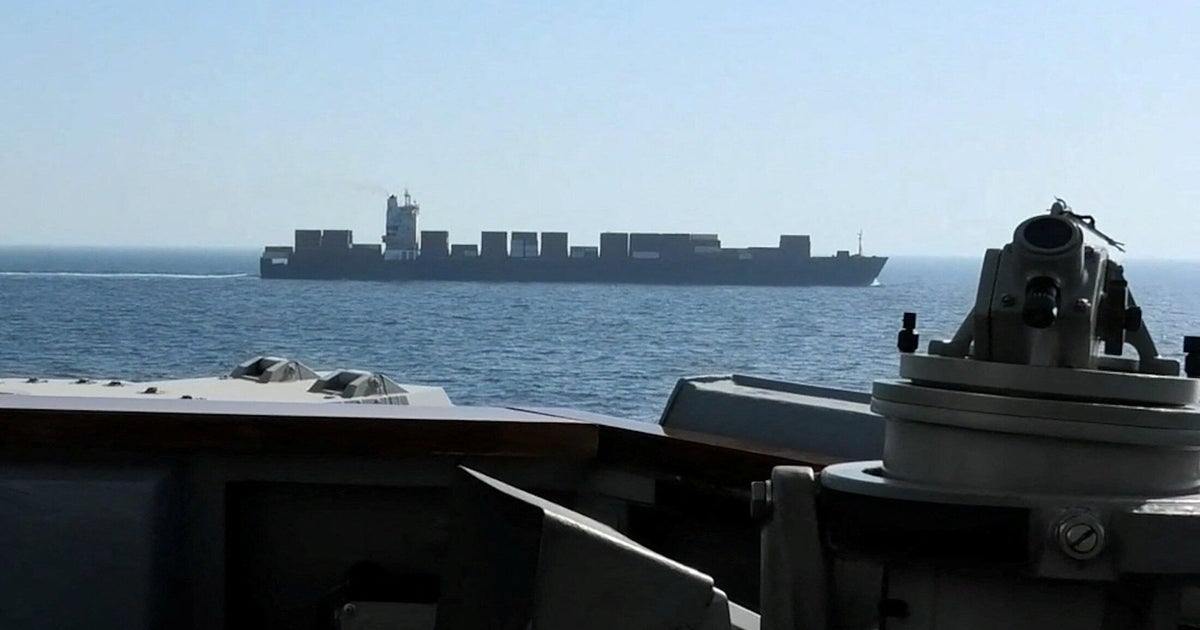
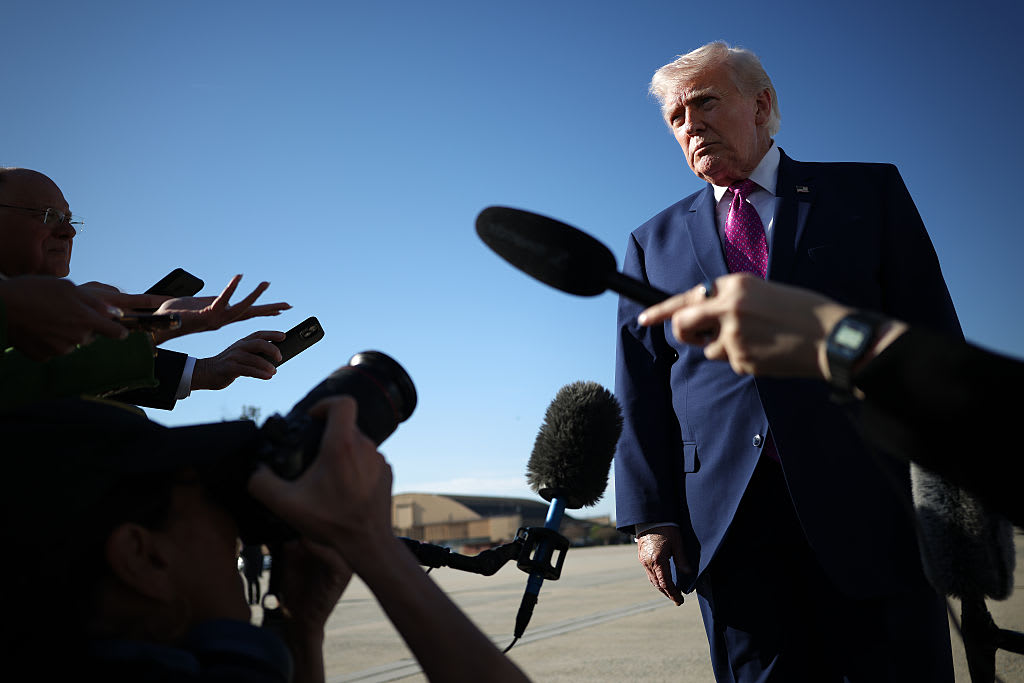
Pakistan says it will host U.S.-Iran talks soon as Iran warns against U.S. ground operations
Follow updates on the war in the Middle East for Monday, March 30, here. See earlier developments below.
What to know about the Iran war:
- Pakistan's foreign minister said Islamabad will host talks in the "coming days" between the U.S. and Iran. There was no immediate comment from Washington or Tehran. The Trump administration is awaiting Iran's formal response to its 15-point peace proposal.
- Iran's parliament speaker warned the U.S. against a ground invasion, threatening to step up attacks on U.S. allies, according to Iranian official media.
- Israel will widen its invasion of southern Lebanon, Prime Minister Benjamin Netanyahu said Sunday. He offered no details, but said Israeli forces will expand the "existing security strip" in the neighboring country.
- American-born Israeli soldier, Sgt. Moshe Yitzchak Hacohen Katz, was killed in combat in southern Lebanon, officials said.
- European allies are telling American diplomats that Russia is directly and materially helping Iran's war efforts beyond what the U.S. will publicly acknowledge, sources told CBS News.
Iran says power grid "stable" after attacks
Iran has restored electricity in parts of the capital and nearby areas after strikes damaged power grids and briefly disrupted supply, the deputy energy minister said on Monday.
"Following last night's enemy attack, the power grid in the provinces of Alborz and Tehran sustained damage and was affected," said Mostafa Rajabi-Mashhadi in an interview with state television.
"The power network across Iran's national electricity grid is stable; in Tehran and Alborz the problems have also been resolved," he added.
Israel restoring access after Latin Patriarch blocked from Church of Holy Sepulchre
Israel said the Latin Patriarch of Jerusalem would regain access to Christianity's holiest site after the decision to block him from entering the Church of the Holy Sepulchre on Palm Sunday triggered international condemnation.
Police prevented Cardinal Pierbattista Pizzaballa from entering the church, citing security concerns as Israel enforces a ban on gatherings in synagogues, churches and mosques during the ongoing war with Iran, which has brought missile strikes near holy sites.
After widespread backlash, Israeli Prime Minister Benjamin Netanyahu said on Monday the Latin Patriarch would get "full and immediate access."
The Latin Patriarchate said in a statement that Pizzaballa and the Custos of the Holy Land, Father Francesco Ielpo, were travelling privately without a ceremonial procession when officers at the church entrance forced them to turn back.
"As a result, and for the first time in centuries, the Heads of the Church were prevented from celebrating the Palm Sunday Mass at the Church of the Holy Sepulchre," it said, calling the incident a "grave precedent" that disregards the sensibilities of Christians worldwide.
Palm Sunday, which opens Holy Week for Christians, marks Jesus Christ's final entry into Jerusalem, days before his crucifixion and resurrection, as described in the Gospels.
The Church of the Holy Sepulchre contains the sites where Christians believe Christ was crucified, buried and resurrected.
Trump says U.S. has already gotten regime change in Iran and deal could be reached "soon"
President Trump said Sunday the U.S. has in essence achieved regime change in Iran and a deal could be reached with Tehran "soon."
Mr. Trump, citing the number of Iranian leaders who have been killed in the month-long U.S.-Israeli war against Iran, said regime change has already been achieved and the new leadership is "much more reasonable."
"We've had regime change," he told reporters aboard Air Force One. "We're dealing with different people than anybody's dealt with before. It's a whole different group of people. So I would consider that regime change."
Asked whether there could be a deal with Iran this week, Mr. Trump said, "I do see a deal in Iran. Could be soon."
Ever since the conflict kicked off with U.S.-Israeli strikes on Iran, Tehran has effectively shut down the Strait of Hormuz, through which about 20 percent of the world's oil and gas transits.
The closure has sent global oil prices soaring, but Mr. Trump said relief was on the way in the form of concessions from Iran, starting with the imminent passage of several tankers through the key waterway.
"They gave us, I think, out of a sign of respect, 20 boats of oil, big, big boats of oil going through the Hormuz Strait," he said, adding that the shipments would be "taking place starting tomorrow morning, over the next couple of days."
"Long live the shah": Iranian diaspora back war at Washington rally
More than 1,000 people of Iranian descent gathered in Washington Sunday to voice support for the war, riding on calls to bring back Iran's exiled crown prince who has emerged as a figure of intense interest.
Reza Pahlavi, the U.S.-based son of Iran's last shah — who was ousted by the 1979 Islamic revolution — has positioned himself as a potential transitional leader following the killing of Tehran's supreme leader in U.S.-Israeli strikes last month.
The rally on the lawn of the National Mall, not far from the White House, had a sea of Iranian and American flags, with chants of "USA! USA!" and "Javid shah" ("Long live the shah") bolstering the crowd, along with songs in Persian.
The former crown prince entered the global spotlight during anti-government protests in Iran, which peaked in January, where "Pahlavi will return" was among the slogans chanted nationwide.
"I agree with the war, because I think it was the only option," said Sharita Kord, a 25-year-old nurse from New York City who grew up in Iran.
As for whether the 65-year-old Pahlavi should return to power, Kord said: "In this situation, you don't have any other choices."
Naz Riz, a 53-year-old attendee wearing a red "Make Iran Great Again" hat, called the conflict in Iran a "rescue operation" coordinated by Israel and the United States.
"They're like cockroaches. They're everywhere," Riz told AFP, referring to those in power in Iran.
Trump says he wants to take Iran's oil
In an interview with the Financial Times on Sunday, President Trump said his "preference would be to take the oil" in Iran, and said he's considering taking Kharg Island, Iran's hub for oil exports.
"To be honest with you, my favorite thing is to take the oil in Iran but some stupid people back in the U.S. say: 'Why are you doing that?' But they're stupid people," Mr. Trump told the newspaper.
"Maybe we take Kharg Island, maybe we don't. We have a lot of options," Mr. Trump said. "It would also mean we had to be there (on Kharg Island) for a while."
Just 20 miles off Iran's northern Gulf coast, Kharg Island is a key bargaining chip Mr. Trump is using to keep the Strait of Hormuz open and safe as talks with Iran are beginning to take shape.
In his interview with the Financial Times, the president compared the potential move to the U.S.'s seizure of Venezuela's oil sector following the capture of former Venezuelan President Nicolás Maduro and his wife.
U.S. Embassy warns of potential attacks on universities in Iraq
The U.S. Embassy in Baghdad, in a statement posted on X Sunday, warned that Iran and allied militias "may intend to target the American Universities in Baghdad, Sulaymaniyah, and Dohuk, along with other universities perceived to be associated with the United States," after Iran threatened American universities across the Middle East.
The statement added that Iran and affiliated militias have already carried out "widespread attacks on U.S. citizens, targets associated with the United States throughout Iraq" and the "Iraqi government has not prevented terrorist attacks against the United States and regional countries from Iraqi territory."
It reiterated a warning for U.S. citizens to leave the country.
Many universities around the region have already moved to teaching online since the U.S. and Israeli attacks on Iran triggered the ongoing war in the Middle East.
AP
Rep. Jim Himes accuses Trump of "flat-out lying" about negotiating with Iran
Democratic Rep. Jim Himes, the top Democrat on the House Intelligence Committee, on Sunday accused President Trump of "flat-out lying" about negotiating with Iran last week amid market turmoil and the ongoing war.
"Last Sunday, he realized, 'I've got a financial cataclysm in the market,' so he just made that statement up," Himes said on "Face the Nation with Margaret Brennan" after Brennan asked if he thought Mr. Trump hadn't been engaging in diplomacy because he hadn't been briefed as a member of Congress.
One week ago, the president announced that he would push a deadline for Iran to reopen the Strait of Hormuz to international shipping, after he had threatened to "obliterate" Iran's power plants if the country failed to concede to the U.S. demand. Iran had threatened to attack U.S. and Israeli energy and infrastructure throughout the Middle East in response to that ultimatum, while stock futures had signaled close to a 1% decline and oil prices soared to $112 a barrel. Stocks rose and energy prices dropped in the immediate wake of the announcement, but neither pattern held up.
"The Iranians have now realized they have the reins," said Himes. "Gasoline prices are up more than $1 a gallon. They have realized, 'Holy smokes, we've got a lot of leverage here.'"
Iran 30 days into internet blackout, isolating millions amid war
Iran's nationwide internet blackout was on its 30th consecutive day on Sunday, leaving millions cut off from information and communication since the war with the United States and Israel began.
"Metrics show that connectivity to the outside world remains at just 1% of ordinary levels," internet monitoring group NetBlocks said on X on Sunday.
While the domestic intranet remains operational — supporting local messaging apps, banking platforms and other services — access to the global internet has been severely restricted.
Many Iranians have been left with little choice but to rely on state-controlled platforms and costly alternatives to stay in touch with loved ones.
"Our biggest concern now is that they might not reconnect the internet at all, and we could end up becoming like North Korea," said 37-year-old Arshia, a marketing manager in Tehran. "Holding onto hope is really hard. The only thing we can do now is spend all our time together as a family."
Pakistan to host talks between U.S. and Iran, foreign minister says
Pakistan will soon host talks between the United States and Iran in an effort to end the month-long war, the foreign minister said on Sunday.
Foreign Minister Ishaq Dar did not specify whether the talks would be direct or indirect. He did not say when the talks might be held, or where. There was no immediate comment from the U.S. or Iran.
"Pakistan is very happy that both Iran and the U.S. have expressed their confidence in Pakistan's facilitation" of the talks, which will happen in the "coming days," Dar said in a televised speech after top diplomats from regional countries met in Islamabad.
He said the foreign ministers of Turkey, Egypt and Saudi Arabia endorsed Pakistan's peace efforts. The ministers are expected to meet again on Monday.
The talks were held as Iran warned the U.S. against launching a ground attack and global oil prices surged amid continued fighting between Iran, the U.S. and Israel.
Pakistan has emerged as a mediator, having relatively good ties with both Washington and Tehran. Pakistani officials have said their public effort follows weeks of quiet diplomacy.
CBS/AP
Lebanon says Israeli strikes have killed more than 1,200 since March 2
Lebanon's health ministry said on Sunday that Israeli strikes had killed 1,238 people in the country since the start of the latest war with Hezbollah on March 2.
The toll included 124 children, the ministry said in a statement. On Saturday and Sunday alone, 49 people were killed, the ministry said, including 10 rescue workers and three journalists.
More than 3,500 people have been wounded, the ministry said.
Retired general says Houthis entering war will not be a "game changer"
Retired Gen. Frank McKenzie, a former commander for the U.S. Central Command, said he does not believe the Houthis' entrance into the war in Iran will be a "game changer" for the overall military operation in the Middle East.
McKenzie, who is a CBS News contributor, told "Face the Nation with Margaret Brennan" on Sunday that their ability to attack Israel directly is "quite limited."
"Yes, they will have the ability to further stop slow traffic through the Bab el-Mandeb, going up into the Suez Canal," he said. "We have the ability to go down there and prevent that. It will require additional resources, but we have those resources, and we can certainly do it if that becomes necessary."
Iranian-backed Houthi rebels targeted multiple sites in southern Israel on Saturday. They were the first attacks from the Houthis against Israel since the war began a month ago.
Israeli military spokesman Brig. Gen. Effie Defrin said that the military has been "prepared" for the Houthis to join the fighting from the beginning of the war.
Israel will widen invasion of Lebanon, Netanyahu says
Israel will widen its invasion of southern Lebanon, Prime Minister Benjamin Netanyahu said Sunday.
The prime minister said Israel would expand what he called the "existing security strip" in Lebanon as Israeli forces continue to target the Iranian-backed Hezbollah militant group.
"We are determined to fundamentally change the situation in the north," he said on a visit to northern Israel, adding that "Hezbollah still has residual capability to fire rockets at us."
He added: "Iran is no longer the same Iran, Hezbollah is no longer the same Hezbollah, and Hamas is no longer the same Hamas. "These are no longer terrorist armies threatening our existence -- they are defeated enemies, fighting for their own survival."
There were no immediate details.
CBS/AP
Kuwait's top diplomat blasts Iran's destabilization of the region
Kuwait's Foreign Minister Sheikh Jarrah Jaber Al Sabah said Sunday that what the region is witnessing is "systematic pattern of undermining regional stability led by Iran", as the monthlong war continues to destabilize the region.
In a statement reported by the state-run Kuna news agency, Al Sabah said that Iran is destabilizing the region through "exploiting chaos and terrorism as tools of influence."
Kuwait's Armed Forces said Sunday that projectile attacks injured 10 members of its forces, and its Defense Ministry said that the warehouses of a private logistics company were hit, resulting in only material damage, as the country intercepted 26 other Iranian missiles and drones over the past 24 hours.
Also on Sunday, Qatar and Bahrain said that they intercepted missiles and drones launched toward them.
Israeli police stop Catholic leaders from entering Jerusalem church
The Catholic Church said Israeli police stopped Cardinal Pierbattista Pizzaballa, the Latin Patriarch of Jerusalem, and a reverend from entering the Church of the Holy Sepulchre to celebrate a Palm Sunday Mass.
The Latin Patriarchate of Jerusalem said in a statement it was the "first time in centuries" that the heads of the church could not celebrate at the site, which marks Jesus' resurrection, and called it a "grave precedent and disregards the sensibilities of billions of people around the world, who during this week, look to Jerusalem."
The Israeli police told the Agence France-Presse that they had received a request from Pizzaballa and "it was clarified that it could not be approved" because of restrictions on large gatherings amid the war on Iran. Police did not specify what the request entailed.
The Patriarchate said the men were stopped while proceeding privately, not as part of a procession or ceremonial act. The organization said preventing their entry "constitutes a manifestly unreasonable and grossly disproportionate measure" and called the Israeli police's decision "hasty and fundamentally flawed" and "tainted by improper considerations."
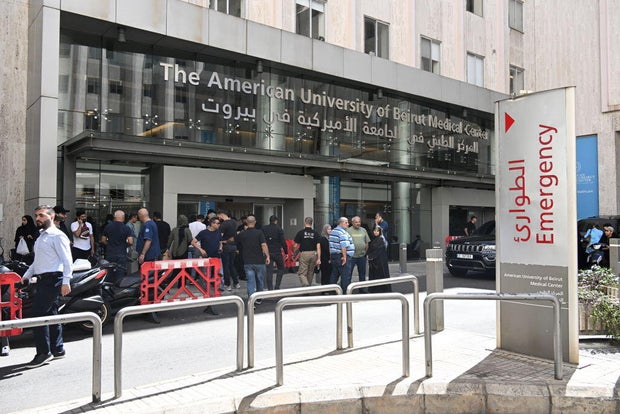
American University of Beirut moves to online classes after Iran's threat on U.S. colleges
The American University of Beirut announced on Sunday that it would operate remotely over the next two days after a threat from Iran's military to target American universities in the region.
President Fadlo Khouri said in a statement on the university's website that while there is no evidence of direct threats against the university, "out of an abundance of caution," they will be transitioning to online. He said there would be no instructional activities or exams on campus during the next two days.
"Our highest priority has always been and will always be the safety of our community and the people we serve," he said, adding, "We remain especially committed to teaching, healing, and serving those less fortunate, at all times. We at AUB will not be driven from our mission, by threats or violence. Not now, and not ever."
Earlier on Sunday, Iran's Revolutionary Guard threatened to target American universities in the Middle East after saying U.S.-Israeli strikes had destroyed two Iranian universities.
Funerals held for journalists killed in Israeli strike in Lebanon
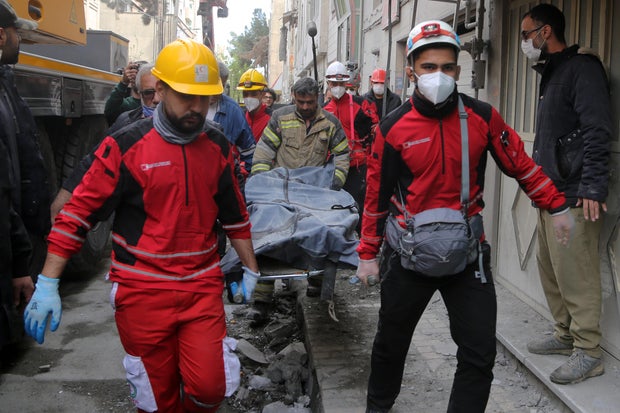
Mourners gathered south of Beirut on Sunday for the funerals of three journalists killed by an Israeli airstrike.
Ali Shoeib, a correspondent with Hezbollah's al-Manar TV, Fatima Ftouni, a reporter with the pan-Arab al-Mayadeen TV, and her brother Mohammed, a cameraman with the station, were killed in a strike on their car while covering the Israel-Hezbollah war in southern Lebanon on Saturday.
Israel's military said it had targeted Shoeib, accusing him of being a Hezbollah intelligence operative, without providing evidence. Lebanese officials have condemned the strike as a war crime, with President Joseph Aoun saying the killings "violated the most basic rules of international law."
Israel's military has not commented on the deaths of the Ftounis.
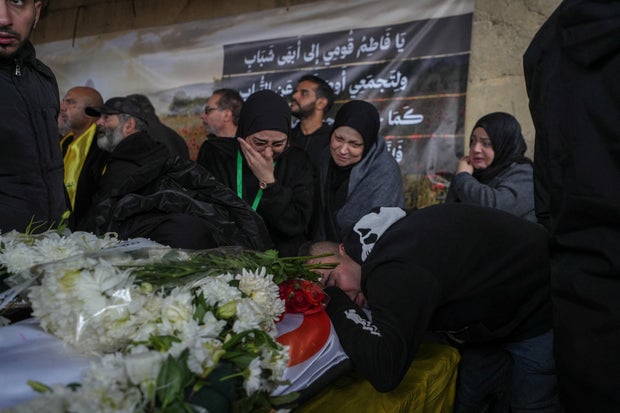
Mourners chanted, "Death to America" and "Death to Israel" as the bodies were buried in an empty lot converted into a temporary graveyard during the war.
"It's not the first time our colleagues are killed," said Mohammad Ali Badreddine, an SNG engineer with al-Mayadeen. "It's a big loss... they were among the brightest and most professional people and also among the kindest people."
Pope Leo XIV rejects claims that God justifies war
Pope Leo XIV used his Palm Sunday Mass homily to reject claims that God justifies war, insisting that God is the "king of peace."
"Brothers and sisters, this is our God: Jesus, King of Peace, who rejects war, whom no one can use to justify war," the American-born pontiff said. "He does not listen to the prayers of those who wage war, but rejects them."
He said he was praying for Christians "suffering the consequences of an atrocious conflict. In many cases, they cannot live fully the rites of these holy days."

Leaders on all sides of the Iran war have used religion to justify their actions. U.S. officials, especially Defense Secretary Pete Hegseth, have invoked their Christian faith to cast the war as a Christian nation trying to vanquish its foes with military might.
Russia's Orthodox Church, too, has justified Russia's invasion of Ukraine as a "holy war" against a Western world it considers has fallen into evil.
Palm Sunday marks Jesus' triumphant entrance into Jerusalem in the time leading up to his crucifixion, which Christians observe on Good Friday, and resurrection on Easter Sunday.
CBS/AP
American-born Israeli soldier dies in Lebanon
An American-born Israeli soldier was killed in combat in southern Lebanon, Israeli officials said Sunday.
Sgt. Moshe Yitzchak Hacohen Katz, 22, was born in New Haven, Connecticut, according to a post from the Israel Defense Forces.
His great-uncle, Rabbi Yehoshua Hecht, remembered him as a "very special young man" who "enjoyed every moment of life," according to the Associated Press.
Israeli Prime Minister Benjamin Netanyahu said that Katz enlisted in the IDF's Paratroopers Brigade after moving to Israel. He did not specify how long Katz had been serving. Further details of his death were not available.
Regional diplomats to meet in Pakistan for talks on ending monthlong war
The top diplomats from Saudi Arabia, Turkey and Egypt are gathering in Pakistan on Sunday to discuss how to end the fighting in the Middle East.
The talks between Egypt's Badr Abdelatty, Turkey's Hakan Fidan and Saudi Arabia's Prince Faisal Bin Farhan come days after the U.S. offered Iran a 15-point "action list" as a framework for a possible peace deal.
Abdelatty said the meetings were aimed at opening a "direct dialogue" between the U.S. and Iran, which have largely communicated through mediators during the war.
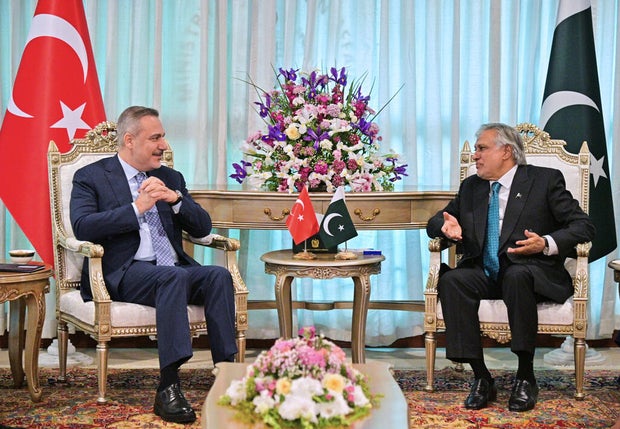
The weekend provided little sign of the talks narrowing the disconnect between the U.S. and Iran. U.S. officials have insisted the war may be nearing an inflection point but Iranian leaders continue to reject negotiations publicly.
The U.S. and Israel were not participating in the Islamabad talks, while Iran's parliament speaker dismissed the talks as a cover while the U.S. dispatched additional troops to the Middle East.
CBS/AP
Iran's parliament speaker warns the U.S. against a ground invasion
Mohammad Bagher Ghalibaf, Iran's parliament speaker, on Sunday warned the United States against a ground invasion, threatening to set American troops "on fire" and step up attacks on U.S. allies, according to Iranian official media.
Ghalibaf said Iranian forces are "waiting for the arrival of American troops on the ground to set them on fire and punish their regional partners forever."
He added: "Our firing continues. Our missiles are in place. Our determination and faith have increased."
He described the U.S.'s 15-point plan, which Pakistan passed to Iran last week, as "their wishes" and said the Trump administration is attempting to do through the plan what it has failed to achieve by force.
"As long as the Americans seek Iran's surrender, our response is clear: Far be it from us to accept humiliation," he said.
Meanwhile, the Revolutionary Guard threatened to target branches of Israeli and American educational facilities in the region, calling them "legitimate targets" if the U.S. does not condemn the bombing of Iranian universities.
"If the U.S. government wants its universities in the region spared, it should condemn the bombardment of (Iranian) universities by 12 o'clock Monday, March 30, in an official statement," the Guard said in a statement, according to state media.
The guard urged the evacuation of American and Israeli educational facilities and told students and staff to stay at least one kilometer away.
The Guard also demanded that the U.S. stop Israel from striking Iranian universities and research centers, which have been attacked in recent days. Israel's military has acknowledged striking Iranian universities it says are connected to weapons development.
American colleges, including Georgetown, New York University and Northwestern, have campuses in Qatar and the United Arab Emirates.
This is the first time Iran has threatened to strike Israeli and American universities.
CBS/AP
2 wounded in Iranian attack on aluminum plant in Bahrain
Two Aluminium Bahrain employees were wounded in an Iranian attack on its facilities over the weekend, Bahrain state media reported on Sunday local time.
"The safety and security of (Aluminium Bahrain's) people remain its top priority and the Company confirms that two of Alba's employees sustained minor injuries," the company said in a statement carried by the official Bahrain News Agency.
It did not give details on the nature of the strike or the extent of the damage.
Aluminium Bahrain, also known as Alba, is one of the world's largest aluminium producers. It said it was assessing the impact on its operations and would issue further updates when available.
Bahraini authorities have not yet released additional information on the incident.
Iran targets Kuwait with missiles, drones
The Kuwaiti military early Sunday morning local time reported that it was targeted by Iran with missiles and drones.
The Kuwait Armed Forces said in a social media post that its air defense systems were intercepting "hostile attacks."
On Saturday night local time, Kuwait reported that over the course of the previous 24 hours, it was targeted by 15 Iranian drones, some of which struck the area around Kuwait International Airport, causing damage to its radar systems, but no injuries.
Kuwaiti airspace has been closed to commercial air traffic since the war began a month ago.
The ripple effect of the Iran war on struggling U.S. farmers: "It couldn't have come at a worst time"
Lance Lillibridge of Vinton, Iowa, has been farming his whole life, and says he's worried for this year's spring planting.
"It couldn't have come at a worst time," Lillibridge told CBS News of the Iran war.
The war has led to skyrocketing diesel and fertilizer prices. Lillibridge says the prices are piling onto an already struggling industry.
"It just feels like the world is trying to take this all away from us right now," Lillibridge said.
The price of ammonia and urea, two fertilizer ingredients seeing disruptions, are up around 20% and 50% percent, respectively, since the start of the Iran war, according to Oxford Economics. The price of diesel gas is up 43.5%, according to AAA.
Lillibridge says his costs have already increased 25% since last year. He argues the situation needs to resolve itself before more damage is done.
"If our kids see us struggling out here, why would they want to take it on?"
Iran threatens strikes on U.S. universities in the Middle East
Iran's regime issued a threat early Sunday morning against all American universities in the Middle East.
"All staff, professors, and students of American universities in the region, as well as residents in their surroundings, are advised to stay at least one kilometer away from these universities to ensure their safety," the Iranian Revolutionary Guards said in a statement.
The Iranian Revolutionary Guards said it was issuing the threat in response to a strike on the Tehran University of Science and Technology.
There are several U.S.-based schools that have branch campuses in the Gulf region, such as Georgetown University Qatar, Northwestern University in Qatar and New York University Abu Dhabi.
U.S. blames "Iran's terrorist militia proxies" for strike targeting home of Iraqi Kurdistan's president
The residence of Nechirvan Barzani, president of the semiautonomous northern Kurdish region of Iraq, in the city of Duhok, was targeted Saturday, causing damage but no casualties, an official with the regional government told The Associated Press.
The official, who spoke on condition of anonymity because he was not authorized to comment publicly, said the residence was empty at the time.
No group has claimed responsibility for the attack. However, in a statement Saturday evening, U.S. State Department spokesperson Tommy Pigott blamed "Iran's terrorist militia proxies in Iraq" for the strike.
"The United States unequivocally and forcefully condemns the despicable terrorist attacks by Iran's terrorist militia proxies in Iraq on the private residence of Iraqi Kurdistan Region President Nechirvan Barzani," Pigott said.
Iraqi Prime Minister Mohammed Shia al-Sudani also condemned the attack in a phone call with Barzani, calling it a "heinous" act, according to a statement from his office.
Al-Sudani said a joint security and technical team from federal authorities and the northern Kurdish region's government would investigate and take legal measures against those responsible.
Qubad Talabani, deputy Prime Minister of the Kurdish region, said that armed groups operating outside state control pose a growing threat to stability in the country.
CBS/AP
Yemen's Houthis launch second missile attack on Israel
Brig. Gen. Yahya Saree, a military spokesman for the Yemen-based Iranian-backed Houthi terror group, said in a prerecorded statement aired by the group's Al-Masirah satellite television that the Houthis had launched a second strike on Israel.
The Iranian-backed Houthi rebels targeted multiple sites in southern Israel to coincide with attacks from Iran and Hezbollah, Saree said, without identifying the locations.
The launch came hours after the Houthis' first missile attack against Israel since the Iran war began a month ago.
Israel said it intercepted the first missile. It did not immediately comment on whether it intercepted any projectiles from Yemen in the second attack.
"We have been prepared for the Houthis to join this from the beginning," Israeli military spokesman Brig. Gen. Effie Defrin said.
European allies say Russia is helping Iran more than the U.S. has acknowledged, sources say
European allies are publicly and privately telling American diplomats that Russia is directly and materially helping Iran's war efforts beyond what the U.S. will publicly acknowledge, sources tell CBS News.
The Europeans are also continuing to argue that the war in Ukraine, the largest land war in Europe since World War II, is intertwined with the war in Iran due to the cooperation between Russia and Iran.
A U.K. official told CBS News that Russian-Iranian defense cooperation has ballooned in recent years, and Iranian technological advancement is now visible in the attacks in the Middle East. The United Kingdom assesses that Iran had not only transferred Shahed drones to Moscow for use on the battlefield in Ukraine but also production know-how to Russia, which has helped Iran refine its drone warfare. The U.K. official could not confirm a recent transfer of hardware to Iran by Russia.
France's Foreign Minister Jean-Noël Barrot publicly described the relationship between Russia and Iran as "two-way cooperation."
"There are reasons to believe that Russia is now supporting Iran's military efforts, which appear to be directed in particular at American targets," Barrot said Thursday.
Iran's Reza Pahlavi cheered at CPAC
Former Iranian Crown Prince Reza Pahlavi walked out onstage at the Conservative Political Action Conference to some of the loudest cheers heard at the event yet.
Pahlavi's father led Iran for decades before the 1979 Islamic Revolution. He is the most prominent member of the regime's opposition, and told CBS News "60 Minutes" he wants to lead Iran in a transition into democracy.
During Pahlavi's remarks on Saturday, the audience interrupted him with cheers of "Reza Pahlavi," "USA," and "Free Iran."
Nassar Meyman, a Dallas resident and CPAC attendee, told CBS News that he hoped to see "a new start" for Iran "with the leadership of Crown Prince Pahlavi."
Qatar reports drone interception for the first time in over a week
Qatar's Defense Ministry said it intercepted several drones fired from Iran, the first attack the Gulf state reports in over a week.
Qatar sounded the alarms to warn citizens against incoming fire on Friday but did not report any attacks following the alarms, according to an AP journalist.
The announcement of the interceptions came the same day Qatar and Ukraine signed a defense agreement that included cooperation on countering threats from missiles and drones.
"The agreement includes collaboration in technological fields, development of joint investments and the exchange of expertise in countering missiles and unmanned aerial systems," the ministry said in a statement during a visit Saturday by Ukrainian President Volodymyr Zelensky.
CBS/AP
Marine Expeditionary Unit arrives in Middle East, CENTCOM says
The U.S. Marine Expeditionary Unit that includes the USS Tripoli has arrived in the Middle East from the Pacific, Central Command said on X Saturday morning.
The MEU is composed of about 3,500 sailors and Marines, CENTCOM said. The USS Tripoli, an amphibious assault ship that had been deployed to Japan, also carries transport and strike fighter aircraft, along with amphibious assault and tactical assets.
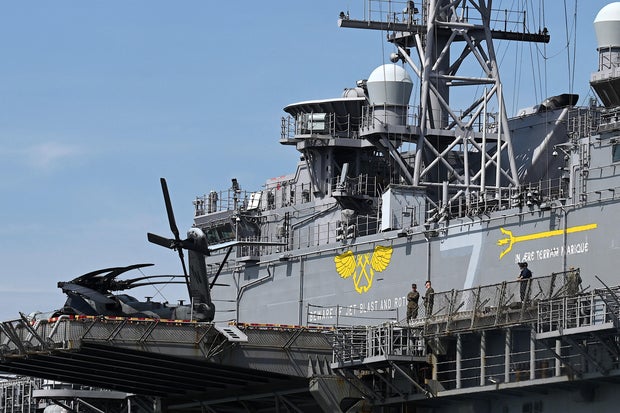
A second MEU, this one made up of about 2,200 Marines and three warships, is still headed toward the Middle East after departing California last week. CBS News previously reported it may take several weeks for the second unit to arrive.
At CPAC, many Republicans stand by Trump on Iran. But they're divided on how the war could end.
As Republicans grapple with a war in Iran during a tight midterm cycle, speakers and attendees at this year's Conservative Political Action Conference are toeing a fine line between backing the Trump administration's war effort and hinting at worries about the conflict expanding.
To be sure, most members of President Trump's party firmly support the war. Some 84% of Republicans approved of the U.S. taking military action against Iran in a CBS News poll released last weekend. Support falls somewhat, to 70%, among non-MAGA Republicans.
But some Trump supporters have expressed hesitation about a conflict with Iran or concerns about its scope — and many are broadly wary of the U.S. intervening abroad.
The debate is playing out during an election year, as Americans' views on the war — and on its impacts on energy prices — could influence who wins control of Congress. The most recent CBS News poll found that 69% of independents are opposed to U.S. military action in Iran.
2 journalists killed in Israeli airstrike on southern Lebanon
Two journalists were killed in an Israeli strike on southern Lebanon, officials said, including one who worked for Hezbollah's al-Manar TV.
The television station said its correspondent, Ali Shoeib, a well-known war correspondent in Lebanon, was killed Saturday in a strike. Beirut-based Al-Mayadeen said its reporter, Fatima Ftouni, was killed in the same strike.
Ftouni had just finished a live report from southern Lebanon just before the strike in the Jezzine area.
Israeli military claimed that Shoeib was a "terrorist in the intelligence unit of Hezbollah's Radwan Force" who operated "under the guise of a journalist… while operating systematically to expose the locations of IDF soldiers operating in southern Lebanon and along the border."
Additionally, the military claimed Shoeib used his position at al-Manar TV to "disseminate Hezbollah propaganda materials."
The strike came days after an Israeli airstrike on an apartment in central Beirut killed Mohammed Sherri, the head of political programs at al-Manar TV, along with his wife.
According to AFP, Lebanon's president, Joseph Aoun, condemned Israel's strike, saying: "This is a blatant crime that violates all the norms and treaties under which journalists enjoy international protection in wars."
CBS/AP
USS Gerald R. Ford docks in Croatia for repairs
The USS Gerald R. Ford, the world's largest aircraft carrier, has anchored in Croatia on its route to the Middle East for repairs and to give sailors "some well-deserved liberty."
The U.S. 6th Fleet said the aircraft carrier anchored in the Port of Split in Croatia following its Adriatic Sea transit from Souda Bay, in Greece, where it conducted repairs and refueled earlier this week.
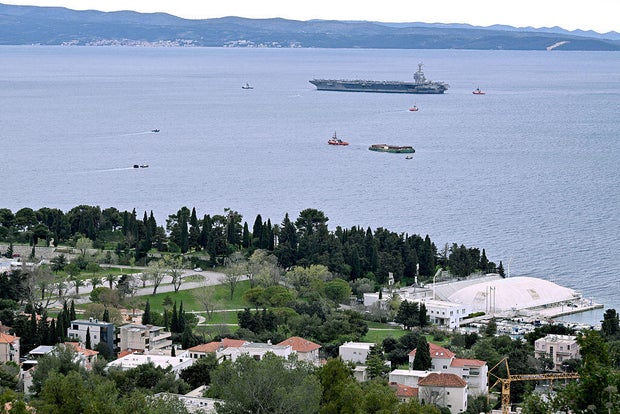
This is the aircraft carrier's second visit to Croatia during its ongoing deployment. It anchored in for a few days in October 2025.
"The crew is excited to be back in Split for some well-deserved liberty," Capt. David Skarosi, commanding officer of Gerald R. Ford, said in a statement. "They have accomplished so much since our initial visit in October. We are extremely thankful to the Croatian community for opening their historic and beautiful city of Split to us once again."
The carrier docked last month at the American naval base at Souda Bay, stirring up protests on Crete ahead of the U.S. and Israeli strikes on Iran that triggered the war. There, it also brought in experts to repair the damage from a fire in the ship's laundry facilities, and military and federal law enforcement to investigate the fire.
Here's what needs to happen before oil starts flowing through the Strait of Hormuz again
Some shipping and insurance experts don't expect the situation in the Strait of Hormuz to return to normal until the war winds down significantly.
Since the start of the conflict, Iran has threatened to hit ships that travel through the strait without its permission. More than a dozen Iranian drone and missile strikes have been reported on ships in the region, and daily transits through the waterway have fallen some 90% to 95% since the conflict began, according to shipping intelligence firm Kpler. Hundreds of tankers are trapped in the Persian Gulf. The cost of marine insurance in the Strait has also skyrocketed. Trump administration officials have discussed offering military escorts, but it's not clear when or how that might work.
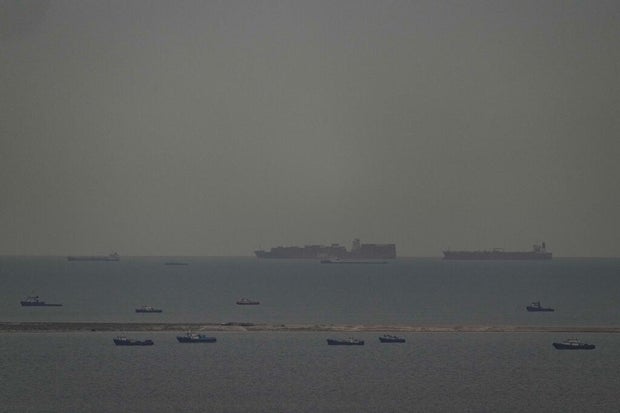
With the end of the war uncertain, when will the logjam clear?
Put simply: "You need to not have fast-moving pointy bits of metal with explosives bearing down onto you at 2,000 miles an hour," said Daniel Sternoff, an analyst at Energy Aspects and senior fellow at Columbia's Center on Global Energy Policy.
Iran's military says it targeted Ukrainian anti-drone system depot in UAE
Iran's military said on Saturday that it targeted a Ukrainian anti-drone system depot in the United Arab Emirates that it said was being used to assist the United States.
"As the hideouts of American commanders and soldiers in Dubai were targeted... a Ukrainian anti-drone system depot that was located in Dubai to assist the US military ... was targeted and destroyed," Iran's military central operational command Khatam Al-Anbiya said in a statement carried by state TV.
The strike came the same day that Ukrainian President Volodymyr Zelenskyy made an unexpected visit to the UAE. During the trip, he met with his Emirati counterpart, Mohamed bin Zayed Al Nahyan, to discuss regional security in the Middle East.
"For Ukraine, this is also a matter of principle: terror must not prevail anywhere in the world. Protection must be sufficient everywhere," Zelenskyy said in a post on X following his meeting with the Emirati leader. He said they had discussed "the security situation in the Emirates, Iranian strikes, and the blockade of the Strait of Hormuz, which directly affects the global oil market."
The Emirates News Agency said the two leaders discussed "security developments in the region amid ongoing military escalation and their implications for regional and international peace and security, as well as their impact on international navigation and the global economy."
Zelenskyy said last week that Kyiv is helping five countries in the Middle East and Gulf region — the UAE, Saudi Arabia, Qatar, Kuwait and Jordan — to counter drone attacks on their territory.
CBS/AP
Pakistan to host talks in push to end war
Foreign ministers from Saudi Arabia, Turkey and Egypt will attend talks in Islamabad aimed at ending the war between the United States and Iran and easing regional tensions, Pakistan's Foreign Minister Ishaq Dar and officials said Saturday.
Saudi Foreign Minister Prince Faisal bin Farhan, Turkey's Foreign Minister Hakan Fidan and Egypt's Foreign Minister Badr Abdelatty will arrive Sunday for a two-day visit to "hold in-depth discussions on a range of issues, including efforts to de-escalate tensions in the region," according to a statement.
The visiting ministers will meet Prime Minister Shehbaz Sharif who said in a televised speech that Pakistan is pursuing "sincere and robust diplomatic efforts" to help stop the conflict through mediation.
Sharif said he had also held "extensive discussions" with Iran's President Masoud Pezeshkian. He said he expressed hope that "a viable path toward ending hostilities could be found collectively" during the conversation that lasted more than an hour. Sharif said Pezeshkian praised Pakistan's efforts.
Iran reports airstrike near Bushehr nuclear plant
An airstrike hit the grounds of Iran's Bushehr Nuclear Power Plant overnight, the country's atomic energy agency reported.
The strike, which was the third in 10 days, did not cause any material damage and there were no casualties, according to the Atomic Energy Organization of Iran. It said no technical disruption was reported at the site.
The International Atomic Energy Agency said it was notified of the strike by Iran.
Houthis say they launched a missile towards Israel, their first since Iran war started
Iranian-backed Houthi rebels claimed a missile launch toward Israel early Saturday, their first since the war in the Middle East started. The Israeli military said it intercepted the projectile.
Brig. Gen. Yahya Saree, a military spokesman for the Houthis, claimed responsibility in a statement aired Saturday morning on the rebels' Al-Masirah satellite television. He said the Houthis fired a barrage of ballistic missiles targeting what he described as "sensitive Israeli military sites" in southern Israel. The attack came hours after Saree signaled in a vague statement Friday that the rebels would join the war.
Sirens went off around Israel's southern city of Beer Sheba and the area near Israel's main nuclear research center as Iran and Hezbollah continued to fire on Israel overnight. Loud explosions also filled the air in Tel Aviv and Israel's Fire and Rescue Service said it was responding to 11 different impact sites across the metro area.
Saturday's assault calls into question whether the Houthis will again target commercial shipping traveling through the Red Sea corridor, as they did during the Israel-Hamas war, upending shipping in the Red Sea, through which about $1 trillion worth of goods passed each year before the war. The rebels also fired drones at Israel.
The potential involvement of the Houthis in the war would also complicate the deployment of the USS Gerald R. Ford, the aircraft carrier that went to port in Crete on Monday for repairs. Sending the carrier back into the Red Sea could draw it into the same high tempo of attacks seen by the USS Dwight D. Eisenhower in 2024 and the USS Harry S. Truman in the 2025 American campaign against the Houthis.
The Houthis have held Yemen's capital, Sanaa, since 2014, and so far had stayed out of the war as the rebels have had an uneasy ceasefire for years with Saudi Arabia, which launched a war against the group on behalf of Yemen's exiled government in 2015.
Strikes intensify across Middle East
Witnesses in eastern Tehran reported a partial power outage following airstrikes. In Israel, loud explosions filled the air in Tel Aviv and emergency crews responded to nearly a dozen impact sites.
An Associated Press journalist heard loud explosions in Tel Aviv, and Israel's Fire and Rescue Service said it was responding to 11 different impact sites across the metro area.
Defense Minister Israel Katz had earlier vowed that Iran "will pay heavy, increasing prices for this war crime."
Israel focused its attacks Friday on sites "in the heart of Tehran" where ballistic missiles and other weapons are produced, the military said. It said it also hit missile launchers and storage sites in Western Iran.
Saudi Arabia's Defense Ministry, meanwhile, said it shot down missiles and drones targeting the capital, Riyadh. In Lebanon, the Health Ministry said two people were killed.
Kuwait said its Shuwaikh Port in Kuwait City and the Mubarak Al Kabeer Port to the north, which is under construction as part of China's "Belt and Road" initiative, sustained "material damage" in attacks. It appeared to be one of the first times a Chinese-affiliated project in the Gulf Arab states has come under assault in the war. China has continued to purchase Iranian crude.
Israeli military launches new round of strikes on Tehran, IDF says
Israel's military said it launched strikes on Iranian "regime targets" early Saturday morning local time, as an AFP journalist in the capital Tehran reported hearing around 10 intense blasts and seeing a plume of black smoke.
A brief military statement from the Israel Defense Forces said it was "currently striking Iranian terror regime targets across Tehran," without elaborating.
Trump again voices disappointment with NATO allies: "They weren't there for us"
President Trump on Friday continued in his criticism of NATO allies for being unwilling to provide military support to help reopen the Strait of Hormuz.
"I think a tremendous mistake was when NATO just wasn't there, they just weren't there," Mr. Trump said at a Saudi-backed investment conference in Miami.
Mr. Trump said that the U.S. spends "hundreds of billions of dollars a year" protecting NATO.
"And we would have always been there for them, but now, based on their actions, I guess we don't have to be, do we?" Mr. Trump said. "...Why would we be there for them if they're not there for us. They weren't there for us."
The president's comments come after he previously called NATO a "paper tiger without the U.S.," a term he reiterated Friday.
"I've always said NATO is a paper tiger," Mr. Trump said. "And I always said, we help NATO, but they'll never help us. And if the big one ever happened, and I don't think it will, but if the big one ever happened, I guarantee you, they wouldn't be there."
When asked about the paper tiger remarks in an interview with "Face the Nation" moderator Margaret Brennan on Sunday, NATO Secretary-General Mark Rutte responded that he had taken part in "several conversations" with Mr. Trump last week.
"The good news is that, look, we had the U.S. for weeks planning for [Operation] Epic Fury and for reasons of security and safety, they could not share with European allies and allies around the world and partner countries what they were doing, because that would have jeopardized the effect of the first attack," Rutte told CBS News, adding that it was "only logical that European countries needed a couple of weeks to come together."
Trump says Iran's regime lied when it said it wasn't negotiating peace deal with U.S.
President Trump accused Iran's regime of lying when it said it wasn't negotiating a peace deal with the U.S. earlier this week.
"Remember this, they lied about three days ago," Mr. Trump said during an address at a Saudi-backed investment conference Friday night. "I said, 'We're negotiating with Israel.' They (Iran) said, 'We are not negotiating.' They are being hit so hard, anybody would be negotiating. They are negotiating. They're begging to make a deal...Turned out I was right. They were negotiating, which they admitted two days later."
Mr. Trump was referring to statements made Wednesday by Iran's foreign minister, Abbas Araghchi, on Iranian state television, in which he claimed there had been "no negotiation or dialogue" with the U.S.
Mr. Trump also claimed in his address on Friday that Tehran sought to "make up for their misstatement" by sending the U.S. 10 ships of oil.
The president's remarks come after he had teased earlier this week that Iran had given the U.S. a "present." Then, during a Cabinet meeting Thursday, Mr. Trump indicated that the present consisted of Iran allowing 10 oil tankers to pass through the Strait of Hormuz. He didn't say which country or countries the oil was from, or where it was heading.
The Trump administration on March 20 announced it was temporarily lifting sanctions on Iranian oil already at sea in an effort to ease gas prices that have spiked amid the war.
U.S. Tomahawks are being used in Iran war faster than stockpile is being refilled
The U.S. has so far used hundreds of Tomahawk cruise missiles against Iran, according to two sources familiar with the matter, several times more than the number procured for the military each year.
One of the sources said over 850 have been used so far in the conflict, a figure that is roughly nine times the number of Tomahawks the Pentagon buys on average each year.
Trump refers to Strait of Hormuz as the "Strait of Trump"
Speaking at a Saudi-backed investment conference in Miami on Friday night, President Trump called the Strait of Hormuz the "Strait of Trump," before correcting himself.
"We're negotiating now, it would be great if they could do something, but they have to open up the Strait of Trump, I mean Hormuz," Mr. Trump said, drawing a laugh from the audience. "Excuse me, I'm so sorry, such a terrible mistake. Fake news will say, 'He accidentally said.' There's no accidents with me, not too many. If there were, we'd have a major story."
The president then went on to reference his move to rename the Gulf of Mexico the Gulf of America after taking office for his second term in January 2025.
10 Americans injured in Iranian attack on Saudi air base
Ten U.S. service members were injured in an attack on Prince Sultan Air Base in Saudi Arabia, according to multiple U.S. officials.
The attack consisted of Iranian missiles and drones, sources told CBS News.
Two of the Americans were very seriously injured, sources said. Eight were seriously injured, which is a different category of injury under the military's classification system.
More than 300 American service members have been wounded in action since the war began, most of whom have returned to duty, a U.S. Central Command spokesperson said Friday.
1 killed in Iranian missile strikes on Tel Aviv, Israeli officials say
Emergency responders said a man was killed in Israel on Friday after the Israeli military reported missiles fired from Iran, as air raid sirens sounded in Jerusalem and explosions were heard from Jericho.
A man died in Tel Aviv following the latest attack, the Magen David Adom emergency service reported, adding that two people suffered mild injuries.
There was a heavy presence of emergency responders at the scene of a missile impact and a main road was partially cordoned off, images from Magen David Adom showed.
USS George H.W. Bush to deploy to CENTCOM's region of responsibility, could potentially join Iran war operations, sources say
The USS George H.W. Bush aircraft carrier, the flagship of the Bush Carrier Strike Group, will deploy to U.S. Central Command's area of responsibility, the major combatant command overseeing American operations against Iran, multiple sources told CBS News.
The Bush Carrier Strike Group completed training earlier this month that certifies it is ready to deploy in major combat operations.
CENTCOM is responsible for U.S. military operations in the Middle East and portions of Asia.
While peace talks between Washington and Tehran are still in the early stages of negotiations, U.S. officials — who spoke to CBS News under condition of anonymity because they were not authorized to speak publicly — said the carrier could potentially join the ongoing operations against Iran.
The USS Ross, a guided missile destroyer assigned to the carrier strike group, deployed from Norfolk, Virginia, on Wednesday. The USS Donald Cook and USS Mason, also guided missile destroyers, both left Florida this week heading to join Operation Epic Fury. The Bush Carrier Strike Group last deployed in 2022, returning to its homeport in Norfolk in August 2023.
Two carrier strike groups, led by the USS Gerald R. Ford and the USS Abraham Lincoln, have been in the Middle East for the first few weeks of the operation against Iran, until the Ford suffered a fire aboard. Earlier this week, it arrived at a naval port in Souda Bay in Crete for repairs.
The Ford has been deployed since last June. The carrier strike group was directed to the Caribbean last November for operations against Venezuela before getting the order earlier this year to deploy to the Middle East.
U.S. stock market closes out its worst week since start of the Iran war
U.S. stocks closed out their worst week since the Iran war began, and their fifth losing week in a row. The S&P 500 fell 1.6% and is now 8.7% below the all-time high it reached in January.
The Dow Jones Industrial Average dropped 1.7%, and the Nasdaq composite sank 2.1%. Crude oil prices rose again with no clear end in sight for the conflict.
Investors fear that the war will disrupt the Persian Gulf's energy industry for a long time, setting off a punishing wave of global inflation by keeping large amounts of oil and natural gas out of global markets.
Vance emerging as central player in diplomacy with Iran, sources say
Vice President JD Vance is emerging as a central player in the diplomacy with Iran, according to two sources familiar with the situation.
Vance is seen as a possible successor to President Trump in 2028, and so his sign-off on a possible deal would carry an implicit guarantee of maintaining the terms of a deal, rather than tearing it up.
U.S. special envoy Steve Witkoff, and Mr. Trump's son-in-law Jared Kushner, also remain involved, per two sources familiar.
On Friday, Witkoff said that the Iranians have had the 15-point U.S. peace proposal for "a bit of time," and optimistically said that there could be meetings as soon as next week to discuss it. He mentioned that it included demands for zero stockpiling of nuclear material.
The last detailed diplomatic deal with Iran was the 2015 Joint Comprehensive Plan of Action, or JCPOA, which was codified as an international accord at the United Nations, but not a U.S. treaty by Congress. Mr. Trump exited it in 2018.
U.S. telling allies a diplomatic deal with Iran will take time, sources say
The White House is privately telling allies to expect that it will take time for the U.S. to reach a diplomatic deal with Iran, two sources familiar with the situation told CBS News, adding that the U.S. estimates that the kinetic activity of the war itself will last another two to four weeks.
Two sources close to Iranian officials said that Tehran expects the diplomacy to take time. The sources said the Iranian regime remains skeptical of U.S. interest in a potential deal, and that Tehran believes that high energy prices provide leverage in Iran's favor.
Iran is also skeptical that the U.S. and Israel have the same shared timeline for an end to combat, the two sources said. Israel Defense Forces had previously said it expects combat to continue until around Passover, which is the first week of April.
Iran says it will help humanitarian aid pass through Strait of Hormuz
Tehran has agreed to "facilitate and expedite" humanitarian aid through the Strait of Hormuz, the Iranian ambassador to the United Nations in Geneva said Friday.
Ali Bahreini said Tehran has accepted a request from the U.N. to let humanitarian aid and agricultural shipments move through the critical waterway, even as it endured strikes on its nuclear facilities.
The aid plan would be the first breakthrough at the shipping chokepoint after a month of war. While markets and governments have largely focused on blocked supplies of oil and natural gas, the restriction of fertilizer threatens farming and food security around the world.
"This measure reflects Iran's continued commitment to supporting humanitarian efforts and ensuring that essential aid reaches those in need without delay," Bahreini said in a post on X.
The U.N. earlier announced a task force to address the ripple effects the Iran war has had on aid delivery.
Why seizing Iran's nuclear material would be "one of the riskiest" missions in U.S. history
President Trump has said eliminating Iran's nuclear weapons capability is a key objective of his military campaign, but U.S. military experts say it would be one of the riskiest missions ever attempted.
Last June, the United States significantly degraded Iran's nuclear infrastructure with massive "bunker buster" bombs designed to reach deeply buried material. But the International Atomic Energy Agency says Iran still maintains about 972 pounds of 60% enriched uranium, a short step away from the 90% enrichment levels needed for high-yield military warheads.
Without a diplomatic deal to remove or destroy the stockpile, a military operation involving boots on the ground deep in Iran is probably the only option.
U.S. Special Forces commandos have been training for decades to seize or neutralize Tehran's uranium. They've practiced repeatedly at sites in the U.S. designed to replicate the tunnels that lead to the underground stockpile. These are the military's most elite forces, who have undergone intensive physical and technical training for this type of mission.
But an operation to move or destroy the highly enriched uranium would be more difficult and complex than anything U.S. Special Operations forces have ever attempted, experts told CBS News.
"This would not only be one of the riskiest special operations missions in American history, but very possibly the largest," said CBS News national security analyst Aaron MacLean, a Marine veteran who deployed to Afghanistan in 2009-10.
U.S. using Tomahawk missiles in Iran at rate far outpacing procurement, sources say
The U.S. has used hundreds of Tomahawk cruise missiles against Iran, according to two sources familiar with the matter. One of the sources said over 850 have been used so far in the conflict, roughly nine times the number of Tomahawks the Pentagon buys each year on average.
The Washington Post was the first to report the figure.
Production of the Tomahawk cruise missile has struggled to keep pace with its growing use. In recent years, the United States has produced only a dozen to a few hundred missiles annually under standard procurement cycles, according to Defense Department budget documents, a rate far below what could be expended in even a short, high-intensity conflict.
Officials and defense analysts have long said that the constraint is not simply funding, but structural limits in a defense industrial base designed for predictable demand rather than rapid wartime expansion.
Iran's foreign minister says Israel launched strikes in coordination with U.S.
Iranian Foreign Minister Abbas Araghchi said Friday that Israel had hit multiple sites in the country. Araghchi alleged that Israel claimed it acted in coordination with the U.S., which he said "contradicts (President Trump's) extended deadline for diplomacy."
U.S. and Israeli officials have not addressed Araghchi's comment.
"Iran will exact a HEAVY price for Israeli crimes," Araghchi wrote on X.
Araghchi said the strikes hit two of Iran's largest steel factories, a power plant and civilian nuclear sites, among other infrastructure.
Iran's men's soccer team honors victims of deadly elementary school strike
The Iranian men's national soccer team on Friday honored the victims of a deadly missile strike on an elementary school in southern Iran.
During the national anthem ahead of a World Cup tune-up game against Nigeria, the players held small pink and purple school backpacks in front of them. Video of the ceremony also showed the players wearing black armbands in remembrance of those killed since the war began.
More than 165 people, most of them children, were killed when a Feb. 28 strike hit the school. Neither the U.S. nor Israel has accepted responsibility for the attack. The U.S. military has said it would never target civilians, but an early assessment showed the United States was "likely" responsible.

Friday's match was played in Antalya, southern Turkey, and Nigeria won 2-1.
The 2026 Men's World Cup will take place in the U.S., Mexico and Canada this summer.
The Islamic Republic's team is scheduled to play three group-stage matches in the U.S. in June.
The Iranian ambassador in Mexico City has said the country asked FIFA to move those three games to Mexico after President Trump discouraged the team from attending, citing safety concerns.Iranian government and soccer officials have said they do not want to boycott the World Cup but that the national team can't go to the U.S. because of military attacks on Iran by Israel and the U.S.
Consumer confidence tumbles as Americans worry about war's economic impact
Consumer confidence slid in March as the Iran war and rising gas prices weighed on Americans' views of the U.S. economy.
The University of Michigan's preliminary March sentiment index, released Friday, showed consumer sentiment fell 5.8% from 56.6 points in February to 53.3 in March. That marks the lowest level since December 2025.
The drop in sentiment was more pronounced among middle and high-income consumers, Joanne Hsu, director of the Surveys of Consumers at the University of Michigan, said in a statement.
Iran state media says its nuclear facilities were attacked
Iranian state media says its nuclear facilities were attacked Friday, just hours after Israel threatened to "escalate and expand" its campaign against Tehran.
IRNA reports that a heavy-water plant and a yellowcake production plant were struck. Yellowcake is a concentrated form of uranium after impurities are removed from the raw ore. Heavy water is used as a moderator in nuclear reactors.
Iran's Atomic Energy Organization said that the strikes posed no risk of contamination, according to state media.
Rubio suggests operation could end "in the next couple weeks"
Secretary of State Marco Rubio said Friday he expects Washington's war objectives in Iran to be completed "in the next couple weeks," regardless of whether the United States sends ground troops.
"When we are done with them here in the next couple weeks, they will be weaker than they've been in recent history," he told reporters in Paris after G7 talks.
Rubio also said Iran had sent "messages" to the American side, but had not responded to a U.S.-proposed peace plan.
"We've had an exchange of messages and indications from the Iranian system -- whatever's left of it- about a willingness to talk about certain things," he said.
Rubio also said Washington was open to diverting U.S. weapons from Ukraine to the Iran war if needed.
Larak Island described by some analysts as Tehran's "toll booth"
Larak Island has been described as Tehran's "toll booth" by analysts at maritime intelligence company Lloyd's List. It is located just a few miles off Iran's coast, and Tehran has been forcing ships to pay fees to pass safely - as much as $2 million for one vessel, according to Iranian state media.
Lloyd's List says it tracked 33 transits via Larak Island in the second half of March, but no transits at all via the more common route further south through the Strait of Hormuz. Put another way, while the Strait of Hormuz has been described as a chokepoint for oil coming out of the Persian Gulf, the route past Larak has become the specific chokepoint of Iran's chokehold on the passage.
Iran threatens to target another vital Mideast shipping lane
Iran's Revolutionary Guard Corps has declared the Strait of Hormuz closed to any ships not explicitly granted permission by Tehran, warning of a severe response for any violators.
An Iranian military official was quoted recently by the Islamic Republic's state-run media as saying another strait vital to world oil supplies could be targeted next. The Bab el-Mandeb Strait is the southern gateway from the Red Sea into the Arabian Sea and all points beyond. An estimated 10% of the world's oil supply flows through the passage, which is bordered by Djibouti to the south and Yemen to the north.
Rubio says Iran may seek to set up toll on Strait of Hormuz
Secretary of State Marco Rubio says ensuring the Strait of Hormuz remains open to shipping is likely to pose an "immediate challenge" even after the U.S. accomplishes its military objectives in Iran.
Speaking to reporters following a G7 meeting in France, Rubio said Friday that Iran may seek to set up a toll on the strait, an act that he said could cause significant economic damage to many nations around the globe.
He said the U.S. would seek international cooperation on a plan to keep the strait open after hostilities end.
"Not only is this illegal, it's unacceptable. It's dangerous to the world," Rubio said of the possibility that Iran would seek to restrict traffic through the strait. "And it's important that the world have a plan."
G7 ministers urge end to attacks against civilians
G7 foreign ministers on Friday urged a stop to attacks against civilians in the war and urged Iran to immediately restore freedom of navigation in the Strait of Hormuz.
A joint statement released in the name of all G7 members, including the United States, called for "an immediate cessation of attacks against civilians and civilian infrastructure."
"There can be no justification for the deliberate targeting of civilians in situations of armed conflict as well as attacks on diplomatic facilities," it said, after the foreign ministers of the world's leading industrialized nations met in France.
A major theme of the meeting was Iran's de facto closure of the Strait of Hormuz.
"We reiterated the absolute necessity to permanently restore safe and toll-free freedom of navigation in the Strait of Hormuz," the statement said.
In their meeting, the ministers focused on efforts "to mitigate global economic shocks such as disruptions to economic, energy, fertilizer and commercial supply chains, which have direct impacts on our citizens," they said.
Israeli military: Air force intercepted over 90% of UAVs launched from Iran, Lebanon
The Israeli military says its air force has intercepted over 90% of the unmanned aerial vehicles – UAVs – launched toward Israel by Iran and Hezbollah in Lebanon since the start of Israel's operation against the Islamic Republic.
"The Israeli Air Force continues to remove threats to Israeli citizens and degrading the capabilities of the Iranian regime and the Hezbollah terrorist organization," the Israel Defense Forces said Friday.
Stocks tumble as Wall Street nears longest losing streak in nearly 4 years
Stocks tumbled Friday as Wall Street was headed for a fifth straight weekly decline, its longest such stretch in nearly four years. The losses come a day after U.S. markets suffered their worst drop since the Iran war began Feb. 28.
The S&P 500 slumped 55 points, or 0.85%, to 6,422 in late-morning trading, while the Dow Jones Industrial Average shed 371 points, or 0.8%, to 45,589. The tech-heavy Nasdaq declined 1.3%.
The S&P 500 has dropped back to its level in August and is 8% below its all-time high set earlier this year.
Investors are unsettled by surging crude oil prices and conflicting messages from U.S. and Iranian leaders.
FBI director's personal email breached by hackers linked to Iran
Cyber criminals linked to Iran have accessed FBI Director Kash Patel's personal email account, sources familiar with the matter told CBS News Friday.
An FBI spokesperson did not have an immediate comment.
The breach was first reported by Reuters, which said the hacker group Handala HackTeam took credit for the attack and posted images online of the FBI director and his purported resume.
Just over a week ago, the Justice Department announced that a domain used by Handala HackTeam was one of four domains it had seized as part of an effort to disrupt Iranian hacking and transnational repression schemes.
U.S. military says 303 service members wounded in action
A spokesperson for U.S. Central Command says 303 U.S. service members have been wounded in action as of Friday.
Ten of them remain seriously wounded while 273 have returned to duty, the spokesperson said. Others are less seriously wounded but not yet able to return to duty.
Some U.S. service members were wounded in a deadly Iranian drone attack in Kuwait in the early hours of the war. Dozens suffered injuries including brain trauma, shrapnel wounds and burns, multiple sources previously told CBS News.
Since the war started in late February, 13 American service members have been killed, including a Minnesota mother and an Iowa college student.
White House expects Iranian response to 15-point proposal today
The Iranian response to the U.S.' 15-point framework for a peace deal is expected on Friday, multiple sources familiar with the matter told CBS News.
President Trump and top White House officials have been told that Iran's counter-proposal would likely arrive Friday via interlocutors, two of the sources said. At the time of publication the response had not yet been received by intermediaries.
U.S. special envoy Steve Witkoff said Thursday that the administration had presented Iran, through Pakistan as an intermediary, a 15-point plan for a potential peace deal. A regional source told CBS News that Pakistan had direct contact with Iran's security establishment that controls the country, not just the foreign ministry.
Israeli military warns residents to evacuate area around Iran's Arak heavy water nuclear reactor
The Israeli military warned people living around Iran's unfinished Arak heavy water nuclear reactor to evacuate on Friday, saying it planned "to operate in these areas in the coming hours."
In a statement shared on its Farsi language social media account, the Israel Defense Forces said all residents in areas designated on maps that it shared, in the northwest of Arak city and in the Khairabad Industrial Area, "are urged to take immediate action."
"The Israeli military, which has recently conducted attacks across Iran targeting military infrastructure, is expected to operate in these areas in the coming hours," it said. "For your safety and security, citizens are strongly advised to evacuate the designated areas on the map immediately."
The area highlighted in Arak includes the heavy water reactor, which was among the nuclear facilities struck in June 2025 during joint U.S.-Iranian strikes.
The Arak heavy water reactor, 155 miles southwest of Tehran, was never completed before those June strikes. The type of facility involved uses heavy water to cool nuclear reactors, but it produces plutonium as a byproduct that could potentially be used in nuclear weapons. In theory, if operational, the facility could have given Iran another path to a nuclear weapon in addition to its highly-enriched uranium.
The Iranian regime has always maintained that it never intended to build a nuclear weapon, but Israel and the Trump administration say it was working toward the capacity.
U.N. warns of looming "catastrophe" as Israel's assault displaces a fifth of Lebanon's population
Nearly a month into the Middle East war, Lebanon faces a deepening humanitarian crisis that now risks teetering over into a "catastrophe," the United Nations refugee agency warned.
Since March 2, more than a million people — one in five residents — have been forced to flee their homes, said the UNHCR.
Israel has issued compounding evacuation orders, telling civilians in dozens of towns and villages across roughly the southern third of Lebanon to flee northward as it attacks alleged Hezbollah positions.
The Iranian-backed terrorist group also has strongholds in the southern suburbs of capital Beirut that have been heavily bombed by Israel, and Israeli forces have moved across the border and are operating on the ground in southern Lebanon.
According to the independent National Institute for Security Studies in Israel, at least 1,116 people have been killed amid the Israeli attacks in Lebanon since the parallel Iran war began.
CBS/AFP
Israel says operations in Iran "will escalate and expand" as Trump pushes for deal to end the war
Israel launched a new wave of strikes on Iran and threatened on Friday that its attacks "will escalate and expand" after President Trump claimed talks on ending the war were "going very well" and gave Tehran more time to open the Strait of Hormuz, though there have been no signs of Iran backing down.
The United States has offered Iran a 15-point proposal for a ceasefire that includes it relinquishing control of the strait, but at the same time has ordered thousands more troops to the region — possibly in preparation for a military attempt to wrest the waterway from Iran's tight grip.
Air raid sirens sounded in Israel, meanwhile, as the military said it was working to intercept Iranian missiles in what has been a daily occurrence. Israel's Defense Minister Israel Katz said Iran "will pay heavy, increasing prices for this war crime."
"Despite the warnings, the firing continues," Katz said. "And therefore attacks in Iran will escalate and expand to additional targets and areas that assist the regime in building and operating weapons against Israeli citizens."
Israel's military said its attack on Friday targeted sites "in the heart of Tehran" used by Iran to produce ballistic missiles and other weapons. It also hit missile launchers and storage sites in western Iran.
CBS/AP
UAE says 6 Iranian missiles, 9 drones intercepted on Friday
The United Arab Emirates Ministry of Defense reported the interception of six Iranian ballistic missiles and nine drones on Friday, bringing the total number of such weapons engaged since the beginning of the Iran war to 393 missiles and more than 1,830 drones.
The UAE has been targeted with more Iranian weapons than any other Gulf state, and has fended off nearly as many missiles as Israel during the war, according to data compiled by the independent Institute for National Security Studies in Israel.
At least 10 people have been killed by the strikes, often by falling debris, in the UAE, including two members of the country's armed forces.
U.S. appears to have dropped anti-tank mines in Iranian village near Shiraz, analysts say
The U.S. appears to have dropped anti-tank mines over a village in southern Iran, the open source research group Bellingcat reported Thursday, as images posted on social media appear to show American BLU-91/B scatterable anti-tank landmines.
Iranian state media reported that "explosive packages" slightly larger than tuna cans had been dropped by aircraft over the southern suburbs of Shiraz, and that some had exploded after being handled.
Several people were killed by the devices, Iranian state TV said, and it urged members of the public to report the items' locations to authorities and not touch them.
Bellingcat cited three independent weapons experts as saying the munitions shown by Iranian state media appeared to be BLU-91/B mines, delivered by American Gator anti-tank mine systems. It noted that the U.S. is the only party in the Iran war known to have Gator Scatterable Mines, the system that uses the BLU-91/B devices.
Saudi Arabia says 6 missiles, 6 drones launched at kingdom as Iran continues targeting Gulf states
Saudi Arabia's Defense Ministry said Friday that it had intercepted two ballistic missiles, while four others fell into the sea off the country's coast or in uninhabited areas, amid Iran's continuing attacks on Persian Gulf states.
The ministry said at least six drones were also intercepted in or near the capital Riyadh, "with interception debris falling in the vicinity of one of the military sites with no injuries."
German foreign minister says direct U.S.-Iran talks "apparently due to take place fairly soon" in Pakistan
German Foreign Minister Johann Wadephul told public broadcaster Deutschlandfunk Friday that a direct meeting between U.S. and Iranian officials "is apparently due to take place fairly soon at short notice in Pakistan."
After Iranian officials confirmed indirect correspondence with the Trump administration earlier in the week, including a set of proposed terms for a peace deal handed to Tehran by an intermediary, which Iranian officials rejected, Wadephul called the prospects of a direct meeting the "first signs of hope and confidence."
"Apparently, initial positions have already been exchanged in writing via third parties," Wadephul said, adding that he did not know "who facilitated all of this," according to German news agency DPA.
He suggested U.S. Secretary of State Marco Rubio, in Paris on Friday for a meeting with his fellow G7 foreign ministers, might "perhaps also set that out a little more precisely today."
Kuwait says major ports struck as Iran continues attacks on U.S. allies in Gulf
Kuwait's government said the country's Mubarak Al-Kabeer Port, still under construction as part of China's Belt and Road Initiative, was damaged Friday as Iran continued its attacks on energy infrastructure belonging to America's Persian Gulf allies.
A statement issued by Kuwait's Ministry of Public Works said port infrastructure "was subjected to a double attack this Friday morning by hostile drones and cruise missiles," with material damage but no casualties reported.
Officials said the Shuwaikh Port in Kuwait City also sustained damage in Iran's latest assault.
The extent of the damage done to the ports was not immediately clear.
U.N. rights chief demands justice and accountability over likely U.S. strike that hit Iran school
Iran's foreign minister on Friday branded a deadly strike on an Iranian school on the first day of the U.S.-Israeli war against his country a "calculated" assault by the U.S.
Addressing an urgent debate in the United Nations Human Rights Council focused on the Feb. 28 strike on an Iranian elementary school in Minab, Abbas Araghchi said "more than 175 students and teachers were slaughtered in cold blood" in a "calculated, phased assault."
The strike, he said in a video address, "was a war crime and a crime against humanity, one that demands unequivocal condemnation by all, and unambiguous accountability for the culprits."
U.N. rights chief Volker Turk said the bombing evoked "visceral horror." He called for "justice" for "those who carried out the attack to investigate it promptly, impartially, transparently and thoroughly."
"Senior U.S. officials have said the strike is under investigation," he said, calling for the findings to be made public.
A preliminary U.S. assessment suggests the U.S. is "likely" responsible for the strike, but did not intentionally target the school and may have hit it in error, possibly due to the use of dated intelligence which wrongly identified it as part of an Iranian military installation, a person briefed on the U.S. intelligence told CBS News on March 9.
President Trump initially suggested Iran itself could have been responsible, despite the strike being carried out with Tomahawk missiles, which Iran does not have.
CBS/AFP
Iran accuses Trump of lying about Strait of Hormuz as it forces 3 ships to turn around in key waterway
Iran's powerful Islamic Revolutionary Guard Corps accused President Trump of making "false statements" about diplomacy between the countries yielding an agreement for some ships to safely transit the Strait of Hormuz, insisting it still had full control of the vital shipping lane.
Mr. Trump said Iran had given him the "present" this week of allowing "eight big boats of oil" to transit the strait, suggesting it was a good will gesture to demonstrate willingness to negotiate an end to the war.
"This morning, following the false statements of the corrupt U.S. president claiming that the Strait of Hormuz is open, three container ships of different nationalities moved toward the designated corridor for authorized vessel traffic, but were turned back after warnings from the IRGC Navy," the Guard Corps said in a social media post.
It said the IRGC Navy reiterated that "the Strait of Hormuz is closed and that any traffic through it will face a severe response," and that the "passage of any ship 'to and from' ports belonging to allies and supporters of the Zionist-American enemies, to any destination and via any corridor, is prohibited."
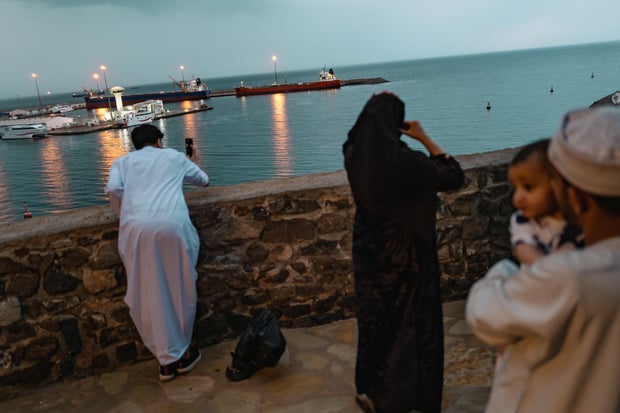
The CBS News Confirmed team found online maritime tracking data to corroborate the Iranian claims about interdicting ships. Data show two large cargo ships owned by Chinese company COSCO Shipping Lines Ltd turned around as they entered the Strait of Hormuz early on Friday and were back in the Persian Gulf. A third ship, also Chinese owned, turned around the previous day.
Iran charging select commercial ships "ransom" for Strait of Hormuz passage enrages Gulf neighbors
Iran is charging some commercial ships to sail safely through the Strait of Hormuz. An Iranian lawmaker said some vessels have been charged $2 million to transit the key shipping lane, to cover the country's cost of war.
Passage has long been free and required no special permission, as formally guaranteed by the United Nations' 1982 Convention of the Law of the Sea, which means Iran is breaching international maritime law.
Only a handful of ships from a few countries, China, India and Pakistan, are known to have gotten through the strait.
The Lloyds List intelligence firm, which tends to take a neutral, diplomatic stance, says the fees charged by Tehran have effectively created a "toll booth" system, but others are more direct, calling it a shakedown in the strait with the Iranian regime acting like a mob boss.
The head of the Abu Dhabi National Oil Company in the UAE, Sultan Ahmed Al Jaber, who has become one of the most vocal critics of Iran's actions, bluntly calls it economic terrorism.
He met Vice President JD Vance in Washington on Thursday and spent hours blasting Iran.
"When Iran holds Hormuz hostage, every nation pays the ransom. At the gas pump, at the grocery store, at the pharmacy, every household. No country can be allowed to destabilize the global economy in this way. Not now, not ever," Al Jaber said the previous day during a speech in Washington.
Iran's parliament is currently drafting a bill to make the fees on ships "official," according to state media, with the plan for it to be finalized in early April.
Stocks fall, oil prices back up on uncertainty over Trump's plans for Iran war
World shares mostly fell and oil gained again on Friday after Wall Street had its worst day since the start of the Iran war over growing doubts about a de-escalation.
In early European trading, Britain's FTSE 100 fell 0.3% to 9,939.96. France's CAC 40 dropped 0.7% to 7,718.97, and Germany's DAX lost 1.3% to 22,314.28.
In Asia, Tokyo's Nikkei 225 closed 0.4% lower at 53,373.07. South Korea's Kospi also lost 0.4% to 5,438.87, narrowing the sharp drop earlier in the day at trading close.
Hong Kong's Hang Seng was up 0.4% to 24,951.88 after dipping earlier in the day, while the Shanghai Composite index traded 0.6% higher at 3,913.72.
Australia's S&P/ASX 200 fell 0.1% to 8,516.30.
Taiwan's Taiex was 0.7% lower, while India's Sensex lost 2.1%.
On Thursday, Wall Street fell to its worst drop since the Iran war began, with the S&P 500 sinking 1.7% for its worst day since January to 6,477.16. The Dow Jones Industrial Average fell 1% to 45,960.11. The Nasdaq composite slumped 2.4% to 21,408.08, and is off 10% below its recent all-time high in what is considered a "correction."
Expectations this week of de-escalation negotiations between Washington and Tehran have sent markets into disarray.
Shortly after Wall Street trading closed Thursday, U.S. President Donald Trump said he was postponing a threatened attack on Iran's energy facilities as he further delayed until April 6 a deadline for Iran to reopen the Strait of Hormuz, a critical waterway for oil and gas transport.
U.S. futures were mostly unchanged on Friday.
Strikes continuing on multiple fronts
Israel's military said its forces carried out "a wide-scale wave of strikes targeting infrastructure of the Iranian terror regime in the heart of Tehran" early Friday.
Iran's Revolutionary Guard Corps said it carried out missile and drone strikes the previous day targeting sites in Israel and military facilities in the Gulf used by U.S. forces.
A maintenance facility for a U.S. Patriot air defense system was targeted in Bahrain, the Guards said in a statement carried by Iranian news agencies.
Lebanese media reported an Israeli strike hit Beirut's southern suburbs early Friday. Journalists heard several explosions from the direction of the Hezbollah stronghold, which Israel has repeatedly struck since war began.
The Saudi defense ministry said, meanwhile, that it had "intercepted and destroyed" four drones over the kingdom's east early Friday.
CBS/AFP
Israeli opposition leader warns military is "stretched to the limit and beyond"
Israeli opposition leader Yair Lapid is warning that the war is taking too high a toll.
"The IDF (Israel Defense Forces) is stretched to the limit and beyond. The government is leaving the army wounded out on the battlefield," Lapid said, echoing a warning delivered a day earlier by military chief Lieutenant General Eyal Zamir.
"The government is sending the army into a multi-front war without a strategy, without the necessary means, and with far too few soldiers," Lapid said.
In a televised briefing, Israeli military spokesman Brigadier General Effie Defrin said: "On the Lebanese front, the forward defensive zone that we are creating requires additional IDF forces. ... For that, more combat soldiers are needed in the IDF."
GOP Rep. Nancy Mace on Iran war: "I haven't seen an exit strategy yet"
One day after walking out of a House Armed Services Committee briefing on Iran, Republican Rep. Nancy Mace of South Carolina told CBS News she has "grave concerns about the Washington war machine getting us into another 20-year-plus endless war."
Mace said in an interview with CBS News congressional correspondent Nikole Killion on "The Takeout" that she would oppose sending ground forces into Iran, and argued the military needs to explain how the war could end. She said Wednesday's briefing with military officials "left most of our questions unanswered."
"I haven't seen an exit strategy yet," said Mace, who is currently running for South Carolina governor. "And I think that's where a lot of us share the heartburn."
Mace added that she remains a strong supporter of President Trump and believes the U.S. operation against Iran has been successful at degrading the country's missile capabilities. But she wants Mr. Trump to "declare victory" rather than allowing it to turn into a "never-ending war."
Trump says he extended pause on striking energy sites because Iran asked for "more time"
President Trump said Thursday on Truth Social that he would postpone his threat to order strikes on Iranian energy plants until April 6, extending his deadline for a second time.
Mr. Trump told Fox News he extended the timeframe for potential strikes against Iran's oil and energy infrastructure because talks with Iran were "going fairly well" and Iran had asked for "more time."
"I gave them a 10-day period," he said on Fox News' "The Five."
The president had previously announced a five-day extension to his ultimatum for Iran to reopen the Strait of Hormuz or face strikes on its energy infrastructure on Monday, which was set to expire Saturday.
"As per Iranian Government request, please let this statement serve to represent that I am pausing the period of Energy Plant destruction by 10 Days to Monday, April 6, 2026, at 8 P.M., Eastern Time," Mr. Trump wrote. "Talks are ongoing and, despite erroneous statements to the contrary by the Fake News Media, and others, they are going very well."
"They asked for seven, and I said, 'I'm going to give you 10,' because they gave me ships," Mr. Trump added, referring to several oil tankers he says Iran allowed through the Strait of Hormuz as a show of good faith. It remains unclear where they were sailing from or where they are going.