China's Xi warns Trump about "conflicts" if Taiwan isn't "handled properly"
Chinese President Xi Jinping had stern words for President Trump on Taiwan as they met in Beijing on Thursday, warning of potential "clashes and even conflicts" if the issue isn't "handled properly," according to Chinese state media.
During their summit, the two leaders are aiming to stabilize their trading relationship after last year's trade war. They're also grappling with uncertainty over the United States' war with Iran. But China made it clear that Taiwan is a top priority in the U.S.-China relationship.
The closed-door session lasted roughly two hours and 15 minutes. The White House characterized the meeting as "good." At a state banquet later, Mr. Trump said he was inviting Xi and his wife for a reciprocal visit at the White House on Sept. 24.
Mr. Trump told Fox News' Sean Hannity that Xi told him he would like to help open the Strait of Hormuz, and claimed that Xi said he's not going to give Iran any military equipment, which Mr. Trump called a "big statement."
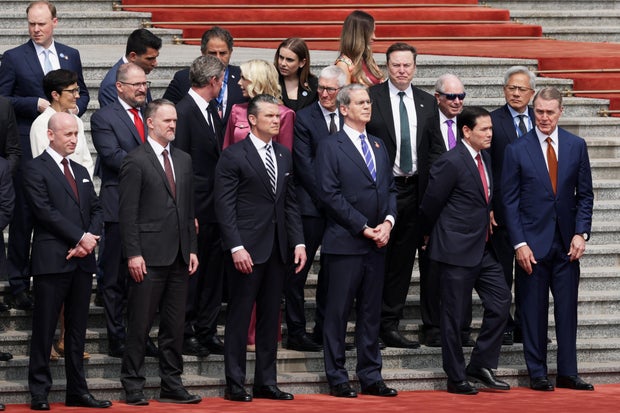
The White House said that several American business leaders joined for a portion of the larger bilateral meeting, with Chinese media indicating Mr. Trump introduced each one individually. The White House shared photos of the bilateral meeting on social media, where the CEOs can be seen standing behind Mr. Trump and U.S. officials.
"The two sides discussed ways to enhance economic cooperation between countries, including expanding market access for American businesses into China and increasing Chinese investment," a White House official said in a readout of the meeting.
Several U.S. executives were invited to travel to China. Figures like Tesla CEO Elon Musk, Nvidia CEO Jensen Huang and outgoing Apple CEO Tim Cook were among those who were in attendance at Thursday's welcoming ceremony at the Great Hall of the People, standing alongside Trump administration officials in the U.S. delegation. China is a key market for many of their companies, with Nvidia seeking to sell more advanced chips to China, even as some worry about giving China access to such advanced technology.
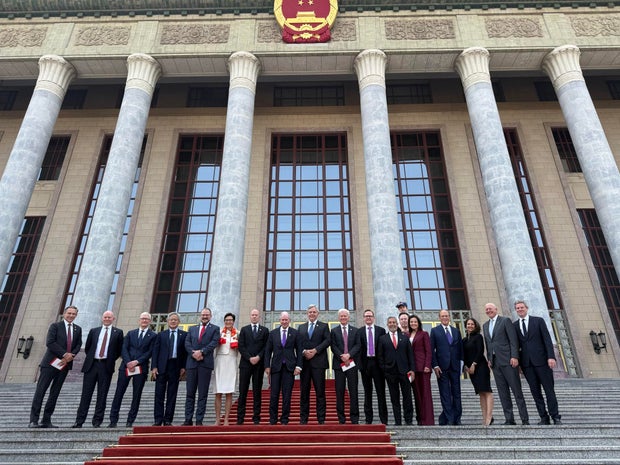
After the meeting, Mr. Trump and Xi visited Beijing's historic Temple of Heaven and then headed to a state banquet.
Reporters asked Mr. Trump how the talks went and he said they were "great," adding that China is a beautiful, incredible place.
The "Taiwan question"
Mr. Trump and Xi both ignored questions about whether they discussed Taiwan. But one regional source said Taiwan did come up in their conversation.
But a readout posted on X by Chinese foreign ministry spokesperson Mao Ning said Xi stressed to Mr. Trump that "the Taiwan question is the most important issue in China-U.S. relations. If it is handled properly, the bilateral relationship will enjoy overall stability. Otherwise, the two countries will have clashes and even conflicts, putting the entire relationship in great jeopardy."
The post said Xi also told Mr. Trump that "'Taiwan independence' and cross-Strait peace are as irreconcilable as fire and water. Safeguarding peace and stability across the Taiwan Strait is the biggest common denominator between China and the U.S."
The White House didn't mention Taiwan in its description of the meeting.
The People's Republic of China has long said it intends to reintegrate with Taiwan, and it has not ruled out using force to take over what it views as a breakaway province. The U.S. has provided billions of dollars in military support to Taiwan and said it opposes any unilateral change to the status quo, but the U.S. also has a longstanding policy of declining to say whether it would come to Taiwan's defense in a war with China.
Meanwhile, some in Taiwan — a democracy that produces the vast majority of the world's most advanced semiconductors — worry that the United States' support for the island may be up for negotiation as Mr. Trump seeks agreements with China, experts say.
Xi, Trump compliment each other at state banquet
At the state banquet, both Xi and Mr. Trump complimented each other. Mr. Trump said they had "extremely positive and productive conversations," while Xi said "the Chinese nation and making America great again can go hand in hand."
Both leaders emphasized the importance of the relationship between the U.S. and China, with Xi highlighting it as "the most important" bilateral relationship in the world.
Xi and Mr. Trump harked back to the history of the two countries' relations, with Mr. Trump pointing toward Chinese influence in American food and culture and Xi reminding the room of Henry Kissinger's visit to China under Richard Nixon.
At the end of the state banquet, Xi played clips from a decade's worth of his various meetings with Mr. Trump, sources in the room told CBS News. The U.S. president watched the montage and loved it, one of them said. As part of the music during dinner, Chinese musicians played an instrumental version of "YMCA" for him.
Economic ties
Both sides struck a positive note on trade.
China's state-run news agency Xinhua reported that Xi told Mr. Trump that, as Xinhua put it, "China-U.S. economic ties are mutually beneficial and win-win in nature."
The agency quoted Xi as saying, "Yesterday, our economic and trade teams produced generally balanced and positive outcomes. This is good news for the people of the two countries and the world. Facts have shown time and again that trade wars have no winner."
"Where disagreements and frictions exist, equal-footed consultation is the only right choice," he said, according to Xinhua, adding that Xi called on "the two sides to jointly sustain the good momentum that they have worked hard to create."
The White House said, "The two sides discussed ways to enhance economic cooperation between our two countries, including expanding market access for American businesses into China and increasing Chinese investment into our industries. Leaders from many of the United States' largest companies joined a portion of the meeting."
Iran
On Iran, the White House said the two leaders "agreed that the Strait of Hormuz must remain open to support the free flow of energy. President Xi also made clear China's opposition to the militarization of the Strait and any effort to charge a toll for its use, and he expressed interest in purchasing more American oil to reduce China's dependence on the Strait in the future. Both countries agreed that Iran can never have a nuclear weapon."
Mr. Trump said he didn't expect the war with Iran to come up as much as trade. Mr. Trump is seeking a deal with Iran, but talks appear to be stalled as both countries vie for control over the Strait of Hormuz. Mr. Trump said this week an early April truce that paused direct U.S.-Iran fighting is on "life support."
Speaking to CNBC's "Squawk Box" on Thursday morning, U.S. Treasury Secretary Scott Bessent said that China has a bigger interest in reopening the strait than the U.S. does.
"China gets about a third of its energy needs from the Gulf," Bessent said. "So, a reopening of the Strait benefits China. Unfortunately, they've been buying — they were the largest consumer of Iranian oil. They were buying about 90% of it. Iranian oil represented about 10% of their energy that they had took in."
China imports large amounts of oil from the Middle East and is the world's largest purchaser of Iranian oil, meaning China is both sensitive to the war's dire impacts on the global oil trade and key to supporting Iran's economy.
Secretary of State Marco Rubio said on Fox News that he expects Iran to come up in this week's talks with Chinese officials, and that "we've made clear to them that any support for Iran would obviously be detrimental for our relationship." He argued that China has an interest in resolving the Iran conflict's impacts on oil shipments, and "we hope to convince them to play a more active role."
Some experts argue the U.S.' focus on the Middle East — including the munitions it has used in Iran — could make it more difficult to prepare for a potential confrontation with China.
"We're going to have a fantastic future together"
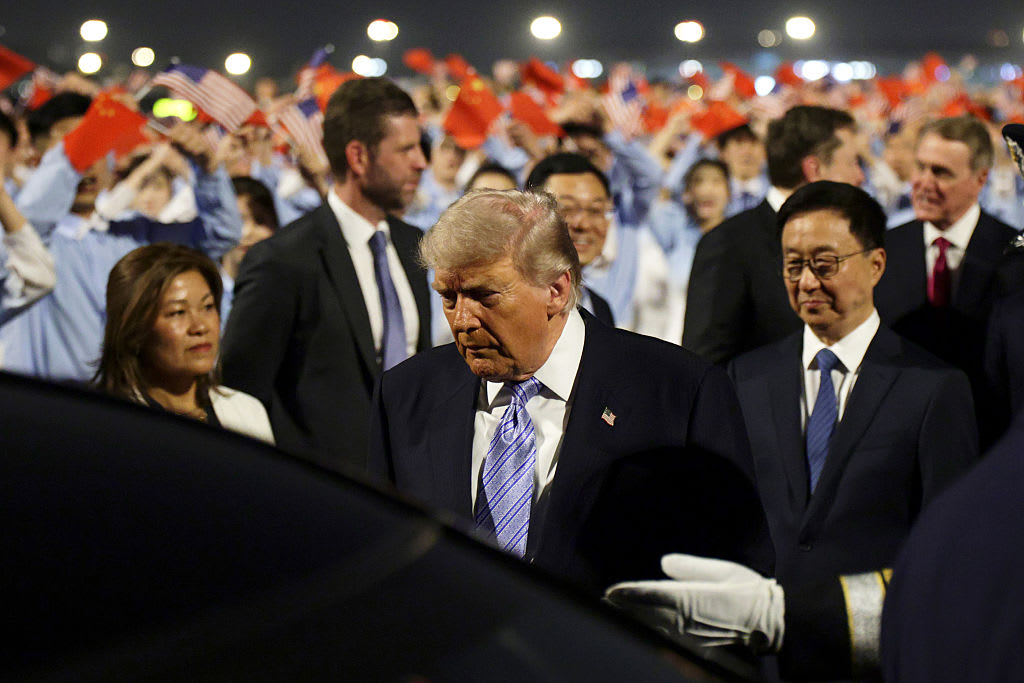
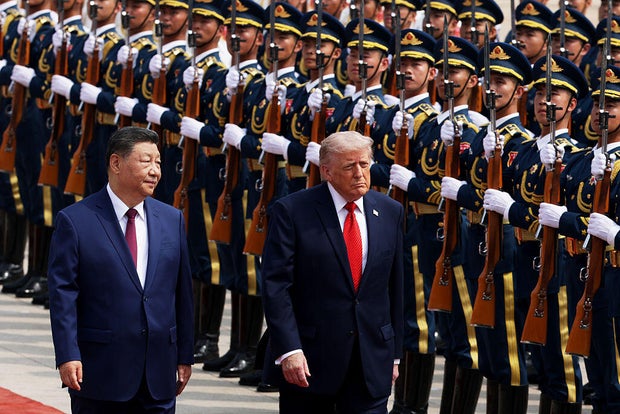
The day began with Mr. Trump and Xi shaking hands outside Beijing's Great Hall of the People on Thursday morning local time, or late Wednesday night ET. The two leaders chatted during an opening ceremony that featured a brass band, marching military units and cheering children waving American and Chinese flags. Inside the meeting room, Mr. Trump and Xi offered positive words on the U.S.-China relationship before reporters were ushered out and talks between the two countries began.
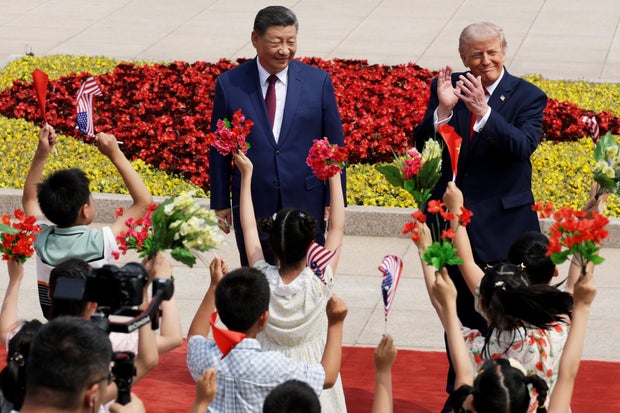
"A stable bilateral relationship is good for the world," Xi said in translated remarks. "We should be partners, not rivals."
Mr. Trump emphasized his personal relationship with Xi, calling him a friend and a "great leader" and saying the two have always been able to work out their disagreements. He also said the U.S. is eager to do business with China.
"We're going to have a fantastic future together," Mr. Trump said.
It was the American and Chinese leaders' first face-to-face meeting since October, and the first visit to China by a U.S. president since Mr. Trump traveled to Beijing in 2017.
Just over a year ago, the U.S.-China relationship was far rockier. President Trump's hefty tariffs on China and dozens of other trading partners sparked a tit-for-tat trade war with Beijing, leading the two countries to briefly jack up tariffs on each other's goods to over 100%. China and the U.S. also squared off over rare earth elements, semiconductors, student visas, shipments of fentanyl precursor chemicals, Chinese soybean imports and other issues.
Tensions have calmed since then, with both countries scaling back tariffs and China agreeing to halt export restrictions on rare earths. It's unclear whether the U.S. and China are on track to strike a more comprehensive trade deal, but experts believe neither side is looking for a repeat of last year's trade war, and both sides have said they are looking for stability.
The Trump administration has sought to preserve U.S. access to rare earths and to allow American companies to export food and other goods to the Chinese market — topics that could come up in this week's Trump-Xi meetings. U.S. Trade Representative Jamieson Greer has also floated the idea of a U.S.-China "Board of Trade" to coordinate those deals.
"We'll be talking with President Xi about a lot of different things. I would say more than anything else will be trade," Mr. Trump told reporters before departing for Beijing on Tuesday.
American executives joining
The CEOs met with Xi at the Great Hall, state broadcaster CCTV said, and Xinhua reported Xi told them China's door would only open wider and he believed U.S. companies would have broader prospects in the country.
Mr. Trump had said on Tuesday that he would ask Xi to "open up" China during the summit.
Huang and Musk told reporters the meetings had gone well as the CEOs exited the venue, with Musk saying "many good things" had been achieved. Cook gave reporters a peace sign and a thumbs-up.
Bessent said Thursday that the U.S. is the "undisputed leader" in AI, and the U.S. will be discussing "the AI guardrails with the Chinese."
"So the two AI superpowers are going to start talking," Bessent added.
Jimmy Lai?
Mr. Trump said before leaving that he would push for the release of pro-democracy Chinese media tycoon Jimmy Lai, who was sentenced in February to 20 years in prison for allegedly violating the Chinese and Hong Kong national security law by supporting foreign sanctions and protest activities.
It's not yet known if Lai has come up as a topic. His son Sebastien Lai told "CBS Mornings" on Thursday that he had not heard from the Trump administration.
Sebastien Lai told "CBS News Mornings" earlier this week that he believes his 78-year-old father will die in prison if the U.S. doesn't intervene.
"I think the president, with his long track record of freeing so many people around the world, is the man that I pin my hopes on," Sebastien Lai said. "I think he wants to do this, so fingers crossed, because otherwise my father will die in prison."