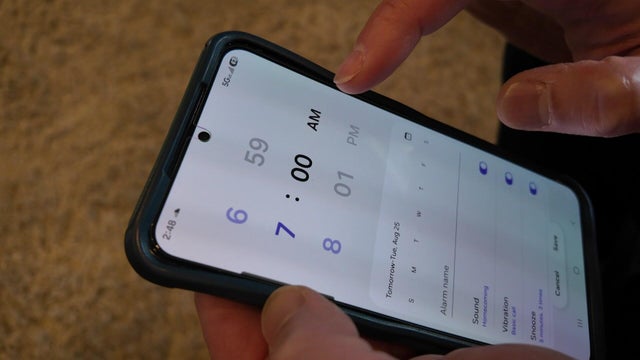
How many alarms should you set to wake up?
A school night usually means earlier bedtimes and setting multiple alarms. WCCO spoke with a sleep medicine physician about how many alarms you should set to wake up.
Watch CBS News
A school night usually means earlier bedtimes and setting multiple alarms. WCCO spoke with a sleep medicine physician about how many alarms you should set to wake up.
A school night usually means earlier bedtimes and setting multiple alarms. In this Good Question, Jeff Wagner explains why trying to squeeze in a few extra minutes of sleep may actually make you more tired.

Kids have nightmares, night terrors and sometimes even sleepwalk. Children’s Minnesota’s Dr. Gigi Chawla has some advice on how to help your kids get back to sleep.
Allina Health sleep expert Dr. Andrew Stiehm shares why “springing forward” feels so hard.
Sleep apnea is often not diagnosed in women, because women are told to expect to be tired.
Mayo Clinic doctors tap into AI technology to detect and treat women with sleep apnea, a disorder that's often misdiagnosed in women.
We want to know: Do you make your bed in the morning?
A new survey shows many people struggle mightily to fall asleep.
New research from the Tniversity of Pittsburgh found that teens who were spending a lot of time on their tablets and phones were found to have weaker connections in the parts of the brain that regulate emotion, and control memory and attention.
Dr. Gigi Chawla, of Children's Minnesota, talks about what parents should be aware of when it comes to babies and sleep.
A new survey shows two out of five Americans say they are “bad” at mornings, with reasons ranging from staying up late to rushing the routine.
Could the secret to fighting sleepless nights be a preemptive approach?
A new study published by researchers at the University of British Columbia found that there is a specific formula for having the perfect day. The formula suggests working no more than six hours per day, but also spending six hours with family. Two hours of exercise is also best.
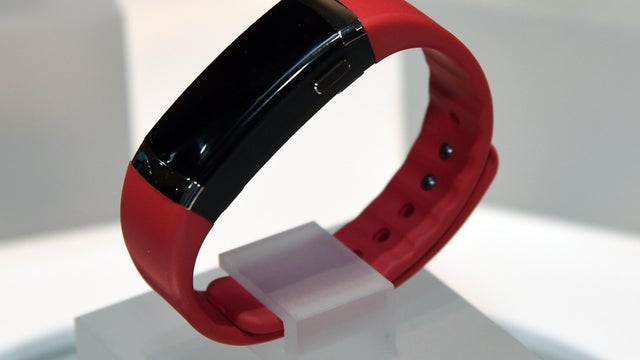
More than one-third of Americans have turned to apps or devices to track the quality of their sleep.

A sleep expert, lawmaker and former dairy farmer in Minnesota agree that the practice of daylight saving time has run its course.

Sleep experts, lawmakers and farmers in Minnesota share their thoughts on whether to keep daylight saving time.

Sleep is the rest and recovery bodies and brains need to be at our best once our eyes open again. Achieving that is easier said than done.

As much as we welcome spring's arrival, losing an hour of sleep for daylight saving time this weekend might be one of the drawbacks, especially if you already struggle getting to bed or staying awake. It may make you wonder, when is the right time to see a sleep specialist?
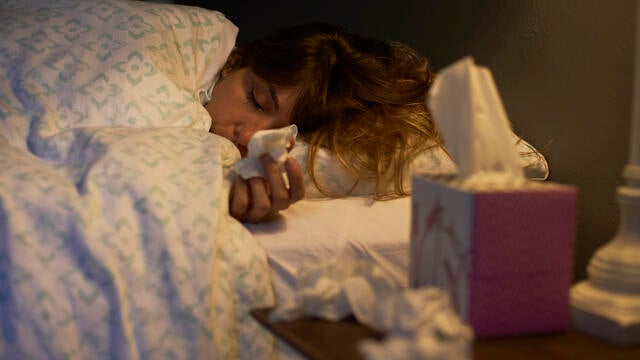
There's a chance you've caught some sort of bug this season. So why do we sleep so much when we get sick? There's a possible link between rest and recovery.
Despite it being late February, our brutal flu season shows no signs of slowing down. Even if it's not the flu, there's a chance you've caught some sort of bug this season. Why do we sleep so much when we get sick? Good Question. Susan-Elizabeth Littlefield explains what we know about rest and recovery.

Researchers at University College London say morning people tend to be in a better mood, have greater life satisfaction, and self-worth.
A new trend has people maximizing the time it takes to do their routine before going to bed so they get more sleep.
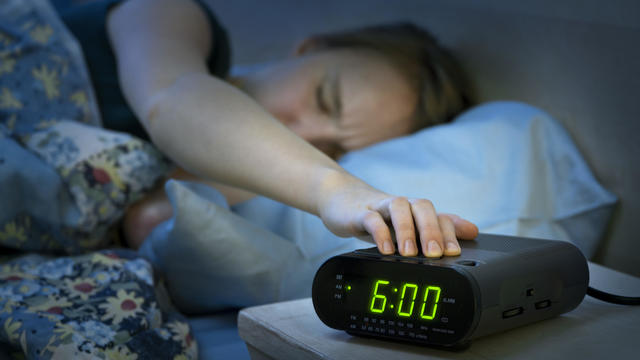
Just like the leaves, the clock falls back and some people fall off balance, according to Dr. Marcel Hungs, a neurologist and sleep medicine specialist at HealthPartners.
You may feel a bit more alert than you normally do this time of night. We all got an extra hour of sleep this weekend thanks to daylight saving time. But did it make a difference? Can you catch up on sleep? Good Question.
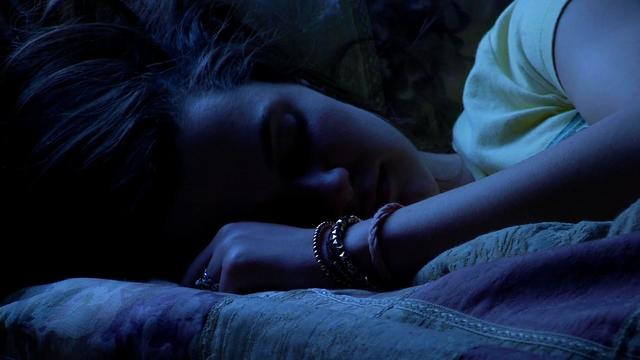
It takes 15 to 20 minutes for most adults to fall asleep. During that period, an odd sensation can occur which about seven out of 10 of us experience: bedtime twitches.