Author Marie Benedict talks to Club Calvi about her bestselling book "Daughter of Egypt"
Please consider joining our Facebook group by CLICKING HERE.
Find out more about the books below.
Readers know they can depend on author Marie Benedict for riveting historical fiction about fascinating women. Her new book "Daughter of Egypt" was an instant New York Times bestseller. The novel uses two timelines and two points of view to reimagine the lives of two women: Lady Evelyn Herbert, who was crucial in the discovery of King Tut's tomb, and Hatshepsut, who was a powerful female Pharoah of ancient Egypt. Mary Calvi talked to Benedict about what drew her to the two women.
"When the book opens, we have Lady Evelyn Herbert of Highclere Castle, which is, of course, Downton Abbey as most people know, setting off to Egypt to find the tomb of Hatshepsut, this incredible, singular, female Pharoah," Benedict told Mary. "When I realized the intersection of these two stories, I just had to tell it."
Mary said she pictured Benedict on the Nile River, writing in a journal. Benedict told Mary that she was right, that visiting Egypt was a big part of the research and the creation of the character of Hatshepsut.
"Even though Hatshepsut was erased from history for so long, now that we know she is there, we've been able to go back to monuments and statues and obelisks," Benedict said.
Benedict explained that years after Hatshepsut's prosperous reign, an army of people set out to scratch her out of history.
"There would be carvings on the walls of her monuments, images of her amidst other figures, and people would come and chisel her out," Benedict said.
She told Mary she keeps a running list of women whose forgotten stories are waiting to be told.
"I come across them everywhere," Benedict told Mary. "Once you realize that they are there, you can't unsee them. It's about the lens through which you look at the past. I often find one woman while I'm researching a different one. Women are often working with other incredible historical women. I'm looking for women who have left behind crucial legacies. They've made contributions that we benefit from today but we might not know their stories. And women who are grappling with topics that are both historic and modern, so that they resonate with readers."
Benedict says these women also resonate with her personally.
"Something about their struggle, something about the issues that they are grappling with, that feels very urgent to me personally," Benedict said. "They are very much my story as well."
You listen to the extended conversation on the Club Calvi Podcast.
You can also read an excerpt from "Daughter of Egypt" and get the book below.
The books may contain adult themes.
________________________________________________________________________________________________________
"Daughter of Egypt" by Marie Benedict
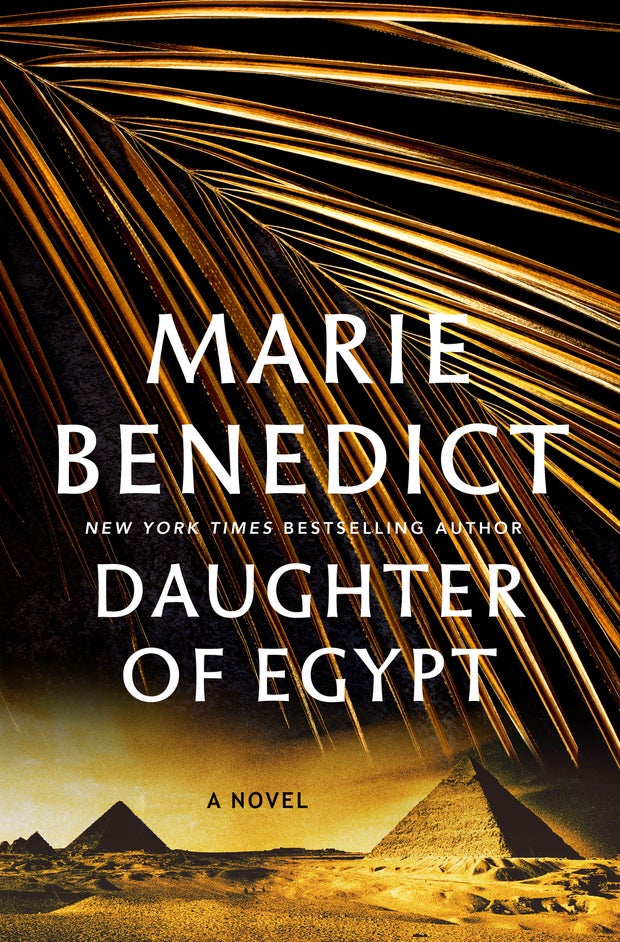
From the publisher: In the 1920s, archeologist Howard Carter and Lord Carnarvon of Highclere Castle made headlines around the world with the discovery of the treasure-filled tomb of the boy Pharaoh Tutankhamun. But behind it all stood Lady Evelyn Herbert—daughter of Lord Carnarvon—whose daring spirit and relentless curiosity made the momentous find possible.
Nearly 3,000 years earlier, another woman defied the expectations of her time: Hatshepsut, Egypt's lost pharaoh. Her reign was bold, visionary—and nearly erased from history.
When Evelyn becomes obsessed with finding Hatshepsut's secret tomb, she risks everything to uncover the truth about her reign and keep valued artifacts in Egypt, their rightful home. But as danger closes in and political tensions rise, she must make an impossible choice: protect her father's legacy—or forge her own.
Marie Benedict lives in Pittsburgh
"Daughter of Egypt" by Marie Benedict (ThriftBooks) $22
Excerpt: "Daughter of Egypt" by Marie Benedict
CHAPTER ONE
July 19, 1919
Hampshire, England
The Saloon glows in the flicker of the candelabras and the low light of ornate wall sconces. Colorful heraldic shields dotting the base of the peaked gallery above enliven the honey-colored limestone walls and columns. The crimson, sapphire, and emerald of the shields are echoed in the ladies' gowns and the jewels on their necks, ears, and wrists. If I allow it to work its magic, the Highclere Castle ball casts a glorious spell on me, banishing the pall of the Great War that lingers in this otherwise jubilant space, and that is precisely what has happened to the other revelers. But I would never allow that alchemy to blind me to the all-important in this otherwise jubilant space, and that is precisely what has happened to the other revelers. But I would never allow that alchemy to blind me to the all-important past. History has always been my chosen companion.
The orchestra strikes up a Chopin waltz, and I permit the next gentleman on my dance card to sweep me up in its three-quarter-time rhythm. The hem of the fussy tulle ultramarine gown Mama insisted upon because, she claimed, it brought out the blue in my eyes, twirls as I spin around the dance floor under the expert hands of Lord Stockton. Surrendering to his lead, I swoop across the floor like the high-flying stone-curlew birds that nest on the estate. Lord Stockton may be in his fifties, but he's still nimble and energetic, and there aren't many young men here tonight in any event. Most of the boys I'd dreamed about as a girl didn't come home from the war, and I won't forget about those men and their sacrifice tonight—even if everyone else seems determined to do so.
The heels of my blue silk T-strap shoes skim across a floor upon which generations of my family have danced. The first Earl of Car-narvon in 1793, whose investiture was made by King George III him-self. The third earl, who worked hand in hand with Sir Charles Barry and Capability Brown in the mid-1800s to fashion the current castle and gardens out of its earlier iterations. The fourth earl, who helped create the Dominion of Canada in 1867 within the castle walls, by drafting countless letters about constitutional provisions as part of his presentation of the British North America Act to Parliament. Oh yes, this was all widely known, but what about the women? The ladies Carnarvon, their daughters, and their guests—not to mention the governesses, maids, and cooks? Growing up amidst the unspoken legacy of all these women—past and present—I've wondered about them since childhood. But theirs aren't the sto-ries that my family usually tells. It's as if the women never walked these corridors or inhabited the rooms, or as if they've simply been erased. Like so many others.
Did my companion say something? It might be the first or the hun-dredth time he's spoken for all I've paid attention to him. But for my momentary surrender to the orchestra and the rhythm of the waltz, my thoughts have been elsewhere.
"Lady Evelyn?"
This time I know I can't ignore conversation in the face of such a plaintive query. Not to mention the politesse of the ball requires these small exchanges. The world may have been upended by the war and the ink has barely dried on the Treaty of Versailles, but the society doyennes are doing their darnedest to return to the rituals and rites that used to govern our days. It seems a pointless, even disrespectful, folly to me.
"Pardon me, Lord Stockton," I reply. "My head seems to be in the clouds."
"No surprise—this is a heady affair." He smiles at his little quip, but when I don't return the grin, he clears his throat and repeats him-self: "I said only that Highclere is in fine fettle."
"The staff has outdone themselves putting Highclere back in order," I answer politely.
"No Humpty-Dumptys there; Highclere is together again. One would never know it had served as a hospital until just recently," he says, his untrained eye unable to see the residual traces of the hos-pital beds and screen stands and nursing stations that are obvious to me. Time can only be turned back so far, even here, where history abounds.
He leads me counterclockwise back across the Saloon dance floor, and when I don't banter back, he adds, "It does lift one's spirits to see a great house restored and wiped clean of the suffering that took place here. Especially when so many estates will not outlast the war." I almost stop dancing. Why should we erase the past? The collec-tive forgetting of the war is being foisted upon us all, and I, for one, do not wish to participate in the forced joyful abandon I see around me. Too many boys are gone for that. History should not be rele-gated to a dusty corner. We should pick it up, examine it, and allow it to inform our current days.
Glancing up, I see my mother staring down from the gallery on the Saloon's second floor, where she has a bird's-eye view of the dancing and me. She is small in stature but fierce in temperament, and the intensity of her dark-eyed gaze gives me a start. I can almost hear her think, Concentrate, Eve, this ball is for you, the capstone of your successful debutante year. Lady Almina Herbert, Countess of Carnarvon, is the last person who should want to delete the past few years from our memory; her nursing work and creation of hospitals for wounded soldiers is the stuff of legend, after all. Yet she was first in line to reinstate the trappings of the Season and the presentation of debutantes to King George, even though the Treaty of Versailles hadn't been negotiated when she began. Mama explains it away by saying that I came of age just as the Great War ended, and so needs must.
But must I?
With Mama's eyes upon me, I return to the waltz. I chat as expected and perform the requisite dance steps. I smile and play the part assigned to me. But no matter how tightly Mama tries to wrap me in duty, my mind drifts, as do my eyes, over Lord Stockton's shoulders and around the room.
Suddenly, I see Streatfield, our ever-proper house steward, appear on the periphery. His presence is a silent signal to me, as he needn't be here otherwise. The muttonchopped, white-tie-wearing steward is here to deliver a message of which he doesn't approve. But as my reluctant champion since childhood, Streatfield will do as I've asked and share the news. The man for whom I've been waiting all night has finally arrived.
From Daughter of Egypt: A Novel by Marie Benedict. Copyright © 2026 by the author and reprinted by permission of St. Martin's Publishing Group.