Firefighter in deadly LaGuardia Airport runway crash heard "stop", but wasn't sure who it was for, NTSB says

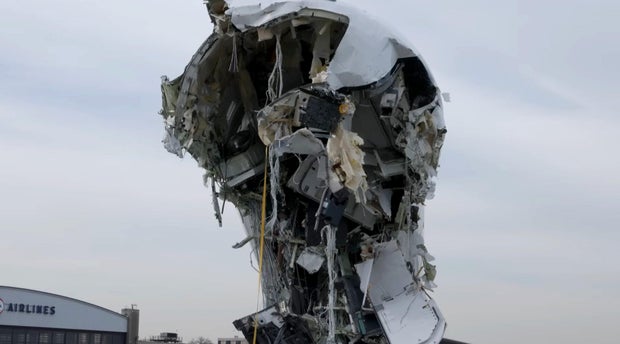
The NTSB has released its preliminary report on the deadly runway crash at LaGuardia Airport, including a detailed timeline of what occurred before an Air Canada jet collided with a firefighting vehicle, killing two pilots.
The report finds that one of the firefighters in the fire truck heard a message from air traffic control to stop, but didn't immediately know who the message was intended for.
Recordings of the air traffic controller on duty that night captured him telling an emergency firefighting vehicle to "stop, stop, stop," just moments after it was first given permission to cross the runway where the collision occurred.
The firefighting vehicle, along with six others, was responding to an emergency taking place at LaGuardia's Terminal B.
Pilots Antoine Forest and Mackenzie Gunther were killed in the crash. Dozens of other people were injured.
The NTSB report also reveals that one of the emergency vehicles attempted to contact the tower but their radio transmission was "obscured" by a simultaneous message on that same frequency.
The report does not say whether the NTSB interviewed the firefighter who was driving the truck, or either of the two controllers in the tower that night.
The report is just preliminary, and the NTSB says it is still investigating. The FAA says for that reason can't comment, and the Port Authority said it's reviewing the NTSB's findings to ensure safety protocols are as strong as they can be.
Partial timeline of the deadly crash
- 11:35:07 p.m. - Air traffic controller clears the Air Canada flight to land on runway four
- 11:35:28 p.m. - The firefighting vehicle leaves its fire station with six other vehicles as the Air Canada jet approaches
- 11:35:47 p.m. - One of the emergency vehicles attempts to contact the tower, but the message is obscured by another radio transmission
- 11:36:44 p.m. - The tower asks which emergency vehicle needs to cross the runway
- 11:36:55 p.m. - The emergency vehicles reply, and are given permission to cross. By this time the Air Canada jet was just 130 feet above the ground and about a quarter of a mile away from the runway
- 11:37:12 p.m. - The tower instructs the emergency vehicles to stop as they are already crossing the runway
- 11:37:17 p.m. - The Air Canada jet's landing gear touch down. The plane was traveling at 129 knots (148 mph)
- 11:37:20 p.m. - The tower again instructs the emergency vehicle to stop as the airplane starts applying its brakes and reversing thrust
- 11:37:22 p.m. - The airplane's nose touches down just two seconds before the crash. The plane struck the vehicle while traveling at 104 mph.
"Stop" messages from the tower
The turret operator of the firefighting truck involved in the crash told NTSB investigators he heard the tower's "stop, stop, stop" message but he did not know which vehicle that message was meant for.
A subsequent message from the tower to stop specified his truck, he said, and then he realized it was meant for them, and he saw the airplane's lights on the runway.
2 controllers on duty at the time of the crash
There had been questions about how many air traffic controllers were on duty at the time of the crash. The NTSB report reveals there were two of them, "consistent with the mid-shift basic watch schedule." One of the controllers had 18 yeaars of experience, and the other had 19.
The report says both controllers "were qualified and current on all control positions" at LaGuardia.
They had been in position for about 40-50 minutes prior to the crash.
Warning system did not alert controllers in tower
A system in place known as ASDE-X, meant to alert air traffic controllers to potential runway incursions in real time, "did not generate an aural or visual alert" for the controllers in the tower.
"Without transponder-equipped vehicles, the ASDE-X system could not uniquely identify each of the seven responding vehicles or reliably determine their positions, or tracks," the NTSB report says. "As a result, the system ... did not predict a potential conflict with the landing airplane."
The report says runway safety lights lit up in red to warn trucks about the incoming plane, and "remained illuminated until about the time Truck 1 reached the (near) edge of runway, when they extinguished, about three seconds prior to the collission.
"An accident that should never have happened"
Dan Rose is an attorney with Kreindler & Kreindler, a law firm representing passengers from the jet.
"Classic example of an accident that should never have happened," he said. "It's a tragic consequence, but there were a lot of safeguards put in place here that were not followed, and technology did not operate as planned."