9 major themes that defined the first year of Trump's second term
Washington — In the year since his return to power, President Trump has shifted America's approach to foreign policy and allies, targeted his political enemies, prioritized mass deportations and put his mark on Washington's architecture. Here are the themes that have shaped his first 365 days in office.
Slashing the federal workforce and agencies
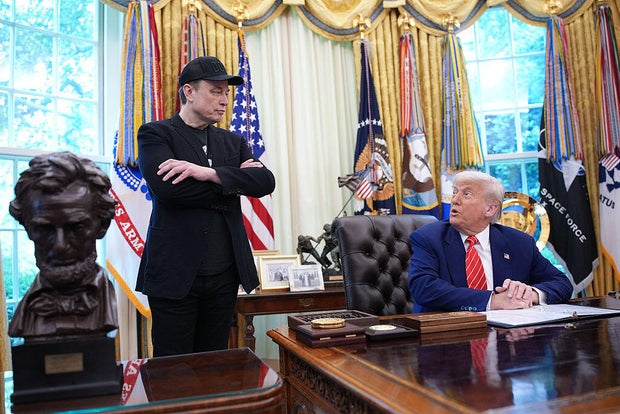
- Elon Musk was initially the face of the president's vow to cut waste, fraud and abuse in government. He and the Department of Government Efficiency, or DOGE, took a chainsaw to the federal workforce through buyouts, reductions in force and shuttering offices. Those efforts resulted in the loss of more than 317,000 federal employees by November, although that was offset by 68,000 hires, according to the Office of Personnel Management. Some jobs were reinstated after court challenges.
- DOGE also claimed to have cut billions in federal spending, although CBS News' analysis found the savings were a fraction of what was claimed.
- Agencies that didn't align with Mr. Trump's mission were targeted for cuts or elimination, including the U.S. Agency for International Development. The president is also trying to fire nearly every employee of the Consumer Financial Protection Bureau, arguing it has overstepped its mission. "RIP CFPB," Musk posted on X in February. In December, a judge blocked the White House from defunding the agency.
- The Trump administration is currently trying to dismantle the Education Department and transfer many of its programs to other departments, arguing that doing so will help return education decisions to states.
- The attorney general has also gutted the Justice Department office that prosecuted public corruption cases.
- The Trump administration announced it would eliminate 20,000 jobs from the Health and Human Services Department, about a quarter of its workforce. The cuts included 1,300 who were fired from the National Institutes of Health, as well as $2 billion in funding. Public health agencies have also slashed funding for vaccine development and mental health and addiction programs, although some cuts were reversed. The president also withdrew the U.S. from the World Health Organization.
- Nonetheless, overall federal spending has not decreased under Mr. Trump. According to federal data analyzed by the Peterson Foundation, outlays in December 2025 were $5 billion higher than in December 2024. The national debt continues to climb.
Settling scores with political foes, targeting rivals — and rewarding allies
- The Trump-era Justice Department has targeted the president's political enemies, including former FBI Director James Comey, New York Attorney General Letitia James and John Bolton, Mr. Trump's former national security adviser. Democratic Sen. Adam Schiff and Rep. Eric Swalwell, who helped lead the impeachment charge against him during his first time in office, have also been the targets of investigations.
- Mr. Trump has denied involvement in the prosecutions, but has publicly encouraged the Justice Department to look into some of his political opponents.
- The administration has also targeted six Democratic members of Congress who appeared in a video in November urging members of the military to refuse to follow "illegal orders." Five of the lawmakers said they had received inquiries from the Justice Department, the Pentagon has moved to demote and cut the pension of Democratic Sen. Mark Kelly of Arizona, who is a retired Navy captain.
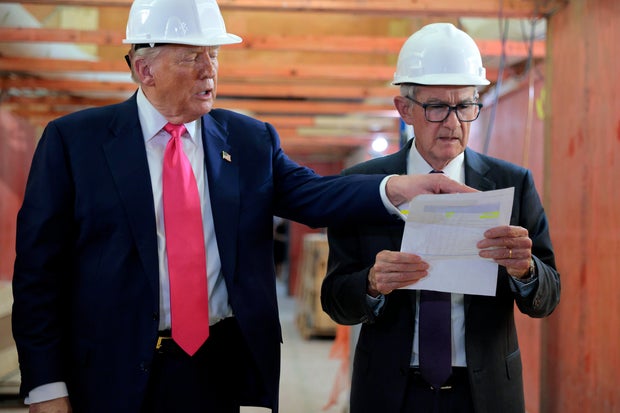
- The Federal Reserve has also fallen into the administration's crosshairs, after the president has repeatedly called on the central bank to lower interest rates. Jerome Powell, the Fed chairman, said the Federal Reserve was recently served subpoenas over his testimony about renovations at the central bank's headquarters, and said the move was part of a pressure campaign. The president has also sought to fire Federal Reserve Board member Lisa Cook, alleging she committed mortgage fraud. Cook is challenging her ouster, and the Supreme Court is scheduled to hear arguments in the case this week. Powell is expected to attend.
- Over the summer, the Justice Department fired dozens of employees who worked on special counsel Jack Smith's dual investigations into Mr. Trump.
- The White House also revoked the security clearances of many officials, including former President Joe Biden, former Vice President Kamala Harris, members of Biden's national security team, Bolton and other current and former national security figures.
- Meanwhile, Mr. Trump has used his pardoning power to wipe away criminal charges from allies and political figures of his choosing.. He pardoned nearly everybody charged or convicted in the Jan. 6 Capitol riot on his first day in office, and he granted clemency to Democratic Rep. Henry Cuellar, former GOP Rep. George Santos, former Puerto Rico Gov. Wanda Vazquez, former Illinois Gov. Rod Blagojavich and former Honduran President Juan Orlando Hernandez.
Carrying out mass deportations and immigration enforcement
- Mr. Trump campaigned on a promise to carry out the largest deportation operation in history. In mid-December, the Department of Homeland Security said there had been an estimated 1.9 million self-deportations and more than 622,000 deportations up to that point. As of last week, Immigrations and Customs Enforcement held 73,000 detainees in custody, the most ever recorded. The administration aims to be able to hold upwards of 100,000 immigration detainees at any given time, as part of its effort to carry out a deportation crackdown of unprecedented proportions.
- The Trump administration has signed agreements with countries to accept immigrants who are not their citizens. In addition to several Latin American countries, some that are half a world away have also agreed to accept deportees, like Eswatini,Uganda, South Sudan, Laos, Myanmar, Kosovo and Rwanda.
- Apprehensions at the Southwest border are at record lows. In December, U.S. Customs and Border Protection apprehended 6,478, 96% lower than the prior year.
- In March, Mr. Trump invoked wartime authority to send hundreds of mostly Venezuelan migrants to El Salvador's notorious CECOT prison. According to a Human Rights Watch report, half had no criminal history and just eight had been convicted of violent or potentially violent crimes. One Salvadoran man who was deported and held in CECOT in error, Kilmar Abrego Garcia, was returned to the U.S.; officials then filed criminal charges against him and are also trying to deport him to another country. All of the Venezuelan men sent to CECOT were later flown to Venezuela as part of a prisoner swap.
- Under Mr. Trump, DHS has launched an immigration enforcement campaign in cities across the country, sending federal law enforcement to Charlotte, Chicago, Los Angeles, Minneapolis, New York City and Portland. Immigration raids have often been met with protests.
- Clashes between authorities and civilians have turned up the temperature, most recently with an ICE officer's fatal shooting of Renee Good in Minneapolis this month.
- The president deployed National Guard troops to assist and protect federal law enforcement, drawing lawsuits. California, Illinois and Oregon sued, arguing the president was reaching beyond his authority, and judges often sided with the states. The National Guard will remain in Washington, D.C., this year, but Mr. Trump sent guard members home from other jurisdictions at the end of 2025.
- Despite the extensive resources being devoted to deportations, the president told "60 Minutes" in November the immigration raids "haven't gone far enough."

Flexing American power overseas, realigning U.S. foreign policy
- Some of the most consequential moves of the president's term so far have involved his willingness to exert American military power overseas and upend relations with longstanding U.S. allies.
- In June, the U.S. carried out major strikes against three Iranian nuclear facilities in an operation called "Operation Midnight Hammer." Mr. Trump has recently threatened to strike the Iranian regime again over its crackdown and killing of protesters.
- Amid a military buildup in Latin America, the U.S. has carried out at least 34 known strikes on boats the administration claimed were ferrying drugs in the Caribbean and Pacific Oceans. The strikes have killed more than 120 people.
- In an extraordinary and controversial military feat, U.S. forces infiltrated Venezuela and captured then-President Nicolás Maduro on Jan. 3. Mr. Trump soon announced the U.S. would be running the country and taking control of Venezuela's oil infrastructure. The U.S., the White House says, will sell the oil for the benefit of Venezuelans, Americans and U.S. oil companies.
- Asserting power over Venezuela is one part of the president's "Donroe Doctrine," which holds that the U.S. should wield influence over the Western Hemisphere and play less of a role in Europe's affairs.
- But the president's audacious campaign to acquire Greenland, a semi-autonomous territory within the Kingdom of Denmark, has sparked intense concern among NATO allies, flying in the face of modern Western democracies' rejection of imperial expansion. The president has refused to rule out the use of military force to acquire the territory, and says he'll impose tariffs on European countries objecting to his efforts — telling several countries he no longer feels "an obligation to think purely of Peace" because he wasn't awarded the Nobel Peace Prize.
- The president has pushed for a resolution to the war in Ukraine, but peace efforts stalled after a high-level summit with Russian President Vladimir Putin in Alaska in August.
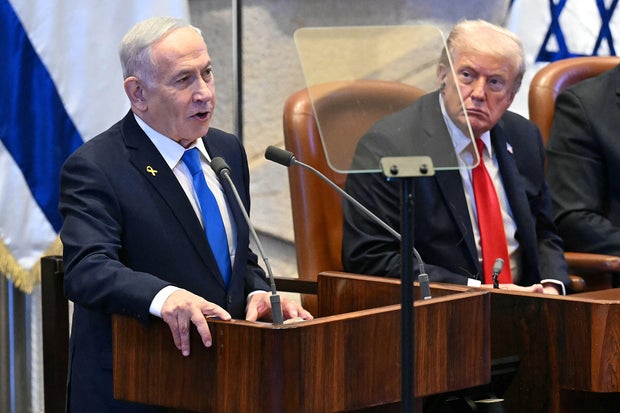
- The Trump administration, with the help of partners in the Middle East, brokered a long-sought ceasefire and peace deal between Israel and Hamas in October. The implementation of the agreement is still underway, but all living hostages have been returned, and the tenuous peace appears to be holding.
Reshaping economic policy, focusing on trade and a love for tariffs
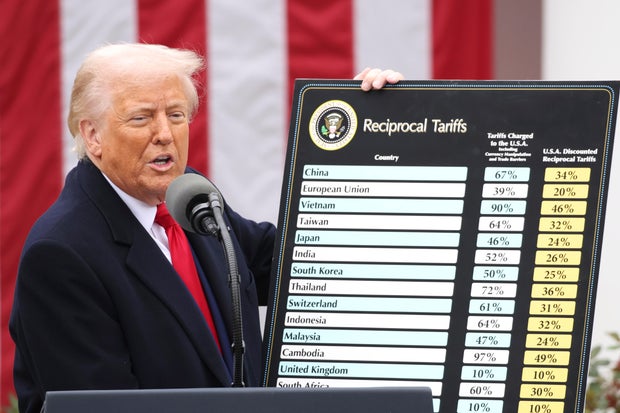
- Mr. Trump calls himself "the tariff king," and his love for tariffs — what he's called his "favorite word" — has reshaped international trade and international relations. Mr. Trump insists tariffs are bringing in billions of dollars for the country, although economists say U.S. consumers will ultimately pay higher prices. Studies show that U.S. importers generally pay the tariffs, not the foreign countries.
- The stock market has continued to climb under Mr. Trump, although inflation, unemployment, hiring and layoff data are a mixed bag. Nearly three in four Americans say the president isn't focusing enough on lowering prices, and just over three in four Americans say their income isn't keeping up with inflation, according to the latest CBS/YouGov poll.
- New U.S tariffs on Chinese goods set the stage for a trade war between the world's largest economies over everything from computer chips and rare earth metals to soybeans and TikTok, briefly sending both countries' tariffs on each other to over 100%. Mr. Trump met with Chinese President Xi Jinping in October and struck a deal that partially defused tensions.
- The president's signature economic legislation, which he calls the "big, beautiful bill," extended a set of tax cuts passed in Mr. Trump's first term, partially paid for through restrictions on Medicaid and food stamps.
Pushing the limits of presidential power
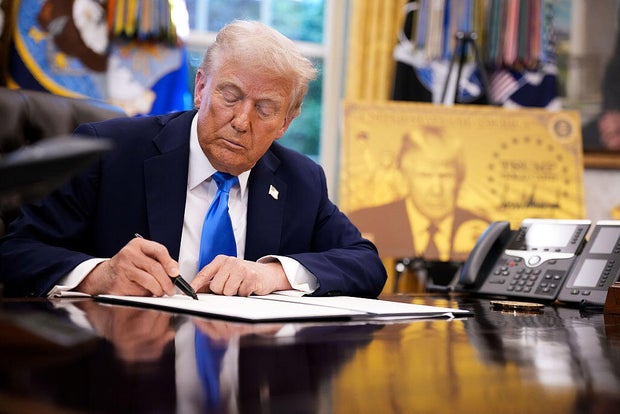
- Despite Republican control of both chambers of Congress, Washington has passed few pieces of major legislation, with Mr. Trump relying heavily on executive actions to accomplish his objectives. He signed 228 executive orders — not including other types of executive actions — in 2025 and the first weeks of 2026, according to the Federal Register, easily outpacing all other presidents in their first year in office.
- The president's use of emergency powers to levy tariffs without approval from Congress has been challenged all the way to the Supreme Court. The justices are expected to rule soon on whether the president had the constitutional right to impose the tariffs. If the court rules he did not, the U.S. government may have to find a way to repay the levies.
- The president's uses of military force without congressional approval in Syria, Iran and Venezuela — and his deployments of National Guard forces to U.S. cities — have also raised questions about constitutionality and the limits of executive power. The Supreme Court blocked a Guard deployment to Chicago last month.
- After an impasse in Congress led to the longest government shutdown in U.S. history, the White House tested the limits of its power to unilaterally move money around. It kept sending out paychecks to members of the military and FBI agents, sought to lay off thousands of idled government workers and threatened to pause food stamp payments, drawing legal challenges.
Bending institutions to his will
- Another theme of Mr. Trump's presidency continues to be pushing institutions to bend to his will. The president has terminated government contracts and revoked security clearances with major law firms that represented political opponents. The American Bar Association sued over the approach, calling it a "law firm intimidation policy." Some firms, under pressure, reached agreements with the administration to spend millions of dollars on pro bono work.
- Mr. Trump has pressed both federal agencies and private employers to end diversity, equity and inclusion (DEI) programs, and his administration has targeted what it views as "woke" initiatives in the military, business, education and other aspects of American society.
- The Trump administration threatened to sue or otherwise pressured universities over their diversity and inclusion practices, pro-Palestinian campus protests or granting of in-state tuition to undocumented immigrants, cutting off funding to some schools. Columbia University settled with the administration to avoid further investigations, and Brown University, Cornell University, Northwestern University and UPenn all reached some type of agreement with the administration.
- The president has also personally sued multiple news organizations over their coverage. Ahead of the inauguration, ABC News parent Disney agreed to pay $16 million to settle a defamation suit Mr. Trump brought. CBS News was also among those the president sued, and then Paramount, CBS News' parent company, agreed to pay $16 million to settle a suit over a 2024 "60 Minutes" interview with Kamala Harris. Neither company admitted wrongdoing.
Dealmaking with companies and countries
- Rather than imposing uniform policy through legislation, the president prides himself on making deals — the more deals the better — with individual companies and nations. The tariff negotiations with different rates for various countries are a prime example of that.
- The president has sought to broker individual deals with pharmaceutical companies to bring down the prices of drugs for Americans. Among the medications that could be sold direct-to-consumer at lower costs are GLP-1 weight loss drugs Ozempic, Wegovy and Zepbound.
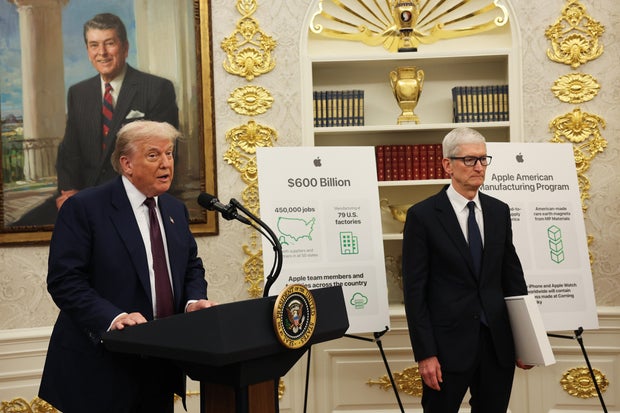
- The president has also unveiled deals to invest in U.S. manufacturing and infrastructure with tech giants like Apple, Meta and OpenAI as well as trading partners like South Korea and Japan — though some of the corporate investments predated Mr. Trump.
- The administration sought to broker a deal for TikTok's China-based parent company to sell its American operations to U.S. investors, avoiding a legally mandated nationwide ban on the social network. It's not yet clear if the deal will be approved by Chinese officials.
- Mr. Trump let Japan-based Nippon Steel buy U.S. Steel, but with a "golden share" that allows the president to review some major corporate decisions.
Putting his stamp on the White House and Washington, D.C.
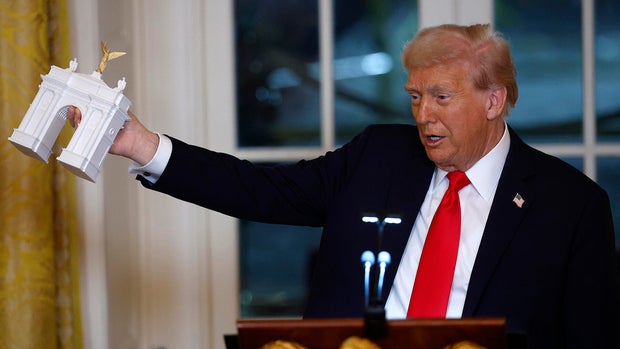
- The president has moved to make his imprint on the White House itself and Washington, D.C., as a whole, forging ahead with plans to build a large ballroom on the grounds of the executive mansion and construct a new triumphal arch to match other major monuments.
- Mr. Trump demolished the East Wing of the White House in October with little warning, paving the way for his ballroom project. Architects working on the ballroom presented plans to a board that oversees construction on federal land earlier this month. The president has said the cost of the project, which has ballooned to roughly $400 million, will be covered by private donations. Some of those donations have come from firms and individuals with extensive business before the federal government.
- Mr. Trump has renovated other parts of the White House, including by building a patio in the Rose Garden, installing massive new flagpoles on the grounds, redecorating the Oval Office with gold-colored furnishings and installing a "Presidential Walk of Fame" with photos of his predecessors — except former President Joe Biden, who is represented by an image of an autopen.
- Mr. Trump has also touted plans for the construction of a triumphal arch across the Potomac River in Virginia. Mockups of the arch the president showcased in October bore the title "Independence Arch."
- The president has also worked to affix his name to institutions around the capital. Mr. Trump's handpicked board of the Kennedy Center, Washington's premier arts venue, voted to rename the institution the Trump-Kennedy Center, a change that would require Congress to become official.
- The administration also added Mr. Trump's name to the U.S. Institute of Peace in December. The State Department said the change was meant to "reflect the greatest dealmaker in our nation's history."