Iran-backed Houthis deny losing ground in Yemen as oil prices ease despite fierce fighting
Follow updates on the war in the Middle East for Wednesday, Oct. 7, here. See earlier developments below.
What to know about the Iran war:
- Iran's Houthi allies in Yemen rejected assertions by Saudi-backed state forces on Tuesday that they've retaken key positions along the Red Sea coast, with a spokesman insisting the rebel fighters had "full control over all their gains on the ground."
- The Houthis claimed to have killed or wounded 200 Saudi Arabian security forces with strikes on the kingdom's primary airport, a Saudi oil refinery and other sites across the country. Saudi officials confirmed attacks on two airports, but said only three people sustained minor injuries in the strikes.
- The price of Brent crude oil, the international standard, fell under $100 a barrel Tuesday despite the fierce fighting as the Houthis battle to maintain control over much of Yemen's Red Sea coast and the Bab el-Mandeb Strait, a crucial chokepoint for global energy shipments.
Houthis say they targeted airport in Saudi capital with ballistic missile
Yemen's Houthis said Wednesday they had targeted King Khalid International Airport in the Saudi capital with a ballistic missile, the latest in repeated salvos aimed at the site.
"Our armed forces have just targeted King Khalid Airport in Riyadh with a ballistic missile. The strike was accurate, by God's grace, and led to a disruption of air traffic at the airport," said Houthi military spokesman Yahya Saree in a statement on X.
In a separate post, the Houthis said they also targeted military supplies at a camp area near the airport in the Yemen government's interim capital of Aden.
The Houthis' latest claims came hours after the Saudi-led coalition backing the Yemen government said its forces had intercepted a ballistic missile north of Riyadh fired by the Iran-backed Houthis.
The flurry of attacks was launched as the Houthis said they were holding their ground amid an onslaught by Yemeni government forces backed by the coalition's air power.
Earlier this week, Yemen's military said its forces had uprooted Houthi fighters from the areas around the Bab al-Mandab strait, a Red Sea shipping chokepoint, and the port city of Mocha.
Claims by both sides have been impossible to independently verify, with the situation on the ground moving fast and access for journalists difficult.
RAF Fairford faced Iran-linked threats to kill U.S. troops and destroy planes, U.S. official says
A U.S.-run military air base in England faced Iranian-related threats, and the Trump administration believes the intention was to kill as many American troops and destroy as many U.S. planes as possible, a U.S. official told The Associated Press.
The official, who was not authorized to comment publicly on the matter and spoke on condition of anonymity, could not speak to the nature of the potential attack. The United States removed its bombers from RAF Fairford, located 100 miles west of London, which has been used by American planes to strike Iran during this year's war.
President Trump told reporters on Monday he didn't want to tempt "the enemy" by having the bombers there.
The new details come as British police on Tuesday arrested a 22-year-old British man in central London on suspicion of preparing terrorist acts. He is the seventh person arrested in connection with the suspected plot against RAF Fairford, which authorities have linked to Iran. But British police so far have released few details of their investigation.
Six of the men arrested have since been released on bail, which drew criticism from Mr. Trump last week.
CBS/AP
Iran summons French envoy over "violent response" to school protests
Iran summoned French ambassador to Tehran, Pierre Cochard, on Tuesday over Paris's treatment of protesters demanding better conditions in schools, state media reported, with French police having clashed for days with demonstrators.
Iran accused France of "violent treatment" of the protesters and "extensive and flagrant human rights violations" during the demonstrations, which began late last month and have been accompanied by unrest.
Relations between France and Iran have been strained for months, with the two expelling each other's diplomats in August.
Iran itself suffered major anti-government protests in January, during which the authorities reported more than 3,000 deaths, blaming "terrorist acts" orchestrated by the United States and Israel. Foreign-based NGOs maintain that security forces fired on protesters.
Most families of U.S. troops killed in the Iran war's deadliest attack to skip White House event
Most families of the six soldiers killed in the deadliest attack of the Iran war will not be attending a major White House event for Gold Star families hosted by President Trump.
Only one family member of those killed in an Iranian drone strike March 1 on Port Shuaiba in Kuwait confirmed to The Associated Press that they planned to attend Tuesday's reception with Mr. Trump and the first lady.
"There are questions about what happened before the attack, what information was available, what decisions were made, and what happened in the moments leading up to six American soldiers losing their lives," Joey Amor — whose 39-year-old wife, Master Sgt. Nicole M. Amor, was among those killed — said in a public Facebook statement Monday. "I am done asking quietly. Today, I am asking the American people to stand with these six families and demand transparency."
Some Gold Star families say they are grateful for how the Trump administration and military have honored their loved one's sacrifice. Other families say the way the White House has handled the reception is the latest indication that the administration does not respect the price they have paid.
The spouse of Maj. Alex Klinner, an airman who was killed in an Iran-related combat operation this summer, said receiving less than two weeks' notice did not give her enough time to arrange for overnight care for her three young children.
In a text message, Libby Klinner said she would not have gone anyway, adding, "I have no interest in supporting an administration that has been so reckless with the lives of our service members."
The war, launched Feb. 28, has claimed the lives of 19 U.S. troops and wounded more than 800 others.
Fighting continues around strategic town in Yemen, military official says
The Houthis were fighting Tuesday around Dhubab, a strategic town in Yemen that its internationally-recognized government had previously said it had retaken, a senior Yemeni military official told The Associated Press. The official spoke on condition of anonymity because they were not authorized to speak to reporters.
Joined by its Yemeni government allies, Saudi Arabia is leading a coalition to attack Houthi military targets in Yemen. Their offensive follows the government's announcement on Sunday, declaring a campaign to reclaim Houthi-controlled territories in the country. Fighting has been concentrated in a region near the southern tip of the Red Sea to prevent disruptions to oil and gas exports.
CBS/AP
Saudi Arabia says forces intercepted Houthi missile targeting country's southwest
The Saudi-led coalition battling Yemen's Houthis said on Tuesday that its forces intercepted a ballistic missile fired by the Iran-backed group at a city in Saudi Arabia's southwest.
The coalition's spokesman Major General Turki al-Maliki said on X that it "intercepted and destroyed" the missile launched towards Khamis Mushait, which is home to an air base.
U.S. military command denies reports of downed Navy helicopter in Red Sea
U.S. military officials on Tuesday denied Iranian state media's reports of a downed U.S. Navy helicopter in the Red Sea.
"Iranian state media has been pushing false reports that a U.S. Navy MH-60R helicopter crashed in the Red Sea after declaring an emergency last night," U.S. Central Command wrote in a post on X.
CENTCOM said the reports were "not true" and that "all U.S. military aircraft and personnel across the Middle East are safe and unaccounted for."
Iranian security official dismisses Bessent's "delusional forecasts"
Major General Mohsen Rezaei, secretary of Iran's Supreme National Security Council, dismissed U.S. Treasury Secretary Scott Bessent's latest statements on Iran, calling his forecasts "delusional" and accusing Washington of propaganda.
"Bessent's delusional forecasts never had any credibility in the first place. His latest propaganda will have an equally short shelf life," Rezaei wrote on X.
He added: "You lost the military war. You will fail in the economic war, too. Hormuz will not be opened by threats or pressure. Iran will not back down."
White House denies Trump suggested Iran should "take out" LA and San Diego
The White House on Tuesday denied that President Trump suggested Iran should "take out" Los Angeles and San Diego.
At a campaign rally in Nebraska, Mr. Trump called the Iran war "artificial," but added that he wanted to see a "total victory." He suggested the war was a "small price to pay for keeping the world safe, keeping our country safe."
"They can take out a city," Mr. Trump said, alluding to the risk of Iran obtaining a nuclear weapon. "Let them take out Los Angeles. Let them take out San Diego."
Attendees cheered after his remark. It was not immediately clear what Mr. Trump meant, but the comments were quickly condemned by California Gov. Gavin Newsom and other state officials.
White House spokesperson Steven Cheung posted Tuesday on X that "the media freakout" over Mr. Trump's remarks was "not rooted in reality."
"He was clearly stating U.S. cities would have been threatened if a nuclear Iran hadn't been stopped," Cheung argued. "America is safer because of the President. Iran has no nuclear, no navy, no air force, and no money."
Iranians spied on London-based journalists "on behalf of" Tehran, says U.K. prosecutor
Three Iranian men went on trial in the U.K. Tuesday on charges of spying for Iran, allegedly laying the groundwork for a violent attack against at least one London-based journalist.
The Iranian nationals visited addresses linked to people including two journalists working for the Farsi-language Iran International television network, which Tehran has long labeled a terror organization.
Mostafa Sepahvand, 41, Farhad Manesh, 46, and Shapoor Noori, 57, who have all pleaded not guilty, appeared at a court in London accompanied by translators Tuesday.
Prosecutor Bill Emlyn Jones told the jury the three were accused of conduct likely to assist a foreign intelligence service, "in other words ... they spied on people of interest to the Iranian regime."
Another of the men's targets was lawyer Jonathan Turner, a founding member of the group U.K. Lawyers for Israel.
The three accused men do not deny visiting the addresses and taking photos and videos, but Sepahvand claimed he had been coerced and acted out of fear, the prosecution said.
Manesh and Noori said they were not aware that what they were doing was to assist the Iranian intelligence services, the prosecution added.
U.K. and U.S. embassies warn nationals in Saudi Arabia of ongoing threat of missile and drone attacks
The British and U.S. embassy in Riyadh have instructed their nationals to follow instructions from Saudi authorities amid ongoing Houthi attacks.
"Saudi Arabia continues to experience missile and drone attacks, targeting cities, airports, military sites and energy infrastructure," the British embassy wrote in a post on X. "We encourage British nationals … to follow instructions from local authorities."
The U.S. embassy said in a statement that due to the "potential for aerial drone or missile attacks on Saudi Arabia," it "strongly encourages all U.S. citizens to remain vigilant and follow the guidance of national alerts released by Saudi Arabia's Civil Defense."
Fighting has raged across parts of Yemen and Saudi Arabia in recent days. Over the weekend, the Saudi-backed Yemeni government vowed to take back all property in the hands of the Iran-backed Houthi rebels, some of which has been under their control for over a decade.
The Houthis stormed Yemen's Red Sea coast in recent weeks, claiming control over the strategic Bab el-Mandeb chokepoint. The Yemeni government has claimed to have taken back the Red Sea port city of Mokha and other strategic territory, but both sides have a history of exaggerating their gains.
The French news agency AFP reported Tuesday that fighting across Yemen had killed more than 270 Saudi-backed government troops and Iran-backed Houthi fighters over the past day, citing sources on both sides.
Oil tanker struck while leaving Strait of Hormuz, says maritime monitor
An oil tanker was struck while exiting the Strait of Hormuz Monday, a British navy maritime agency said Tuesday.
The vessel was hit by an unknown projectile, the U.K. Maritime Trade Operations center (UKMTO) said, adding that authorities were investigating the incident.
UKMTO reported earlier Monday that another tanker had turned back after being threatened by Iranian forces in the strait "or the vessel would be targeted," and that three tankers were hit by unknown projectiles in the waterway over the weekend.
Two of the vessels were crude oil carriers; one was a liquid natural gas carrier, according to UKMTO.
Iranian officials said Sunday that a U.S. response to Tehran's proposed conditions for reopening the strait was being reviewed Sunday and it was preparing one of its own. President Trump had rejected Tehran's proposed conditions for reopening the Strait of Hormuz while leaving the door open to further talks or renewed military operations.
Iran claims its weapons production has increased by 250%, with help from China and Russia
Iran's weapons and defense equipment production capacity has increased by 250% compared to before the U.S. and Israel launched the war on the country more than seven months ago, the Islamic Republic's defense ministry claimed Tuesday, crediting the purported boost in part to cooperation with Russia and China.
"The country's capacity to produce weapons and defense equipment compared with before the Ramadan War has increased 2.5 times, and in some weapons, the level of production has increased by more than three times," Iranian Defense Ministry spokesman Brig. Ge. Reza Talaei-Nik said Tuesday.
"Iran's defense cooperation with Russia and China has not stopped or decreased, and in some areas it has also been strengthened and continues," he said.
The spokesman said any renewed attack on Iran by the U.S. would see Iran's foes "face heavier defeats."
The Trump administration has insisted repeatedly that most of Iran's military and defense production capacities have been destroyed during the war.
More than 270 people killed in 24 hours of Yemen fighting, sources tell AFP
Fighting across Yemen has killed more than 270 Saudi-backed government troops and Iran-backed Houthi fighters over the past day, sources on both sides told the French news agency AFP on Tuesday.
Fighting has intensified in Yemen since the internationally recognized government, which is backed by Saudi Arabia, launched a counteroffensive aimed at recovering territory seized by the Houthis last month.
Yemeni forces claimed this week to have retaken key territory along the Red Sea coast, but the Houthi movement insisted Tuesday that its fighters still had "full control over all their gains on the ground."
Government sources told AFP on condition of anonymity that 115 troops had died over the past 24 hours, and that dozens of others were wounded in fighting and by Houthi missile and drone attacks.
The focus of the violence is southwest Yemen, around the Bab al-Bandab Strait, which is crucial to global energy flows.
Houthi military sources meanwhile told AFP that they had lost 160 fighters over the past day, mainly in Saudi strikes on areas under their control.
CBS/AFP
Stock markets climb as oil prices retreat
Stock markets firmed Tuesday and oil prices retreated, helping to temper worries about spikes to government borrowing costs.
European stock markets climbed around half a percent in midday trade after Tokyo and Hong Kong closed with gains of one percent.
On Wall Street, the technology-focused Nasdaq index closed at a record high Monday, driven by advances in stocks linked to artificial intelligence.
Oil futures were down about 2.5% Tuesday but international benchmark Brent crude remained close to – but just beneath – the psychological $100 a barrel level.
"Brent crude oil fell back below $100, much to the relief of the market," noted Dan Coatsworth, head of markets at AJ Bell. "This gave a boost to interest-rate sensitive stocks including real estate and consumer cyclicals."
"Gulf exports excluding Iran averaged 19.2 mb/d in September, equivalent to 81% of pre-war levels. Crude exports were back to 91% of pre-war levels, while refined product exports were only around 60%," added Arne Lohmann Rasmussen, an analyst with Global Risk Management.
There remains plenty of uncertainty among traders over the Middle East crisis, which is putting pressure on central banks to hike interest rates to combat energy inflation.
CBS/AFP
Mideast oil flows at 80% of pre-war levels, Shell CEO says
Oil flows from the Middle East are back up to around 80% of their pre-war levels, the CEO of Shell, the British multinational oil and gas giant, said Tuesday.
"Despite everything happening, we're now close to 80-plus percent of prewar levels, showing the resilience of many of these nations to continue to honor their commitments to supply the world," Wael Sawan said at the Energy Intelligence Forum in London, according to Bloomberg.
Precise data on traffic in and out of the Strait of Hormuz are impossible to obtain currently, as ships are routinely switching off their tracking systems to avoid detection by either Iranian or American forces, which are trying to enforce opposing blockades in the waterway.
Maritime tracking firm Kpler said this week that oil exports from the region surpassed pre-war levels last week, despite ongoing attacks on ships in the strait.
12 wounded after Panama-flagged vessel struck off Oman, says India's foreign ministry
12 crew members of a Panama-flagged commercial vessel were wounded in a strike off the coast of Oman, according to India's foreign affairs ministry.
The ship, MT On Peace, had a total crew of 19, and 11 of those wounded were Indian nationals, according to a foreign ministry statement posted Tuesday on X.
"With the assistance of Omani authorities, the injured crew have since been evacuated and are receiving medical treatment in Khasab, Oman," the bulletin read.
Commercial vessels have been targeted by both Iran and the U.S. throughout the Iran war, which is now in its eighth month.
U.S. Central Command said Monday that it had destroyed 13 commercial ships in the Strait of Hormuz in the past 12 weeks, accusing the vessels of either violating the U.S. blockade of Iranian ports and vessels, or operating as part of Iran's shadow fleet.
The U.S. has urged commercial ships for weeks to use a southern route through the strait that skirts close to Oman's coastline, offering military protection to vessels as Iran rejects the route as a violation of its own blockade stipulations and has attacked many ships for trying to use it.
U.K. diesel price hits record high, official figures showed
The average U.K. diesel price has hit a record high of close to £2 a liter (around $10 per gallon) as shockwaves from the U.S.-Iran war continue to reverberate, government data showed Tuesday.
The average reached 199.52 pence per liter in the week leading up to Oct. 5, official figures showed, surpassing the previous record of 199.22 pence in July 2022 following Russia launching its full-scale invasion of Ukraine, a key energy producer.
The price of Brent crude oil, the international benchmark, fell below $100 early Tuesday, likely thanks to reports of a significant increase in the amount of crude oil being shipped out of the Persian Gulf last month.
Many analysts believe the price drops this week - which still have oil priced about 30% higher than it was before the U.S. and Israel launched the war on Iran - could be short-lived, as security remains deeply uncertain in the Persian Gulf region and in the Red Sea.
CBS/AFP
Saudi aviation authority confirms airport strikes, says three people injured
Saudi Arabia's aviation authority said that two of the country's airports were attacked on Monday evening, the King Abdullah bin Abdulaziz airport on the country's southwest coast and Najran airport in the south along the border with Yemen.
"The attacks resulted in three minor injuries and property damage," the General Authority of Civil Aviation said in a statement posted on X Tuesday.
The Iran-backed Houthis claimed Monday to have struck the King Khalid airport in Saudi capital Riyadh, and Abha airport in the southwest of the country with a ballistic missile.
"We renew our warning to all global airlines about the consequences of continuing to operate flights in Saudi airspace, as it has become a theater for our military operations," Houthi military spokesperson Brig. Gen. Yahya Saree said Tuesday in a post on X.
Houthis claim more than 200 Saudi-backed fighters killed or wounded in recent strikes
Yemen's Iran-backed Houthi rebels claimed Tuesday to have killed or wounded more than 200 Saudi-backed fighters in a series of attacks, describing the scale of casualties inflicted as unprecedented for the group.
"The armed forces confirm the death and injury of more than 200 of the enemy's forces during the past hours," Houthi military spokesperson Brig. Gen. Yahya Saree said in a post on X.
Saree said Houthi forces carried out attacks against Saudi-backed forces east of al-Jawf province, north of Yemen's capital Sanaa, and in Marib province, east of the capital, claiming the operations resulted in "large numbers of dead and wounded" and the destruction of military vehicles.
He also claimed the Houthis were continuing to pursue Saudi-backed forces in the remaining government-held districts of Taiz province, in the southwest, claiming the state troops were in "a state of great confusion" and claiming that some of the fighters had fled.
Houthis deny Saudi claims that they have lost ground along the Red Sea
Yemen's Houthi rebels on Tuesday rejected assertions by Saudi-backed state forces and the Saudi-led military coalition to have retaken territory seized recently by the Iranian proxy group, with a spokesman insisting they still have "full control over all their gains on the ground."
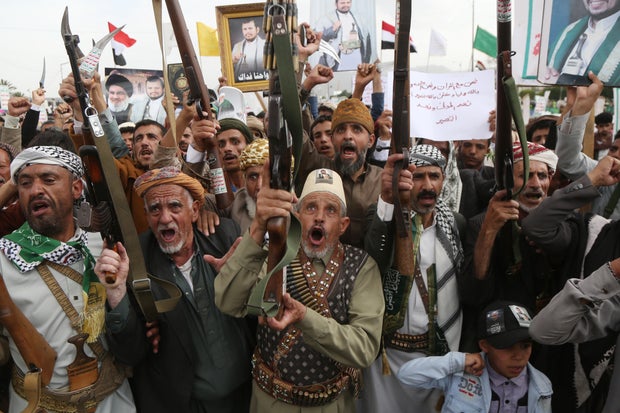
"What the enemy is promoting is imaginary heroism to satisfy its masters," Houthi military spokesperson Brig. Gen. Yahya Saree said in a post on X, dismissing the Saudi and Yemeni government claims as part of what he called the enemy's "malicious methods."
The Houthis seized virtually all of Yemen's Red Sea coast in a lightning offensive launched in early September, including territory along the vital shipping lanes of the Bab el-Mandeb Strait, which is the southern gateway to the Red Sea.
The Saudi-backed Yemeni government claimed Monday to have retaken the Red Sea port city of Mocha and other key territory near the Bab el-Mandeb Strait, a key global energy chokepoint.
Trump suggests allowing Iran to "take out" LA and San Diego during campaign rally
Gov. Gavin Newsom rebuked President Trump after he suggested letting Iran "take out" Los Angeles and San Diego during a campaign rally in Nebraska.
"It's a small price to pay for keeping the world safe, keeping our country safe," Mr. Trump said. "They can take out a city. Let them take out Los Angeles. Let them take out San Diego."
Attendees cheered after his suggestion.
"After sending the National Guard and Marines to occupy California, Donald Trump is now saying our foreign enemies should 'take out' Los Angeles and San Diego," Newsom wrote on X. "He is deranged and dangerous."
San Diego Mayor Todd Gloria wrote on X that, "San Diego is not collateral damage. We are not expendable. And we are never a 'small price to pay.' Keep our city out of your reckless war talk."
Tom Wait and Matthew Rodriguez
Trump signs executive order on tax-free use of red dye diesel in attempt to cut costs for farmers
President Trump on Monday signed an executive order to ease limits on the tax-free use of red dye diesel, a decision he said would save "millions" for farmers and drive down the cost of all goods as war with Iran continues to drive up fuel prices.
"The typical trucker will save more than $100 every time they fill up," Mr. Trump said, signing the executive order onstage before a crowd in Grand Island, Nebraska, located in the solidly conservative south-central part of the state.
"Pete and Jim, this should absolutely ensure your election, I guarantee you that," Mr. Trump said, addressing GOP Gov. Pete Ricketts, who is running against an independent candidate backed by national Democrats, and Gov. Jim Pillen, who is seeking a second term.
Diesel fuel prices have spiked in the aftermath of the Iran war, rattling voters and putting pressure on Republicans. It hit a record high of $6.53 a gallon last month, and has only eased slightly since then, according to AAA data.
The dyed diesel fuel is exempt from federal and state excise taxes. Temporarily removing the limits would reduce cost pressures on the businesses that rely on diesel.
Mr. Trump last month also floated the idea of banning diesel exports to help temporarily lower prices.
CBS/AP
Yemen's Houthi forces say they targeted Riyadh airport, Saudi Aramco refinery
The Iran-backed Houthis in Yemen said they had struck the international airport in Saudi Arabia's capital of Riyadh, a Saudi Aramco refinery and other sites across the kingdom's south in response to the Saudi-led coalition's attacks on Houthi military targets earlier Monday.
The attacks, which included drones, ballistic and cruise missiles, targeted King Khalid International Airport in Riyadh, Houthi military spokesman Yahya Saree said in a statement, adding that the Aramco refinery in Rabigh was also hit along with military sites and smaller airports.
The statement also warned "all global airlines using Saudi airspace against continuing their flights," with the exception of airspace over Mecca and Medina.
U.S. forces destroyed 13 commercial ships in Strait of Hormuz in recent months, CENTCOM says
The U.S. military destroyed 13 commercial ships in the Strait of Hormuz over the past 12 weeks, U.S. Central Command said in a statement Monday.
CENTCOM said the commercial vessels were either violating the U.S. Navy's blockade of the waterway, which resumed nearly three months ago under President Trump's direction, or were part of the Islamic Revolutionary Guard Corps' multibillion-dollar shadow network.
Since July 14, U.S. forces have disabled three ships that refused to comply and redirected 130 commercial vessels attempting to pass through the strait, according to CENTCOM.
Saudi Arabia and allies say their coalition attacked military targets in Yemen
A Saudi Arabia-led coalition in Yemen said Monday it had struck "military targets" belonging to the Houthis in Hodeida on the Red Sea coast.
Coalition spokesman Turki Al-Malki said on X that its naval forces had "destroyed weapons depots, facilities storing booby-trapped boats and naval mines" and had "thwarted a planned attack" targeting waterways in the southern Red Sea.
The Yemeni military said it carried out more than 1,000 strikes and began an offensive against the Houthi-held capital, Sanaa, while the Saudi-led coalition supporting the internationally recognized government said 100 warplanes flew sorties at dawn.
The government had announced on Sunday the lofty goal of retaking all Houthi territory — home to most of Yemen's population, and much of it held for more than a decade.
Last month, the Iran-backed group seized swathes of coastline along the Red Sea and Bab el-Mandeb Strait, a chokepoint for oil and cargo shipping, in Yemen's deadliest fighting in years.
Turkey, Pakistan to deploy troops to Saudi Arabia amid escalating Houthi attacks
Turkey and Pakistan will undertake a "rapid deployment" of troops to Saudi Arabia as part of a new mutual defense alliance, the three countries said Monday, as the Gulf kingdom faces escalating attacks from Yemen's Houthis.
Following a meeting in Riyadh, the trio agreed "to move immediately to the practical implementation of the collective defense commitments and to take the necessary measures to provide the agreed military forces and capabilities and ensure their rapid deployment in the Kingdom," according to a joint statement.
Iran president calls U.S. negotiations "meaningless," state media reports
Iranian President Masoud Pezeshkian said negotiations with the U.S. were "meaningless" and only resulted in renewed attacks, state media reported, with progress on ending the Middle East war stalled for months.
"So far, they have attacked us three times after talks, and this shows that they are not seeking dialogue; rather, their goal is to overthrow the Islamic Republic of Iran," Pezeshkian was quoted as saying by the state news agency IRNA on Monday.
"With an enemy that every day resorts to assassination, sanctions, pressure and threats, and that breaks its commitments, negotiations are meaningless."
Negotiations have effectively been at an impasse since Iranian attacks on vessels in the Strait of Hormuz prompted the U.S. to resume military operations, and recent indirect talks between the U.S. and Iran on the sidelines of the U.N. General Assembly failed to produce a breakthrough.
After the U.S. scaled back military operations in September, favoring economic pressure instead, Iran's top diplomat said Sunday that the war would not be resolved through military action or new sanctions.
Vowing that Iran would respond with a stronger defense if attacks resumed, Foreign Minister Abbas Araghchi said that "only negotiations based on justice and fairness could end the conflict."
CBS/AFP
Direct flights between Iraq and Iran to resume this week, airline says
Iraqi Airways will resume direct flights to Iran starting Thursday, the airline announced Monday, according to Iraq's Ministry of Transport.
The airline said its "new operating plan will include regular daily flights" between Najaf International Airport, in central Iraq, and major Iranian airports in Mashhad, Tehran and Isfahan.
The move comes as part of efforts by Iraq's Ministry of Transport to "reactivate air transport" and strengthen air connectivity between Iraq and regional destinations.
According to the ministry's statement, the move to restore flights to Iran aims to "enhance the smooth flow of passengers" and provide "regular air transport options between Iraq and Iranian cities."
Trump blames Ukraine strikes on Russian oil infrastructure for driving up gas prices instead of Iran war
President Trump on Monday blamed Ukrainian attacks on Russian oil refineries for high gas prices, insisting that the Iran war was no longer responsible.
"What's driving up Gasoline is no longer the Strait of Hormuz, because Record Numbers of Barrels are coming out now on an almost daily basis, but the word, 'Refineries,' where Russia's are being blown up by Ukraine," Mr. Trump wrote in a Truth Social post.
Mr. Trump also blamed what he said was the closing of oil refineries in California, led by Democratic Gov. Gavin Newsom, with whom the president has a longstanding political rivalry. His comments came as the Republican Party potentially faces losing control of Congress after the November midterm elections.
CBS/AFP
Iranian interior minister travels to Doha for talks with Qatari counterpart
Iranian Interior Minister Eskandar Momeni traveled to Doha on Monday, where he'd been invited by his Qatari counterpart to meet with senior Qatari officials.
Momeni was scheduled to meet and hold talks with Sheikh Khalifa bin Hamad bin Khalifa Al Thani, Qatar's interior minister, according to Iran's Interior Ministry's Information Center. The center said Momeni would also meet with several other Qatari officials during the visit, joined by a delegation of Iranian Interior Ministry officials and governors who accompanied him.
U.N. chief "deeply concerned" by "sharp escalation" of Yemen conflict
United Nations Secretary-General António Guterres said Monday that he is concerned about the "sharp escalation" of conflict in Yemen, amid fighting between Houthi rebels and Saudi-backed government forces.
"The Secretary-General is deeply concerned by the sharp escalation in fighting, which has intensified markedly in recent days," Guterres' spokesperson, Stéphane Dujarric, said.
"He condemns the continued Houthi cross-border attacks against the Kingdom of Saudi Arabia."
CBS/AFP
Soldiers seriously wounded in Iranian drone strike say the U.S. military failed them
U.S. soldiers wounded in the Iran war's deadliest strike yet on American troops are raising concerns publicly, many for the first time, about whether commanders underestimated the threat. Some of those wounded also said the military medical system failed them.
The Pentagon has so far released few details about the Iranian drone strike on Port Shuaiba in Kuwait that killed six soldiers on March 1, the day after the U.S. and Israel started the war against Iran.
The Associated Press spoke with 13 soldiers, primarily officers, serving in key positions of responsibility there or familiar with high-level briefings. Many said the Pentagon did not take Iranian threats seriously enough as it launched Operation Epic Fury. Some of the wounded soldiers said they've faced inadequate medical care and bureaucratic barriers since then.
Several soldiers spoke on the record — rare for troops still in the Army — others on the condition of anonymity for fear of reprisal.
U.S. approves $1 billion arms sale to UAE
The U.S. on Monday announced the approval of a $1 billion sale to the United Arab Emirates of up to 10,000 Advanced Precision Kill Weapon System guidance sections for rockets.
"The proposed sale will improve the United Arab Emirates' capability to meet current and future threats by developing and maintaining a strong and ready self-defense capability and improving interoperability with U.S. forces," the State Department said in a statement.
It "will support the foreign policy and national security objectives of the United States by improving the security of a major defense partner," the statement added.
The Advanced Precision Kill Weapon System converts unguided rockets into precision munitions that can be employed for purposes including shooting down drones, thereby avoiding the use of costly missiles to shoot down comparatively cheap aircraft.
The UAE and other U.S.-allied Gulf countries – many of which are home to American bases – have been hard hit by the Iran war, during which Tehran's forces have repeatedly targeted them with both drones and missiles.
The State Department also announced on Monday the approval of a $400 million sale to Kuwait – another Gulf state – of "repair and return services" for Patriot missiles, which have played a key role in countering Iranian attacks in the region.
"Kuwait will use the enhanced capability to strengthen its homeland defense" and "will have no difficulty absorbing these articles and services into its armed forces," the department said in a statement.
CBS/AFP
3 tankers struck in Strait of Hormuz over the weekend, according to maritime monitor
Three tankers were hit by unknown projectiles in the Strait of Hormuz over the weekend, according to the U.K. Navy's Maritime Trade Operations Center (UKMTO). The attackers are unknown.
Two of the vessels were crude oil carriers; one was a liquid natural gas carrier, according to UKMTO.
The monitor reported earlier that another tanker transiting the strait on Monday was instructed to turn around by Iran's Revolutionary Guard Corps "or the vessel would be targeted."
"The master of the tanker has confirmed that they have complied with the instruction," UKMTO wrote in its update.
Iranian officials said Sunday that a U.S. response to Tehran's proposed conditions for reopening the strait was being reviewed Sunday and it was preparing one of its own. President Trump had rejected Tehran's proposed conditions for reopening the Strait of Hormuz while leaving the door open to further talks or renewed military operations.
Houthis accuse Saudi Arabia of escalating attacks
The Houthis have accused Saudi Arabia of escalating its military campaign and blockade against Yemen, saying Riyadh was returning to a direct role after what the Iran-backed rebel group described as its previous failures.
In a statement shared on social media, Houthi spokesperson Mohammed Abdel Salam, who is based in Muscat, Oman, accused Saudi Arabia of carrying out airstrikes targeting civilian areas and residential neighborhoods in several Yemeni provinces.
In 2015, Saudi Arabia intervened in Yemen's months-old civil war on the side of the internationally-recognized government against the Houthis.
A 2022 ceasefire had largely held until this summer, when the Iran war reignited fighting in Yemen. That fighting escalated Monday, with both sides claiming to have control over the crucial Bab el-Mandeb Strait energy chokepoint.
Saudi-backed government forces announced a new operation, meanwhile, aimed at retaking control of Yemen's capital city Sanaa, which has been under Houthi control for more than a decade.
In his statement, Salam accused Saudi Arabia of being "at the forefront of the aggression against Yemen, committing dozens of massacres, as happened today in more than one province."
Iran executes two men over killing of four police officers during January protests
Iran's judiciary said two men were executed Monday for involvement in the deaths of four police officers during anti-government protests in January. Authorities accused them of murdering the officers in the central city of Isfahan during protests that began in the capital Tehran in December over economic grievances before spreading nationwide.
"Alireza Sepahi and Alireza Raissi were hanged this morning after the Supreme Court upheld the verdict," the judiciary's Mizan Online website said, without specifying the dates of their arrest or any details of their trials.
The court had sentenced the two men, whose ages were not given, to death "for membership in an armed group and undermining national security," Mizan added.
The number of executions in Iran has risen since the start of the war with the U.S., which was triggered in late February by joint U.S.-Israeli strikes on Iran.
In 2025, Iran more than doubled its number of executions, according to Amnesty International.
On Saturday, Iran announced the execution of another man convicted of numerous charges including firing a military-grade weapon at police officers during the protests.
CBS/AFP
Houthis warn airlines that Saudi airspace "will be a theater for operations"
A Houthi-affiliated group on Monday warned airlines against operating in Saudi Arabian airspace, indicating the Iran-backed rebels could threaten civil aviation over Saudi Arabia as long as the kingdom's support for Yemen's government forces continues.
"For the safety of civil aviation, we warn airlines operating in the skies of Saudi Arabia that they are unsafe as long as the Saudi aggression against our country continues," the center said.
The statement from the Houthis' Humanitarian Operations Coordination Center (NOCC) said "the skies of Saudi Arabia will be a theater for operations by our armed forces," declaring that the rebel group would accept "no responsibility after this announcement" for anything that happens to aircraft.
Yemen's Saudi-backed government announces assault to retake capital city Sanaa from Houthis
Yemen's Saudi-backed government claimed Monday to have launched an assault on the country's Houthi-held capital of Sanaa, as fighting against the Iran-backed rebels continued to convulse the country.
"Our armed forces have begun implementing a strategic offensive operation on Sanaa," Majed Al-Nazili, spokesman for the Yemeni armed forces, said Monday in a post on X.
The Houthis said government strikes on Sanaa had killed a female student.
"A student was killed and two others were wounded in a Saudi attack" on the Bani Hashish area, the Houthi-affiliated TV channel Al-Masirah reported, adding that strikes also targeted Saada, a region known as a stronghold.
The Houthis seized Sanaa more than a decade ago, at the outset of Yemen's grinding civil war, which has now become intertwined with the wider war in the region sparked by the joint U.S.-Israeli strikes on Iran at the end of February.
CBS/AFP
Tanker turns back in Strait of Hormuz after Iranian threats, U.K. navy maritime agency says
A tanker turned back after being threatened by Iranian forces in the Strait of Hormuz on Monday, according to the U.K. navy's Maritime Trade Operations center (UKMTO).
"A tanker transiting the Strait of Hormuz inbound was hailed by the [Iranian Revolutionary Guard Corps] and instructed to turn back or the vessel would be targeted," UKMTO said, adding that the "master of the tanker has confirmed that they have complied with the instruction."
The ship was entering the strait near Oman's coastline, the agency added, using a route touted repeatedly by the U.S. government as safe and open.
On Sunday, UKMTO said it received a report of a possible attack on another tanker in the region's other vital shipping chokepoint, the Bab el-Mandeb Strait, which is the southern gateway to the Red Sea.
Multiple explosions detonated close to a tanker south of Al-Mukha, Yemen, in the Bab el-Mandeb, the monitor said, adding that the crew were reported safe.
Hormuz, through which about one fifth of the world's oil and gas transited before the war, remains a key sticking point in negotiations between Iran and the U.S. to end their conflict.
While attacks on ships blamed on Iran have continued, the U.S. has not announced strikes against the Islamic Republic since Sept. 1.
CBS/AFP
Head of state energy giant Saudi Aramco warns global oil stockpiles "scarily thin"
Global oil stockpiles are "scarily thin" owing to the U.S.-Iran war, Saudi Aramco chief executive Amin Nasser said Monday, days after G7 nations agreed to release more of their inventories to ease supply concerns.
"The system is already straining," Nasser told the Energy Intelligence Forum in London. "And with precious little else the world can turn to, the supply resilience cushion is scarily thin."
His remarks came hours after the news that oil flows from the Middle East surpassed pre-war levels last week. That welcome news for markets has been tempered, however, by furious fighting between Saudi-backed forces and Iran's Houthi rebel allies in Yemen over control of the Bab el-Mandeb Strait, another key energy chokepoint and the southern gateway to the Red Sea.
CBS/AFP
Conflicting reports about flow of oil through Saudi Arabia's East-West pipeline after new strike
Saudi Arabia's East-West Crude Oil Pipeline was struck again Sunday, a source working in the kingdom's energy sector told French news agency AFP on Monday, adding that the flow of oil through the pipeline had stopped.
"The East-West pipeline was attacked again yesterday," the source told AFP. "A pumping station east of Riyadh in Khurais. It wasn't targeted before. There was big damage and the pipeline stopped again."
The Reuters news agency reported Monday, however, that oil was still flowing through the pipeline, also citing an unnamed source. Bloomberg also reported that oil was still flowing, citing people familiar with the matter.
News of the strike came a day after the Iran-backed Houthis in Yemen said they had targeted sites in Saudi Arabia belonging to state oil giant Aramco, including infrastructure in Khurais.
The East-West pipeline has been targeted multiple times since war erupted across the Middle East, following the U.S. and Israel launching joint strikes on Iran at the end of February.
Last month, Saudi Arabia, the world's top oil exporter, shut the East-West pipeline, which runs about 700 miles between its main oil fields in the east and the Yanbu terminal on the Red Sea.
The pipeline was shut down from Sept. 11 to 22, according to commodity-tracking platform Kpler.
CBS/AFP
Yemen's military announces broad strikes against Houthis, claims control of Bab el-Mandeb Strait
The Yemeni military announced a broad set of strikes against Houthi targets on Monday after the government declared a new campaign to retake all territory from the rebels, even as the Iran-backed group made fresh gains on the ground.
The declared offensive sets a lofty goal for the beleaguered Saudi-backed government a month after it lost swathes of the country's Red Sea coastline, including key territory around the Bab el-Mandeb Strait — a key choke point for international shipping.
Hours after the Yemeni government's announcement, Yemen's military spokesman said its forces launched over 1,000 "strikes against artillery and rocket launcher positions, defensive fortifications, approach and reinforcement routes, supply lines and logistics assets, combat reinforcements" belonging to the Houthis.
He later said the military had taken back control of the Bab el-Mandeb Strait. Houthi-aligned media earlier denied government forces had retaken territory in the area, the Reuters news agency reported.
The government strikes appear to have had little immediate impact on the Houthis' ongoing advances on the ground. On Sunday, the group effectively encircled the key city of Taiz after cutting the main supply route linking it to the interim government capital of Aden.
Fighting between the two sides in and around Taiz province killed more than 70 people in a single day, sources from both sides of the conflict told the French news agency AFP on Sunday. The agency previously reported that 80 combatants had been killed on Friday.
CBS/AFP
Iran's top diplomat says only talks can end the war, not military moves
Iran's foreign minister insisted on Sunday that there would be no military solution to the United States' war against the Islamic republic, with talks on ending the conflict apparently at an impasse.
A campaign of heavy U.S. bombardment failed to bring a decisive close to the war as it began, and Washington has dialed back military operations in recent weeks in favor of economic pressure.
The main point of contention remains Iran's continuing attempt to blockade the Strait of Hormuz, a vital conduit for Gulf oil and gas where a U.K. maritime agency reported on Sunday that another tanker had been struck by an unknown projectile.
"If our enemies again choose the path of military confrontation, our response will be stronger than before, and we will defend ourselves with even more force," Abbas Araghchi said at a gathering of his counterparts.
"There is no military solution, nor any solution based on new sanctions," he continued, adding "only negotiations based on justice and fairness" could end the conflict.
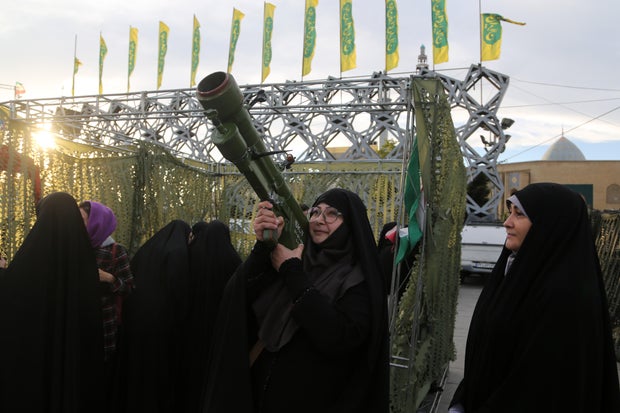
The two sides signed a memorandum of understanding in June that spelled out a framework for a permanent resolution, but Iranian attacks on vessels in the strait prompted the U.S. to resume military operations.
Iran has sought to impose its control over the vital shipping lane since the start of the war, striking vessels that try to transit without its authorization.
The U.S. has imposed a counterblockade of Iranian ports and has struck vessels it accuses of violating the countermeasure.
Mideast oil exports exceeded pre-Iran war levels last week, tracking firm says
Middle East oil exports, excluding those from Iran, surpassed their pre-war levels last week, despite attacks on ships in the Strait of Hormuz, according to data from the maritime tracking firm Kpler.
For the first time since the U.S. and Israel launched their offensive against Iran at the end of February, the weekly average of shipments rose for several days above the pre-conflict average of 18 million barrels per day.
Crude oil exports reached pre-war levels in September, with at least 16.5 million barrels leaving the region excluding Iran, Kpler said.
"Forty percent now bypass Hormuz, and most crude crossing the strait changes tankers offshore," Kpler said, adding that most of the oil flowed through Saudi and United Arab Emirates pipelines.
Those figures include flows via the Red Sea, a route increasingly used to bypass the blockade Iran is attempting to impose on the strait, through which around a fifth of the world's petroleum supplies crossed before the conflict.
Iran still claims control over the strait, and ships without its authorization risk coming under attack, but more and more are making it out, and alternative routes meant to bypass the waterway are operating at full capacity.
Despite the rebound, experts stressed that the situation is far from normal, and Iran is still being deprived of a large share of its own exports by a U.S. counterblockade of Iranian ports.
Energy Secretary Chris Wright says Trump was "well aware of the risks to energy flows" before launching Iran war
Energy Secretary Chris Wright said Sunday that President Trump was "well aware of the risks to energy flows" before launching the war in Iran earlier this year, but argued "the world cannot sustain a nuclear-armed Iran."
"He knew it was going to elevate energy prices in the short run, he said, 'I'm going to take a hit there, but I got to do the right thing,'" Wright said on "Face the Nation with Margaret Brennan."
Americans have been feeling the financial squeeze of soaring gas and diesel prices in recent months. But the Trump administration has pointed to the potential threat a nuclear-armed Iran could pose, and how it could represent a long-term threat to energy prices. Wright defended the president on Sunday, arguing that Mr. Trump has taken a "strong stand that Iran, the world's greatest terrorist regime, cannot and will not have nuclear weapons."
Wright expressed confidence that prices will fall, pointing to increasing supplies coming out of the Strait of Hormuz, U.S. gasoline production, the summer driving season slowing, among other factors. Asked whether he expects prices to go down over the next four weeks — as Republicans eye a tough environment in the lead-up to the midterm elections — Wright said, "absolutely."
Iran preparing response after U.S. rejects conditions to reopen Hormuz, Iranian officials say
After President Trump rejected Tehran's proposed conditions for reopening the Strait of Hormuz — while leaving the door open to further talks or renewed military operations — Iranian officials said the U.S. response was being reviewed, and it was preparing one of its own.
"The Americans, through intermediaries, have also conveyed their views on this proposal, and these views are currently being examined inside the country through the relevant channels and procedures," Iranian Deputy Foreign Minister Kazem Gharibabadi told reporters on Sunday, according to the Iranian state news agency IRNA.
"Whenever the final position of the Islamic Republic of Iran is ready, appropriate steps will be taken accordingly," he said. "At the same time, the Islamic Republic of Iran is also preparing itself for any other possible scenario."
Meanwhile, Iranian foreign ministry spokesperson Esmaeil Baqaei characterized the latest U.S. counterproposal as being "in line with their previous proposals concerning nuclear issues."
"We have clearly indicated that we are focusing on the issue of the Strait of Hormuz," he said Sunday, adding that reopening the waterway required "an end to the disruptions to Iranian commercial maritime traffic and the lifting of sanctions."
The U.S. and Israel have said the war is necessary to prevent Iran from acquiring nuclear weapons, though the focus soon shifted to reopening the Strait of Hormuz after its closure sent shockwaves through world energy markets.
CBS/AFP