Iranian vessel struck on Strait of Hormuz, as Houthis expand control of oil shipping lane
Follow updates on the war in the Middle East for Monday, Sept. 14, here. See earlier developments below.
What to know about the Iran war:
- Iranian state media said early Sunday that 1 person was killed and 3 were injured after one of their commercial vessels was struck near the Strait of Hormuz.
- Yemen's Houthis, a group backed by Iran, have in recent days expanded their control of the strategic Bab el-Mandeb Strait, through which much of Saudi Arabia's oil has flowed since the disruption on the Strait of Hormuz. The move makes it easier for the Iran-backed rebels to further choke Saudi oil exports.
- Yemen government forces, supported by Saudi Arabia, said Saturday they had launched strikes against Mokha, newly in Houthi hands. Weapons and vehicles were destroyed and Houthi fighters were killed, a spokesperson said.
Iranian cargo vessel struck in Strait of Hormuz killed 1 and wounded 4, state media reports
An Iranian cargo vessel was struck early Sunday off Qeshm Island in the Strait of Hormuz, Iranian state media said, and a plan by Tehran to brief neighboring countries on its contested efforts to manage shipping in the strait was postponed.
The attack, which the reports said killed one and wounded four, drew attention back to the strait after threats to shipping in the region intensified last week when Iran-backed Houthi rebels captured an island on the Bab el-Mandeb Strait in the Red Sea.
Iran's state-run IRNA news agency quoted the Qeshm governor as blaming a "terrorist enemy" for Sunday's attack. There was no immediate comment by the U.S. military, which has struck Iranian-flagged vessels during its blockade of Iranian ports and faces a new threat from Iranian ballistic missiles launched at its warships.
Qeshm Island, about 14 miles from the port city of Bandar Abbas, is key to Iran asserting control over the Strait of Hormuz.
Hours before the attack, Iran's government remained defiant. "Our people can't be bullied into submission. Iran won't surrender," President Masoud Pezeshkian said in a social media post.
President Trump disagreed, saying on Sunday that Iran "wants to make a deal so bad" that "they're calling constantly." Mr. Trump spoke at his golf course in Doonbeg, Ireland, where he was attending a tournament.
Later, when asked by a reporter whether the U.S. struck the Iranian cargo vessel early Sunday in the Strait of Hormuz, Mr. Trump said: "I don't want to say." He then boarded Air Force One to head back to Washington.
U.S. Embassy in Abu Dhabi warns Americans of "continued need for caution"
The U.S. Embassy in the United Arab Emirates issued a security alert on Saturday, warning Americans in the Middle East country to exercise increased caution in areas associated with the Jewish and Israeli communities.
"The U.S. Mission to the United Arab Emirates reminds Americans of the continued need for caution at locations in the UAE associated with the Jewish and Israeli communities, including places of worship," the alert dated Friday, Sept. 11, said.
The embassy did not specify whether there were threats at any specific sites. This weekend marks the Jewish holiday Rosh Hashanah.
Since March, the Department of State has advised Americans worldwide to exercise increased caution following the U.S.-Israeli war with Iran.
Trump says he doesn't care if Gulf states meet with Iran
President Trump, asked about Gulf states meeting with Iran in Oman on Monday to discuss the Strait of Hormuz, said he doesn't care.
"I don't care. That's up to them," Mr. Trump told reporters at his golf course in Ireland. "If they could be happy… if they're happy, that's fine."
The planned meeting comes as the Islamic Republic has blockaded the Strait of Hormuz during the war, driving up oil prices.
Mr. Trump claimed on Sunday that the war with Iran will end "right after the midterms," adding that "gasoline is going to drop like a rock." He said "Iran wants to make a deal so badly," saying they are "calling constantly."
Iran president says Tehran and UAE want to "turn the page" on war
Iran and the United Arab Emirates, whose relations have deteriorated since the start of the Middle East war, want to "turn the page", the Iranian president claimed on Sunday.
"For the first time since the war and the incidents that occurred in the Persian Gulf, we had a constructive exchange with the crown prince of Abu Dhabi," Massoud Pezeshkian said a day after a meeting with Sheikh Khaled Bin Mohamed Bin Zayed Al Nahyan in India, on the sidelines of the BRICS summit. "It was agreed that we would turn the page, look to the future and build it together."
After U.S.-Israeli attacks on Iran in February launched the Middle East war, Tehran retaliated against America's allies in the region, with the UAE bearing much of the brunt.
In August, the UAE announced it was suspending trade and financial exchanges with Iran.
Dubai, the UAE's largest city, is home to a deeply rooted Iranian community and is a vital economic lifeline for Iran, which is struggling under the weight of U.S. and international sanctions.
Yemen official describes Houthi advance as "painful"
A senior government official in Yemen said its forces will return to the Red Sea coast and fight back, after the Iran-backed Houthis' swift capture of territory last week.
Sultan al-Arada, a member of the ruling presidential council, described the collapse of government forces in the port city of Mokha and elsewhere on Yemen's west coast as "painful and regrettable."
Al-Arada, also governor of central Marib province, said in the televised interview aired late Saturday that forces "are currently regrouping and will return to the battle in one form or another."
On Friday, a senior military official with Yemen's internationally recognized government blamed "lack of coordination" between Yemen's army and multiple allied militias, saying it gave the Houthis "a priceless opportunity."
The official, who spoke on condition of anonymity because he wasn't allowed to speak to the media, also said they were stunned that the Saudi air force didn't act to prevent the capture of Mokha, about 50 miles from the strait.
Houthis say they fired drone towards Saudi Arabia
Iran-backed Houthi rebels in Yemen said they fired drones and missiles toward neighboring Saudi Arabia.
The Houthis' military spokesperson, Brig. Gen. Yahya Saree, claimed in a statement that they targeted a military base in Sharurah province in the Najran region. He didn't provide evidence or say when the attack took place. Sirens went off in the province on Saturday, according to the Saudi civil defense, which didn't report casualties or damage.
The civil defense overnight also said a projectile fell in al-Tawwal governorate near the border with Yemen along the Red Sea, injuring two people and damaging a mosque and several other buildings. The statement blamed the Houthis.
1 killed, 3 wounded in strike on Iranian vessel
1 person was killed and 3 were wounded when an Iranian commercial vessel was struck early Sunday near the Strait of Hormuz, Iran's state media reported.
The United Kingdom Maritime Trade Operations monitor separately reported a vessel was hit by a projectile while transiting the strait, with no details.
There was no immediate statement by the U.S. military, which previously has struck Iranian-flagged vessels as it keeps up a blockade of Iranian ports.
CBS/AP
Iran, Russia condemn Western sanctions at BRICS summit in New Delhi
The BRICS group of emerging economies on Saturday expressed concern over rising tensions in the Middle East and condemned the use of sanctions not authorized by the United Nations, as the leaders met in New Delhi to strengthen their position in global affairs seen as dominated by the West.
The meeting, which included Iranian President Masoud Pezeshkian, voiced concern over "deliberate attacks" on civilian infrastructure and peaceful nuclear facilities under the U.N. atomic energy agency's safeguards, saying nuclear safety and security must be protected during armed conflicts. The statement was seen as indirect criticism of U.S. and Israeli strikes on Iranian nuclear facilities.
The leaders also took aim at unilateral sanctions not authorized by the U.N. Security Council. They did not name any countries, but Russia, one of the founding members of BRICS, has faced Western sanctions following its full-scale invasion of Ukraine in 2022.
"We call for the elimination of such unlawful measures, which undermine international law and the principles and purposes of the U.N. Charter," the joint statement said.
Iran has also pushed for mechanisms that could reduce the bloc's reliance on Western financial systems and shield members from economic pressure, as Tehran faces sweeping sanctions and a U.S. blockade.
"One of the most important steps is to expand the use of national currencies in trade among the members," Pezeshkian told reporters on Friday.
For India, the summit also highlights its effort to maintain strategic ties with Russia and Iran while deepening relations with the U.S. and Europe. New Delhi has sought to balance its longstanding partnerships with Moscow and Tehran with efforts to expand economic, defense and technology ties with Washington and other Western nations.
India has maintained close ties with both Moscow and Tehran despite the war in Ukraine and tensions between Iran and the U.S., while calling for dialogue and diplomacy to resolve conflicts. Modi met Putin and Pezeshkian separately in New Delhi on Friday ahead of the summit.
In May, BRICS foreign ministers failed to agree on a joint statement over the Iran war, forcing India to issue a chair's summary instead.
The 11 nations in BRICS are China, Russia, India, Iran, Brazil, Egypt, Ethiopia, Indonesia, Saudi Arabia, South Africa and the United Arab Emirates.
Houthis say they struck Saudi military base
The Iranian-backed Houthi militant group in Yemen said early Sunday local time that it used drones and missiles to attack a military base in southern Saudi Arabia.
The attack at the Sharurah base targeted "weapons depots and command and control centers that are managing the aggression against our nation and people," Houthi military spokesman Yahya Saree wrote on X.
The date of the operation was not specified. Clashes have increased this week between the Houthis and Yemeni government forces, which are backed by Riyadh.
The ongoing clashes follow a week-long Houthi offensive that culminated in the group capturing the remainder of Yemen's Red Sea coast and several strategic islands, cementing their hold on the Bab al-Mandab Strait at the sea's southern entrance.
The waterway has become an important artery for Saudi Arabian oil exports after Iran largely cut off shipments through the Gulf with its blockade on the Strait of Hormuz at the start of the Iran war.
The Houthis have recently declared their own maritime blockade of Riyadh's Red Sea ports.
Explosions heard off coast of Qeshm in southern Iran: State media
Explosions were heard Saturday off the coast of an island located in the Strait of Hormuz, Iranian state media said.
"A few minutes ago, the sound of two explosions was heard on Qeshm Island, coming from the direction of the sea," the official IRNA news agency said.
In recent weeks, Iran has been targeting oil tankers passing through the strategic waterway as well as U.S. bases in the Gulf countries in retaliation for the attacks carried out by the U.S. military on Iranian targets.
The United States has also targeted ships trying to break its own counterblockade of Iranian ports.
Houthis say they've liberated more than 200 prisoners in newly captured regions
Yemen's Houthis said on Saturday they had freed more than 200 of their members detained by Saudi-backed pro-government forces in areas they captured in recent days.
Houthi official Abdelkader al-Murtada said they were prisoners of war who had spent up to eight years in jail before the Iran-backed group launched a rapid offensive to take over areas bordering the Bab el-Mandab Strait.
"We have welcomed 210 of our prisoners, freed from Saudi enemy prisons on the west coast," Murtada said at a conference in the capital, Sanaa.
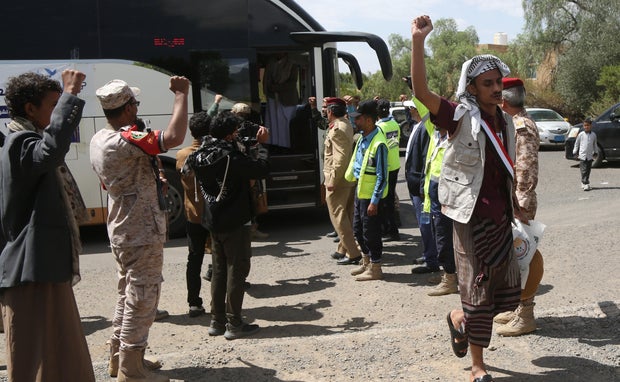
The Houthis had already controlled large parts of northern Yemen, including most of the country's populated areas and the major cities of Sanaa and Hodeida, before making dramatic advances last week.
Aboard the large buses taking them to the capital, the freed detainees celebrated their liberty by chanting "Death to America, death to Israel" before being welcomed by their supporters.
"I have rediscovered the taste of life. For five years I was in prison, under the yoke of aggression. For five years, I suffered every day," Mohammed Bajash told AFP.
Yemen government forces launch strikes against Houthis in Red Sea city
Yemen's Riyadh-backed government forces said on Saturday they had struck Iran-allied Houthi fighters in the strategic Red Sea city of Mokha.
Following a weeklong offensive, the Houthis on Friday captured Yemen's Red Sea coast, cementing their hold on the Bab el-Mandab Strait, a vital artery for Saudi Arabian oil exports as the Strait of Hormuz remains closed amid the U.S.-Iran war.
They had seized Mokha the day before after heavy fighting.
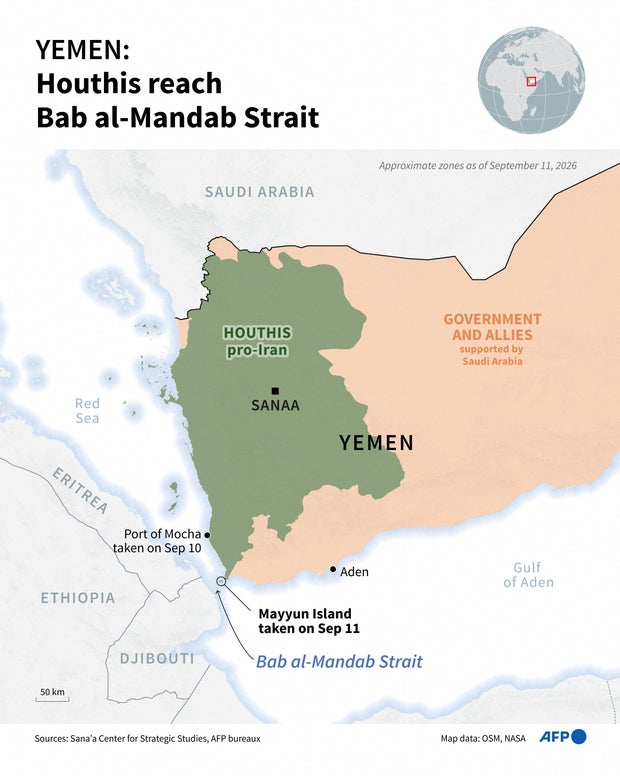
"The armed forces destroyed vehicles and weapons and killed members of the Houthi terrorist militia backed by the Iranian regime" near Mokha's port, the government news agency Saba reported on Saturday.
The spokesman for the Yemeni government forces, Majed Abdullah al-Nazili, said they had also struck Houthi vehicles and fighters on the Mokha-Dhubab road, just outside the city, according to Saba.
"In the past 48 hours, Saudi enemy aviation has launched 129 airstrikes distributed across the provinces of Taiz, Marib, Hodeidah, Al-Jawf, Saada, Amran, and Hajjah," a Houthi spokesperson said. "These aggressions against our people will not go unanswered and unpunished."
CBS/AFP
At least 76,000 have fled fighting in Yemen since July: U.N.
At least 76,000 people have been displaced in Yemen since July, with the number quadrupling in the past week as fighting flared between government forces and Iran-backed Houthi rebels, the United Nations said Saturday.
"The International Organization for Migration (IOM) is warning of a rapidly worsening displacement crisis in Yemen unfolding by the hour," the U.N. agency said in a statement.
The Houthis, who have for years controlled large parts of northern Yemen, launched a large-scale offensive last week against Saudi-backed Yemeni government forces, scoring one victory after another in fighting that has left hundreds dead.
Since the Houthis announced a maritime blockade against Saudi Arabia in July, "at least 76,000 people have fled their homes," IOM said.
"That's four times last week's total, as fighting intensifies," it said, warning "entire families are on the move, often at night. They have nowhere safe to go."
More than 70,000 of those displaced had fled just since the start of September, an agency spokesman told AFP.
U.S. blockade on Strait of Hormuz has now redirected 100 ships, military says
The U.S. blockade on the Strait of Hormuz has now redirected 100 ships trying to exit or enter Iranian ports, according to the U.S. Central Command.
Central Command said on Friday the total stood at 99 and said 96 had been redirected through Thursday.
"ZERO ships have passed through the blockade without U.S. forces allowing. American service members remain laser focused on this mission," CENTCOM said on X.
The blockade was put back into place on July 14 after the memorandum of understanding between the U.S. and Iran fell apart. Iran felt the language of the MOU determined it would control flow through the Strait of Hormuz, while the U.S. said that was not the intent. Iran targeted ships traveling on the Oman coast, the U.S.-sanctioned route, and the blockade was put back in place shortly after.
The first blockade, which was in place from April 13 to June 18, redirected about 140 ships.
Iraq pledges investigation into drone launches that targeted Saudi pipeline
Iraqi leader Ali Faleh Al-Zaidi has approved an investigation, requested by Iran, into the drone platforms discovered near the countries' border, according to the prime minister's office.
The drone platforms were reportedly used to launch a strike on the East-West pipeline in Saudi Arabia, a crucial lifeline for crude oil transport across the country with the Strait of Hormuz effectively shut down by Iran.
There are several groups supported by Iran operating in neighboring Iraq, some of which were targeted in joint strikes by the U.S. and Saudi Arabia in late July. The strikes targeted the Popular Mobilisation Forces, the largest of those Iranian proxies in the region, which had conducted strikes against Gulf nations.
While the groups are often supported by Iran and serve in Iran's interests, they are also semi-autonomous. The Iraqi government, backed by the U.S., has also tried to get the proxies to disarm with limited success.
An exclusive look aboard the USS George Washington in its crucial role in the Iran war
The USS George Washington, with its approximately 5,000 personnel, fighter jets and munitions, is the backbone of the U.S. military's tactical operation in the Iran war, as well as a primary target of the Tehran regime.
A CBS News crew was taken aboard the aircraft carrier this week to get an exclusive look at its latest mission, supporting the U.S. war against Iran from its position in the Arabian Sea near the critical Strait of Hormuz.
The George Washington was sent to the Middle East last month to replace the USS Abraham Lincoln, which came under scrutiny for the length of its deployment, a record nine months, and concerns about conditions aboard the carrier and the mental health of its troops.
CBS News watched this week as the George Washington's service members launched nighttime missions to help maintain the U.S. blockade against Iran and provide cover for commercial vessels transiting the strait.
Bahrain says it won't participate in Hormuz meeting with Iran
Bahrain said on Saturday it would not take part in a proposed meeting in Oman between Iran and Gulf states to discuss the Strait of Hormuz, which Tehran has blockaded throughout the war.
Pointing to attacks on infrastructure across the Gulf, the ministry said that security and stability in the region "cannot be preserved through a policy of appeasement" and called for Hormuz to be open without "discrimination, fees or permits."
Iranian President Masoud Pezeshkian did not specify which country's foreign ministers would attend the Monday gathering when he announced it on Friday.
Bahrain has come under sustained drone and missile strikes throughout the war with Iran. It has been one of the top Iranian targets for retribution against the U.S., including targeting the U.S. Navy's Fifth Fleet headquarters.
"They blew the hell out of Bahrain," acting Secretary of the Navy Hung Cao said in an interview with The Epoch Times this week.
CBS/AFP
Iranian president and UAE crown prince meet in New Delhi
Iran's president and the United Arab Emirates crown prince met in New Delhi on Saturday, the Iranian embassy in India said, as the countries remain at odds over the Middle East war.
Iranian President Masoud Pezeshkian "held a meeting and talks" with the senior UAE official on the sidelines of the BRICS summit, the embassy said, posting a photograph of the meeting with Khaled bin Mohamed bin Zayed on social media.
Iran launched several waves of drone strikes and ballistic missiles at the UAE early in the war, including strikes on the Dubai International Airport. More than a dozen people were killed, including civilians, in the attacks. Attacks on civilian locations have waned in recent months, but Iran has continued to target bases used by U.S. troops.
CBS/AFP
Iraq closes 3 Iran crossings after drone strike hit Saudi oil pipeline: Sources
Iraq closed three border crossings with Iran on Saturday, officials told AFP, after a drone attack on a Saudi Arabian pipeline that both Riyadh and Baghdad said was launched from Iraq.
Soon after the attack, Iraqi Prime Minister Ali al-Zaidi dismissed the military commander in Missan province, bordering Iran, after authorities determined the drones had been launched from there.
No group has claimed responsibility, and an alliance of powerful Iran-backed Iraqi armed groups said they hadn't struck the pipeline, but the Saudis have previously accused these groups of targeting its oil infrastructure.
An Iraqi security source and a government official told AFP that authorities ordered the closing of three border crossings with Iran.
The security source said the decision is "part of an intelligence effort to track down the perpetrators and prevent their escape ... and to hinder the smuggling of drones through these crossings."
China, Russia, Iran leaders gather in India as BRICS nations seek common ground
Chinese President Xi Jinping joined the leaders of Russia, Iran, India and other BRICS nations in New Delhi on Saturday, seeking common ground on the Middle East war as deep divisions test the 11-member bloc.
Xi told the summit the Middle East war "does not serve the common interests of the international community," according to Chinese state news agency Xinhua.
Foreign ministers of the BRICS grouping failed to agree on a joint statement when they met in New Delhi in May, with Iran, Saudi Arabia and the United Arab Emirates divided over the war that began with U.S.-Israeli strikes on Feb. 28.
However, Indian diplomatic sources said leaders were working toward a joint position on some issues as the bloc seeks to bolster its global influence and address conflict, trade turbulence and energy security.
BRICS was created in 2009 as a forum for major emerging economies seeking greater influence in institutions dominated by Western powers.
Iran's Pezeshkian attended the summit shortly after warning the Middle East does not need the United States to be a "regional policeman," with the two countries at war and tensions threatening the vital Strait of Hormuz.
UAE President Mohamed bin Zayed Al Nahyan is also at the summit in New Delhi, as is Egyptian President Abdel Fattah al-Sisi, and Saudi Foreign Minister Prince Faisal bin Farhan is expected to join later on Saturday.
BRICS nations call for "restraint" amid Middle East conflict
Members of the 11-nation BRICS group including China, Russia, Iran and India called for calm in the Middle East, in a joint statement issued Saturday at a summit in New Delhi.
"We express deep concern over the continued escalation of tensions in Middle East/West Asia and, recalling our respective national positions, call for exercising maximum restraint, as well as avoiding actions that could further aggravate the situation," said the statement.
The statement also condemned attacks on civilian infrastructure and nuclear facilities.
"We express serious concern over deliberate attacks on civilian infrastructure and peaceful nuclear facilities under full safeguards of the International Atomic Energy Agency (IAEA), in violation of international law and relevant resolutions of the IAEA," it said.
"Nuclear safeguards, safety, and security must always be upheld, including in armed conflicts, to protect people and the environment from harm."
Trump says war with Iran will end "very soon"
President Trump told reporters the war with Iran would end "very soon."
"I think it'll be probably right after the trip," President Trump told reporters during a bilateral meeting in Dublin with the Taoiseach of Ireland.
"They're trying to hold out as long as they can to complicate the election, but I think people are wise to it because Iran cannot have a nuclear weapon. It's very simple," Mr. Trump added.
The president also said Iran was "probably" responsible for the attacks on Saudi Arabia that led to the shutdown of one of the country's main oil pipelines.
Houthis "don't want to fight" U.S., Trump says
President Trump said Saturday that Yemen's Iran-allied Houthi fighters, who have taken control of a vital shipping corridor linking Europe and Asia, have asked Washington not to intervene.
"The Houthis called us and they don't want to fight with us," Trump told reporters on a visit to Dublin, Ireland. "They don't want us to go after them," he added.
Lebanon's president makes rare visit to country's south
Lebanon's president made a rare visit to a southern city Saturday, close to where Israel captured a strategic hill.
President Joseph Aoun's visit to Nabatiyeh came after Israel seized parts of Ali Taher ridge earlier this month, where Israeli officials said they had blown up Hezbollah tunnel networks, despite a June 20, U.S.-brokered ceasefire between Israel and the Lebanese militant group.
The ceasefire largely halted active fighting, which began on March 2. However, Israel has continued attacks and airstrikes on areas in southern Lebanon. Hezbollah has also fired explosive drones without claiming responsibility.
Heads of the crisis-hit nation's security agencies accompanied Aoun, the state-run National News Agency reported. Some residents of Nabatiyeh have been calling on the army to boost its presence in the city in order to avoid a possible Israeli ground offensive.
Lebanon and Israel have held several rounds of direct talks in Washington and Rome. The State Department announced Friday that the next round of Israel-Lebanon talks will be held in Rome in October.
Hezbollah rejects direct talks with Israel and has called on the government to abolish the framework agreement reached in June.
U.S. reportedly asked ships to transit Strait of Hormuz under their protection at specific times
The U.S. military asked tankers to transit through the Strait of Hormuz at specific times in order to protect them from Iranina attacks, according to the British newspaper Financial Times.
Since May, Washington has been offering air-based defense at night to ships wanting to sail through the vital waterway via a route close to the coast of Oman, the newspaper reported.
But at the start of September, vessels were reportedly asked to only sail at specific times in order to guarantee that protection due to a ramp up in attacks.
Iran has repeatedly attacked oil tankers it says were not permitted to transit the strait. Instead, Tehran has insisted ships need to use the route closest to the Iranian border.
Israel-Lebanon peace talks delayed to October, U.S. official says
The next round of negotiations between Israel and Lebanon in Rome have been delayed until October, a U.S. official said Friday.
Last month, the U.S. had said the next round of talks in the Italian capital would take place in early September.
While the Rome talks will not go ahead as planned, the Lebanese and Israeli ambassadors will meet at the State Department in Washington next week "to discuss ongoing developments and the continued implementation" of a framework deal agreed in June, the official said, on a customary condition of anonymity.
The so-called Trilateral Framework involves the disarmament of the Iranian-backed militant group Hezbollah, a gradual withdrawal of Israeli forces from Lebanon's south, and the deployment of the Lebanese army to the region, starting in test areas known as "pilot zones."
The US official Friday said the deal "remains the only viable mechanism to restore Lebanon's sovereignty and Israel's security."
After the U.S. and Israel launched their war against Iran in late February, Hezbollah brought Lebanon into the conflict by launching missiles at Israel.
There had been a lull in violence after the memorandum of understanding reached between Iran and the U.S. in June, followed by an agreement between Lebanon and Israel. But strikes have increased in intensity in recent days.
Saudi Arabia shuts East-West oil pipeline after drone attack causes damage, injuries, Saudi officials say
Saudi authorities shut the East-West oil pipeline in the Riyadh and Medina areas after it came under attack, injuring a number of people, an energy ministry official told state media on Friday.
"The East-West pipeline in the Riyadh and Medina regions was subjected to several attacks on Thursday morning," the official told the SPA news agency, adding, "The pipeline was stopped as a precaution, and the attacks resulted in some injuries."
Saudi Arabia's foreign ministry later said in a statement that the pipeline was targeted by several drones launched from Iraq "which caused human injuries and damage."
While Saudi authorities did not attribute blame for the attack, multiple reports indicate the Iran-backed Houthis targeted the vital crude oil pipeline.
The pipeline, which is 750 miles long, transports crude from the Abqaiq oil fields in the Eastern Province to the Red Sea port of Yanbu. It transports about 5 to 7 million barrels of oil per day. By comparison, about 20 million barrels of oil per day were taken out through the Strait of Hormuz before the war.
The East-West pipeline has become a critical way for Saudi oil to circumvent the Strait of Hormuz by instead transporting it through the Suez Canal or Bab el-Mandeb Strait. The pipeline was actually built in the 1980s, during the Iran-Iraq war, to do the same thing as today: avoid the Strait of Hormuz.
Now, however, the success of the Houthis in capturing portions of the western coast of Yemen has opened up Saudi oil tankers to greater risk of attack in the Bab el-Mandeb Strait.
CBS/AFP
U.S. stocks jump after oil prices ease and inflation update comes in near expectations
U.S. stocks are rebounding Friday and clawing back much of their losses for the week after oil prices eased off their recent spurt.
An update on inflation across the United States that came in close to economists' expectations, even if prices are still rising too quickly for everyone's liking, also helped calm the market.
The markets got help from a pullback in oil prices, which had jumped to their highest levels since May because of the ongoing war with Iran. The price for a barrel of Brent crude, the international standard, fell under $105 after getting near $110 overnight.
That took a bit of pressure off inflation, which remains stubbornly high. A report on Friday showed that U.S. consumers had to pay prices for gasoline, food and other costs of living that were 3.4% higher last month than a year earlier.
Iranian foreign minister continues to taunt Bessent over U.S. economy
Iranian Foreign Minister Abbas Araghchi continued his campaign of taunts against U.S. Treasury Secretary Scott Bessent on Friday.
Bessent has earned growing ire from Tehran after the U.S. announced stiff sanctions it likened to "economic D-Day."
"The U.S. Treasury Secretary has been gleefully boasting about wanting to impoverish Iranians and collapse our economy," Araghchi wrote on X. "Instead, he stands powerless and exposed as the world loses belief in the U.S. financial system."
"Meltdown over cost of funding U.S. debt is only the beginning," he added.
Araghchi posted a graph of skyrocketing 30-year government bond yields along with his criticism. The yields hit their highest level since 2004 on Friday even as Bessent said his agency would buy $6 billion in long-term bonds earlier this week in a bid to allay concerns. Higher Treasury yields raise borrowing costs for consumers and businesses.
India's Modi holds talks with Putin and Iran's president before BRICS summit
Indian Prime Minister Narendra Modi held talks with Russian President Vladimir Putin and Iranian President Masoud Pezeshkian separately in New Delhi on Friday as the countries seek to strengthen ties before a weekend summit of the BRICS nations.
BRICS, chaired by India this year, is a grouping of major emerging markets and developing countries. The group's acronym comes from the names of its founding members in 2006, Brazil, Russia, India, China, as well as South Africa, which joined soon after. It has expanded to include 11 member countries representing about half the world's population.
Modi thanked Pezeshkian for Iran's high-level participation in BRICS, "despite the challenging circumstances," the ministry's separate statement said, referring to the Iran war. The statement also said both leaders discussed bilateral ties.
Despite India's deepening partnerships with Israel and the Gulf Arab states, New Delhi has steadily maintained its ties with Iran.
India's relationship with Iran remains constrained by geopolitics, with New Delhi balancing its strategic interests against strong Western pressure. Severe U.S. sanctions and secondary penalties on businesses trading with Iran have forced India to stop direct crude oil imports and made banking transactions more difficult.
Iran to discuss Strait of Hormuz with Gulf states in Oman on Monday, foreign ministry says
Iran's foreign ministry said the country would meet with Gulf states in Oman on Monday to discuss the strategic Strait of Hormuz, which the Islamic republic has blockaded during the war.
"This meeting is intended to promote better understanding among the countries of the region and help strengthen shared regional security," the ministry said in a statement on Friday.
"Iraq and other littoral Persian Gulf states" will participate, it added.
More than six months into the war, the battle over control of the strait continues to drive up oil prices, which soared past $105 a barrel this week.
Oman and Iran, which both border the Strait of Hormuz, have been discussing for several weeks how the crucial waterway will be managed in the future.
The strait was free to transit before the war, but Iran now requires vessels to obtain permission and is considering a mechanism to impose service fees.
Ships that do not comply are regularly targeted by Iranian drone or missile strikes, while the United States periodically bombs the Iranian coastline to challenge the Islamic republic's control of the strait.
Saudi Arabia's MBS pressed Trump to strike Houthis in Yemen, sources say
Saudi Crown Prince Mohammed bin Salman has personally pressed President Trump to take military action against the Iran-backed Houthis as Houthi forces have advanced rapidly along Yemen's Red Sea coast, two sources familiar with the matter told CBS News, adding Mr. Trump and the crown prince have spoken multiple times in recent days about the escalating situation.
Despite bin Salman's urging, Mr. Trump has so far declined to involve the U.S. military directly, offering instead to assist with intelligence and targeting support, according to the sources, who were granted anonymity to discuss the sensitive talks.
Adm. Bradley Cooper, the commander of U.S. Central Command, was in Saudi Arabia for coordination talks on Friday, one source said. A CENTCOM spokesperson declined to comment on his whereabouts.
The Saudi push is part of an effort to build a coalition against the Houthis and protect the kingdom against potential Iranian retaliation, one of the people familiar with the situation said, noting the concern is if the Houthis are attacked, Iran could retaliate against Saudi Arabia.
War "likely to be protracted with no clear victor," analyst says
In recent weeks, the United States has succeeded in loosening Iran's grip over the Strait of Hormuz while virtually shutting down Iran's own oil exports, accelerating its economic free fall.
But the war launched by the U.S. and Israel in February — intended to last a few weeks — is still far from over, and the stalemate is costly for both sides. An agreement reached in June quickly crumbled, with no sign of diplomatic progress since then. Low-level fighting persists, and the U.S. does not seem to have an exit strategy.
The mounting economic pressure on Iran has yet to stoke an uprising, and if its leaders are backed into a corner, they may opt for military escalation rather than capitulation. Their Houthi allies in Yemen have meanwhile stepped up attacks on Saudi Arabia, helping to push oil prices back up.
The price of a barrel of Brent crude, the international benchmark, surged above $105 this week, and diesel — heavily used in transport and farming — hit a record, potentially stoking inflation. U.S. President Donald Trump has acknowledged that gas prices are likely to stay high through the midterm congressional elections.
"Unfortunately, the U.S. is not winning in the war with Iran despite its limited success in loosening Iran's grip over the strait and the devastating impact on Iran's economy," said Mona Yacoubian, a Middle East expert at the Center for Strategic and International Studies in Washington.
"Iran shows no sign of backing down, and instead has demonstrated a willingness to not only fight back, but escalate wherever it can. The war is likely to be protracted with no clear victor."
Houthis seize last 2 Bab el-Mandeb islands, Yemen military official says
Yemen's Houthis on Friday seized Greater and Lesser Hanish, the last two islands that were not under their control in the Bab el-Mandeb Strait, a military official in the internationally recognized Yemeni government told the AFP news agency.
"Everything that was under our control on the western coast has fallen," the official said, hours after the Houthis seized control of the strategic Mayun Island, which is also known as Perim, part of its campaign to consolidate its control over the vital shipping corridor.
CBS/AFP
Hegseth brings up Iran war at 9/11 ceremony, says U.S. still fighting an "Islamic theocracy"
After recognizing the heroes of 9/11 at the Pentagon ceremony on Friday, Defense Secretary Pete Hegseth brought up the Iran war, saying the U.S. is raising up a new generation to fight.
"Over the past six months, we have laid waste to the world's most prolific state sponsor of terrorism," Hegseth said. "Our warriors have fought an Islamic theocracy that have wished us death for nearly half a century, that cheered on 9/11. A regime that has sponsored terrorist attacks against Americans for decades, killing thousands, including our comrades in Iraq and Afghanistan. But they did not factor in this president."
"We're still sending terrorists where they belong, to hell, and tankers to the bottom of the ocean, where they belong," he continued. "And we're ensuring Iran will never have a nuclear weapon."
Houthis claim to have expelled Saudi-backed forces from 6 districts in western Yemen
Yemen's Iranian-backed Houthis said Friday they had launched a large-scale military operation against Saudi-backed forces along the country's western coast, claiming to have driven them from six districts covering more than 2,000 square miles.
In a televised statement, the group's military spokesman, Brig. Gen. Yahya Saree, said the operation, dubbed "Allah Is Stronger in Might and Stronger in Inflicting Punishment," began Sept. 3 across several fronts.
Saree said the operation was aimed at expelling Saudi-backed forces from parts of the western coast and claimed the objective had been achieved despite heavy Saudi air support.
The operation resulted in "the expulsion of the Saudi enemy's forces from six districts in the governorates of Taiz and Hodeidah, with a total area of 5,400 square kilometers (2,000 square miles), which, thanks to Allah, have become safe and stable," Saree said.
He said Houthi forces had also struck seven military divisions comprising 38 brigades, claiming that "hundreds" of Saudi personnel had been killed, captured or wounded.
Saree claimed that Houthi forces had freed prisoners who had been held by Saudi-backed forces along the western coast "for years."
Turning to maritime traffic, Saree said navigation remained safe for all commercial vessels except Saudi ships, which he said were already subject to a ban.
"The Yemeni armed forces affirm that maritime navigation is safe for all companies except Saudi ships, which were previously declared subject to the ban," Saree said. He didn't mention where specifically, but was likely referring to the Red Sea and Bab el-Mandeb Strait.
He said the Houthis would continue what they called "the equation of blockade for blockade," including attacks on Saudi-backed forces and further escalation, until what they described as the aggression against Yemen ends and the blockade on the country is lifted.
6 missiles hit Yemen's Red Sea Mokha port, says local official
Six missiles on Friday struck the port in Yemen's strategic Red Sea city of Mokha, now under Houthi control, a local official told the AFP news agency, without specifying where they came from.
"Six missiles targeted the Mokha port," the Yemeni government official said.
Earlier on Friday, media for the Iranian-backed Houthis accused Saudi Arabia of launching two strikes on the airport in Mokha, which the Houthis seized on Thursday in a large-scale offensive against Riyadh-backed Yemeni government forces, according to multiple reports.
The Reuters and Associated Press news agencies also reported that the Houthis took the strategic island of Perim in the Bab el-Mandeb Strait on Friday.
CBS/AFP
Adviser to Iran's supreme leader calls Houthi advance in Yemen a "resounding victory"
An adviser to Iran's Supreme Leader Mojtaba Khamenei called the advance in Yemen by Tehran-backed Houthi fighters a "resounding victory" on Friday, after they seized a key island in the strategic Bab el-Mandeb strait, according to The Associated Press, Reuters and AFP news agencies.
"Congratulations on this resounding victory, Ansar Allah," Mohammad Mokhber wrote on X, referring to the Houthis by their formal name.
Iran's Vice President Mohamed Aref also congratulated the Houthis on X, writing that Iran is "delighted with the victories of the heroic Yemeni people."
CBS/AFP
Anthropic says Yemen fighters used AI to seek guided weapons
A group in Yemen attempted to use Anthropic's Claude chatbot to build guided rockets and missiles, the U.S. firm has revealed, as Iran-backed Houthi rebels are on the offensive in the country.
In a report published Thursday on how it had prevented illegal uses of Claude in several countries, Anthropic said it had "identified a cell of threat actors based in northern Yemen running three weapons development programs," without specifying who they were.
Those were "a guided rocket that used a commodity phone-class flight computer with final-phase homing guidance; a multi-stage ballistic missile with a stated range goal above 2,000 kilometres (1,250 miles); and a multi-variant missile ... that included a hypersonic glide vehicle variant," the report says.
The cell used Claude to develop guidance, navigation and control software for the airborne weapons that would have otherwise required a team of engineers.
"We do not have evidence the actors succeeded in fielding an operational device; but they did test-fire a guided rocket," Anthropic said.
"This field test appears to have failed: within hours, the actors returned to Claude to work out why it failed."
Anthropic said it had banned the relevant accounts as soon as it had detected the illegal activity.
While the company did not identify the actors in question, it is likely to involve the Houthis, who control much of northern Yemen, including the capital, Sanaa.
The revelation comes at a time when the Iranian-backed militants have launched a wide-ranging offensive across the country toward the strategic Bab el-Mandeb strait, which connects Europe to Asia, seizing key Red Sea territory, according to The Associated Press, Reuters and AFP news agencies.
On Friday, the Houthis claimed control of a Red Sea island in the middle of the Bab el-Mandeb shipping lane, completing their push to control the area.
CBS/AFP
Houthis say "no cause for concern" for free navigation through Bab el-Mandeb Strait
A member of the Houthis' politburo on Friday sought to allay global fears for international shipping through the crucial Bab el-Mandeb waterway after fighters from the Iranian-backed group completed their takeover of the area.
"Freedom of navigation and international trade in the Red Sea and Bab el-Mandeb are safe and orderly," Hazem al-Assad told the Al-Araby al-Jadeed news outlet. "There is no cause for international concern, as they face no danger from the Yemeni side."
CBS/AFP
Houthis capture Red Sea island, reports say, in threat to shipping
Yemen's Iranian-backed Houthi rebels captured a strategic island in the Bab el-Mandeb Strait at the entrance of the Red Sea, two officials told The Associated Press news agency Friday, in a swift advance that further threatens Saudi oil exports through one of the world's key commercial lanes.
Saudi Arabia responded with airstrikes against the airport in the key port city of Mokha that the Houthis seized on Thursday, a Houthi broadcaster said. There were no immediate reports of damage or deaths.
The capture of Mayun, a tiny, barren volcanic island in the strait, was confirmed by a senior military official with Yemen's internationally recognized government and by a Houthi official. Both spoke on condition of anonymity because they were not authorized to talk to journalists.
Four Yemeni government sources made the same assertion to the Reuters news agency on Friday.
The island, also known as Perim, is about 2 miles off Yemen's west coast.
The Houthi rebels launched a major offensive against Saudi-backed government forces last week, killing hundreds.
Saudi Arabia has hit Houthi forces with dozens of retaliatory airstrikes in recent days.
CBS/AP
Trump rejects Saudi request for strikes on Houthis, Axios reports
President Trump rejected pleas from Saudi Crown Prince Mohammed bin Salman to strike the Iranian-backed Houthis in Yemen, news website Axios reported Thursday.
The Houthi rebels launched a major offensive against Saudi-backed government forces last week, killing hundreds. Several outlets quoted sources Thursday as saying they had taken the strategic Red Sea port city of Mokha.
Saudi Arabia has hit Houthi forces with dozens of airstrikes in recent days, with the latest hitting an airport in the strategic port city of Mokha, Houthi media reported Friday.
Citing two anonymous U.S. officials, Axios reported that the crown prince called Mr. Trump twice on Thursday – in the first call warning him about the deteriorating military situation in Yemen, and in the second urging him to strike the Houthis.
The president declined, but Washington will provide the Saudis with intelligence and targeting data on the Houthis, a U.S. official told Axios, while more than 200 U.S. military personnel are already in Saudi Arabia providing "non-kinetic support."
Houthi control of the Bab el-Mandeb Strait, which separates the Red Sea and the Gulf of Aden and is a vital global energy chokepoint, would be a major point of leverage for their allies Iran.
Control of Mokha would make it easier for the Houthis to target Saudi oil tankers in the Red Sea, which they have been doing for weeks.
At least 46,000 flee fighting in Yemen, U.N. says
Tens of thousands of people have been forced to flee their homes since fighting escalated in Yemen last week, the United Nations said Friday, with the number more than doubling in a matter of days.
The Iranian-backed Houthi rebels, who have for years controlled large parts of northern Yemen, launched a large-scale offensive last week against Saudi-backed government forces, scoring one victory after another in fighting that has left hundreds dead.
Since the fighting escalated, "at least 46,000 people have been displaced," the International Organization for Migration said in a statement, warning that "the number is alarmingly rising by the hour."
On Tuesday, the U.N. agency had put the number at around 18,500.
The announcement came after the Houthis seized control of the strategic Red Sea port city of Mokha on Thursday, according to sources speaking to the AFP, Associated Press and Reuters news agencies, before seizing a key island in the middle of the Bab el-Mandeb Strait on Friday.
Saudi Arabia responded with dozens of airstrikes, with the latest two hitting the Mokha airport, Houthi media reported on Friday.
The displacements had happened across the west coast and Taiz areas, the IOM said, also pointing to reports of large numbers of people seen leaving Mokha with their belongings overnight to Friday.
The agency said people also seemed to be moving north.
"Entire villages are reported to have emptied" to the west of Taiz, it said, adding that the Mokha-Taiz road, a key supply route, had reportedly been cut.
IOM chief Amy Pope warned that "as fighting spreads, reaching people with lifesaving assistance is becoming harder."
"We urgently need safe, unimpeded access," she said in the statement.
"All parties must protect civilians and humanitarian workers, and safeguard the supplies, vehicles and facilities we depend on to deliver help."
CBS/AFP
Saudi airstrikes hit rebel-held Mokha airport in Yemen, Houthi broadcaster says
Saudi airstrikes hit the rebel-held Mokha airport in Yemen on Friday, an Iranian-backed Houthi broadcaster reported, a day after the Houthis entered the key port city on the Red Sea, bringing them closer to the strategic Bab el-Mandeb Strait.
Their advance further threatens commercial shipping on an important alternative to the Strait of Hormuz.
Earlier Friday, Iran's government called for an end to Saudi Arabia's blockade of Yemen, throwing its support behind its ally, the Houthis. In its first statement since the rebels entered the port, Iran's Foreign Ministry also called for a return to negotiations between Saudi Arabia and the Houthis.
The rebels' capture of Mokha, overlooking tanker routes out of the Red Sea, could boost Iran's strategy of driving up world oil and gas prices to pressure the United States, experts say. It also raises concerns of a new front opening after more than six months of war in the region - one in which Saudi Arabia is forced to respond.
Experts say the developments in Yemen could give Tehran more leverage in any negotiations with the United States. On Wednesday, the spokesperson for Iran's powerful Revolutionary Guard called for any negotiated settlement with the U.S. to include Yemen, the first explicit reference to that front.
Iran seeks end to Saudi blockade of Yemen after Tehran-backed rebels take key port
Iran's government on Friday called for an end to Saudi Arabia's blockade of Yemen and the immediate resumption of talks, in its first public statement since Iran-backed Houthi rebels entered a key Yemeni port – according to sources speaking to the AP, AFP and Reuters news agencies – and intensified their threat to a key global shipping alternative to the Strait of Hormuz.
In a statement carried by the state-run IRNA news agency, Iran's foreign ministry said Yemen's sovereignty must be respected and its problems cannot be resolved through a blockade or military alliances.

Iran also said it was ready to help support negotiations. Meanwhile, experts say the developments in Yemen could give Tehran more leverage in any negotiations with the United States after over six months of war.
The Houthis' entry into the Red Sea port of Mokha on Thursday brings them within 50 miles of the Bab el-Mandeb Strait, an important alternative for global shipping as Iran targets vessels on the Strait of Hormuz. It's the rebels' biggest territorial gain in years.
CBS/AP
At U.N. meeting, Yemen seeks international support in its conflict with Houthis
Yemen's special envoy to the United Nations called on support from the international community after the Iran-backed Houthi militant group seized control of the Red Sea port city of Mokha.
"This renewed war should alarm us all," Hans Grundberg, the U.N. special envoy for Yemen, warned at an emergency meeting of the U.N. Security Council on Thursday.
"It effectively marks the end of the relative calm that Yemen has experienced for over four years since the U.N.-brokered truce," Grundberg said.
He called on the international community to address this "new and more dangerous phase – one whose consequences, if left unchecked, will not stay within Yemen's borders."
The Iranian-backed Houthi rebels have entered Yemen's strategic Red Sea port city of Mokha, two local residents told The Associated Press on Thursday.
A Yemeni military source told the AFP news agency earlier on Thursday that the Houthis had taken the city. Four government military sources made the same assertion to the Reuters news agency.
Yemen's U.N. Ambassador Abdullah Al-Saadi said a single Yemen state with a monopoly on weapons that has sovereignty throughout the country, which the government is seeking, is "a fundamental guarantee" for security for Yemen, Saudi Arabia and the region.
He called on the Security Council to condemn the Houthis' military escalation and to implement measures "prohibiting the supply of arms, components, technology, and military expertise to the militia" which are fueling the conflict.
Saudi U.N. Ambassador Abdulaziz Alwasil said that the kingdom remains supportive of peace in Yemen but that it would "take all measures necessary to deter Houthi attacks."
Alwasil warned that "the kingdom's commitment to de-escalation and to supporting a political solution must not be allowed to become an opportunity that this militia exploits to continue its attacks and to threaten the security of the kingdom and the region."
CBS/AP
Diesel prices top $6 a gallon for the first time ever
Diesel prices in the U.S. have passed a painful new milestone for the transportation industry: $6 a gallon, a surge experts said is likely to have ripple effects for consumers as businesses pass on their higher energy costs.
The national average for a gallon of diesel rose to a record $6.05 on Friday, up more than 60% from $3.71 a year ago, according to data from AAA. Diesel is widely used in trucking and rail, affecting the cost of transporting goods around the U.S., as well as in construction and farming.
Iran destroys U.S. sea drone in Strait of Hormuz, IRGC says
Iran's Revolutionary Guard said Thursday that its navy targeted a U.S. unmanned surface vessel in the Strait of Hormuz.
"The Navy of the Islamic Revolutionary Guard Corps targeted a Saildrone Explorer-type unmanned surface vessel in the Strait of Hormuz area," the guard said in a statement carried by its Sepah news outlet under the headline "Destruction of a US Saildrone in the Strait of Hormuz."
The ideological arm of the Iranian military added that the sea drone had been used in the region by the U.S. Fifth Fleet stationed in Bahrain.
Washington has previously used Saildrone Explorer USVs to gather data and images in the Gulf. The sea drones are driven by solar and wind energy and can be deployed on missions in the ocean for up to one year.
This isn't the first time Iran has seized a U.S. Saildrone Explorer. In September 2022, Iran seized multiple drones, but later released them at the United States' request.
Iran on Wednesday said it captured an unmanned U.S. submarine drone, providing video of the drone being pulled out of the water. The U.S. military said one of its underwater drones had "malfunctioned."
CBS/AFP