Soaring U.S. diesel prices slam local communities as fuel costs surge
Soaring diesel prices are rippling through the U.S. economy, putting a financial squeeze on schools, farmers and small businesses as their fuel costs spike.
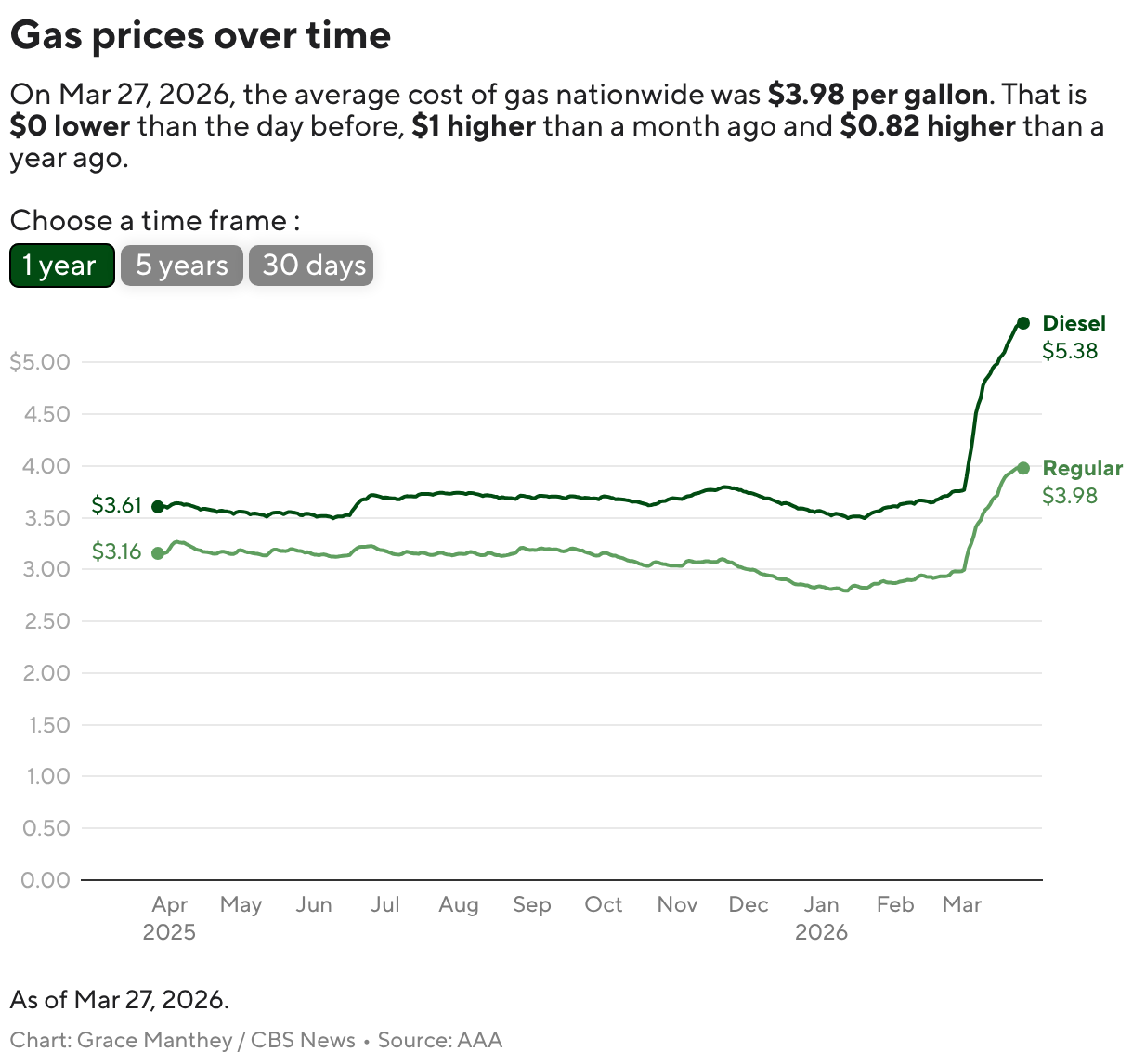
Average diesel prices hovered around $6.50 a gallon on Friday, just below their record high of $6.53 on Sept. 22 and up from $3.69 a year ago, according to AAA. That jump is raising the cost of operating school buses and forcing some institutions to scramble for ways to cut costs.
Farmers, who rely on diesel to run agricultural machinery, also face sharply higher costs, while enterprises ranging from construction firms to food banks report sharply higher expenses to fuel their vehicles and delivery trucks.
One Georgia food bank said it will spend an extra $100,000 this year on diesel, money that otherwise would have gone to feed families.
"That would actually translate to about 122,000 meals that we would be able to provide if we didn't have to spend that on unexpected diesel fuel prices," Kenneth Hill, the supply chain officer for the Atlanta Community Food Bank, told CBS News Atlanta.
Georgia diesel prices averaged $6.32 a gallon on Friday, up from $3.54 a year ago, according to AAA.
Ranchers are feeling the pinch due to their reliance on diesel-powered trucks to check on herds and water pumps, said Andrew Coppin, CEO of Ranchbot, which sells remote monitoring technology for water pumps and other equipment.
"Outside of labor, diesel is the single biggest input into a lot of farming operations, so it's a very material increase in the cost of operations," he told CBS News, noting that his company has seen a major increase in inquiries from ranchers due to surging diesel prices. "If it's an F-250, a Ram 2500 or a Silverado, we're talking 1-ton diesel trucks, and on a good day they are getting 12 miles to a gallon."
Diesel's impact on inflation
Diesel is widely used in commercial trucking, agriculture, and construction, and rising prices can increase the cost of transporting goods across the country.
Gasoline prices have also soared, although not as much as diesel, which is facing a global shortage due to shipping and refining disruptions stemming from the Iran and Russia-Ukraine wars.
As a result, economists warn that the spike in diesel costs could fan inflation, which rose in August at an annual rate of 3.4%, up from 2.4% at the beginning of 2026.
Inflation could jump to 3.6% by year-end due to the rise in fuel prices, according to EY-Parthenon chief economist Gregory Daco.
"Higher diesel and freight expenses risk bleeding into core inflation by raising the cost of producing and transporting consumer goods," Bernard Yaros, lead U.S. economist at Oxford Economics, said in a report. "Prices for grocery store items, restaurants and delivery services are the most sensitive to higher diesel prices."
Those higher costs are also being felt more broadly across local communities.
"Certainly, when I wake up in the morning, I'm thinking about diesel," Marty Gray, owner of Gray Farms in Watseka, Illinois, told CBS News Chicago. "I'm thinking about the trucks running, the [grain] elevator and stuff like that."
Gray also said his family-owned farm is facing tight margins as harvest season gets underway. "So, we're just trying to decide do we fill up the tanks now, or do we need to wait a little bit? Will it get better, or will it get worse?"
Raptor Roll Offs, a Colorado waste management and dumpster rental business that uses diesel trucks to deliver dumpsters to and from homes and industrial sites in the Denver area, may need to pass higher fuel costs on to customers, owner George Dempsey told CBS News Denver.
"We're holding on as long as we can," Dempsey said. "We can't absorb it all ourselves, and so you have this trickle effect."
Colorado diesel prices now average $6.16 per gallon, compared with $3.51 a year ago, AAA data shows.
Colorado's Cherry Creek Schools relies on diesel to power its more than 300 buses, which transport roughly 24,000 students across the district. It's facing an additional $500,000 in diesel costs this year, pushing its total fuel budget to about $2 million — far higher than the $1.5 million it had originally budgeted, Mark Ingram, the district's director of transportation, told CBS News Denver.
Ingram said the school district is weighing consolidating some routes and scaling back certain activity trips to save fuel costs.
Would a diesel export ban help?
Some Republican lawmakers are calling for the U.S. to ban diesel exports to lower costs. The U.S. refines more diesel than it can use domestically, with energy companies selling the remainder abroad.
Although an export ban might initially lower diesel costs in some U.S. regions, it could eventually backfire by worsening global shortages, according to energy experts and economists. That would likely send diesel prices even higher, they say.
"A ban would temporarily lower prices, but short-term relief would be uneven geographically," Oxford Economics said in a report. "Price declines would be concentrated in the Gulf Coast and Midwest, where most refining capacity is located. Distillate shortages are concentrated in the Northeast and West Coast, and these regions would see little benefit from an export ban."