Trump promises not to resume strikes before midterm elections
Follow updates on the war in the Middle East for Friday, Oct. 9, here. See earlier developments below.
What to know about the Iran war:
- President Trump promised Thursday the U.S. would not attack Iran before the midterm elections, tempering rising crude oil prices. He also touted "productive conversations" with Iran, though he did not provide specifics.
- The Houthis claimed Thursday to have hit Saudi Arabia's main airport with a ballistic missile, the third time this week the Iran-backed rebels have claimed an attack on the facility amid Yemen's escalating civil war.
- New videos obtained exclusively by CBS News show Iranian attacks on a major U.S. military base in Kuwait as the war with Iran kicked off seven months ago. U.S. forces faced ballistic missiles, drones and what witnesses described as Iranian F-5 fighter jets.
USS Lincoln returns home to San Diego for first time in over 10 months
The USS Abraham Lincoln and its more than 4,500 sailors returned home to San Diego on Thursday for the first time in 321 days, a jubilant homecoming after a long deployment that included months in the Middle East.
Braving the heat, hundreds of family members and friends waited for hours in the sun to greet their loved ones. As the ship pulled into the harbor, a roar of cheers erupted from a pier. Sailors stood at attention on the deck for the aircraft carrier's long approach, and after they were released, smiles and waves broke out as sailors took out their phones to call people on the pier.
In one such reunion, McKenzie Adkins held her 10-week-old son Declan as she waved to her husband, Alexander, on the ship's deck, before the new father met his son for the first time.
The Lincoln carrier strike group had been deployed for more than 10 months, including more than 250 uninterrupted days at sea this year. Much of that time was spent in the Middle East, where the aircraft carrier and its escort ships supported the U.S. war against Iran. It left the region in late August.
Read more here.
Putin tells Iran leader he will "do everything" to help end war
Russian President Vladimir Putin held talks with Iranian counterpart Masoud Pezeshkian on Thursday and promised to "do everything" to help end the Middle East conflict, Russian news agencies reported.
"We are ready to do everything that is in our power to contribute to the settlement of this situation," Putin said ahead of a regional summit in the Central Asian nation of Turkmenistan, adding Iran had made "real efforts to end the war" since U.S.-Israeli attacks started on Feb. 28.
Putin noted the "positive evolution" in relations between Iran and Russia.
The two have reinforced diplomatic and military links since Russia launched its offensive in Ukraine in February 2022, becoming increasingly reliant on each other.
Ukraine and Western countries have accused Iran of supplying Russia with Shahed drones and short-range missiles for use in the military campaign.
Russia has been accused of supplying targeting data to Iran for its strikes on U.S. interests in the Middle East.
The meeting came as talks between Tehran and Washington appear to be at an impasse. Pezeshkian said this week negotiations with Washington were "meaningless."
Iran war has damaged or destroyed 81 aircraft from U.S., congressional report shows
At least 81 U.S. military aircraft and drones have been lost or damaged in the war with Iran, according to a Congressional Research Service report updated this week.
The downed aircraft include what the military has publicly acknowledged as lost — like those destroyed as part of the rescue mission to recover two downed aviators in Iran — as well as dozens of drones that the military has refused to discuss.
Among the 81 damaged or destroyed aircraft were 45 MQ-9 Reaper drones, 12 F-15E Strike Eagle jets, seven KC-135 Stratotanker aerial refueling aircraft and an F-35A Lightning II fighter jet, the report says.
U.S. Embassy in Saudi Arabia issues new security alert over airport attacks
The U.S. Embassy in Saudi Arabia is warning Americans to "exercise heightened vigilance" if they are traveling through King Khalid International Airport in Riyadh due to attacks by the Iran-backed Houthi militant group.
"The Houthis have engaged in hostilities against Saudi Arabia, including against civilian airports, and the military conflict has the potential to escalate," the embassy wrote on X. "U.S. citizens should be aware of potential flight cancellations, airspace closures, and travel disruptions."
The Houthis have launched attacks on the airport, hundreds of miles into interior Saudi Arabia, four times this week. Three people were killed at airports on Oct. 6 and 7 in Saudi Arabia, including one at King Khalid International Airport, according to the country's aviation authority.
The embassy had already warned citizens not to travel near the Yemeni border. U.S. government employees are banned from traveling within 20 miles of the border. On Thursday, the embassy also said government officials now require special authorization to travel through King Khalid International Airport.
U.S. imposes sanctions targeting 17 vessels of Iran "shadow fleet"
The United States imposed sanctions Thursday targeting "the remnants of Iran's shadow fleet" of tankers used to transport oil products to foreign markets — the latest move to ramp up pressure in its war against Tehran.
"Today's action effectively neutralizes the vast majority of Iran's remaining shadow fleet network," the U.S. Treasury Department said in a statement.
The aim is to deprive Tehran of funds needed to "wage war in the region," added Treasury Secretary Scott Bessent.
Thursday's move takes aim at 17 vessels said to have moved millions of barrels of Iranian crude oil, alongside petroleum and petrochemical products, to markets across South and East Asia.
The Treasury Department designated companies that own these vessels, accusing them of operating in the petroleum or petrochemical sectors of the Iranian economy.
Crude oil tanker struck in the Strait of Hormuz on Tuesday, maritime monitor says
Another crude oil tanker was struck in the Strait of Hormuz this week, according to a U.K. navy maritime monitor. It said the incident happened Tuesday.
In a post on X Thursday, United Kingdom Maritime Trade Operations said the tanker was "struck by an unknown projectile" and that there were no casualties, though the damage to the vessel is unknown.
Several other vessels have been struck in the waterway recently, according to UKMTO.
Trump says U.S. won't attack Iran before midterms, touts oil coming through strait
President Trump has promised the U.S. would not attack Iran before the midterm elections, which take place on Nov. 3. He also touted "productive conversations" with Iran, though he did not provide specifics.
"I want to make it clear to everybody that, while Iran is in very bad condition, both Economically and Militarily, and while the Blockade will remain in full force and effect, with Oil flowing in Record Numbers of Barrels through the Hormuz Strait (22 Million Barrels, last night alone, with not one barrel coming from, or going to, Iran!), we will not be attacking Iran at any time prior to the Midterm Elections to be held in the United States on November 3rd," he wrote on Truth Social.
Several outlets reported on Thursday that Mr. Trump was considering new strikes on Iran before the midterms.
The Trump administration has consistently provided numbers for the millions of barrels being escorted out of the Strait of Hormuz under U.S. military protection. Moving out 22 million barrels of oil in one night would mark a total similar to prewar levels.
Brent crude, the international standard, was up to $105 a barrel, about a 4% increase from close Wednesday, before Mr. Trump's post on social media. After the post, it dropped to $103 a barrel.
Saudi kindergarten hit by interception debris
The Saudi civil defence agency said in a post on X that a kindergarten and a medical complex in Riyadh were damaged by debris from a missile interception on Thursday, after Yemen's Iran-backed Houthis said they had targeted the capital's airport.
Saudi Arabia leads a pro-government coalition fighting against the Houthis in Yemen's civil war, and the Iran-backed group has repeatedly targeted Riyadh since the conflict roared back to life, vowing to hit critical infrastructure and disrupt Saudi airspace.
The conflict in Yemen had lain dormant since 2022 but erupted again in July, and the scale and frequency of the attacks on the Saudi capital since then have been unprecedented in the eight months of wider war in the Middle East.
Riyadh's airport has been repeatedly targeted by the Houthis in recent days as the group ramps up its attacks on the kingdom, including its oil facilities and cities close to the Yemeni border.
On Thursday, the group warned workers to evacuate Saudi Arabia's oil facilities, having days before hit a major refinery south of the capital.
Around the same time, the Saudi-led coalition fighting the Houthis said it had intercepted two missiles fired towards Riyadh.
Shortly after, the kingdom's civil defence agency said "interception debris" had damaged a kindergarten and a medical complex in the city. It did not say if there were any casualties or provide details of the damage.
Admissions by Saudi authorities of civilian targets being hit are relatively rare, with officials issuing few statements on Houthi attacks in recent weeks.
CBS/AFP
Houthis tell employees at Saudi oil facilities to evacuate, say lives are at risk
The Houthis told employees at Saudi oil facilities to evacuate Thursday, saying their lives were at risk.
"The armed forces warn all employees, including experts, engineers and workers at all Saudi oil facilities, against being present in locations that represent targets for our forces, so as not to put their lives at risk," Houthi military spokesman Brig. Gen. Yahya Saree wrote in a post on X.
He also renewed previous warnings to aviation companies, passengers and workers, about operating in Saudi airspace, which the Houthis have said they now see as a theater of war.
Houthis claim another attack on Saudi capital's airport
Houthi military spokesman Brig. Gen. Yahya Saree said the group's forces targeted King Khalid International Airport in Riyadh with a ballistic missile, claiming the missile struck its target and caused damage and disruption to air traffic.
"Our armed forces, with the help of God, managed to target King Khalid Airport in Riyadh with a ballistic missile this afternoon, which successfully hit its target and caused damage and disruption to air traffic at the airport," he wrote in a post on X Thursday.
If true, it would be the fourth time the group has targeted the airport this week.
The Saudi-led coalition fighting with the Yemeni government said Thursday it had intercepted two ballistic missiles fired by the Iranian-backed Houthis towards Riyadh, the Saudi capital.
In a brief post on X, coalition spokesperson Maj. Gen. Turki Al-Maliki gave no further details.
Iran reviewing U.S. reaction to peace proposal, to respond "within a few days"
Iranian Foreign Minister Abbas Araghchi said negotiations with the United States are continuing through intermediaries Thursday, adding that Tehran is reviewing Washington's response to an Iranian proposal described as a "seven-day plan."
Speaking to the Students News Network, an official news agency, after attending a funeral ceremony in Tehran earlier today, Araghchi said: "The negotiating process is still continuing and, through intermediaries, messages are being exchanged."
He said Iran had presented its proposal and had subsequently heard the U.S. position in response.
"We presented our plan, which was the plan referred to as the seven-day plan. We heard the Americans' views in response. We are now reviewing them."
"I think we will respond within a few days," he added. "As I said, the negotiating process continues."
Trump weighing whether to strike Iran before midterm elections, The Atlantic reports
The White House has asked the Pentagon to prepare strike options for a possible resumption of attacks on Iran before November's U.S. midterm elections, according to The Atlantic.
Citing two administration officials, the magazine reported Wednesday that the magnitude and targets of the potential strikes were still under discussion, and that a wider operation could take place after the November 3 voting.
The Atlantic cited the officials as saying the preparations were a sign of how eager President Trump is to reduce gas prices and show progress in the conflict, as consumer prices weigh heavy on voters' minds ahead of the midterms.
The plan's proponents do not think the attacks will bring Iran to talks or see the Strait of Hormuz reopened, according to The Atlantic. The hope is that they might demonstrate U.S. strength leading into the vote, the report said.
"It would make the president look like he got a win and that gas prices would start going down," a Republican familiar with the deliberations told the magazine.
The price of Brent crude oil, the international benchmark, shot up more than 4% Thursday after the story was published.
Asked by CBS News for comment on the report, a White House official said: "The Commander-in-Chief has all options available at any time. The United States is in a very strong position with control of the Strait of Hormuz and the Iranian economy collapsing. Iran has been decimated, and things will go one of two ways; the easy way or the hard way. President Trump holds all the cards and will do whatever is best for the United States."
The U.S. hasn't announced strikes on Iran for weeks, and Mr. Trump has threatened repeatedly to renew the attacks after the midterms. Last week he told TIME magazine he might order new strikes after the midterms, and he told reporters separately that he believed the U.S. would win the war "right after the election," though he also said, "maybe before the election."
Saudi-led coalition says two Houthi ballistic missiles fired at Riyadh intercepted
The Saudi-led coalition fighting with the Yemeni government said Thursday it had intercepted two ballistic missiles fired by the Iranian-backed Houthis towards Riyadh, the Saudi capital.
In a brief post on X, coalition spokesperson Maj. Gen. Turki Al-Maliki gave no further details.
The Houthis claimed Thursday, for the third time this week, to have struck the Saudi capital's main international airport with a ballistic missile.
Earlier this week the Iranian proxy force said it had launched a series of attacks on Saudi Arabia, which killed three people.
AFP journalists heard several explosions in Riyadh on Thursday.
Along with the claims of repeated attacks on Saudi airports in recent days, Houthi weapons have also targeted critical energy infrastructure and military sites elsewhere in the kingdom.
EU backs extension of U.N. peacekeepers' mandate in Lebanon
The European Union's foreign policy chief Kaja Kallas said Thursday that the bloc favors extending the mandate of United Nations peacekeepers in south Lebanon. Israeli troops have occupied a large portion of southern Lebanon for months, after invading as part of Israel's war with the Iran-backed group Hezbollah, which attacked Israel in the days after the Iran war started in late February.
On a visit to southern Lebanon, Kallas told French news agency AFP that EU member states "have been saying that there can't be any security vacuum in southern Lebanon, so everybody is worried about the UNIFIL mandate ending," using the acronym for the U.N.'s Lebanon peacekeeping mission.
She added that "it would be most welcomed if this mandate is extended, so that is the position of the member states."
Last year, the U.N. Security Council voted not to renew the UNIFIL mandate after 2026, and its multinational forces – who have been in place since 1978 – are due to complete a draw-down in 2027.
Fighting in southern Lebanon has continued despite a three-way agreement signed in June by Lebanon, Israel and the U.S. on a framework that lays out provisions for the Israeli withdrawal from Lebanon and Hezbollah's disarmament.
The Iranian-backed group has rejected the agreement, and progress on all aspects has largely stalled in recent months.
CBS/AFP
Dubai repatriation flights nixed after UAE pulls landing permit for Israeli carriers
Repatriation flights operated by Israeli airlines Arkia, Israir and El Al that had been due to bring Israeli nationals back from Dubai to Tel Aviv after the FlyDubai co-pilot's alleged attack on a flight captain last week have been canceled a day before they were set to fly.
The flights were canceled after the carriers' permission to land in the United Arab Emirates was revoked on Wednesday, according to the Times Of Israel.
"Arkia has engaged with all relevant parties to regain authorization and operate the flights," the airline said in a statement. "Unfortunately, these efforts have so far been unsuccessful, and we are therefore forced to cancel the flights."
Israel had expected the repatriation flights to be completed by Thursday, according to the outlet.
Last week, an attempted attack by the co-pilot of FlyDubai flight 1073 as it approached Israel resulted in the carrier suspending all flights to Tel Aviv. That left an estimated 10,000 Israelis stranded in Dubai and other destinations with return journeys scheduled via the UAE, according to the Times Of Israel, though about 7,400 had managed to fly home from Dubai before the flight cancellations this week.
Passengers on the flight involved in the incident last week were repatriated the same day from Saudi Arabia, where the plane made a safe emergency landing.
Diplomats and students in Saudi capital take shelter, residents and diplomats tell AFP
Diplomats were instructed to shelter in place in their respective embassies in the Saudi capital Riyadh Thursday, diplomats told the French news agency AFP, as residents said international schools were also taking precautions, with at least one facility sending children into a basement for safety.
The measures came after repeated blasts were heard in the city, in one of the loudest disturbances since the beginning of the Iran war.
Two people working in Riyadh's business hub – the King Abdullah Financial District – also told AFP that some companies were evacuating staff from the area.
Yemen's Houthis have announced attacks against the Saudi capital on a near daily basis in recent days, including claiming three strikes on the same airport in the capital, as fighting between the kingdom and the Iran-backed group continues to escalate.
CBS/AFP
U.K. navy sailor charged with spying for unnamed foreign power
A serving member of Britain's Royal Navy has been charged with spying, police said Thursday, adding the case was not connected to suspicious activity near an airbase used by the U.S. air force.
Teddy Young, 24, is accused of obtaining protected information between November 2024 and May 2025 which could benefit an unnamed foreign power, London's Metropolitan Police said in a statement. He was to appear in court Thursday.
Young was arrested by counterterror police at his home in Bedfordshire north of London on Tuesday, police said.
He has been charged under section 1 of the National Security Act which covers principal espionage offenses, and under section 18, with the lesser offense of engaging in conduct "in preparation for committing an offense of disclosing protected information."
"These are very serious charges against a serving member of the armed forces," said Commander Helen Flanagan, head of Counter Terrorism Policing London, adding that "the arrest and charges are not connected to the recent investigation into the incident at RAF Fairford."
The United States this week confirmed it had withdrawn all B-1 bombers from RAF Fairford, with President Trump citing unspecified threats against the base.
CBS/AFP
Oil prices surge and stocks sink on fresh inflation worries
Oil prices soared Thursday to around $105 per barrel and equities tumbled on fresh inflation fears following a report that President Trump is considering resuming attacks on Iran ahead of next month's U.S. midterm elections.
The selling tracked a retreat on Wall Street, where tech firms pulled back from recent gains, having weathered concerns over spiking borrowing costs and geopolitical uncertainty.
Crude oil prices started the week on the back foot thanks to signs that exports from the Middle East were heading back toward pre-war levels, and that G7 nations had agreed to tap their stockpiles.
But anxiety returned as figures showed Tehran had increased strikes on tankers in the Strait of Hormuz, Yemen's Houthis rebutted claims they had lost key territory and top oil officials warned that global reserves were running worryingly low.
And on Wednesday, The Atlantic reported that the White House had asked the Pentagon to draw up options to hit sites in Iran ahead of the midterms, with the president's Republicans in danger of losing both houses of Congress.
Both main crude contracts, international benchmark Brent Crude and U.S. staple West Texas Intermediate, jumped over 4% early Thursday.
News that International Energy Agency members were ready to tap more oil from reserves did little to assuage worried traders.
CBS/AFP
Iran says first flight by a foreign airline lands there since war began
The first commercial flight operated by a foreign airline to fly into Iran since the outbreak of the Middle East war landed on Thursday, state media reported, after the United States granted a sanctions waiver for Iraq's national carrier to fly to the Islamic Republic.
State TV broadcast a short video of the Iraqi Airways flight landing in Tehran from Iraq's Najaf, a city holy to Shia Muslims, adding that it was a round-trip service.
"Operated by Iraqi Airways, the flight took off from Najaf Airport and landed successfully at Imam Khomeini Airport in Tehran," state TV said.
Last month, Iraq's transport ministry said the U.S. had granted Iraqi Airways an exemption to fly to Iran, with an official telling AFP it applied to pilgrims traveling between Iran and Najaf.
The Iraqi government also said last week that it had secured an agreement with the U.S. allowing Iranian airlines, except Mahan Air, to operate daily flights to and from Najaf, home to one of the most revered shrines in Shia Islam.
It came after Washington imposed restrictions on Iran's aviation industry last month, vowing to take a hard line against companies that assist it.
As a result of the sanctions, major Iranian airlines were forced to cancel international flights after several countries implemented bans.
Yemen's Houthis say they struck main airport in Saudi capital
Yemen's Houthis said Thursday that they struck the Saudi capital's main international airport with a ballistic missile, in another attack on the kingdom claimed by the Iran-backed group.
The claim came a day after the anti-government fighters launched a series of attacks in Saudi Arabia that killed three people, and after the Riyadh-backed Yemeni government announced a major counter-offensive against the Houthis.
The Houthis, who control most of the country's northwest, are battling against the Yemeni government for territory after the civil war reignited in July.
"Our armed forces successfully targeted King Khalid International Airport in Riyadh with a ballistic missile, which accurately struck its target and disrupted airport operations," Houthi military spokesman Yahya Saree said on X.
This marks the third time this week that the group has claimed responsibility for an attack on the airport.
"We reiterate our call and warning -- for the last time -- to all international airlines against continuing to operate flights through Saudi airspace," Saree added.
AFP journalists heard several explosions in Riyadh on Thursday.
Along with the Houthis claiming repeated attacks on Riyadh airports in recent days, salvos have been aimed at critical infrastructure and military sites elsewhere in Saudi Arabia.
New videos show Iran's attack on a major U.S. base in Kuwait at the start of the war
New videos obtained exclusively by CBS News show Iranian attacks on a major U.S. military base in Kuwait as the war with Iran kicked off seven months ago. American forces faced ballistic missiles, drones and what witnesses described as Iranian F-5 fighter jets.
The footage obtained by CBS News was recorded by a person stationed on the ground at Camp Buehring, and captures the moments of impact and their explosive aftermath. Damage to buildings and military equipment can also be seen in the videos.
The attacks on Camp Buehring offer a window into the strain Iranian attacks placed on American forces during the opening days of the war. CBS News has learned that soldiers defending the base ran critically low on .50-caliber ammunition as some soldiers were repositioned into the Udari Desert in Kuwait. Two soldiers were injured by lightning there in late April, according to U.S. officials with knowledge of the matter.
Contacted by CBS News, U.S. Central Command, the primary unit which oversees American military operations across the Middle East, declined to comment.
Tanker in Persian Gulf reports hits from multiple projectiles, U.K. maritime agency reports
A tanker sailing off the north coast of Qatar reported being struck "by multiple projectiles," causing an unspecified number of casualties, the United Kingdom Maritime Trade Operations said on Wednesday.
The incident took place 59 miles off the coast of Madinat ash Shamal, a coastal city in the Persian Gulf, the British maritime agency said, adding that authorities were investigating. It did not specify the ship's origin.
"Vessels are advised to transit with caution and report any suspicious activity to UKMTO," the agency's statement said.
CBS/AFP
Pete Hegseth applauds resilience as USS Lincoln returns to home port after record deployment
Defense Secretary Pete Hegseth delivered remarks on Wednesday from the USS Abraham Lincoln off the coast of San Diego as the sailors were presented with the Presidential Unit Citation for extraordinary heroism and thanked them for the long deployment.
The carrier and its escort ships were set to return to home port Thursday after a record 321-day deployment in the Middle East.
The strike group executed 3,693 combat sorties, delivered 1.37 million pounds of ordnance, launched 450 Tomahawk land attack cruise missiles, shot down 77 one-way attack unmanned aerial systems, sank 64 Iranian warships, destroyed 21 anti-ship cruise missiles, and defended against four fast-attack craft and explosive-carrying dhows, according to Pentagon statistics.
Hegseth said some in the media tried to turn the Lincoln into a symbol of low morale, but after meeting with some of the sailors and leadership, he says it's the exact opposite. He acknowledged some hardships, but the crew of the Lincoln was resilient.
"What makes the U.S. military and the U.S. Navy and all these sailors different is that you adapt, and that you're resilient, and you overcome," he said. "You finish the mission nonetheless."
There were eight suicide attempts across the carrier strike group since the beginning of its grueling monthslong deployment last year, acting Navy Secretary Hung Cao said last month in a letter obtained by CBS News.
3 killed in Houthi attacks on Saudi airports, aviation authority says
Three people were killed and dozens more wounded in Houthi attacks on two airports in Saudi Arabia Tuesday and Wednesday, according to the Saudi aviation authority.
The Iran-backed Houthis have been regularly targeting airports and oil infrastructure in Saudi Arabia as they also battle Saudi-backed Yemeni government forces in the western part of Yemen.
Two people were killed and 28 injured in an attack on Abha International Airport, which is located about 40 miles north of the Yemen border.
A third person was killed at King Khalid International Airport, which is in the capital of Riyadh. Unlike Abha, Riyadh is located hundreds of miles into the interior of the country. There were also eight injuries in that strike, according to the Civil Aviation Authority.
The Houthis had said earlier in the day they had targeted King Khalid International Airport with a ballistic missile, the latest in repeated salvos aimed at the site.
"Our armed forces have just targeted King Khalid Airport in Riyadh with a ballistic missile. The strike was accurate, by God's grace, and led to a disruption of air traffic at the airport," Houthi military spokesman Yahya Saree said in a statement on X.
Trump: War will end "very soon"
President Trump said the war will end "very soon" during an Oval Office press availability on Wednesday, a claim he has been making for months.
Mr. Trump also said oil prices will "drop like a rock" once the conflict is over. The cost of Brent crude, the international standard, has hovered around $99 on Wednesday. The cost fell below $100 after spiking as high as $108 in mid-September.
"As soon as we're finished with the war, which will be very soon, it's going to be very soon," the president said. "One way or the other, we'll be finished with it, but oil will come down to levels that were, I think, maybe even lower than they were before the war started."
Mr. Trump has been saying the war will be over "very soon" since at least March 9 at a press conference from his Doral country club near Miami.
France summons Iran ambassador over "disinformation campaign" on protests
The French foreign ministry on Wednesday summoned the Iranian ambassador to protest against a "disinformation campaign conducted by the Iranian authorities" over high school protests that have rocked France.
The ambassador was told "the misleading content disseminated online" by official accounts of the Iranian foreign ministry was "absolutely unacceptable," the ministry said in a statement, after Tehran on Tuesday summoned the French ambassador over the treatment of protesters in France.
Iran accused France of "violent treatment" of the protesters and "extensive and flagrant human rights violations" during the demonstrations, which intensified last week and have seen clashes between demonstrators and the security forces.
But the French foreign ministry said the summoning of its ambassador to Tehran was "baseless."
Iran's anger over events in France came after Iranian security forces used deadly force earlier this year to crack down on anti-government protests that peaked on Jan. 8-9.
Norway-based rights group Iran Human Rights says it has identified 4,219 people killed during the protests — almost all on Jan. 8 and 9 — but has warned the toll is likely far higher.
Agency ready to release more oil reserves if necessary
The International Energy Agency's member countries stand ready to release additional oil from their strategic reserves if necessary and will prioritize diesel due to tight supplies of the fuel, the head of the group said Wednesday.
IEA member states still have ample reserves of crude oil and refined products and stand "ready to release more of these stocks to the market if and when required," its director, Fatih Birol, said in a statement.
G7 countries, in coordination with the IEA, agreed last Friday to immediately release 100 million barrels of diesel and crude oil to ease global energy supply concerns caused by fallout from the U.S.-Iran war.
While shipments of crude through the Strait of Hormuz have recently picked up, damage to refineries in the region, along with those in Russia, has led to shortages of some refined products like diesel.
"IEA members also supported the prioritization of the release of diesel stocks, to the extent possible, given the current tightness in diesel markets," Birol said in his statement.
The IEA said Saturday that member countries had so far released 325 million barrels of oil and oil-derivative products from strategic reserves, from 400 million barrels promised in March.
Birol said IEA member countries still have significant levels of publicly held emergency oil stocks — equivalent to around 1.1 billion barrels, including over 200 million barrels of diesel.
Saudi Aramco's chief executive Amin Nasser said Monday global oil stockpiles are "scarily thin."
CBS/AFP
U.S. Embassy issues new security alert for Saudi Arabia
The U.S. Embassy in Saudi Arabia issued a new security alert on Tuesday as the conflict between the Iran-backed Houthis and Saudi-backed Yemeni government forces continues to grow.
"Due to the ongoing security situation in Saudi Arabia and Houthi public threats against airports and airspace across Saudi Arabia, the U.S. Mission reminds all U.S. citizens to exercise heightened vigilance," the embassy said in a statement. "The Houthis have engaged in hostilities against Saudi Arabia, including against civilian airports, and the military conflict has the potential to escalate."
It continued, "U.S. citizens should be aware of potential flight cancellations, airspace closures, and travel disruptions. We recommend checking your flight departure status directly with the airline and with the airport."
U.S. government workers are also prohibited from traveling within 20 miles of the Yemeni border. The embassy advised U.S. citizens should also not travel near the border.
The State Department already had Saudi Arabia rated as Level 3–Reconsider Travel. The country also includes some areas rated at the highest level, Level 4–Do Not Travel. The State Department issued those warnings on Sept. 15.
Iranian army threatens U.S. bases with preemptive strikes
Iran's army is better prepared than before to confront any renewed attack, according to spokesperson Brig. Gen. Mohammad Akrami-Nia, who told the semi-official Fars news agency that Tehran is prepared to launch preemptive strikes on U.S. positions if necessary.
"We have carried out this type of operation in the recent war," Akrami-Nia said, adding Iran's military doctrine had shifted from a defensive to an offensive one and that such operations were intended to "take the initiative away from them."
According to Akrami-Nia, the army has already targeted U.S. bases prepared for operations against Iran, including with drones. "Therefore, within the framework of preemptive warfare, we have carried out actions and operations," he said.
"Before they could take action, they were struck and came under attack," he continued.
"If necessary, in the future we will carry out preemptive operations to prevent the enemy from carrying out any aggression or attack," he added, saying Iran now has "large stockpiles" of weapons after continued production.
Syria poised to give Iraq another Strait of Hormuz bypass option for crude oil exports
Syria looks set to provide an overland route for Iraqi crude oil to bypass the Strait of Hormuz, the head of Syrian Petroleum Co. has told Bloomberg.
"I expect the export of Iraqi crude via Syria by trucks to start as soon as possible as the deal between both governments is almost done," Yousef Qiblawy, chief executive officer of the state-owned Syrian Petroleum Co., said Wednesday. "So, hopefully, by mid-October the first chain of trucks with crude will come to Syria."
The Iraqi government requested Syria's help to increase crude exports, Qiblawy said.
Iraq already uses around 1,000 trucks daily to transport fuel oil overland to Syria's Mediterranean port city Baniyas, where it is loaded onto tankers for shipment further afield.
"I think there will be at least the same number of trucks with crude as with fuel oil, or even more than 1,000 trucks per day, because the quantity of Iraqi crude is much more than of fuel oil," Qiblawy said.
Maritime tracking firm Kpler said this week that oil exports from the region surpassed pre-war levels last week, while the CEO of Shell said Tuesday that oil flows from the Middle East were back up to around 80% of their pre-war levels.
Much of that boost is thanks to the use of other alternative routes for crude oil to get out of the Persian Gulf, including overland pipelines and U.S. military escorts for vessels using shipping lanes in the Strait of Hormuz that Iran continues to threaten.
Ships have continued to come under attack by both U.S. and Iranian forces in recent weeks, as the warring sides try to enforce their opposing blockades in the strait.
Yemen's escalating civil war has now displaced more than 200,000 people, U.N. agency says
More than 200,000 people in Yemen have been forced to flee from their homes because of the ongoing war between the Iran-backed Houthi rebels and the Saudi-backed Yemeni government, according to the United Nations International Organization for Migration.
"People are running for their lives and finding nowhere safe to go," IOM Director General Amy Pope said in a statement Wednesday. "They need a roof, food and safety today. Our teams are on the ground, but the funding is not. I am asking donors to act now, because every day of delay costs lives. Yemen must not become a forgotten crisis. The world has the means to help. It must use them now."
Many of the displaced have fled their homes since the beginning of September, amid escalating fighting between the Houthis and the Yemeni army. After the Houthis seized control of much of Yemen's southwest Red Sea coast, the government over the weekend announced the start of an offensive to take back all Houthi-held territory, some of which has been in the rebels' possession for over a decade.
Putin to meet Iran's president on Friday
Russian President Vladimir Putin will meet Iranian President Masoud Pezeshkian Friday in Turkmenistan, according to Iran's official news agency IRNA.
The pair held a phone call Wednesday, according to IRNA, in which Pezeshkian congratulated Putin on his birthday.
During the call, the two presidents also emphasized the continuation and strengthening of bilateral and strategic cooperation between Tehran and Moscow, according to the Iranian state news agency's readout.
Iran's defense ministry said Tuesday that cooperation with Russia, as well as China, had strengthened over the course of the seven-month war, crediting those ties, in part, for a purported boost in Iranian weapons and defense equipment production capacity.
Iranian ex-oil minister dismisses Trump claims over resignation
Outgoing Iranian Oil Minister Mohsen Paknejad has rejected President Trump's account of his resignation, saying his departure had nothing to do with the claims the president made about Iran's economy and oil industry.
Speaking to reporters Tuesday, Mr. Trump claimed Paknejad had said, "We have no economy, we have no oil, we have nothing," and said that millions of barrels of oil had passed through the Strait of Hormuz in recent days.
In a statement posted on X on Wednesday, Paknejad said, "My resignation has nothing to do with Trump's claims last night."
Paknejad described himself as "a soldier of the homeland" and said Iran's oil production and exports had continued despite U.S. sanctions and what he described as a blockade. He credited workers in Iran's oil industry with maintaining production and exports under pressure.
"Having suffered a hard blow, it is natural for them to resort to making such false claims," Paknejad said, referring to the president's remarks.
U.S. "requests and ideas" about Iran's nuclear problem "at odds with Iran's demands" to end war, Iranian official tells Reuters
U.S. "requests and ideas" about Iran's nuclear program are "at odds with Iran's demands" to end the war, an unnamed senior Iranian official told the Reuters news agency Wednesday, while also indicating some willingness to negotiate the level of enrichment.
Asked about Vice President JD Vance's comments Tuesday that Tehran must make a "meaningful" reduction of its nuclear enrichment capacity to end the war, appearing to soften the Trump administration's position on the issue, the official said: "Vance's comments are Washington's ideas and requests ... Americans are free to make requests and have ideas, but they are at odds with Iran's demands."
The official, who is involved in indirect negotiations with the U.S., according to Reuters, said there had been no negotiations on Iran's nuclear program and that the U.S. must meet Iran's conditions — which include dropping the blockade of Iranian ports — before the nuclear issue can be addressed.
Iran's right to nuclear enrichment is a red line that Tehran "will not show flexibility on in any way." However, he added that details of enrichment can be discussed later, referring to Vance, which would appear to leave the door open to negotiations.
Iranian military official says Iran will soon block "illegal routes" through Strait of Hormuz
Iran will soon block what it calls illegal routes through the Strait of Hormuz, a senior Islamic Revolutionary Guard Corps adviser said Wednesday, hours after Secretary of State Marco Rubio said the regime had "lost complete control" of the strategic waterway.
Brig. Gen. Mohammad Reza Naqdi, a senior adviser to the IRGC commander-in-chief, reiterated Iran's stance that the strait is closed and that Iranian armed forces have "full control" over it, adding that the situation would continue until Iran's "legitimate demands" are met.
Earlier Wednesday, Rubio said that Iran had "lost complete control" of the strait and insisted it was open to commercial vessels.
"The Straits of Hormuz are open. There's almost as much oil flowing out now as there was before this conflict began. So they've lost complete control of the straits," Rubio told reporters during a visit to Greece.
Maritime tracking firm Kpler said this week that oil exports from the region surpassed prewar levels last week, despite ongoing attacks on ships in the strait. The CEO of Shell said Tuesday oil flows from the Middle East are back up to around 80% of their prewar levels.
Naqdi acknowledged that some oil was being ushered through the strait against Iran's wishes, but he said the volume was minimal and did not indicate the strait is open.
He claimed oil shipments were getting through using new routes created by unnamed parties clearing paths that were previously impassable, using explosives, but that such routes would be blocked "in the near future."
Oil rises and stocks fall as Hormuz worries flare
Oil prices rose on Wednesday and stocks fell amid fresh concerns about Middle East supplies following a warning that Iran appeared to be stepping up attacks in the Strait of Hormuz.
The retreat came as investors brushed off another record day on Wall Street, where the Nasdaq and S&P 500 were boosted by a rush back into the AI trade.
Confidence has been given a boost as reports said exports from the Middle East – excluding Iran – were pushing back towards pre-war levels. Brent crude oil, the global benchmark, fell below $100 a barrel, and West Texas Intermediate fell below $90, easing inflation concerns and giving central banks some room to hold off hiking interest rates.
However, both contracts rebounded on Tuesday as figures showed Tehran increased strikes on tankers in the crucial Strait of Hormuz. U.K. Maritime Trade Operations, a British navy maritime monitor, said there were nine attacks so far this month, representing half of the September total in the waterway and the Gulf combined.
CBS/AFP
Rubio says Iran has "lost complete control" of the Strait of Hormuz
Iran has "lost complete control" of the Strait of Hormuz, Secretary of State Marco Rubio said Wednesday, adding that Tehran's economy was "in total and complete freefall."
"The Straits of Hormuz are open. There's almost as much oil flowing out now as there was before this conflict began. So they've lost complete control of the Straits," Rubio told reporters during a visit to Athens.
He argued that as a result of "crippling" sanctions, the Iranian economy was "about to reach a place few countries in the world have been."
Every dollar received by the "radical Shia clerics" is spent on Hezbollah and Hamas, he said.
"Iran cannot have a nuclear weapon, simple, period, end of story," Rubio said.
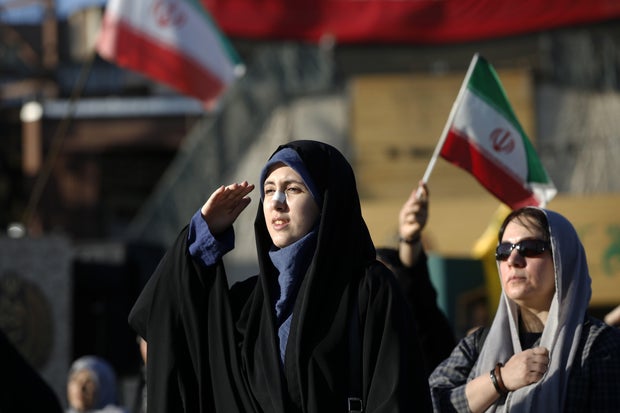
"And anything they agree to that would be acceptable to the United States has to be something that ensures that Iran will never have a nuclear weapon."
He argued that what Iran "was trying to do was build up a conventional capability so massive that they would become untouchable."
CBS/AFP
Vance appears to soften U.S. demands on Iranian nuclear enrichment
Vice President JD Vance appeared to backtrack on U.S. demands on Iranian nuclear enrichment Tuesday, saying Iran needed to make a "meaningful" reduction of its capacity, but not suggesting it should be required to completely give up enrichment, as President Trump has previously.
Iranian nuclear enrichment has been a key issue for the White House, with the president and other top officials stressing that Iran can never have a nuclear weapon as a core objective of the war.
In February, the day before the war began, President Trump said of Iran: "They want to enrich a little bit. You don't have to enrich when you have that much oil … I say, no enrichment. Not 20%, 30%. They always want 20%, 30% … They want it for civil. I think it's uncivil."
In April, he told CBS News that Tehran had agreed to have its enriched uranium removed from the country.
In an interview with the Reuters news agency published Tuesday, however, Vance said Tehran should not "build highly enriched fuel," and they should "do something meaningful on their enrichment capacity," in what appeared to be a softening of U.S. demands.
Under the Obama-era nuclear deal, the JCPOA, which President Trump was highly critical of and pulled the U.S. out of unilaterally during his first term, Iran agreed to limit its uranium enrichment to a purity level of 3.75%, with verification by the International Atomic Energy Agency.
After Mr. Trump pulled out of the JCPOA, the Iranian regime steadily ramped up its program and built a stockpile of uranium enriched to at least 60%, which is a short technological step away from weapons-grade material.
"If you don't want a nuclear weapon, then why do you need 60% enriched fuel? And if you want to show commitment to not building a nuclear weapon, don't build highly enriched fuel. That's a very basic threshold issue," Vance told Reuters. "I think if they want to show a commitment to not building a nuclear weapon, they would do something meaningful on their enrichment capacity."
"The goal here is to prevent the Iranians from having a nuclear weapon," he added.
Gazans still living in horrific conditions as Israeli bombing continues
For Palestinians, the three-year mark since Oct. 7, 2023, brings another day of misery and difficulties amid an Israeli retaliatory campaign against Hamas in Gaza that local health officials say has killed more than 70,000 people.
Most of the Gaza Strip's population, which was about 2.3 million people before the war, lives in vast, squalid tent camps, with large parts of the territory's cities reduced to rubble. More than half of Gaza has now been occupied by Israel's military.
Despite a ceasefire deal reached nearly a year ago, Israeli strikes are still reported almost daily.
No events were expected Wednesday in the besieged enclave, but Gazans say reminders of how much their lives have changed over the past three years are everywhere.
"We witnessed death, destruction, and bombardment that we had never known before," Walid Akram, a Gaza City resident, told The Associated Press.
Raed Khozeiq's coastal neighborhood in Tel al-Hawa was largely flattened.
"No country in the world has gone through what we have experienced here," he said. "A war of extermination, starvation, the absence of schools and universities – nothing remains."
Around half of those killed during the war were women and children, according to Gaza's Hamas-run health ministry. Their numbers are seen as generally reliable by U.N. agencies and independent experts. Israel disputes the figures, but has not offered its own estimate of the number of deaths in Gaza.
Since the ceasefire, 1,460 Palestinians have been killed in Gaza, according to the health ministry. Seven Israeli soldiers have been killed in that period.
CBS/AP
Israeli taken hostage marks Oct. 7 in Israel for first time
Elkana Bohbot, 37, marked Oct. 7 on Wednesday in Israel for the first time, after being released from 738 days of captivity last year. For most of that time, he said, he was held 165 feet underground in a dark, damp tunnel.
In August, his wife, Rivka, gave birth to a daughter, fulfilling a promise that Bohbot made to himself in the tunnels to give his 5-year-old son, Reem, a sibling.
The newborn Michele is "not a symbol for my people, she is more of a symbol for the enemy," Bohbot told The Associated Press. "So this child is the message for you that we were here, and we will always be here forever."

Israelis mark Oct. 7 with moment of silence
Israelis gathered on Wednesday to commemorate the Oct. 7, 2023, Hamas-led attack that killed 1,200 people, saw 251 taken hostage and sparked a devastating war in Gaza that has left much of the territory in ruins and its 2 million people living in dire conditions.
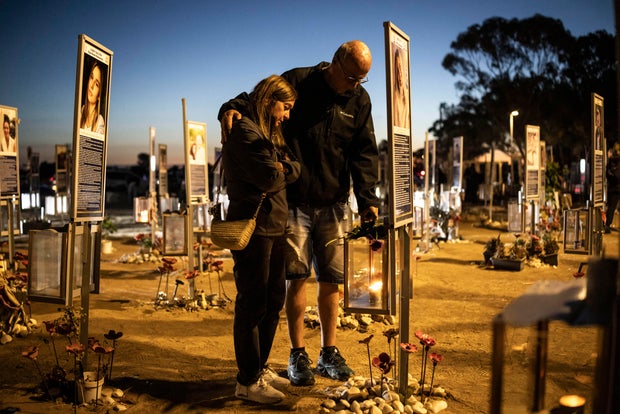
In southern Israel, families mourned at intersections, bomb shelters and the site of a music festival that the militants overran three years ago in the deadliest attack against Israel. It is the first anniversary that all the hostages are home, marking a new stage of grief.
Near the town of Reim, where the music festival was underway on the day of the attack, families gathered around photos of their killed relatives. They hugged at 6:29 a.m. – the exact time the first rockets were launched three years ago – as booms from explosions in nearby Gaza were heard.
Anya Davitashili, who lost her 25-year-old son, Sean, said she comes to the site every Saturday because it's where she feels closest to him.
"I feel him here. I'm terribly sorry that I couldn't save him, I couldn't help him get out of this massacre," she told the AFP news agency, tears filling up her eyes.
—CBS/AP
Hamas marks Oct. 7 as "a historic and honorable milestone in our ongoing struggle"
Hamas has issued a wide-ranging statement marking three years since its Oct. 7, 2023, attack on Israel, portraying the assault as a landmark in the Palestinian struggle and reiterating its commitment to armed resistance against Israel.
Hamas said the attack, which killed at least 1,195 people, was "a historic and honorable milestone in our ongoing struggle," and a response to decades of Israeli occupation, blockade and violence.
The statement accused Israel of genocide and other war crimes, citing Palestinian casualty figures and accusing Israel of continuing what it called a "silent genocide" even after the ceasefire. Israel has killed more than 70,000 people in Gaza since the attack three years ago.
On his Telegram, Abu Ubaida, spokesperson for Hamas' Al-Qassam Brigades, called the attack a "sacred crossing" and paid tribute to what he called the "heroes and martyrs" involved.
"O people of great Gaza," he added. "The price has been enormous, but what you have done has been great. Future generations will remember you as makers of glory."
Houthis say they targeted airport in Saudi capital with ballistic missile
Yemen's Houthis said Wednesday they had targeted King Khalid International Airport in the Saudi capital with a ballistic missile, the latest in repeated salvos aimed at the site.
"Our armed forces have just targeted King Khalid Airport in Riyadh with a ballistic missile. The strike was accurate, by God's grace, and led to a disruption of air traffic at the airport," said Houthi military spokesman Yahya Saree in a statement on X.
In a separate post, the Houthis said they also targeted military supplies at a camp area near the airport in the Yemen government's interim capital of Aden.
The Houthis' latest claims came hours after the Saudi-led coalition backing the Yemen government said its forces had intercepted a ballistic missile north of Riyadh fired by the Iran-backed Houthis.
The flurry of attacks was launched as the Houthis said they were holding their ground amid an onslaught by Yemeni government forces backed by the coalition's air power.
Earlier this week, Yemen's military said its forces had uprooted Houthi fighters from the areas around the Bab el-Mandeb Strait, a Red Sea shipping chokepoint, and the port city of Mocha.
Claims by both sides have been impossible to independently verify, with the situation on the ground moving fast and access for journalists difficult.
RAF Fairford faced Iran-linked threats to kill U.S. troops and destroy planes, U.S. official says
A U.S.-run military air base in England faced Iran-related threats, and the Trump administration believes the intention was to kill as many American troops and destroy as many U.S. planes as possible, a U.S. official told The Associated Press.
The official, who was not authorized to comment publicly on the matter and spoke on condition of anonymity, could not speak to the nature of the potential attack. The United States removed its bombers from RAF Fairford, located 100 miles west of London, which has been used by American planes to strike Iran during this year's war.
President Trump told reporters on Monday he didn't want to tempt "the enemy" by having the bombers there.
The new details come as British police on Tuesday arrested a 22-year-old British man in central London on suspicion of preparing terrorist acts. He is the seventh person arrested in connection with the suspected plot against RAF Fairford, which authorities have linked to Iran. But British police so far have released few details of their investigation.
Six of the men arrested have since been released on bail, which drew criticism from Mr. Trump last week.
CBS/AP
Most families of U.S. troops killed in the Iran war's deadliest attack to skip White House event
Most families of the six soldiers killed in the deadliest attack of the Iran war will not be attending a major White House event for Gold Star families hosted by President Trump.
Only one family member of those killed in an Iranian drone strike March 1 on Port Shuaiba in Kuwait confirmed to The Associated Press that they planned to attend Tuesday's reception with Mr. Trump and the first lady.
"There are questions about what happened before the attack, what information was available, what decisions were made, and what happened in the moments leading up to six American soldiers losing their lives," Joey Amor — whose 39-year-old wife, Master Sgt. Nicole M. Amor, was among those killed — said in a public Facebook statement Monday. "I am done asking quietly. Today, I am asking the American people to stand with these six families and demand transparency."
Some Gold Star families say they are grateful for how the Trump administration and military have honored their loved one's sacrifice. Other families say the way the White House has handled the reception is the latest indication that the administration does not respect the price they have paid.
The spouse of Maj. Alex Klinner, an airman who was killed in an Iran-related combat operation this summer, said receiving less than two weeks' notice did not give her enough time to arrange for overnight care for her three young children.
In a text message, Libby Klinner said she would not have gone anyway, adding, "I have no interest in supporting an administration that has been so reckless with the lives of our service members."
The war, launched Feb. 28, has claimed the lives of 19 U.S. troops and wounded more than 800 others.