New Epstein files include photos, documents with redactions as DOJ releases initial trove of records
What to know about the Epstein files:
- The Justice Department released more documents Saturday from the Jeffrey Epstein files, after an initial release Friday of thousands of photos, police reports and other material — the first records to come to light under a new law signed by President Trump.
- The files can be accessed on the Justice Department's website here. CBS News is also maintaining a searchable database here.
- Among the thousands of photos are new images of prominent figures, Epstein's travels, his various homes and more. They also include grand jury transcripts from the various cases brought against Epstein and his associates.
- The Epstein Files Transparency Act required the Justice Department to release all its files related to Epstein by Friday, with exceptions for survivors' personal information and other narrow categories. But Deputy Attorney General Todd Blanche said the "volume of materials" means the files must be released "on a rolling basis."
- Some of the files are heavily redacted, drawing criticism from congressional Democrats.
- CBS News has a team of journalists going through the files and is highlighting notable discoveries below.
At least 15 newly-released Epstein files have disappeared from DOJ's website, records show
At least 15 newly-released files have disappeared from the Justice Department's website containing documents related to Jeffrey Epstein, including one file that shows a photo of President Trump, CBS News has determined.
CBS News downloaded the complete set of documents on Friday and compared it to what was available Saturday.
The Department of Justice has not responded to a request for comment about the discrepancy, and it's unclear why the files are missing a day after they were initially released.
However, in a social media post to its X account Saturday night that seemed to touch on the issue, the DOJ wrote: "Photos and other materials will continue being reviewed and redacted consistent with the law in an abundance of caution as we receive additional information."
One of the missing files showed a mass of framed photos on a desk. They include former President Bill Clinton and the pope. In an open drawer in the same image, there was a photo of Mr. Trump, Epstein and Epstein associate Ghislaine Maxwell.
Other missing files included photos of a room with what appeared to be a massage table and nude photos and nude paintings.
Woman testified before 2007 grand jury that she brought several fellow high school girls to Epstein
The files released Saturday included grand jury testimony from April 2007 in which a 21-year-old woman testified that she brought several fellow high schoolers to Jeffrey Epstein.
The woman testified before a federal grand jury in West Palm Beach, Florida, that she was introduced to Jeffrey Epstein through two acquaintances she met at a beach resort when they were all 16.
"They made a proposition to me," the woman testified. "[redacted] had asked me if I wanted to make money and she was working for this guy, Epstein, in Palm Beach. So I told her I was interested and she further went into detail about massaging him, that you would have to take off articles of clothing and there would be touching and fondling involved."
She says she took the friends up on the offer, and within a few days, she was at Epstein's home, where she met Epstein associate Ghislaine Maxwell, who took her to a massage room.
"I was naked and he tried fondling me and I wouldn't have it, so after the massage he gave me another proposition to bring girls to the house, and for every girl that I brought, I would make $200," the woman testified, adding she was paid $200 for her massage.
Epstein paid her personally, the woman said, in $100 bills, but would never pay her in front of others. This girl said she never gave Epstein a massage again, but did start bringing girls to him. She said she brought girls from her high school, and other girls went up to her to ask about it.
"They had no problem with it," she testified.
She says she took seven to 10 girls to Epstein's home, including a 23-year-old woman. She testified that she was told that the woman was too old and was asked to not bring her back. The woman testified that nearly every other girl she brought to Epstein was 16 to 18 years of age, except one who was 14 years old.
"The more you did is the more you make," she testified. "Basically, the more clothes that come off, the more you let him touch you, the more you just let him have his way with you is the more that you would make. Otherwise, you would be demoted down to bringing girls over and just making money that way."
The woman said she would go through Maxwell to set up appointments with the girls, and once an appointment was made, she would drive the girls to the house.
She testified that, at times, she would be the one who would set things up for the massages if Maxwell could not do it.
When asked by a grand juror if she and Epstein were still in touch, she responded, "I don't talk to any of the females that I once brought over there. I haven't been in contact with Epstein for years. He tried contacting me a few times, I haven't contacted him back. I refuse to talk to him. I refuse to talk to any of the girls that were involved. However, I did live with one of the girls in Orlando for a couple months to a year. I haven't spoken to her in over a year either."
Grand juries were convened in West Palm Beach in 2005 and 2007 to investigate Epstein, but he reached a deal with prosecutors to avoid federal charges by pleading guilty in 2008 to state prostitution charges. He served 13 months in county jail and had to register as a sex offender.
FBI special agent testified in 2007 about victim at Epstein's house
An FBI special agent testified before a federal grand jury in 2007, describing how a victim was brought into Jeffrey Epstein's home, one Epstein file released Saturday showed.
"[Redacted] was the one who brought [redacted] to Mr. Epstein's house. [Redacted] told [redacted[ that she may have to remove her clothing and that she could make $200 if she performed a massage for Mr. Epstein," the agent said.
"She also was told by [redacted] that he may try to touch you, but if you are uncomfortable, just tell him no, and she also said that if Epstein asked her age, she was to say she was 18," the agent said.
One victim told the agent she was 16 when she first went to Epstein's home, the agent said.
Massages turned more sexual in nature, as in other cases, and the girls were either partly or fully naked during the future massages, the agent testified. The Department of Justice redacted lines about Epstein's actions on one girl.
The victim told the FBI agent that Epstein got the girl something sexual for her 18th birthday, and used it on her. It's unclear what it was since the item was redacted in the file.
The victim also detailed to the agent how Epstein associate Ghislaine Maxwell would set up Epstein's appointments, and Maxwell would play phone tag with victims to see if they were around when they would be traveling to different cities.
Epstein accuser Marina Lacerda says "the justice is system is failing us"
Marina Lacerda, an accuser of convicted sex offender Jeffrey Epstein, demands that the Justice Department "stop redacting names that don't need to be redacted" from the Epstein files.
Lacerda, who alleges Epstein started sexually abusing her at his New York City mansion when she was 14, told The Associated Press in an interview that the newly released files are not fully transparent.
"Who are we trying to protect? Are we protecting survivors or are we protecting these elite men that need to be put out there? And people need to know these are predators that are in the files," Lacerda said. "I feel like again the DOJ, the justice system is failing us."
FBI agent in Palm Beach grand jury testimony wouldn't say Epstein coerced girls
Asked by a grand juror in 2007 if Epstein coerced the girls he abused, an FBI agent struggled to answer, citing their pay, a transcript made public Saturday shows.
"[As] far as coercion, they were paid $200 to $400 to perform these massages. They are not trained in performing massages, they don't -- they are not masseuses, but yet if you ask if they were coerced, they were paid quite a bit of money for 30 to 45 minutes work," the agent said, adding that, "some of the girls, being that they were minors going to his residence, got in over their heads and did not always return or come back"
Grand jurors in that case asked more than once for the agent to clarify the extent to which Epstein abused minors, as opposed to adults. The agent said most of the victims identified by federal and state law enforcement were minors.
"In the state investigation there were over 25 girls identified and more than a majority would have been under the age of 18," the agent said.
The case ended with a non-prosecution agreement in which Epstein pleaded guilty to state charges of soliciting and procuring a minor for prostitution.
Record confirms FBI was told about Epstein in 1996
One file that was released Friday shows that a woman reported Epstein to the FBI in 1996 — more than 20 years before he eventually faced federal charges.
The handwritten document recounts a complaint that was made to the FBI's Miami field office in September 1996 in what the bureau categorized as a child pornography case. The accuser, described as a professional artist, said that Epstein "stole" photos that she had taken of her 12- and 16-year-old sisters for her own art, and "is believed to have sold the pictures to potential buyers."
"Epstein is now threatening [the accuser] that if she tells anyone about the photos he will burn her house down," the complaint continues.
The accuser's name is redacted, but the story's details are essentially identical to those of Maria Farmer, who has said for years that she reported Epstein to the New York Police Department and the FBI in 1996.
CBS News has also separately obtained a copy of a 1996 NYPD report in which Farmer said Epstein called her and "stated he was going to burn victims' paintings and send her poloroids [sic] of the burnt paintings." The report was categorized as an aggravated harassment complaint.
Farmer's attorney, Jennifer Freeman, confirmed to CBS News that the file appeared to be notes from her 1996 report to the FBI.
Farmer said in a statement shared by her legal team that she feels "redeemed" by the document's release, calling it "one of the best days of my life," though she pointed to other Epstein survivors like Virginia Giuffre, "who were harmed because the FBI didn't do its job."
"I'm crying for two reasons," she said. "I want everyone to know that I am shedding tears of joy for myself, but also tears of sorrow for all the other victims that the FBI failed."
In addition to taking her photos, Maria Farmer says both Epstein and Maxwell assaulted her as an adult. Her younger sister, Annie Farmer, has also testified that she was sexually abused by Epstein when she was 16.
Maria Farmer is currently suing the federal government for failing to properly investigate her allegations, which she says allowed Epstein to continue threatening her and abusing others for years.
Epstein faced his first set of criminal charges in the mid-2000s, stemming from a sexual abuse investigation launched by police in Florida. But in a controversial move, former U.S. Attorney Alex Acosta agreed not to charge him federally if he pleaded guilty to prostitution charges in state court. He was ultimately charged with sex trafficking in Manhattan federal court in 2019. Epstein died by an apparent suicide in a Manhattan federal detention center just over a month following his arrest.
Jordan Merson, an attorney representing another set of Epstein survivors who are suing the government, said in a statement: "The Maria Farmer complaint establishes that the FBI did not do what it was supposed to do to protect the many victims of Jeffrey Epstein."
Maxwell's role in Epstein's abuse described in grand jury testimony
Ghislane Maxwell was "like a cool older sister and made comments like this is what grownups do," a survivor of Epstein's abuse said, according to an FBI agent who testified before a 2019 federal grand jury.
The agent described interviews with three different women, who, as teenagers, were abused by Epstein. The agent said the women described Maxwell being either present or waiting just outside, as Epstein sexually abused them in massage rooms at his residences in Palm Beach, New York and New Mexico, as well as another location in London.
The FBI agent testified that, after the first time Epstein abused one 14-year-old girl, Maxwell called her and said, "in sum and substance, 'well, aren't you a clever girl, Jeffrey was very impressed.'"
Said she was flown all over the world with Epstein for years. She described to the agent an incident after she turned 18.
She "said that Maxwell had shown her to a bedroom and on the bed was a school-girl outfit."
"Maxwell said, 'Well, I thought it would be adorable if you gave Jeffrey his tea in this,'" the agent said.
"So [she] felt like she had to put it on so she put it on, took Epstein his tea, and Epstein then slapped her on the buttocks and reached under the skirt and touched her."
Asked what the woman's demeanor was like, recounting this during her witness interview, the agent replied: "She was crying; she was very upset."
The agent said a schoolgirl outfit was recovered from Epstein's New York mansion by law enforcement in 2019.
Handwritten notes show messages for Epstein, including missed call from Trump
Over a dozen handwritten messages left for Epstein were shown in what appears to be a 2019 grand jury presentation.
Several similar messages for "Mr. JE" reference females being available or asking if they are, while two others focus on whether a female can work. Another message appears to be from a girl trying to talk to "JE" about college. Another message seems to be from a female trying to get in touch with Epstein and includes the note "please call her."
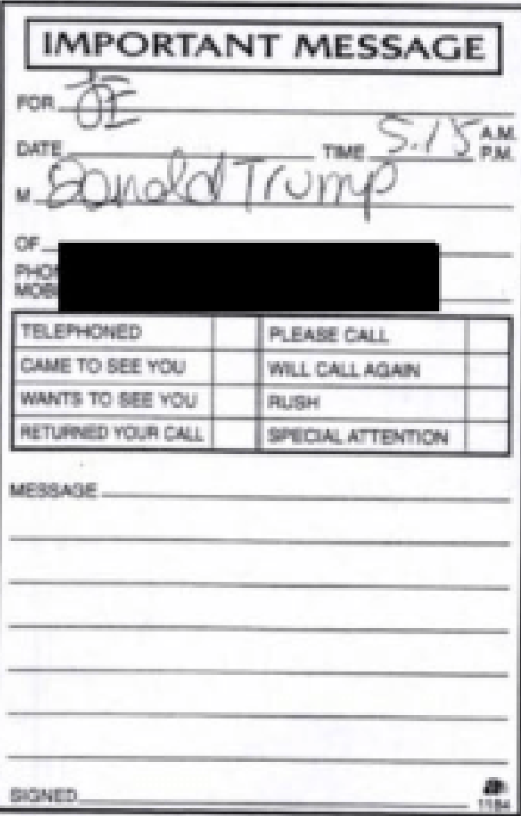
Another message shows that now-President Trump called Epstein. The call time is recorded as 5:18, but the message is not dated. No reason is given for the call.
Another message is connected to someone named Darren. The message says, "He has the info please call him."
There were 18 messages total featured in the presentation. All callers were redacted except for the ones referencing Trump and Darren.
2019 grand jury testimony outlines abuse by Epstein in New York, Florida
An FBI agent told a 2019 grand jury in New York that Epstein used his victims to recruit other young girls, testimony released on Saturday shows.
In the testimony, the FBI agent said he interviewed multiple victims in New York and Florida, who told him that they would go to Epstein's home to give him a massage and that "things progressed each additional time."
The agent also recalled what they learned about a 2005 police raid of Epstein's West Palm Beach home, where they found a massage table and sex toys, phone messages and more. In a room, they found message pads that included one note saying: "she has a female for Mr. JE" and a date of birth.
Files released Saturday include court documents
Over 500 pages in Epstein files were entirely blacked out, CBS News finds
The Justice Department released thousands of new records on Jeffrey Epstein on Friday, but at least 550 pages in the documents are fully redacted, CBS News has found.
The newly released files included photos of several prominent people in Epstein's orbit, images from his homes and investigative records that detail disturbing allegations against the late sex offender. But the heavy redactions in many of the records have drawn criticism from Democrats and some Republicans, as the department defends its handling of the files.
One series of three consecutive documents — totaling 255 pages — is entirely redacted, with each page covered by a black box. A fourth 119-page document labeled "Grand Jury-NY" is also entirely redacted. And at least 180 blacked-out pages appear in files that are mostly but not entirely redacted.
DOJ says it didn't redact politicians' names
The Justice Department said on X Friday it did not redact the names of politicians from the Epstein files.
The department included a quote to Fox News Digital from Deputy Attorney General Todd Blanche that read, "The only redactions being applied to the documents are those required by law — full stop. Consistent with the statute and applicable laws, we are not redacting the names of individuals or politicians unless they are a victim."
Some documents in Epstein files release are entirely redacted, including one labeled "Grand Jury-NY"
Friday's release of documents on Jeffrey Epstein includes more than 350 pages' worth of files that are entirely blacked out due to redactions.
Two consecutive hundred-page-long documents are fully redacted, followed by a third 55-page blacked-out document. It's unclear what the files were.
Elsewhere in the records, a 119-page document labeled "Grand Jury-NY" is entirely redacted. It's not entirely clear what grand jury proceedings it stemmed from, but the document listed immediately before it is a transcript in which a prosecutor asks a grand jury in 2020 to consider evidence for a superseding indictment of Maxwell.
It's unclear why the documents were redacted. The law that required the Justice Department to release its Epstein files allowed for redactions in a handful of situations, including to take out victims' identifying information and to protect ongoing investigations. Deputy Attorney General Todd Blanche told lawmakers Friday the department needed more time to review all of the documents and planned to release more in the future, even though the law required all documents to be released by Dec. 19.
Initially, grand jury transcripts were subject to restrictions due to secrecy rules. But judges in Epstein and Maxwell's cases gave the government permission to release the transcripts as long as identifying information on victims was redacted.
Democrats have roundly criticized the Justice Department for the redactions.
"Simply releasing a mountain of blacked out pages violates the spirit of transparency and the letter of the law. For example, all 119 pages of one document were completely blacked out. We need answers as to why," Senate Minority Leader Chuck Schumer said in a statement.
DOJ releases another set of photos
The Justice Department has released a fifth batch of Epstein-related files. Most of them appear to be photos of hard drives, file folders and other pieces of evidence that aren't especially newsworthy.
Police report describes sexual abuse allegation — and Epstein's threat that "bad things could happen" if victim tells anyone
A 96-page police report describes a litany of apparent abuse allegations against Epstein — including one leveled by a 15- or 16-year-old girl in early 2006.
The report by the Palm Beach Police Department in Florida says the unnamed victim told a detective she went to Epstein's house after she "was told she could model lingerie for money for a wealthy Palm Beacher."
When she arrived at Epstein's house, she said she was prepared a meal by his chef and then brought upstairs to a master bedroom. Parts of the document are redacted, but at one point, she seems to describe giving Epstein a massage while he appeared to masturbate. He then allegedly gave the victim $200 and told her "she could not tell anyone what happened at the house or bad things could happen."
The victim told police that she went to Epstein's home three or four times in total. She described feeling "very nervous."
"She knew because of Epstein's money he was powerful," the police report read.
It's not clear if the allegation was previously public. The report was filed at a time when local authorities in Florida were investigating Epstein on multiple allegations of sexual abuse, often related to massages.
Local authorities later referred the matter to federal investigators. Epstein ultimately reached a deal in which he pleaded guilty to prostitution charges in state court but was spared federal prosecution — an arrangement that has drawn widespread criticism.
"This isn't about Bill Clinton," former president's spokesman says
Bill Clinton's spokesman suggested that Friday's release — which included multiple photos of the former president — was meant to turn the former president into a scapegoat, while shielding those who allegedly knew of Epstein's crimes.
"The White House hasn't been hiding these files for months only to dump them late on a Friday to protect Bill Clinton," Angel Ureña said in a statement. "This is about shielding themselves from what comes next, or from what they'll try and hide forever. So they can release as many grainy 20-plus-year-old photos as they want, but this isn't about Bill Clinton. Never has, never will be. Even Susie Wiles said Donald Trump was wrong about Bill Clinton."
"There are two types of people here. The first group knew nothing and cut Epstein off before his crimes came to light. The second group continued relationships with him after. We're in the first. No amount of stalling by people in the second group will change that," the statement continued. "Everyone, especially MAGA, expects answers, not scapegoats."
Massie and Khanna say Justice Department isn't complying with Epstein files law
Reps. Thomas Massie and Ro Khanna, the bipartisan duo who spearheaded the movement to get the Epstein files released, expressed frustration with the Justice Department, saying the administration is not complying with the Epstein Files Transparency Act.
Khanna posted on X that the Justice Department's effort Friday "failed to comply with the law." In a video, he warned that the officials responsible could be impeached, held in contempt of Congress or referred for prosecution.
About an hour later, Massie quoted Khanna's post and echoed his complaint.
"Unfortunately, today's document release … grossly fails to comply with both the spirit and the letter of the law," Massie wrote.
Trump virtually absent from new documents
Mr. Trump is virtually absent from the files published by the Justice Department. He appears in one photo amid many being stored in a drawer. His book, "The Art of a Deal," is seen on a bookshelf; three copies of Michael Wolff's book about Trump, "Fire and Fury," appear in another picture.
Mr. Trump has been mentioned in some previous documents, and his team has acknowledged that his name was likely to appear. The two men had a friendship that soured in the early 2000s, and Mr. Trump has said he cut ties many years before Epstein's death. The president has not been accused of any wrongdoing related to Epstein.
Previously released documents show Epstein kept tabs on Mr. Trump over the years and, after the 2016 presidential election, routinely emailed mutual acquaintances about his former friend. Epstein also sought help from Trump ally Steve Bannon as part of a last-ditch effort at reputation repair before his 2019 arrest.
Series of photos show Epstein with Walter Cronkite
A series of seven photos show Walter Cronkite, the legendary anchor of the "CBS Evening News," sitting in what appears to be a living room with Epstein and a second, unidentified man.
Cronkite is seated in an armchair, while Epstein and the other man are on a couch. The photos appear to be from 2007, when Cronkite was 90 years old.
DOJ searched for over 1,200 names of victims and relatives, Blanche says
Justice Department lawyers scoured the Epstein files for the names of over 1,200 survivors and relatives, Deputy Attorney General Todd Blanche told lawmakers in a letter Friday.
The law that ordered the files' release called for redactions to protect victims' personal identifying information. As part of that process, Blanche said, the Justice Department asked lawyers for Epstein's victims to provide names — resulting in a list of over 1,200 people.
DOJ needs more time to release all Epstein files despite Friday deadline, Blanche tells Congress
The Justice Department is "continuing to review additional documents" related to Epstein, Deputy Attorney General Todd Blanche told members of Congress in a letter Friday. Democratic lawmakers have accused the department of failing to comply with a Friday deadline to release virtually all Epstein files.
Blanche said that, due to the massive volume of documents and the need to review each one for redactions, "final stages of review of some material continue."
"The Department has worked diligently to meet the Act's deadline. But the volume of materials to be reviewed — many of which continue to be produced to [the Justice Management Division] — means that the Department must publicly produce responsive documents on a rolling basis," he wrote.
He said the documents included in Friday's release came from the FBI's case files on Epstein and Maxwell, an earlier FBI investigation into Epstein in the mid-2000s and multiple reviews of his death while in federal custody.
Over 200 Justice Department lawyers were involved in reviewing the documents, said Blanche, including 187 national security lawyers who conducted an initial check and 25 who looked for victims' information.
A spokesperson for Sen. Dick Durbin, the top Democrat on the Senate Judiciary Committee, criticized the less-than-complete disclosure.
"The Justice Department's failure to fully comply with the Epstein Files Transparency Act not only violates the law, it continues this administration's pattern of protecting President Trump and other perpetrators and perpetuating the ongoing Bondi-Patel coverup at the expense of Epstein's survivors," said the spokesperson, Josh Sorbe.
Khanna says law requires explanation for "every" redaction
Democratic Rep. Ro Khanna of California, who spearheaded the Epstein Files Transparency Act, said the law requires the Justice Department to justify all redactions.
"They owe the Congress and the American public an explanation for every redaction," he told reporters Friday after the first batch of files were released. "The law is very clear that any redaction has to be justified in writing."
Khanna said he and Republican Rep. Thomas Massie of Kentucky are looking at all legal options to ensure that the Justice Department complies, including "holding people in inherent contempt, recommending people for prosecution, recommending impeachment or private lawsuits."
Khanna also called it "disappointing" that all the documents weren't released by Friday's deadline.
"While it's clear they're trying, at the very least, to meet the deadline, they should have been able to do more," he said.
He said there needs to be a "clear timeline" of when the rest of the documents will be released, and an explanation for why they didn't release all of them today.
Schumer demands answers on heavy redactions
Senate Minority Leader Chuck Schumer demanded that the Justice Department explain why many of the files released Friday are heavily redacted.
"Simply releasing a mountain of blacked out pages violates the spirit of transparency and the letter of the law. For example, all 119 pages of one document were completely blacked out. We need answers as to why," Schumer said in a statement.
The New York senator said Senate Democrats are assessing the materials that have been released "to determine what actions must be taken to hold the Trump administration accountable."
"We will pursue every option to make sure the truth comes out," he said.
New photo appears to show Prince Andrew with Ghislaine Maxwell
One photo appears to show Andrew Mountbatten-Windsor, formerly Prince Andrew, laying across the laps of several women, while Maxwell stands in the background and looks on. The women's faces are redacted in the photo, which is undated.
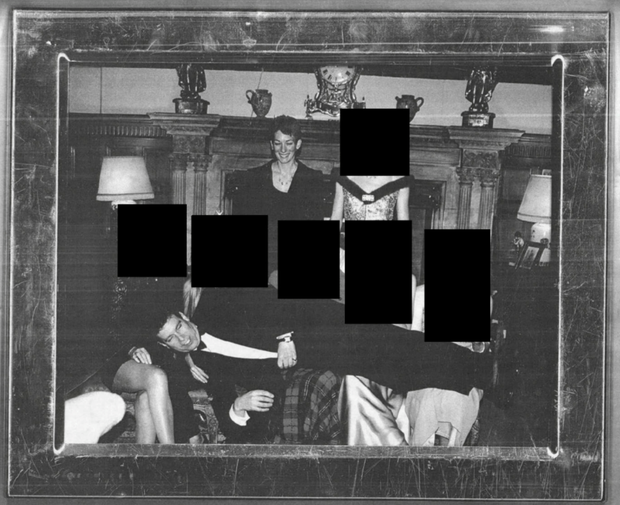
The British royal, who was stripped of his formal titles in October, has drawn years of criticism over his friendship with Epstein. Virginia Giuffre, an Epstein accuser who died by suicide earlier this year, has alleged that she was trafficked to have sex with the prince when she was underage. The royal denied the allegations. He settled a lawsuit brought by Giuffre in 2022.
CBS News has reached out to Mountbatten-Windsor's spokesperson for comment.
Epstein survivor mentioned going to his island with British supermodel Naomi Campbell
Handwritten notes from a July 2019 interview with one of Epstein's accusers lists Naomi Campbell, a British supermodel, as among those who went to Epstein's island in the U.S. Virgin Islands.
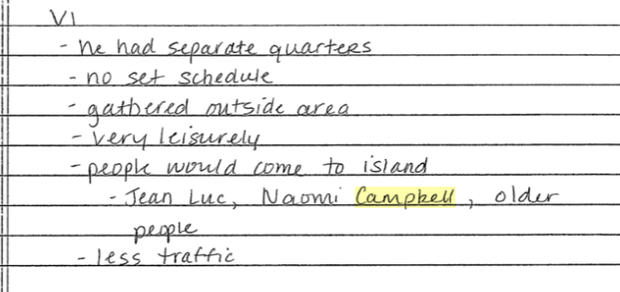
The accuser's name is redacted in the document, but the details shared match those from Teala Davies, who sued Epstein's estate in November 2019 and alleged she was sexually abused by the disgraced financier when she was 17 years old.
At the time of the lawsuit, Davies' lawyer Gloria Allred shared an undated photo of Davies and Epstein on a helicopter. That image is included in the latest release from the Justice Department, though there is a black box covering her face.
According to the handwritten notes, Davies said Campbell went to Epstein's island with "Jean Luc" and "older people." Jean-Luc is likely a reference to Jean-Luc Brunel, a modeling agent who was close to Epstein. He was found dead in a French jail cell in 2022, where he was being held in an investigation into alleged rape of minors and trafficking of minors for sexual exploitation.
In a 2019 YouTube video, Campbell said she met Epstein at her birthday party, but did not address whether she spent additional time with him. Campbell said she was "sickened" by his actions. She has appeared on Epstein's flight logs.
Maxwell told Blanche, the deputy attorney general, in July that Campbell visited Epstein in Palm Beach and "may have gone" to his island, as well as to his house in New York.
Campbell's agent did not immediately return a request for comment.
New documents span 3,965 files, totaling 3 GB of data
The total number of files across all four new data sets is 3,965, with a total file size of about 3 GB. Nearly all of the files are PDFs, with one video file. Some of the files are individual images, while others are documents with many pages.
New photos include one of Clinton in a hot tub
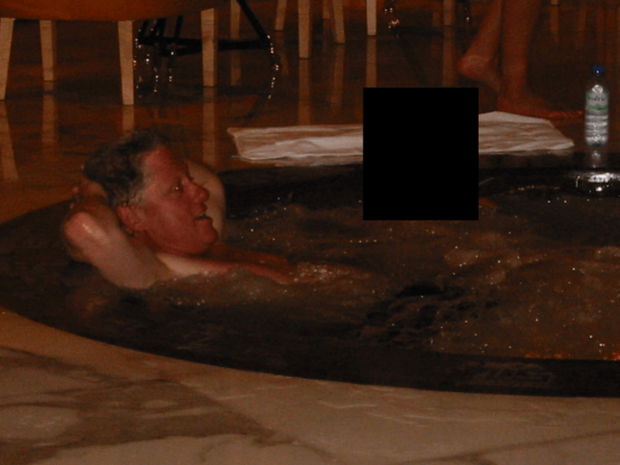
The files released Friday include several photos of former President Bill Clinton, including one showing him in a hot tub with a person whose face is not shown.
In that image, Clinton is seen leaning back, with his arms behind his head:
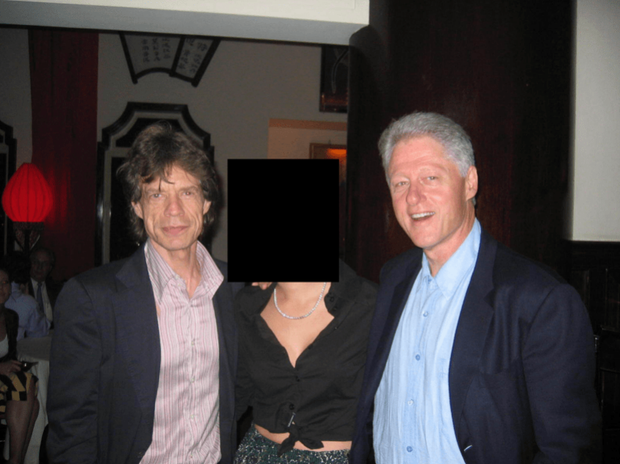
Another three images show Clinton with Epstein. In two of the photos, both men are seen wearing cultural garb. In another, Clinton is seen at an event with rockstar Mick Jagger. There's a person standing between them whose face is redacted. Epstein does not appear in that image.
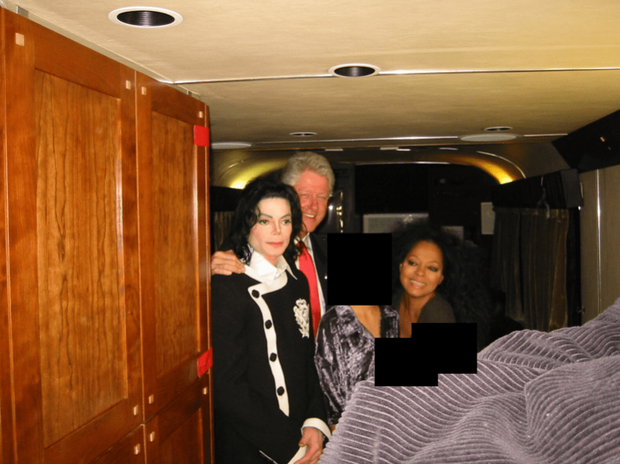
Another photo shows Clinton apparently on an airplane, with musicians Michael Jackson and Diana Ross.
Angel Ureña, a spokesperson for Clinton, accused the Trump administration of "shielding themselves from what comes next, or from what they'll try and hide forever." He also said Clinton's team "knew nothing and cut Epstein off before his crimes came to light."
"So they can release as many grainy 20-plus-year-old photos as they want, but this isn't about Bill Clinton. Never has, never will be," he said in a statement posted to social media.
Ureña previously said in 2019 that the former president took four trips on Epstein's plane in 2002 and 2003, traveling to Europe, Asia and Africa. Ureña said the trips included stops in connection with the Clinton Foundation, and staff, foundation supporters and Clinton's Secret Service detail were on every leg of every trip.
White House claims administration is "most transparent in history" with Epstein release
In response to the release of the files related to the Justice Department's investigation into Epstein, Abigail Jackson, a White House spokeswoman, said:
"The Trump Administration is the most transparent in history. By releasing thousands of pages of documents, cooperating with the House Oversight Committee's subpoena request, and President Trump recently calling for further investigations into Epstein's Democrat friends, the Trump Administration has done more for the victims than Democrats ever have. And while President Trump is delivering on his promises, Democrats like Hakeem Jeffries and Stacey Plaskett have yet to explain why they were soliciting money and meetings from Epstein after he was a convicted sex offender. The American people deserve answers."
A previous release of records related to Epstein included a May 7, 2013, email from a political fundraising firm that touted Jeffries as "one of the rising stars in the New York Congressional delegation," and asked whether Epstein would like to be involved in a fundraising dinner hosted by Democratic campaign committees.
The earlier documents also showed Plaskett, a nonvoting delegate from the U.S. Virgin Islands, was texting with Epstein during a 2019 congressional hearing.
A spokesperson for Plaskett said last month, when the exchange was released by the Oversight panel, that Plaskett received text messages from staff, constituents and members of the public during the hearing, according to CNN.
Justice Department's release includes many photos, some police records
The material released by the Trump administration includes many photos, including of unidentifiable females, and some police records. Many of the images are heavily redacted, with black boxes obscuring the subjects in them.
Other images appear to be from Epstein's Manhattan home, including photos of his bedroom, risque wall art and a taxidermied tiger.
Other files include images of framed photos. Epstein is in some of the photos released by the Justice Department.
Justice Department says "reasonable efforts" have been made to shield survivors' personal information
The website housing the Epstein files contains a privacy notice at the top that warns: "In view of the Congressional deadline, all reasonable efforts have been made to review and redact personal information pertaining to victims, other private individuals, and protect sensitive materials from disclosure. That said, because of the volume of information involved, this website may nevertheless contain information that inadvertently includes non-public personally identifiable information or other sensitive content, to include matters of a sexual nature."
The Justice Department also warned the public that some contents in the "Epstein Library" include descriptions of sexual assault. "As such, please be advised that certain portions of this library may not be appropriate for all readers."
In addition to documents released under the Epstein Files Transparency Act, the full library includes court records, records made public pursuant to public records laws and material released by the House Oversight and Government Reform Committee.
Justice Department release is broken into 4 data sets
The release of the files is broken up into four data sets, which CBS News is now reviewing. They can be found here:
Justice Department releases new Epstein files
The Justice Department has posted the first batches of the new Epstein files on its website. They can be found under the section labeled "Epstein Files Transparency Act (H.R.4405)" here.
Trump doesn't take questions at announcement with drug makers
Mr. Trump did not take questions Friday at an event at the White House with nine pharmaceutical companies who have agreed to lower some of their prices.
"I prefer not talking and asking questions only for the reason that this is such a big announcement," Mr. Trump told reporters. "I really don't want to soil it up by asking questions, even questions that are very fair questions that I'd love to answer. So I think we have to just stop right here."
"I don't want to be asking questions having to do with anything else," Mr. Trump added.
Justice Department says it's meeting "initial deadline" for disclosure
The Justice Department refuted that it will not comply with the deadline to release all files related to its investigation into Epstein and said it will meet the "initial deadline" while working to protect survivors.
"The DOJ is releasing a massive tranche of new documents that the Biden and Obama administrations refused to release. The story here: the Trump administration is providing levels of transparency that prior administrations never even contemplated," the department's public affairs office said on X. "The initial deadline is being met as we work diligently to protect victims."
Mr. Trump succeeded former President Barack Obama in the White House, and former President Joe Biden was elected after him in 2020. Epstein faced federal sex-trafficking charges during Mr. Trump's first term, and Maxwell was tried and convicted during the Biden administration.
Wyden adds to chorus of Democrats criticizing Blanche
Oregon Democratic Sen. Ron Wyden, who has long been critical of the Justice Department's handling of the Epstein investigations, responded scathingly to Blanche's comment that not all files would be released immediately.
"It is an insult to the intelligence of the American people when a lawyer for Donald Trump, Jeffrey Epstein's longtime wingman, claims the administration is blowing off this deadline out of concern for the privacy of Epstein's victims," Wyden said, referring to Blanche's time as Mr. Trump's private criminal defense attorney. "The administration began combing through the Epstein files for any mention of Donald Trump shortly after the inauguration, so they know what's in there and they've had plenty of time to make the necessary redactions."
Wyden reiterated that the law passed by Congress and signed by Mr. Trump last month sets today as the deadline for all files to be made public.
"The law Congress passed did not say 'release some of the Epstein files' or 'release the files whenever it's convenient for Donald Trump.' Anything short of a full release today is a violation of the law and a continuation of this administration's coverup on behalf of a bunch of pedophiles and sex traffickers," Wyden said.
Top Democrats on House committees examining legal options after Blanche comments
Rep. Jamie Raskin, the top Democrat on the Judiciary Committee, and Rep. Robert Garcia, the top Democrat on the Oversight Committee, accused the Trump administration of violating the law after Blanche suggested the Justice Department will make additional releases of Epstein-related files after the statutory deadline.
"Donald Trump and the Department of Justice are now violating federal law as they continue covering up the facts and the evidence about Jeffrey Epstein's decades-long, billion-dollar, international sex trafficking ring," Raskin and Garcia said in a joint statement. "For months, Pam Bondi has denied survivors the transparency and accountability they have demanded and deserve and has defied the Oversight Committee's subpoena. The Department of Justice is now making clear it intends to defy Congress itself, even as it gives star treatment to Epstein's convicted co-conspirator, Ghislaine Maxwell."
Raskin, of Maryland, and Garcia, of California, said they are "examining all legal options" given Blanche's earlier admission.
"The survivors of this nightmare deserve justice, the co-conspirators must be held accountable, and the American people deserve complete transparency from DOJ," they said.
Release of Epstein documents expected at 3 p.m.
The Justice Department is expected to release the Epstein documents at 3 p.m. ET this afternoon, two sources tell CBS News.
Khanna says DOJ must provide "clear timeline" for full release of files
Democratic Rep. Ro Khanna of California, the lead sponsor of the Epstein Files Transparency Act, said in a statement to CBS News that "the fact they are even releasing hundreds of thousands of these is a historic moment for survivors across our nation," even if the full set of files isn't out today.
Khanna said the Justice Department "had months to prepare for this" and "must today offer a clear timeline for the full release."
Read Khanna's full statement below:
"My bipartisan Epstein Files Transparency Act has finally forced Trump to comply with Congress after a year of his willful disregard for our laws. The law requires 'all unclassified records' to be released in a "searchable and downloadable format" by today. If DOJ is producing real documents of interest that are not overly redacted, and if they are clear about a timeline for full production then that is a positive step. They ultimately must release all of it. The north star remains justice for survivors and holding the rich and powerful men who raped young girls or covered up the abuse accountable.
"They have had months to prepare for this, and they have continually rejected our offer to meet with them about this or to meet with survivor's lawyers about the logistics.
"That said, there are millions of pages of documents they need to go through to protect victim's identities and redact graphic materials. The fact they are even releasing hundreds of thousands of these is a historic moment for survivors across our nation.
"In addition to today's document release, the DOJ must today offer a clear timeline for the full release. The key is they release the names of all the powerful men in question who abused underage girls or covered it up. They must provide a clear framework to the survivors and the nation by when we will have everything public.
Schumer says Trump administration is "hellbent on hiding the truth"
After Blanche's comments, Senate Democratic Leader Chuck Schumer said that a failure by the Trump administration to make all the documents public by Friday would be violating the law.
"The law Congress passed and President Trump signed was clear as can be — the Trump administration had 30 days to release ALL the Epstein files, not just some. Failing to do so is breaking the law," Schumer, a New York Democrat, said in a statement. "This just shows the Department of Justice, Donald Trump, and Pam Bondi are hellbent on hiding the truth."
Schumer said Senate Democrats are working with lawyers representing survivors as well as outside legal experts "to assess what documents are being withheld and what is being covered up by Pam Bondi."
"We will not stop until the whole truth comes out," he said. "People want the truth and continue to demand the immediate release of all the Epstein files. This is nothing more than a cover up to protect Donald Trump from his ugly past."
Massie highlights portion of law requiring "all" files to be released today
GOP Rep. Thomas Massie, who led the discharge petition to force a vote on releasing the files, wants the full tranche of files to be released today.
Asked about Blanche's comment implying that the Justice Department intends to make public hundreds of thousands of documents and that there will be more file drops to come, a spokesperson for Massie pointed to a post on X from the congressman.
The post is an image of the act requiring the Epstein files' release, with one line and one separate word highlighted:
"Not later than 30 days after the date of enactment of this act," Massie highlighted, referring to today, Dec. 19, and then the word "all" before a description of the documents.
Massie also posted a 14-minute-long video Thursday describing his expectations for the release. Massie laid out a few ways he believes the public will be able to tell if the Department of Justice does not fully release all of the material.
"The victim's lawyers have been in contact with me, and collectively they know there are at least 20 names of men who are accused of sex crimes in the possession of the FBI. These would reside in the FD 302 forms," Massie said, referring to FBI records of interviews. "If we get a large production on Dec. 19, and it does not contain a single name of any male who is accused of a sex crime or sex trafficking or rape, or any of these things, then we know they haven't produced all the documents. It's that simple."
How Congress passed the Epstein Files Transparency Act, forcing release
In July, Reps. Thomas Massie, a Kentucky Republican, and Rep. Ro Khanna, a California Democrat, introduced legislation to require the Justice Department to release the Epstein files within 30 days. In September, Massie filed a discharge petition to force a vote on the bill, circumventing GOP leadership.
The petition, which required 218 signatures, won support from all Democrats and four Republicans. The final signature needed remained out of reach for weeks, as newly elected Democratic Rep. Adelita Grijalva's swearing in was delayed during the government shutdown.
When the shutdown ended last month, Grijalva signed the petition, forcing the vote on the Epstein Files Transparency Act. Mr. Trump had opposed the legislation, but once it was evident that the bill would pass the House, he gave it his blessing.
The House voted almost unanimously in favor of the measure. The Senate quickly followed suit, approving it with no objections.
House Speaker Mike Johnson, who had led the charge against it in Congress, ultimately voted to move it forward, saying that he expected the Senate to amend it. Senate Majority Leader John Thune did not. President Trump signed it into law on Nov. 19.
Justice Department set to release "several hundred thousand" Epstein files, top official says
Todd Blanche, the deputy attorney general, said Friday morning that the Justice Department will release "several hundred thousand" documents related to its investigation into Epstein. He told Fox News' "Fox and Friends" that the batch will include photographs and other material, but indicated that there will be some information that is redacted to protect Epstein survivors.
"We are looking at every single piece of paper that we are going to produce making sure every victim — their name, their identity, their story, to the extent that it needs to be protected — is completely protected," Blanche said.
He predicted that the Justice Department will release more material in the coming weeks.
"So, today, several hundred thousand, and then over the next couple of weeks, I expect several hundred thousand more," Blanche said. "There's a lot of eyes looking at these, so we want to make sure that when we do produce the materials that we're producing, we're protecting every single victim."
What Epstein files does the law require the Justice Department to release?
The legislation passed by Congress in November requires the attorney general to make public all unclassified records, documents, communications and investigative materials in possession of the Justice Department, the FBI and U.S. attorneys' offices within 30 days of becoming law. President Trump signed the law on Nov. 19.
The documents would stem from a pair of federal investigations, in Florida and New York, spanning more than a decade.
The documents could include bank records, witness interviews, and messages or other files retrieved from Epstein's electronic devices.
Read more here.
What Epstein files can be redacted or withheld?
The law lets Attorney General Pam Bondi withhold files under narrow circumstances.
Records can be redacted to remove survivors' personal information, and the Justice Department can hold back documents that include child sexual abuse material or "images of death, physical abuse, or injury of any person." If any materials need to "be kept secret in the interest of national defense or foreign policy," those wouldn't come out, either.
The law also allows for the withholding of records that "would jeopardize an active federal investigation or ongoing prosecution, provided that such withholding is narrowly tailored and temporary."
One of the bill's initial sponsors, Republican Rep. Thomas Massie of Kentucky, warned last month that the last category may come into play, as President Trump has directed the Justice Department to investigate Epstein's relationships with high-profile Democrats.
"I'm concerned that now he's opening a flurry of investigations, and I believe they may be trying to use those investigations as a predicate for not releasing the files," Massie told reporters.
It isn't clear whether the Justice Department plans to use that provision to withhold files.
The law requires Bondi to provide lawmakers with a list of redacted and withheld records within 15 days of the files being made public. It also says: "No record shall be withheld, delayed, or redacted on the basis of embarrassment, reputational harm, or political sensitivity, including to any government official, public figure, or foreign dignitary."
Some case records were impacted by grand jury secrecy rules. But in recent weeks, three federal judges have ordered the unsealing of grand jury transcripts from Epstein's 2019 case, his convicted associate Ghislaine Maxwell's 2020 case and an investigation into Epstein in the 2000s, following requests from the Trump administration.
What Epstein files have already been released this year?
Tens of thousands of pages of documents have been released over the past year, in most cases by a House committee that subpoenaed the Justice Department and Epstein's estate. They included emails and text messages showing that Epstein continued to court the rich and famous right up until his 2019 arrest.
Dec. 18, 2025: Democrats on the House Oversight Committee released a batch of 68 photos from a trove of about 95,000 the committee obtained from Epstein's estate.
Dec. 12, 2025: An earlier batch of photos from Democrats on the House Oversight Committee, obtained from Epstein's estate, included snapshots of prominent figures like President Trump, former President Bill Clinton, former Treasury Secretary Larry Summers, filmmaker Woody Allen and former Trump adviser Steve Bannon. The photos do not implicate any of those pictured in Epstein's crimes.
Dec. 4, 2025: Democrats on the House Oversight Committee released 73 photos and four videos of Epstein's estate on the 72-acre private island known as Little St. James, in the U.S. Virgin Islands. Epstein allegedly exploited underage girls for sex at the island, and he had stakes in businesses in the U.S. territory.
Nov. 12, 2025: The House Oversight Committee released 20,000 records from Epstein's estate, including scores of emails. The disgraced financier's messages often referenced Mr. Trump. Other messages showed him bantering with Larry Summers and attempting to reconnect with Bill Gates, neither of whom is accused of wrongdoing.
Sept. 8, 2025: House Oversight released a tranche of material from Epstein's estate, including a 2003 birthday note to Epstein that appeared to be signed by Mr. Trump. The president has denied penning the message. Republicans have often accused Democrats of cherry-picking documents.
Sept. 2, 2025: The panel released more than 33,000 pages of files from the Justice Department, including court documents, flight records from Epstein's private plane, and a video of Epstein's cell block from before his death that includes a minute missing from earlier videos. Many of the documents had been released before.
Aug. 22, 2025: The Justice Department released a transcript and audio recording of Deputy Attorney General Todd Blanche's interview with convicted Epstein associate Ghislaine Maxwell, who is serving a 20-year sentence.
Feb. 27, 2025: The White House gave a group of 15 conservative influencers binders labeled "The Epstein Files: Phase 1," but the binders contained little new information.
Prior to 2025: Other documents, including contacts, schedules, flight logs and depositions, were made public previously, often as part of Epstein and Maxwell's criminal cases and in connection with civil lawsuits filed by survivors.
What have Epstein survivors said about the files?
Dozens of Epstein's accusers have hailed the effort to release records on the late sex offender.
Annie Farmer, who testified that she was abused by Epstein and Maxwell when she was 16, called the passage of the Epstein Files Transparency Act a "long-overdue victory."
"It's also bittersweet because of, I think, what it took for us to get to this moment," Farmer said in an interview last month with "CBS Mornings." She added that she's hoping for more information on those who may have enabled Epstein and "people in positions of power that were looking the other way."
Her sister, Maria Farmer, accused Epstein and Maxwell of abuse in the 1990s, and has said the FBI ignored her initial report. In a statement shortly after Mr. Trump signed the bill, she said Congress "finally listened to survivors," but that the bill's passage "doesn't absolve the government and law enforcement's enormous failure to do its job in the past 30 years."
"I hope to see the government make good on its promise of transparency and release the entirety of the files — not bits and pieces, not mass redactions, but the complete truth, removing only child sexual abuse material and victim names and identifying information," she said.
Before and after the bill passed, dozens of other survivors and their families signed open letters and held rallies pressing for the files to be released — including relatives of Virginia Giuffre, who died by suicide earlier this year.
Many survivors say careful redactions are necessary to ensure their privacy is protected. One law firm criticized the redactions so far as inadequate, writing in a letter last month to a judge who was weighing whether to unseal grand jury transcripts: "transparency CANNOT come at the expense of the privacy, safety, and protection of sexual abuse and sex trafficking victims."