Iran War Updates: Gulf states and tankers under fire as U.S. and Iran ramp back up tit-for-tat strikes
What to know about the Iran war today:
- Bahrain and Kuwait said Wednesday that they intercepted weapons launched by Iran after the U.S. carried out strikes on Iran's Qeshm Island in the Strait of Hormuz. Iran appears to be stepping up attacks on America's Persian Gulf allies as tension ratchets back up across the region.
- A U.S. official called the Tuesday strikes on Iran's strategic Qeshm Island a defensive response to Iranian forces "targeting U.S. personnel and assets" in the region. The strikes came hours after Iran said it targeted a U.S. radar installation in Bahrain for the third time in less than a week. Those attacks were all intercepted, U.S. authorities said.
- A crew member was missing Wednesday after a ship belonging to the United Arab Emirates' state oil company ADNOC was struck in the Strait of Hormuz, the energy firm said. Eleven people were injured, and search and rescue operations were ongoing, according to ADNOC.
U.S.-Saudi nuclear agreement "very satisfactory," says U.N. nuclear watchdog agency IAEA
The head of the IAEA, the United Nations nuclear watchdog agency, described on Wednesday a deal that could see the United States help equip Saudi Arabia with a civilian nuclear program as "very satisfactory."
The deal announced in July has drawn questions about the risks of possible nuclear proliferation.
"It's a very satisfactory outcome that we have with this agreement," Grossi told reporters after opening an International Atomic Energy Agency board of governors' meeting, according to the AFP news agency.
The IAEA chief said if and when nuclear power development gets under way in Saudi Arabia, "we will be there."
In his opening statement, Grossi told the board the U.S. and Saudi Arabia had asked the IAEA in October "to take the necessary steps to implement safeguards and verification measures" for their agreement.
Under the deal, the IAEA "will be provided with information about, and access to any sites for conversion, enrichment, fuel fabrication and reprocessing" in Saudi Arabia, Grossi said, adding that he welcomed "the open, transparent approach and engagement of both governments with member states and the secretariat on this matter."
Saudi Arabia had also agreed to "additional verification measures on a voluntary basis," Grossi said.
President Trump said after the agreement was signed that moving forward on the deal would be contingent upon Saudi Arabia signing onto the Abraham Accords, formally normalizing relations with Israel.
CBS/AFP
U.S. naval presence in Mideast now greater than during peak of war with Iran, think tank says
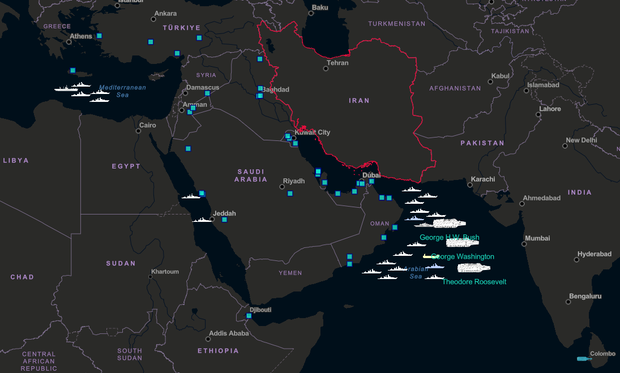
The U.S. military's naval presence in the Gulf of Oman, the Arabian Sea, Red Sea, and Mediterranean is currently greater than the force that was deployed during Operation Epic Fury, at the peak of U.S. and Iranian hostilities, according to an open source intelligence analysis by the Institute for National Security Studies, an independent think tank in Israel.
The U.S. military confirmed Monday that there are now three aircraft carrier strike groups in the region after the recent arrival of the USS Theodore Roosevelt. That carrier joined the USS George H.W. Bush and USS George Washington, alongside with a slew of destroyers and other vessels.
The three-carrier presence is expected to be temporary, however, as carrier strike groups rotate through the region.
According to an interactive map published by the INSS, the U.S. has deployed 12 destroyers to the Arabian Sea, one of which appears to be positioned just inside the Gulf of Oman, east of the Strait of Hormuz.
The map indicates that there are not currently any U.S. warships in the Persian Gulf or the gateway to it, the Strait of Hormuz, which Iran and the U.S. both claim control over.
A senior Iranian military figure said in late October that the regime "will not allow U.S. military ships in the Persian Gulf under any circumstances and at any time."
"The U.S. president must dream of seeing the armed forces enter the Persian Gulf," Iranian armed forces chief of staff Ali Abdollahi was quoted as saying by state TV. "He will take that dream to his grave."
The INSS map does show two U.S destroyers in the Red Sea, where the Iran-backed Houthi rebels have recently expanded their control over Yemen's coastline on the Bab el-Mandeb Strait, threatening Saudi Arabia's oil exports.
Iranian protesters criticize regime in rare public demonstration after deadly bus crash
Some demonstrators who gathered in western Iranian town offered rare public criticism of the Islamic Republic regime Tuesday during a protest over the deaths of 13 gas and oil workers in a bus crash, according to eyewitness accounts.
While Iran's tightly controlled media outlets portrayed the gathering in the city of Abdanan as a protest over road safety, eyewitnesses said the demonstration took on an anti-government tone.
Iran's Fars News Agency, which is closely affiliated with the country's powerful Islamic Revolutionary Guard Corps, reported that the protest grew to around 1,000 people, and it acknowledged that slogans chanted by attendees had a "political tone."
"At first, people were mostly angry about the accident, but gradually the slogans became political and against the government," Jamshid, a shopkeeper who witnessed the demonstration, told CBS News over the phone.
He said "security forces eventually dispersed the crowd by force, using tear gas and even shooting warning shots."
State broadcaster IRIB called the gathering "another failure of the counter-revolution plan" and claimed residents had come out to quell the unrest themselves in support of the government.
A resident of Iran's capital Tehran, who asked to remain anonymous due to concerns for his safety, disputed the state broadcaster's account.
"The accident brought people into the streets, but the anger wasn't only about the workers who died," he told CBS News. "People were chanting against the government, even against the new supreme leader, and some were supporting the exiled crowned prince."
Saudi coalition says major attack on Iran's Houthi allies in Yemen destroyed "60 legitimate military targets"
The Saudi-led coalition fighting the Iranian-backed Houthis said Wednesday it launched a major air attack across territory held by the rebels in Yemen. The Houthis said the Saudi strikes killed at least 17 people.
Maj. Gen. Turki al-Maliki, spokesman for the Saudi coalition, said the strikes launched Tuesday destroyed "60 legitimate military targets" in Yemen's Houthi-held capital Sanaa, and the provinces of Amran, Saada and Hodeida.
The strikes aimed to weaken the Houthis' missile and drone capabilities by destroying tunnels into mountain warehouses where ballistic missiles are stored, and workshops used to assemble and store drones, al-Maliki said.
Anees al-Asbahi, a spokesman for the Houthi-run health ministry, said one strike hit a sponge factory in Hodeida, killing at least 15 people and wounding 13 others. Another strike in the district of Kitaf in Saada killed at least two people and wounded four others. In Sanaa, at least nine people were wounded in a strike that hit a shoe factory, al-Asbahi said.
CBS/AP
Bahrain, Kuwait say they fended off strikes by Iran
Bahrain and Kuwait claimed Wednesday that they repelled air attacks launched against them, as Gulf nations face retaliatory bombardment following U.S. strikes on an Iranian island.The Iranian army said Wednesday its drones "targeted Patriot air defence systems and drone and missile launch platforms belonging to the terrorist U.S. military at Ali Al-Salem Air Base in Kuwait," in a statement carried by state television IRIB.
Kuwait's military said Wednesday its air defenses were "responding to hostile drone threats" and urged the public to follow security and safety advice.
The foreign ministry said in a statement posted on social media that "the continuation of these attacks constitutes a dangerous escalation that threatens the region's security and stability and undermines diplomatic efforts aimed at de-escalation."
Meanwhile, Bahrain said its air defenses intercepted attacks early Wednesday, a day after Tehran's Revolutionary Guard said it struck a base used by the U.S.
Iran's official IRNA news agency cited a regional official as saying the United States had hit Qeshm Island in the Strait of Hormuz but did not cause serious damage.
CBS/AFP
Iraq resumes pumping oil through pipeline to Turkey in order to avoid Strait of Hormuz
Iraq has resumed pumping oil to Turkey through a pipeline at an initial capacity of 120,000 barrels a day, Oil Minister Bassem Mohammed Khudair al-Abadi said Tuesday in comments carried by state media. The export capacity will be gradually increased to reach 500,000 barrels a day, he said.
The capacity is fairly small compared to other pipelines in the region. The Saudi East-West pipeline, which crosses from the Persian Gulf to the Red Sea in order to avoid the Strait of Hormuz and Bab el-Mandeb Strait, has a capacity of 7 million barrels per day.
In August, Iraq and Turkey signed a deal to increase oil exports through a pipeline to the Turkish Mediterranean port of Ceyhan.
Iraq is moving to strengthen the resilience of its oil export infrastructure following the U.S.-Iran war's disruptions to shipping through the Strait of Hormuz.
The Iraq-Turkey pipeline has been largely idle since 2023 following legal and commercial disputes.
CBS/AP
One crew member missing after ship struck in Strait of Hormuz, UAE state oil firm says
The United Arab Emirates' oil firm ADNOC said Wednesday that a crew member was missing after one of its ships was struck the night before in the Strait of Hormuz.
"All other crew members have been safely evacuated from the vessel. Eleven sustained injuries and where required are receiving medical care," ADNOC said, adding that search and rescue operations were continuing.
Monitoring agencies report ships being attacked in or near the Strait of Hormuz on a near-daily basis. Iran claims it carried out some of the attacks on ships it considers transiting through the waterway without its permission.
The U.S. military has also previously said it struck and halted ships it deems to be violating its naval blockade on Iranian ports.
CBS/AFP
U.S. announces "self-defense" strikes on Iran's Qeshm Island
The U.S. launched precision strikes on an Islamic Revolutionary Guard Corps missile site on Iran's Qeshm Island in the Strait of Hormuz, according to a U.S. military official.
The official said the strike was launched "in self-defense."
"The strike was in response to IRGC aggression targeting U.S. personnel and assets," the official said. "U.S. Central Command remains highly vigilant and fully postured to protect Americans across the region."
While the official did not specifically mention the IRGC aggression, the strikes came hours after Iran targeted a U.S. radar site in Bahrain. The s
This was the third attempted strike by Iran on a U.S. military installation in the last five days. All of them were intercepted, U.S. officials said.trikes were successfully intercepted, according to U.S. Central Command.
Iran had earlier said the U.S. attacked Qeshm Island, but they "caused no damage to residential, commercial, or infrastructural areas," according to Ahmad Nafisi, deputy provincial governor of the southern province of Hormozgan, quoted by the official IRNA news agency.