NYC Council speaker blasts health department over Legionnaires' cluster on Upper East Side


New York City Council Speaker Julie Menin blasted the city's health department on Thursday over its handling of the Legionnaires' disease outbreak on the Upper East Side.
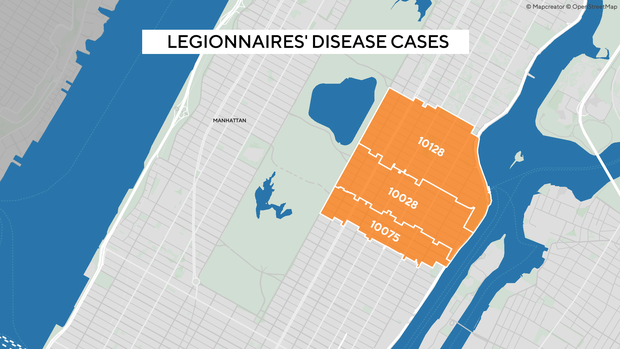
As of Thursday night, city officials say 46 cases of the life-threatening bacterial infection, which causes flu-like symptoms, have been linked to cooling towers in three Manhattan zip codes: 10075, 10028 and 10128.
"More people are contracting this"
As of Thursday, the city has tested about 160 cooling towers east of Central Park between 76th and 97th streets for Legionella bacteria and detected it in at least one.
Twenty-two patients have been hospitalized since the city first alerted residents to cases last week.
"On the East Side of Manhattan, we have a large senior population and seniors are more susceptible to contracting Legionnaires'," Menin said. "Every single day that they wait to mandate that these towers be disinfected is another day that more and more people are contracting this."
Earlier this week, the speaker wrote a letter to New York City Health Commissioner Dr. Alister Martin, saying she was "deeply concerned that the Department of Mental Health and Hygiene has still failed to require building owners to proactively disinfect all cooling towers in the area under investigation."
NYC to release list of buildings
A health department spokesperson said in response to Menin that officials have been "aggressively identifying cooling towers that test positive for the presence of Legionella bacteria and ordering building owners to clean and disinfect."
City Hall said it plans to release a list of all buildings that tested positive for Legionella bacteria in the coming days.
"I would love for more communication, like, if they could tell us where they're finding the bacteria and what we can do to avoid it and anything we can do to protect us. It would be great," said Victoria Franco, an Upper East Side resident.
Legionnaires' does not spread from person-to-person. People are typically exposed through mist from cooling towers in instances where there were multiple cases in a neighborhood, the health department says. Residents living in a building where Legionella is present may continue to drink tap water, cook and use air conditioning without fear of getting sick, officials say.
Anyone who lives or works on the Upper East Side should contact their doctor immediately if experiencing symptoms.
Nonprofit calls for preventative action
Tom Leach, the director of outreach and communications for the nonprofit Alliance to Prevent Legionnaires' Disease, says it's time for the city to take bigger preventative action.
"Maintaining disinfectant residuals from the time it leaves the treatment plant to that last connection on the service line," he said. "It requires our buildings to enact comprehensive water management plans."
He added, "Case numbers only continue to rise ... so there needs to be recognition that we need to do something different."
The nonprofit says cooling towers are one of many sources that can spread the bacteria.
"People need to understand, it comes in the drinking water system, and it ends up in appliances that aerosolize water," said Robert Bowcock, water resource manager for the nonprofit.
In a statement, the New York State Department of Health (NYSDOH) said, "Both the New York State Department of Health and New York City Department of Health and Mental Hygiene have nation-leading regulations that require cooling tower owners to maintain their towers to reduce the public's exposure to Legionella. NYSDOH is collaborating closely with New York City to offer technical assistance and guidance related to testing and enforcement. Any New Yorker experiencing symptoms should seek medical treatment immediately."
The city health department said in a statement, "We will do a complete review of the existing regulations and any potential new regulations after the investigation is complete. For now, our focus is on the most important task at hand: cutting off the source of exposure by rapidly identifying and treating cooling towers."


