Democrats reach historic House majority not seen since 1992
Democrats secured their 258th seat in the House on Sunday, marking the largest majority either party has won in the lower chamber in a general election in three decades.
Democrats have gained 44 House seats so far, four more than the 40 they picked up in President Trump's first midterm in 2018. It's an election sweep unseen since 1992 for either party, creating not only vast opportunities for Democrats to govern but also intense pressure to deliver on campaign promises and priorities.
The 258-seat tally was reached Sunday after Democrat Chuck Hubbard defeated Republican Rep. Virginia Foxx in North Carolina. Hubbard led Foxx by 330 votes following a recount, according to the North Carolina Board of Elections.
"House Democrats have just secured the largest majority any party in Congress has held this century. BOOM," Democratic leader Hakeem Jeffries, of New York, wrote on X Sunday afternoon.
The milestone in the 435-member House exceeded Democrats' own expectations, and they could still gain a few more seats with four other House races remaining outstanding: one each in Minnesota and Tennessee and two in Louisiana that are heading to a December runoff.
Republicans will have at least 173 seats in the minority.
The blue wave, or as some have called it, "blue tsunami," sets up a divided government, with the Senate also in Democratic hands and with a Republican president in the White House. Emboldened Democrats are preparing a 100-day agenda to address the high cost of living while also confronting Mr. Trump with a vast oversight agenda for the remainder of his second term.
The Democrats' majority will be bigger than any the party has seen in elections since Bill Clinton was first elected president in 1992 (258) or the election of Barack Obama in 2008 (257), yet not quite the high-water mark of the Franklin D. Roosevelt era, which saw House Democratic majorities swell past 300.
It presents opportunities and challenges ahead.
In an interview on "Face the Nation with Margaret Brennan" on Sunday, Jeffries repeatedly emphasized the need for action, saying, "Can you imagine how angry the American people will be with Washington if, over the next two years, we fail to do anything about affordability, fail to do anything about healthcare, and fail to do anything about immigration?"
Election rout creates a mandate to govern
The numbers underscore the extraordinary scale of Democratic wins, which spanned from the strongest Republican states to the Midwest and East Coast, as voters, angry over high prices and war with Iran and concerned over corruption, made clear their discontent with Mr. Trump.
Persistent negative views of the economy turned against the party in power. Those who said the economy was bad voted for Democrats in their House races, according to CBS News exit polls. This was the second straight election most voters told CBS News inflation was a hardship for them, and more said their finances are worse now compared to two years ago — these voters also backed Democrats over the Republicans for the House.
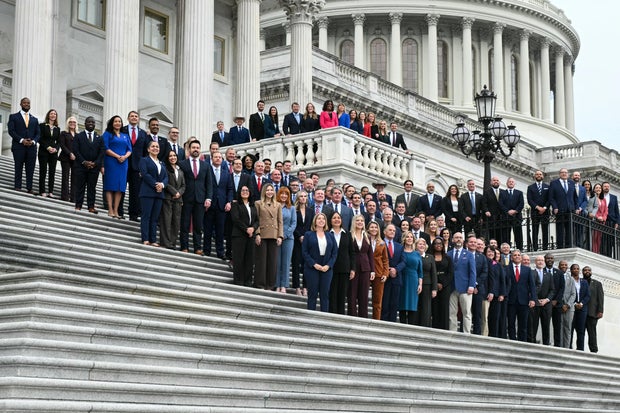
Taking control of both the House and the Senate come January, the Democrats will carry with them the backing of voters and the expectations to deliver. The Senate Democrats won a 56-seat majority in the 100-member chamber, their biggest advantage in over a decade.
The Democrats, as part of their 100-day agenda, are planning swift votes to reverse the Republicans' Medicaid cuts and restore the Affordable Care Act tax credits the Republicans allowed to expire.
Democrats have vowed to marshal their subpoena powers and launch a flurry of investigations to exert the role of Congress as a check on presidential power. That includes plans to probe how Mr. Trump and his family have become wealthier since he returned to office. Jeffries, who is in line to become House speaker, has not ruled out trying to impeach Mr. Trump for a third time.
"This is a historic moment for our country. This is one of the largest classes we have seen," said progressive leader Rep. Alexandria Ocasio-Cortez at the Capitol.
The New York Democrat called the big numbers "a mandate for change."
Rep. Tom Suozzi, a centrist Democrat from New York and an accountant by profession, said the House Democrats should focus 75% of their time on affordability issues and 25% on accountability.
"Everything should be tied back to the people — and how it's affecting the people," he said.
For example, he said, as the Democrats launch investigations into Mr. Trump's financial dealings, they should be connecting the dots: "How does that affect people's pocketbooks?"
The White House has issued a warning to Democrats over their planned probes into the administration, going as far as claiming that such investigations — a standard oversight function of Congress — may amount to "blatant criminality."
A new generation of leaders
After House Speaker Mike Johnson struggled to keep the House functioning for the past two years with a narrow single-digit majority — meaning a few GOP lawmakers could derail the agenda — the Democrats will have a wide margin that provides the new leadership much more room to maneuver.
Jeffries, who is poised to make history as the first Black speaker of the House if his colleagues elect him to the job on Jan. 3, 2027, will be able to lose dozens of Democrats on any given vote and still have the 218 needed for passage, in the face of GOP opposition.
"We're not a monolith — people come to the caucus with different ideas — it's OK," said Democratic Rep. Troy Carter of Louisiana, who is expected to lead the Congressional Black Caucus.
Republicans saw their number of House seats fall to one of the lowest tallies in decades. They're far from the end of the Obama administration, when the House Republicans won 247 seats in the 2014 election and the rise of Newt Gingrich when they won 230 seats in 1994.
Rep. Jim Jordan of Ohio, who was elected by his colleagues to be the Republican leader in the minority, vowed to fight their way back to power.
"Over the next two years, House Republicans will fight for American families," Jordan said.
The GOP's high-water marks include the 1920 election, with 301 seats for House Republicans.