U.S. thwarts Iranian missile attack on U.S. troops, strikes Iranian proxies in Iraq with Saudi forces
Follow updates on the war in the Middle East for Wednesay, July 29, here. See earlier developments below.
What to know about the Iran war:
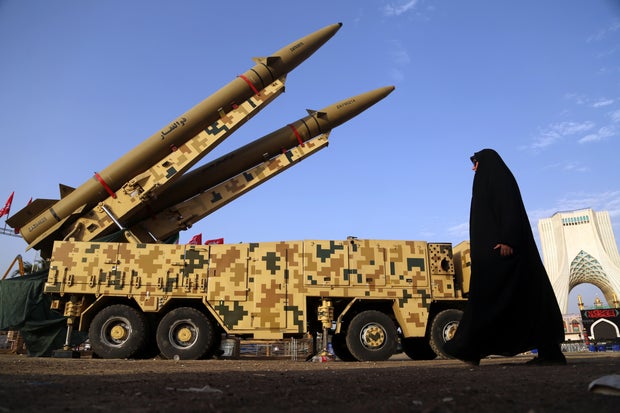
- U.S. Central Command said Tuesday night that it thwarted an "attempted surprise attack" by Iran's Revolutionary Guard, which it said launched multiple ballistic missiles at U.S. forces in the Middle East. CENTCOM said all the missiles were "successfully intercepted."
- U.S. and Saudi Arabian military forces conducted joint strikes Tuesday targeting what U.S. Central Command called "Iran-aligned terrorists" operating in Iraq. The U.S. said the strikes were in retaliation for more than 30 aerial drone attacks that were conducted over the past 72 hours at the direction of the Iranian Revolutionary Guard.
- Israeli Prime Minister Benjamin Netanyahu met President Trump at the White House Tuesday for the first time since the U.S. and Israel launched their war with Iran. Israel has not taken part in the latest round of hostilities between the U.S. and Iran, which flared earlier this month but has been paused amid diplomacy aimed at a deal to reopen the Strait of Hormuz.
Iran-backed Iraqi paramilitary group confirms 20 killed in U.S-Saudi strikes
The Popular Mobilisation Forces (PMF), an Iraqi paramilitary group backed by Iran, said at least 20 of its fighters were killed and 32 wounded in U.S.-Saudi strikes.
In a statement released Wednesday, the group said its headquarters in Baghdad, Wasit, Nineveh, Basra, Kirkuk, Karbala, and Diyala were hit and reported widespread damage.
The group added the number of casualties is preliminary and could rise.
At least 10 reportedly dead in U.S.-Saudi strikes on Iran-backed group in Iraq
At least 10 members of an Iran-backed paramilitary alliance in Iraq were killed in U.S.-Saudi strikes on their bases in the country, two alliance sources told French news agency AFP.
The strikes hit positions belonging to the Hashed al-Shaabi, or the Popular Mobilisation Forces (PMF), "across several provinces, with the deadliest attack in Nineveh province, where at least 10 members were killed," an official said, adding that the toll will likely rise.
Injuries were reported in other provinces, he added. Another official confirmed the initial toll.
Jordan says 5 Iranian missiles intercepted
Jordan's military said the country's air defenses intercepted five missiles launched from Iran early Wednesday. In a statement, the military said the missiles had been "intercepted and destroyed." It did not mention any casualties.
Earlier, the U.S. military said it knocked down an Iranian missile barrage and worked with Saudi Arabia's forces to strike sites in Iraq that Tehran-backed militias have used to launch attacks in recent days, shattering a brief pause in fighting.
All Iranian missiles launched against American forces in the Middle East were intercepted, U.S. Central Command said.
Iran strikes 3 oil tankers in Strait of Hormuz, state media says
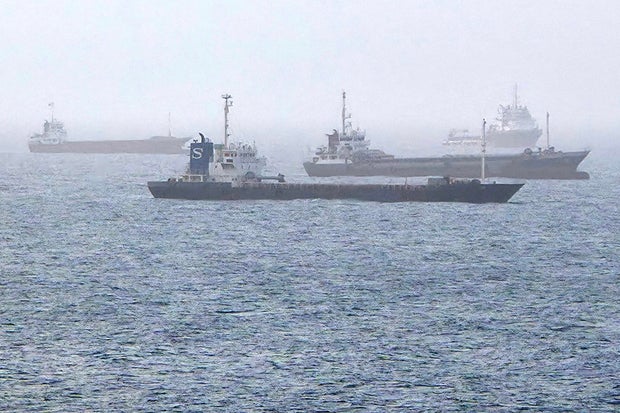
The Iranian Revolutionary Guards struck and halted three oil tankers in the Strait of Hormuz, according to Iran's semi-official Tasnim News Agency, which is linked to the Revolutionary Guards.
"Three violating oil tankers, which ignored our warnings and continued sailing an unsafe and illegal route, were struck and brought to a halt," the Tasnim News agency reported.
It was not immediately clear if the tankers sustained any significant damage, or if there were any injuries to crewmembers from the attacks.
Earlier Tuesday, the Yemen-based Houthi militant group, which is an Iranian proxy, said it fired several ballistic missiles at a Saudi-flagged tanker in the Red Sea.
CBS/AFP
U.S., Saudi forces conduct strikes on Iranian proxies in Iraq
U.S. and Saudi Arabian military forces conducted joint strikes on "Iran-aligned terrorists" in Iraq Tuesday in retaliation for Iranian drone attacks in the Middle East, U.S. Central Command said Tuesday night.
U.S. and Saudi fighter jets "struck multiple terrorist logistics and weapons sites across eastern Iraq," according to a statement from CENTCOM.
CENTCOM said the strikes were in response to more than 30 aerial drone attacks that occurred over the past 72 hours that were conducted at the direction of the Iranian Revolutionary Guard.
Earlier Tuesday, CENTCOM said Iran had launched a surprise ballistic missile attack on U.S. forces in the Middle East. CENTCOM said that all of Iran's missiles were intercepted.
Per CENTCOM, between February and April of this year, there were more than 600 attempted attacks on U.S. citizens and facilities by Iran-aligned terrorist militias in Iraq.
"The IRGC and its terrorist proxies must cease these attacks to avoid further U.S. military response," CENTCOM said.
Iran launched ballistic missile attack on U.S. forces in Middle East, CENTCOM says
Iran launched multiple ballistic missiles at U.S. forces in the Middle East in what U.S. Central Command described as an "attempted surprise attack."
CENTCOM said the missiles were launched at 5:45 p.m. ET Tuesday by the Iranian Revolutionary Guards. They were all "successfully intercepted," according to CENTCOM.
"U.S. forces remain vigilant and at a high state of readiness," CENTCOM said in its statement.
Ukraine says it wants to avoid "escalation" with Iran
Ukraine and Iran's foreign ministers spoke by phone on Tuesday, Kyiv said, adding it wants to avoid an "escalation" after a Ukrainian attack on an Iranian vessel in the Caspian Sea.
Ukrainian Foreign Minister Andrii Sybiha wrote on his X account that he had a "frank conversation" with his Iranian counterpart, Abbas Araghchi.
"Diplomacy is about direct conversation, even when it's difficult. I stressed that our goal is to avoid unnecessary escalation," Sybiha wrote.
Iran on Monday warned of "unforeseen consequences" after the attack last week that killed one sailor and wounded several others.
Ukrainian President Volodymyr Zelenskyy on Saturday said Kyiv had carried out long-range strikes in the Caspian Sea against vessels carrying military cargo involving Iran.
Sybiha said he reiterated to Araghchi that "all of Ukraine's actions are aimed solely at defending our country from Russian aggression and never intended to target civilian vessels or people."
Blockade has stopped 18 ships entering or exiting Iranian ports, U.S. military says
The reinstated U.S. blockade on Iranian ports has now stopped 18 ships from exiting or entering Iranian ports, according to U.S. Central Command.
Eighteen ships is an increase by one vessel from yesterday. The number of ships boarded (two) and disabled (two) remained the same.
Central Command said more than 20 U.S. warships are taking part in the blockade, which President Trump described as a "steel wall" last week.
Transits in the Strait of Hormuz are down sharply after the ceasefire fell apart and Iran targeted several vessels earlier this month. Only 29 verified crossings were recorded from July 24 to 26, according to data company Kpler. About 100 vessels would transit the strait on a daily basis before the war.
Netanyahu and Trump had "extremely positive" meeting: Source
The White House meeting between President Trump and Israeli Prime Minister Benjamin Netanyahu was "extremely positive," according to a senior Israeli source who accompanied Netanyahu in the meeting.
"It was an extremely positive meeting," the source said. "The Prime Minister and President held an excellent and comprehensive discussion on the key issues of the day, first and foremost Iran. The leaders reaffirmed their ironclad commitment to ensuring that Iran never has nuclear weapons."
The meeting held the potential to be tense, emphasized by Mr. Trump's comments to Fox News just before the meeting. He pushed back on a reporter's question about Netanyahu wanting to discuss Pickaxe Mountain, a supposed Iranian nuclear facility, saying, "I don't need Bibi to tell me that."
"Bibi's telling me that because he wants me to stay involved," Mr. Trump told Fox News. "I said, 'Why didn't you just tell it to me, why did you have to announce it to the world?'"
"I know exactly what's going on at Pickaxe. It's not a big problem," Mr. Trump added.
The meeting lasted for a little over an hour.
Iran says it prevented third-party country from de-mining Strait of Hormuz, haven't requested talks with U.S.
Iran has rejected a proposal by Oman to allow another country to de-mine the Strait of Hormuz, according to Iranian Deputy Foreign Minister Kazem Gharibabadi.
Gharibabadi did not say which country Oman proposed to de-mine the strait but said "Tehran blocked the plan," he told the semi-official Tasnim News Agency.
The top diplomat also noted Iran has not reached out to the United States for talks in the last 15 days, despite President Trump saying Iran wanted to talk.
"We have not submitted any request to negotiate with America during the past 15 days," Gharibabadi said. "The Americans are the ones who asked us to hold a dialogue, and as they informed us through Oman, they will not carry out military actions against us."
He also reiterated the Strait of Hormuz "will never return to its pre-war state," a common sticking point in any negotiations with the U.S.
"The Strait of Hormuz has become part of our national security and it provides defensive capabilities, and we will never give it up," Gharibabadi said. "We do not fear any action to enforce our sovereignty over the Strait of Hormuz, even if that means resuming the war."
Houthis fire on Saudi oil tanker in Red Sea
The Iran-backed Houthi paramilitary group fired on a Saudi-flagged tanker in the Red Sea on Tuesday, the group said.
The Houthis fired "a number of ballistic missiles" at the oil tanker NCC Ghazal for "for violating the maritime navigation ban imposed on the Saudi enemy and ignoring the warning calls," according to spokesperson Yahya Saree. The ship turned around and "retreated" from the fire, he said.
"The armed forces affirm their continuation in implementing the maritime blockade decision against the Saudi enemy within the equation of siege by siege and comprehensive escalation by comprehensive escalation," Saree said, translated from Arabic.
The Houthis had threatened to target Saudi tankers transiting the Bab el-Mandeb, the southern route out of the Red Sea, in solidarity with Iran. Two Saudi tankers were targeted last week, one of which was struck and caused a fire. The group, however, has said the strait is open to non-Saudi ships.
Few ships are now transiting the Bab el-Mandeb on a daily basis though — about 20 per day, compared to an average of about 50 a day prior to the threats.
The Houthis also targeted oil facilities on the western coast of Saudi Arabia on Sunday.
U.N. peacekeepers find ammonium nitrate explosives in southern Lebanon
U.N. peacekeepers said Tuesday they had found around 4.4 tons of explosives this month in a southern Lebanon border village currently under Israeli occupation.
On July 2 during a "routine route check" near Hula, "peacekeepers found 385 containers abandoned inside a building, containing approximately 4,000 kilograms of explosive material, consisting mainly of ammonium nitrate compounds," the U.N. Interim Force in Lebanon (UNIFIL) said in a statement.
UNIFIL specialists "later carried out on-site procedures to render the material inert, making it safe and removing the risk it posed."
A source with knowledge of the matter told the AFP news agency on condition of anonymity that the containers had Hebrew writing on them and were "likely used for demolitions."
Hula is within a band of territory stretching across southern Lebanon, and about six miles into the country from the Israeli border, which has been occupied by Israeli forces for weeks amid the country's fight against Iranian-backed Hezbollah. Tens of thousands of residents have been ordered to evacuate towns and villages in the so called "security zone" and Israel has warned them not to return.
Hezbollah drew Lebanon into the Middle East war on March 2 by firing rockets and drones at Israel in support of Iran, triggering major Israeli airstrikes and the ongoing ground invasion.
While violence has declined since a framework deal was signed between Lebanon and Israel, Lebanon has reported ongoing Israeli demolitions of homes and other buildings in border villages and towns. Lebanon's president on Monday called the demolitions a "direct violation of human rights and a clear breach of international laws."
Lebanon's state-run National News Agency has reported Israeli detonations in Hula on four occasions this month.
CBS/AFP
Trump concludes meeting with Netanyahu, White House says
President Trump has concluded his meeting with Israeli Prime Minister Benjamin Netanyahu after about an hour, according to White House press secretary Karoline Leavitt.
The meeting with Netanyahu came immediately after one with Ukrainian President Volodymyr Zelenskyy.
"President Trump has concluded his meetings in the Oval Office with President Zelenskyy and Prime Minister Netanyahu," Leavitt posted on X. "Both meetings were positive and productive!"
Both meetings lasted about an hour — the meeting with Netanyahu lasted a little over an hour, while Zelenskyy's was a little under.
Photos from Netanyahu's meeting showed attendants, in addition to Mr. Trump, included Vice President JD Vance, Secretary of State Marco Rubio and Secretary of Defense Pete Hegseth.
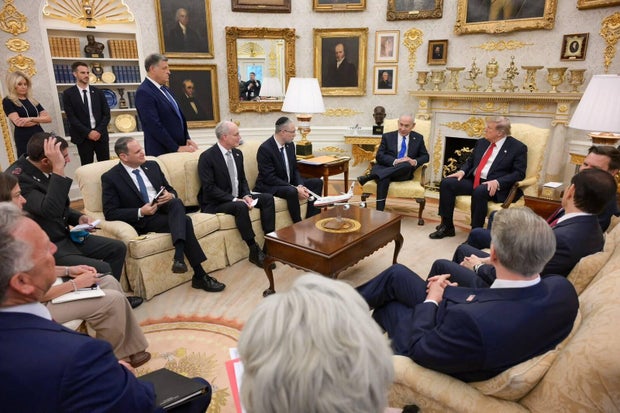
Zelenskyy had earlier posted the meeting with Mr. Trump also went well, saying, "Thank you for everything we do together to protect the lives of Ukrainians and advance peace."
"The President and I discussed licenses for Patriot interceptor production and several other ideas that could help," the president said. "We also spoke about diplomacy – it's important that the diplomatic process be reinvigorated. Our teams will arrange the details of their further communication. I am grateful to the United States for its firm support."
Russia calls Ukrainian strike on Iranian vessel "an attack on Iran"
Kremlin spokesperson Dmitry Peskov said Tuesday that Ukraine's attack on an Iranian commercial vessel in the Caspian Sea over the weekend was an assault on Iran.
The Saturday strike killed one sailor and wounded another, according to Iran's foreign ministry.
"This is an attack on Iran," Peskov said Tuesday. "The geographical scope of the Kyiv regime's terrorist activity is expanding."
Ukraine's Volodymyr Zelenskyy, who had a closed-door meeting at the White House with President Trump on Tuesday, said Monday that he didn't want to open a "new front" with the attack on the ship, but that Iran had "already attacked us," referring to Iran supplying Russia with attack drones.
"This threat must be neutralized and definitively eliminated," Peskov said of Ukraine.
Former Israeli military and intelligence officers call on Trump to intervene over escalating settler violence
Around 600 former Israeli senior officials called on President Trump to intervene to end escalating violence by settlers against Palestinians in the Israeli-occupied West Bank, ahead of his meeting on Tuesday with Prime Minister Benjamin Netanyahu.
In an open letter addressed to Mr. Trump and other U.S. officials, including Jared Kushner and Steve Witkoff, the former officials of the "Commanders for Israel's Security" group warned of an increase in "terrorist activity carried out by settlers," saying the violence could have consequences more damaging than the aftermath of the Oct. 7 Hamas attack on Israel, which sparked the Gaza war.
The signatories include former senior figures from Israel's military, the Mossad and Shin Bet intelligence services, and the Foreign Ministry. They called on Mr. Trump to use his influence with Netanyahu's government to halt the escalation, arguing that only direct intervention by the U.S. leader could prevent what they said was a looming catastrophe.
Netanyahu said last week that his government would establish new settler outposts in the occupied West Bank and legalize more existing ones, after a clash left two Israelis and four Palestinians dead in the territory.
All Israeli settlements in the West Bank are regarded as illegal under international law, but they've been encouraged by Israel's current government, which swung sharply to the right when Netanyahu formed his governing coalition with parties that had long existed on the right-wing fringes of Israeli politics.
Israel disputes the international position that the West Bank settlements are illegal, arguing that most are legal under its own domestic law.
Iran and Oman to decide on fees for ships in Strait of Hormuz, Iranian ambassador in Russia says
Iran and Oman will jointly determine future fees for ships transiting the Strait of Hormuz as part of ongoing negotiations over the strategic waterway, Iranian Ambassador to Russia Kazem Jalali told Russia's state news agency TASS.
"Iran and Oman are holding negotiations on this issue," Jalali said Tuesday. "As the Iranian authorities and foreign ministry have noted, we and Oman are making decisions regarding the security of the Strait of Hormuz and the regime governing the passage of ships through it."
The U.S. suspended strikes on Iran Friday after 13 consecutive nights of attacks, in an attempt, according to U.S. Ambassador to the U.N. Mike Waltz, to allow diplomacy to yeild an agreement to reopen the strait.
Recent talks have been limited to Iranian and Omani officials trying to establish a joint "mechanism" to control shipping traffic through the Strait of Hormuz, Iranian officials have said this week.
Jalili told TASS that "compensation for services related to passage [through the strait] and their cost are the subject of our negotiations. An appropriate decision on these issues will be made in the future."
Jalali said Tehran and Muscat were also discussing future security arrangements and rules to govern maritime traffic through the waterway. Iran and Oman held talks in Tehran on July 24 and 25 regarding shipping through the strait, and the two nations agreed to continue technical consultations, he said.
Oman's foreign minister joined a virtual meeting on Tuesday with counterparts from other Persian Gulf states to discuss the strait and the ongoing negotiations with Iran, according to the official Oman News Agency.
European Union condemns Iranian aggression against French diplomats
The European Union on Tuesday condemned what it called Iranian aggression against two French diplomats this month in Tehran.
"The EU unequivocally condemns the aggression against two diplomats of the Embassy of France in Tehran perpetrated by Iranian security forces on July 19," the EU foreign policy chief Kaja Kallas said in a statement. "Such acts constitute a blatant violation of the Vienna Conventions and jeopardise the very conduct of diplomatic relations."
France said the two diplomats suffered "an extremely serious act of intimidation" by Iranian security services, with one of them abused physically.
Both were "brutally arrested in a private place" before being "detained for several hours without reason, interrogated, and one of them was physically abused," before they were able to return to the embassy, French Foreign Minister Jean-Noel Barrot said in a July 20 statement.
Iran's foreign ministry said Monday that it had summoned the French ambassador to protest the conduct of the diplomats. A ministry spokesman said the diplomats had "interfered in Iran's internal affairs under the pretext of engaging with civil society."
CBS/AFP
Trump and Zelenskyy don't share same vision of Middle East war, analyst says
President Trump and Ukraine's Volodymyr Zelenskyy don't share the same vision of the war in the Middle East, an analyst said Tuesday, after Mr. Trump downplayed Russia's alleged support for Iran.
Ukraine struck an Iranian commercial vessel in the Caspian Sea on Saturday, killing one sailor and wounding another, according to Tehran.
Zelenskyy, who arrived Tuesday at the White House for a closed-door meeting with Mr. Trump, said the previous day that Iran had "already attacked us," referring to Iran supplying Russia with attack drones.
Ukrainian Ambassador to Israel Yevgen Korniychuk said Sunday that Israel and Ukraine were "fighting the same enemy, a different side of the same evil axis."
Phillips O'Brien, a professor of political science at St. Andrews University in Scotland, said, however, that that is not a "shared U.S.-Israeli-Ukrainian vision" of the nexus between the conflicts in the Middle East and Europe.
"Ukraine would like support from the United States and would love support from Israel, too, but it's not getting much, if any," he told CBS News' partner network BBC News on Tuesday.
"Israel has actually always been very careful to stay close to Russia," he said, while the U.S. "is trying to cooperate with China" and "is closer to Russia than it is to most European states."
Mr. Trump on Monday downplayed accusations made not only by Ukrainian officials, but by European officials publicly, and by U.S. officials to CBS News, that Russia has aided Iran during the war.
"I don't think they've been doing it. Certainly not at a high level, and if they have, it has been very unimpactful," Mr. Trump said, adding that he would "ask Putin" about it.
Ukraine attacked the Iranian ship "to say to America, 'Look, we can help you fight Iran,' but … from what Trump even said yesterday, they don't share that vision," said O'Brien.
Trump hails "very good talks" with Iran, but renews threat to "finish the job" if a deal isn't made
President Trump said Tuesday that there had been some "very good talks" with Iran, but he reiterated his warning that if a deal isn't reached with the regime, the U.S. will "finish the job."
"We can be in the midst of a beautiful discussion, and they'll come out and say … 'we didn't discuss nuclear,'" Mr. Trump told Fox News. "Well that's all we discuss, because they'll never have a nuclear weapon. They understand that. And we have had some very good talks."
The president alleged the U.S. had "destroyed most of [Iran], frankly," adding: "If they don't make a deal then I go back and I finish the job, but that's going to take them forever to rebuild."
Mr. Trump, who has threatened repeatedly to order strikes on Iranian civilian infrastructure, including bridges and power plants, said Tuesday that he wanted to avoid such attacks, telling Fox that the Iranian people, "have to live."
"It's a very, very delicate balance," Mr. Trump told Fox. "So, I think we have a very strong position right now. They know I'm going to do that if they don't make a deal."
Trump says U.S. will "take out" Iran's Pickaxe Mountain "very easily" if a deal isn't made
President Trump on Friday renewed his threat to attack Iran's Pickaxe Mountain, a secure facility allegedly used for nuclear activity, saying "we'll take it out very easily" if a deal isn't made.
The U.S. has paused its strikes on Iran since Friday, after 13 consecutive nights of attacks, to allow for diplomacy, according to U.S. Ambassador to the U.N. Mike Waltz.
Iran says recent talks have been limited to Iranian and Omani officials trying to establish a joint "mechanism" to control shipping traffic through the Strait of Hormuz.
Mr. Trump was asked Tuesday on "Fox & Friends" about reports that Israel's Prime Minister Benjamin Netanyahu was planning to discuss alleged recent activity at Pickaxe Mountain, where there are believed to be nuclear facilities buried deep under rock, during a meeting at the White House later in the day.
"I don't need Bibi to tell me that," Mr. Trump said, using a common nickname for the Israeli leader. "Bibi's telling me that because he wants me to stay involved ... I said: 'Why didn't you just tell it to me, why did you have to announce it to the world?'"
"I know exactly what's going on at Pickaxe. It's not a big problem," Mr. Trump told Fox. "We took out their nuclear sites, and we'll have to take out Pickaxe if we don't make a deal. We don't make a deal, we'll take it out very easily."
Israeli defense chief says U.S. aircraft used Israeli bases to strike Iran
Israeli Defense Minister Israel Katz said Tuesday that American warplanes used Israeli bases during recent attacks on Iran, reiterating that his country was prepared to retaliate if targeted.
Fighting between the U.S. and Iran paused Friday after 13 nights of U.S. strikes on the country.
Israel has not taken part in the latest round of hostilities, which started in early July after a ceasefire agreed to in mid-June collapsed.
"The fact is that, at the moment — and this could change within an hour — the Iranians are firing at everything in the region except one country: the State of Israel," Katz told Israel's right-wing Channel 14, according to the AFP news agency.
"They know that American aircraft are taking off from here to carry out strikes," he added. "This does not mean we know what will happen tomorrow; it means we know what our response will be. I announced it, the Prime Minister announced it, and we made it absolutely clear: if Israel comes under fire, we will strike back with full force."
President Trump on Monday voiced optimism for a deal with Iran, as the two sides held their fire for a third consecutive day, but added that the U.S. would "go back to doing what we were doing" — striking Iran — if the talks fail.
Shipping tanker costs skyrocketing because of Iran and Ukraine wars, say analysts
The threat of attacks in three critical shipping routes in the Middle East and Europe, linked to the wars in Iran and Ukraine, has driven the cost for tanker operators to new highs, according to a new analysis by the Lloyd's List business intelligence group.
Costs for tankers loading in the Black Sea have reached peak levels as Ukraine continues to attack Russian-linked vessels in the area, while prices for tankers loading at the western Saudi Arabian port of Yanbu on the Red Sea surge, and Persian Gulf shipping via the Strait of Hormuz remains at the low levels seen in the early days of the U.S.-Iran war.
It all amounts to a perfect storm for energy shipping markets, Lloyds said Tuesday.
"All of this is happening at once, and the various tanker markets are interacting with each other," wrote Lloyd's Greg Miller in the analysis. "Everything is connected in ocean shipping."
Spot rates – the price charged on a shipment-by-shipment basis at the current market rate – and rising insurance premiums are making very large crude carrier (VLCC) and suezmax shipments (the largest vessels that can navigate the Suez Canal) more expensive.
The volume of product being transported through the Red Sea, Strait of Hormuz, and Black Sea has declined due to the threat posted by Yemen's Iran-backed Houthis, Ukrainian attacks, and Iranian strikes on merchant vessels respectively.
The networks that carry oil and cargo in the region are also becoming increasingly connected, as ship owners look to alternate routes, potentially causing bottlenecks and further driving up costs, Lloyd's said.
Iran's military says it "will not leave any threats unanswered" after Trump comments
Iran's military said Tuesday that it "will not leave any threats unanswered," after President Trump warned on Monday that the U.S. would "go back to doing what we were doing" – striking Iran – if ongoing indirect negotiations fail to yield an agreement.
The U.S. paused its bombardment of Iran Friday after 13 consecutive nights of strikes.
Mr. Trump expressed optimism Monday about diplomatic efforts, but he also warned that if the U.S. and Iran can't make a deal, "we go back to doing what we were doing" when Washington was striking Iran.
So far the recent diplomacy, according to Iran, has been limited to discussions between Iranian and Omani officials aimed at establishing a joint "mechanism" to control shipping traffic through the Strait of Hormuz.
Iran's Khatam Al-Anbiya central military command said Tuesday that the U.S. had, "over the past three days threatened Iranian vessels, commercial ships, and oil tankers in the country's coastal and territorial waters."
The command said this would "be considered an expansion of the war in the region," adding that Iran "will not leave any threats or hostile actions" by the U.S. "unanswered and will respond accordingly."
Jordan and Iraq report more drone attacks
Jordan and Iraq reported more drone attacks on their territory on Tuesday, after Qatar and Saudi Arabia blamed Iranian-backed militias for incursions the day before.
Jordan's army said in a statement Monday that it had intercepted a drone that entered its airspace on Tuesday in its eastern desert, near the border with Iraq and Saudi Arabia.
Local media in Iraq meanwhile reported that several drones targeted Iranian opposition sites in the area around Erbil, the capital of the country's Kurdistan region, early Tuesday morning, and drones were intercepted heading toward the U.S. consulate in the area.
The origin of the drone attacks on Iraq and Jordan remains unknown, but on Monday Qatar and Saudi Arabia blamed Iranian-backed militias based in Iraq for similar drone incursions.
Iraqi Prime Minister Ali Al-Zaidi ordered a probe on Tuesday into the Saudi statement "based on information provided by the Saudi side," according to a post on X from his office.
On Monday, Israel said it had intercepted two drones near the border with Jordan, which Jordan confirmed.
Iran chief diplomat discusses Strait of Hormuz in calls with Oman, Saudi Arabia
Iranian Foreign Minister Abbas Araghchi held separate phone calls on the Strait of Hormuz with his Omani and Saudi counterparts Badr Al-Busaidi and Faisal bin Farhan, state TV said Tuesday.
During the calls, "they stressed the need to strengthen cooperation and advance joint diplomatic efforts to establish stability in the region and eliminate the insecurity imposed on the Strait of Hormuz due to the aggressive actions of the United States," the state broadcaster added.
Iran has maintained control over the strait since the start of the Middle East war on Feb. 28, disrupting shipping through the vital conduit.
In recent weeks, fighting has also spread to involve Saudi Arabia and the Iran-backed Houthi rebels in Yemen.
But the last few days have seen a lull in hostilities in the region.
Iran hangs two anti-government protesters in public
Iran's judiciary on Tuesday announced the hanging of two men over charges relating to anti-government protests that peaked in January, with media reporting it took place in a public square.
"The death sentences of Abolfazl Sepahi and Amir-Hossein Safari were carried out this morning," the judiciary's Mizan Online website said.
Mehr news agency meanwhile reported that the hanging took place in "a square in the city of Malekshahr" in the central Isfahan province, with people present.
The two were found guilty of "attacking police officers with machetes and knives, tying them to road signs, pulling them on the ground, dousing them with gasoline, and setting them on fire" on Jan. 8, Mizan said.
It added that they had faced charges of "moharebeh (waging war against God) by drawing weapons and creating fear and terror" and "corruption on earth for committing acts that severely disrupted public order and security in the country," among other counts.
In late December, a protest movement initially sparked by the high cost of living rapidly evolved into widespread anti-government demonstrations that peaked on Jan. 8 and 9.
Iranian authorities reported more than 3,000 deaths, attributing the violence to "terrorist acts" orchestrated by the United States and Israel, while rights groups based abroad maintain that security forces fired on protesters.
On July 19, two other men were hanged over similar charges in Isfahan province.
Amnesty International says Iran conducts the second most executions of any country, after China.
Israel says it intercepted drone near Jordan border
The Israeli military said on Tuesday that it intercepted a drone near the Jordanian border and was looking into its origin.
"A short while ago, the Israeli Air Force intercepted a UAV in the area of the Jordan border," the military said.
"The UAV did not cross into Israeli territory. The origin of the launch is under review."
Jordan has been repeatedly targeted since war resumed between Iran and the United States earlier this month.
Israel hasn't taken part in the latest round of fighting.
Separately, Jordan's army said Monday that a drone was downed in its airspace, the state news agency reported, according to the Reuters news agency.
Netanyahu and Trump to hold first in-person meeting since Iran war began
Israeli Prime Minister Benjamin Netanyahu will meet President Trump at the White House on Tuesday for the first time since the Iran war began.
Tuesday's meeting is expected to be dominated by the war, which began with U.S.-Israeli strikes on Iran in late February, as Washington says it wants to give negotiations a chance.
Israel has not taken part in the latest round of hostilities between the U.S. and Iran, which flared earlier this month after an April ceasefire collapsed.
Tuesday's meeting will be the eighth between the leaders since Mr. Trump's return to office last year, as well as their first in-person talks since the war began.
"This is a great privilege, but it is also a great responsibility," Netanyahu said before departing Israel on Monday.
"We will discuss all the issues on the agenda, first and foremost Iran. Naturally, our goal is to safeguard our security and also to expand the circle of peace around us," he added.
The U.S. has not launched strikes on Iran since Thursday night — a pause that followed 13 consecutive nights of strikes by the U.S. Mr. Trump expressed optimism Monday about diplomatic efforts, but he also warned that if the U.S. and Iran can't make a deal, "we go back to doing what we were doing" when Washington was striking Iran.
Iran urged to halt death sentences of 10 men
U.N. experts on Monday called on Iran to cancel the death penalties given to 10 young men over antigovernment protests that rocked the country in January.
Twelve men, aged between their late teens and early twenties, were sentenced and two were executed on July 19.
"Sentencing 12 people to death in one hearing, in a closed courtroom and without clarity as to each defendant's individual responsibility violates established fair trial standards," the experts said.
The 13 experts are special rapporteurs of the United Nations and members of working groups on forced disappearances and arbitrary detention. But they do not speak on behalf of the world body.
The 12 young men condemned to death were accused of involvement in the death of four members of the security forces as well as acts of arson and vandalism during protests on Jan. 8 in Shahid Alikhani Square, Isfahan.
They were convicted based on televised confessions, the U.N. experts said.
"The charges against them remain unclear, as the Revolutionary Court hearings are closed and judgments are not published," they added.
Iran says U.S. made "extreme demands" in Islamabad talks
Kazem Gharibabadi, Iran's deputy foreign minister for legal and international affairs, said Tehran rejected a U.S. proposal during recent negotiations in Islamabad, describing the proposal as containing "extreme demands." He insisted Iran made no attempt to keep the talks alive after Washington threatened to walk away.
Speaking at a conference for legal professionals, Gharibabadi said, "The U.S. side presented a proposal that reflected extreme demands. The Iranian delegation explicitly rejected this proposal."
According to Gharibabadi, "The U.S. side stated that if this proposal were rejected, the negotiations would be considered a failure and they would leave." He added that this is ultimately what happened, with the U.S. delegation ending the talks.
Gharibabadi stressed that "there was absolutely no insistence or pleading from the Iranian delegation to continue the negotiations, and this approach was an example of the Islamic Republic of Iran's 'dignified diplomacy.'"
The deputy foreign minister also addressed developments related to the Strait of Hormuz, saying that after Iran "once again closed the Strait of Hormuz following the crimes committed by the United States more than two weeks ago," talks were subsequently held in Oman.
He said, "The other side insisted that the southern route, which had been opened for ship traffic, remain open until the Iran-Oman negotiations reached a conclusion and only then be closed, but the Iranian delegation did not accept this proposal."
Gharibabadi added: "We explicitly declared that whatever the outcome of the negotiations, the principled policy of the Islamic Republic of Iran had been clear since the beginning of the war, and such proposals would not be accepted."
Trump says he has a lot of patience for reaching deal with Iran
President Trump said he has a lot of patience and time for reaching a deal with Iran. He also said the Strait of Hormuz is in "very good shape," despite Iran's recent efforts to interfere with shipping through the key waterway.
The president said Iran requested to meet with the U.S. through surrogates and directly. A reporter asked the president how much patience he has for the situation right now.
"I have a lot of patience," Mr. Trump said. "I have plenty of time. Plenty of time."
He said they're having "good talks."
"I think there's a good chance that something could happen. And if it does, good, if it doesn't, we go back to doing what we were doing two days ago."
Trump says U.S. hasn't talked with Saudis about signing Abraham Accords
President Trump said he hasn't spoken with Saudi Arabia about joining the Abraham Accords, a condition he added for the U.S. and Saudis to go through with a civilian nuclear program on Saudi soil. After the deal was signed last week, the president took to Truth Social to say the Saudis must join the agreement normalizing relations with Israel for the nuclear deal to go through.
A reporter asked the president if he's received any indications from Saudi Arabia as to whether they will sign onto the Abraham Accords.
"We haven't talked about that," he responded.
Trump says U.S. has plenty of ammunition following reports of stockpile concerns
Speaking to reporters aboard Air Force One, President Trump said the U.S. has plenty of munitions, following reports from CBS News and other outlets that the rapid pace that the U.S. is expending some of its most advanced air-defense interceptors and precision-guided weapons in the Middle East is a point of great tension inside the Trump administration, according to U.S. military and intelligence officials.
Officials told CBS News there are broader concerns about America's readiness for conflict in the future. A reporter asked the president if he's concerned about depleted stockpiles.
"No. We have plenty. We have a lot of ammunition. Different types," Mr. Trump responded. "You know, Biden gave a lot to Ukraine. And so we're building that up. But we have a lot. We have a lot of the mid-level stuff too. I mean, more than we could use no matter what. But we have a lot. I'd like to have more, to be honest. But so much was given to Ukraine by Biden. When I left, the cupboards were full."
The president said for some of the most sophisticated technology, the U.S. would like to have more supply.
Head of Iran's national security commission renews threat of retaliation against Ukraine for strike on Iranian vessel
The head of Iran's parliamentary national security commission warned Monday, in a social media post written in Ukrainian, that Ukraine could soon "come to understand that Iran does not leave its actions unanswered," following a Ukrainian attack on an Iranian commercial vessel over the weekend.
"Any attack on Iran always comes at a price, and this remains true today as well; the US and Israel are well aware of this. Ukraine may soon also come to understand that Iran does not leave its actions unanswered," the lawmaker, Ebrahim Azizi, wrote on X, adding that "the list of those who miscalculated continues to grow!"
Ukraine's President Volodymyr Zelenskyy said earlier Monday that he wanted to avoid opening a "new front" as his country continues battling to repel Russia's full-scale invasion, but he acknowledged a Ukrainian strike on Saturday that hit an Iranian commercial vessel in the Caspian Sea.
"We have to be careful. We have to do everything we can to not open a new front in any way," Zelenskyy told Britain's Sky News. "But we have to be honest: The Iranians and the North Koreans have already attacked us."
Iran's Foreign Ministry summoned the Ukrainian diplomatic representative in Tehran on Saturday to condemn the Ukrainian strike, which the ministry said killed one sailor and wounded another.
Iranian Foreign Minister Abbas Araghchi said Sunday that the attack "cannot go unanswered."
Pakistani and Qatari mediators make significant progress toward getting U.S.-Iran talks back on track, AP reports
Mediators, led by Qatar and Pakistan, have made progress toward bringing the United States and Iran back to negotiations and restoring an interim ceasefire deal that collapsed in early July after exchanges of fire, The Associated Press reported Monday, citing two regional officials.
The AP cited one of the officials as describing the progress made in the mediation efforts as "significant."
The official said mediators were working with Iran and Oman on a mechanism to manage vessels' passage through the Strait of Hormuz, the flashpoint for the latest strikes and counterstrikes.
Iran's foreign ministry spokesman confirmed earlier Monday that talks with Oman were continuing, "focused on creating the necessary arrangements regarding the Strait of Hormuz."
Spokesman Esmail Baqaei noted that the discussions with Oman "may sometimes be subject to different interpretations," and he stressed that there was no direct dialogue between Iranian and U.S. officials.
By Mais Al-Bayaa and Tucker Reals
Trump says if "very deep talks" with Iran don't work, U.S. will "go back to very strong military action"
Speaking to Axios Monday, President Trump said there were "very deep talks" with Iran underway, but if they don't work, the U.S. will "go back to very strong military action."
Iran and Oman are talking about reopening the Strait of Hormuz, and regional sources told CBS News those talks are making some progress, though Tehran insists there has been no new direct dialogue with U.S. officials.
"We are in very deep talks with Iran," Mr. Trump told Axios. "If they don't work out, we will go back to very strong military action."
Axios asked the president how long he will give the diplomacy.
"Not much time," he responded. "Either it goes fast or not at all."
Bahrain announces war games with Persian Gulf neighbors to bolster "coordination to face various challenges"
Bahrain's Ministry of Defense announced Monday that the small Persian Gulf state would conduct a joint military exercise this week with some of its neighbors, all of which have come under attack by Iran during the war with the U.S.
The "Bahrain Shield" exercise will run from Tuesday through Thursday, "with the participation of armed forces from fellow Gulf Cooperation Council (GCC) member states," the Bahrain Defense Forces said in a statement, adding that the drills would "improve combat performance levels."
Without specifying which of the six GCC member states would take part, the Bahraini military said the exercise would help strengthen "the cooperation framework and joint military coordination to face various challenges."
The last three days have seen no new strikes by Iran against U.S. allies in the Middle East, and the Trump administration has said it is giving diplomacy a chance amid talks between Iran and Oman aimed at reopening the Strait of Hormuz.
Prior to the current detente, however, Iran had attacked GCC members daily during a renewed round of fighting with the U.S., which began in early July as a ceasefire agreed to as part of a memorandum of understanding signed by President Trump and his Iranian counterpart crumbled.
According to the independent Institute for International Security Studies in Israel, Iran has targeted Bahrain with at least 70 weapons launches since the now-defunct U.S.-Iran ceasefire took effect in mid-June, and it was targeted with more than 700 Iranian weapons before the memorandum of understanding was signed.
Qatar condemns thwarted drone attack targeting Saudi oil infrastructure by Iranian proxies in Iraq
The government of Qatar on Monday strongly condemned attacks by Iran-backed groups in Iraq "that attempted to target oil facilities in the Eastern Province and Riyadh regions of the sisterly Kingdom of Saudi Arabia using drones."
Saudi Arabia's military confirmed earlier that drones targeting oil infrastructure in the two locations were intercepted, causing no damage.
"The Ministry of Foreign Affairs affirmed the State of Qatar's full solidarity with the sisterly Kingdom of Saudi Arabia and its support for all legitimate measures it takes to safeguard its sovereignty, security, and territorial integrity," the Qatari ministry said in its statement, shared on social media.
Lebanon president calls Israel razing villages in south "a direct violation of human rights," international law
"Israel's continued destruction of homes and bulldozing of villages in southern Lebanon constitutes a direct violation of human rights and a clear breach of international laws and norms," Lebanese President Joseph Aoun said during a meeting Monday with United Nations High Commissioner for Human Rights Volker Türk, according to a statement from the president's office.
"Israel has also targeted religious and heritage sites, demonstrating premeditated intentions against both people and property, especially since such sites are not military targets and do not host armed groups," said Aoun, calling for "international action to put an end to" the Israeli operations against the Iranian-backed group Hezbollah.
"Lebanon remains committed to implementing the 'Framework Formula,' but fears that Israeli practices will undermine its effectiveness, and it will not accept the continued violation of its provisions," he said, referring to a deal brokered by the U.S. between Israel and Lebanon.
Türk said the U.N. human rights office was monitoring developments in Lebanon, "particularly the continued Israeli attacks since March 2, in order to prepare a detailed report on violations affecting human rights," according to Aoun's office.
Saudi Arabia says drones launched from Iraq intercepted
Saudi air defenses intercepted several drones launched from Iraq on Monday that were targeting petroleum facilities, Major General Turki Al-Maliki, the spokesperson for Saudi Arabia's Ministry of Defense, said in a brief statement shared on social media.
Al-Maliki said the "terrorist attempts were launched from Iraqi territory and carried out by terrorist militias affiliated with Iran," and he stressed the kingdom's inherent right to defend itself and to "respond at the appropriate time and place."
Iran has not launched drone or missile strikes on Saudi Arabia or other Persian Gulf states since U.S. forces paused their attacks on Iran on Saturday.
Netanyahu says he'll discuss with Trump how to "maintain our security and also expand the circle of peace"
Israeli Prime Minister Benjamin Netanyahu told reporters before leaving for a visit to Washington on Monday that he would discuss with President Trump "all the issues on the agenda, primarily Iran."
"Our goal is to maintain our security and also expand the circle of peace around us," Netanyahu said. "I am embarking on this mission with one clear goal - to ensure the security, strength and future of our precious State of Israel."
Netanyahu, who will also attend the funeral of former U.S. Senator Lindsey Graham, said he would "pay my last respects to our friend, a true friend of mine and of the State of Israel."
Shipping through Bab el-Mandeb Strait, gateway to the Red Sea, falls as Houthis and Saudis trade fire, Kpler says
Shipping through the Bab el-Mandeb Strait, the southern gateway to the Red Sea and a key maritime chokepoint like the Strait of Hormuz, dropped to its lowest level in months on Sunday after Iran's Houthi rebel allies in Yemen traded fire with Saudi Arabia, according to shipping intelligence firm Kpler.
The Houthis attacked oil installations along Saudi Arabia's Red Sea coast on Saturday and said their blockade of Saudi ports would remain in effect. The Houthis imposed their blockade last week in response to Saudi attacks on their infrastructure.
Traffic through the Bab el-Mandeb had increased last week, as an alternative route for energy products with the Strait of Hormuz largely gridlocked, but Sunday saw only 11 commodity ships transit the passage, which Kpler said was the lowest level in months.
The disruption to shipping through both straits caused oil prices to jump sharply last week, though the lull in fighting between Iran and the U.S. over the weekend has seen the cost of crude fall again.
Shipping traffic through the Strait of Hormuz has not rebounded.
Ukraine's Zelenskyy says he hopes to avoid "new front" after attack on Iranian commercial vessel
Ukraine's President Volodymyr Zelenskyy said Monday that he wants to avoid opening a "new front" after Ukraine's military struck an Iranian commercial vessel in the Caspian Sea on Saturday.
"We have to be careful. We have to do everything we can to not open a new front in any way," Zelenskyy told Britain's Sky News on Monday. "But we have to be honest: the Iranians and the North Koreans have already attacked us."
Iran's Foreign Ministry summoned the Ukrainian diplomatic representative in Tehran on Saturday to condemn the Ukrainian attack on an Iranian ship, which the ministry said killed one sailor and wounded another.
Iranian Foreign Minister Abbas Araghchi said Sunday that the attack "cannot go unanswered."
Ukraine's security services said the target was "cargo ships that are subject to international sanctions and were used to transport military cargo between Iran and Russia."
Zelenskyy alluded to the attacks in a social media post, reporting "very good results from long-range strikes in the Caspian Sea."
Iran has supported Russia's war in Ukraine, selling drones including the Shahed-136 to Moscow. Russia has also been accused by U.S. officials of providing intelligence to Iran throughout the war launched jointly by the United States and Israel on Feb. 28, including targeting data on U.S. positions in the Middle East.
Zelenskyy warned Saturday that Russia could be increasing its support for Iran, and he promised to share evidence with the U.S.
"Since the beginning of July, we have recorded active Russian satellite surveillance of the Gulf states and U.S. military facilities located there," Zelenskyy said on X. "These images subsequently appear in Iran. At the same time, there is a clear correlation between Russia's satellite imagery of these sites and Iranian strikes — both before the attacks, in preparation for them, and afterward, to assess the damage inflicted."
Zelenskyy is expected to visit Washington this week, though neither his travel, nor a possible meeting with President Trump, have been confirmed.
Energy and stock markets breathe sigh of relief as fighting halts, diplomacy retakes center stage
World shares were mostly higher Monday and oil prices slipped nearly 7% as the U.S. and Iran refrained from fighting while discussing a possible resumption of negotiations on an interim ceasefire deal.
The Pentagon has not openly discussed the pause in attacks on Iranian coastal areas and infrastructure after nearly two weeks of escalating fighting, but U.S. Ambassador to the United Nations Mike Waltz said Sunday on "Face the Nation with Margaret Brennan" that it was aimed at "giving diplomacy some space."
Markets reacted with relief. U.S. futures surged early Monday and the price of a barrel of Brent crude, the international standard, dropped 6.8% to $85.49. U.S. benchmark crude dropped 7% to $83.06 per barrel.
"Oil's sharp retreat at the Monday open did more than knock a few dollars off the barrel. It loosened the geopolitical knot that had been tightening around equities, currencies, bonds and central banks for most of July," Stephen Innes of SPI Asset Management said in a commentary.
In early European trading, Germany's DAX gained 1.6% to 25,497.42 and the CAC 40 in Paris was up 0.8% at 8,436.94. Britain's FTSE 100 rose 0.5% to 10,784.00.
The futures for the S&P 500 and Dow Jones Industrial Average were up 1%.
Iran says no talks with U.S., but confirms dialogue with Oman on "mechanisms" to reopen Strait of Hormuz
Iran's foreign ministry denied on Monday any current direct negotiations with the U.S., but acknowledged ongoing talks with Oman aimed at finding an arrangement to reopen the Strait of Hormuz to shipping traffic.
"The discussions we have had over the past few days have been exclusively with Oman," ministry spokesman Esmael Baqaei told reporters in Tehran on Monday.
He said as the two countries with coastline in the strait, Iran and Oman were "trying to establish mechanisms regarding maritime traffic."
"We currently have no negotiations with the United States. The negotiations that we are having — and which may sometimes be subject to different interpretations — are the same negotiations that we are conducting with Oman, focused on creating the necessary arrangements regarding the Strait of Hormuz."
An Iranian official told CBS News' Margaret Brennan on Sunday that the talks between Iranian and Omani officials over the weekend were constructive, with discussions aimed at reopening the strait moving in a positive direction.
U.S. Ambassador to the United Nations Mike Waltz told "Face the Nation with Margaret Brennan" the pause was aimed at "giving diplomacy some space."
Waltz said the U.S. would gauge how things are going over the coming days, and he stressed that more U.S. military assets "are moving into the region," adding: "The regime should believe the president when he says they're locked and loaded."
Iran's Revolutionary Guard turns back 6 ships in Strait of Hormuz, state TV says
Iran's Revolutionary Guard's navy stopped six vessels trying to transit the Strait of Hormuz through routes not approved by Iranian authorities, state television reported on Monday.
"Last night, six vessels that attempted to transit through a route other than the designated one were stopped by the IRGC Navy with warning shots and turned back," a state television correspondent reported from the Gulf.
Earlier, state TV had said one was involved in an "incident," without elaborating.
On Saturday, the Guards said they'd stopped four vessels that were trying to transit through the southern part of the strait after firing warning shots.
Iran has effectively blockaded the Strait of Hormuz since the start of the Middle East war in late February.
400 U.S. service members flown out for treatment since Operation Epic Fury began
More than 400 U.S. service members have been flown out of the Middle East for various types of treatment since Operation Epic Fury began, a U.S. official told CBS News. However, most cases were not combat-related, the official said.
Operation Epic Fury, the military campaign carried out jointly by the U.S. and Israel against Iran, started Feb. 28.
Strait of Hormuz's status remains unchanged, Iranian official says
Iran's Foreign Ministry spokesperson, Esmail Baqaei, said on Sunday that the Strait of Hormuz's status remains unchanged, as Iranian and Omani officials continued talks to manage the safe transit of ships through the waterway that passes between both countries.
Baqaei said the talks had made progress. They took place after Tehran asserted that its interim deal with the U.S. allows it to manage shipping in the strait for now, and objected to U.S. efforts to support a route through the strait that passes close to Oman instead. The strait was considered an international waterway before the war.
The U.S. military on Saturday said its recently reimposed naval blockade against Iran continued, with a dozen commercial ships redirected, two disabled and two boarded. U.S. forces "remain highly vigilant, focused, lethal, and ready," it added.
Israeli Prime Minister Benjamin Netanyahu said Sunday on Fox News' "Sunday Morning Futures" that he supports Mr. Trump's pressure on Iran to end its nuclear program. During his upcoming visit to Washington, Netanyahu suggested he wouldn't share new intelligence with Mr. Trump and instead listen to "what he has in mind, because I think in many ways, it's his decision."
Talks between Iran and Oman moving in positive direction, official says
Discussions between Iranian officials and their Omani counterparts over the last two days have been constructive, one Iranian official told CBS News on Sunday. Talks to reopen the Strait of Hormuz are also moving in a positive direction, the official said.
This diplomacy aims to reopen waterways around the Strait. It's directly linked to the U.S. halting strikes on Iran for the last two consecutive nights, although President Trump and Defense Secretary Pete Hegseth say the Strait is open already, and the U.S. controls it.
The U.S. Central Command paused bombings Friday and Saturday after 13 straight days of strikes. Tehran also paused bombings on Sunday.
U.S. Ambassador to the United Nations Mike Waltz told "Face the Nation with Margaret Brennan" on Sunday that the pause was aimed at "giving diplomacy some space."
"It's giving diplomacy a little bit of time. The president tried diplomacy last year, tried it this year. He is a president of peace. He is giving diplomacy a chance," said Waltz, who added that the U.S. will gauge how things are going in the coming days. "Make no mistake, assets, additional military assets, are moving into the region. The regime should believe the president when he says they're locked and loaded."
In a letter dated July 10, Mr. Trump gave formal notification to Congress that hostilities against Iran resumed on July 7.