Maps show Maryland's stormy July helped improve drought conditions
Maryland has seen more rain than usual over the month of July, helping to improve the state's ongoing drought.
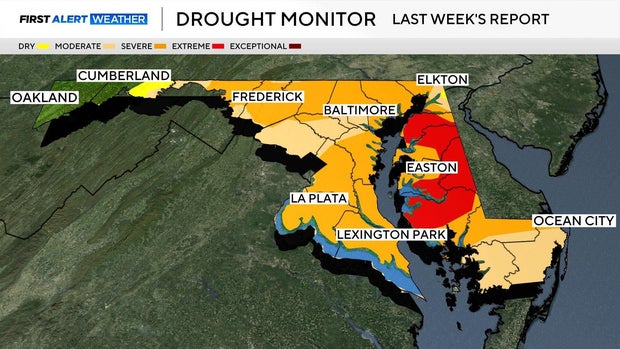
The U.S. Drought Monitor was updated Thursday morning, showing a significant decrease in the portion of the state that's considered to be under "extreme drought" conditions.
The area, which includes eastern Caroline and Queen Anne's counties, dropped from 13.20% to 1.3% week-over-week.
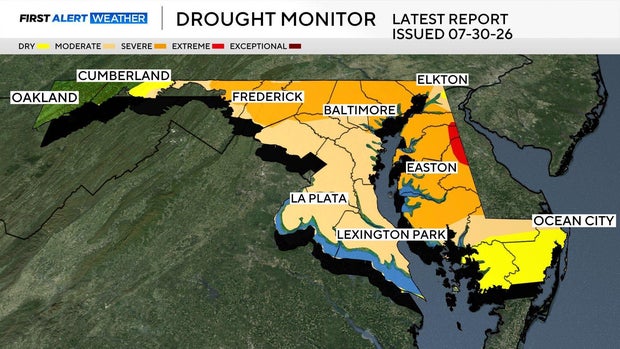
Meanwhile, the portion of the state experiencing "severe drought" conditions also decreased from 67.91% to 44.49%. That includes the northernmost and easternmost parts of the state from Washington to Dorchester counties.
Recent heavy rainfall
The latest National Weather Service data shows many areas, particularly along the eastern shore, received upwards of 50%, or even 75%, more rainfall than normal over the past month. Central parts of the state received 26-50% more, and the western border received 11-25%.
It has been a stormy month throughout Maryland, with severe weather events nearly every week -- including a powerful storm over the Fourth of July weekend.
This week's latest round caused flash flooding around the Baltimore metro, as well as reports of large hail and wind gusts up to 70 mph. The severe weather took down trees and power lines, knocking more than 26,000 Baltimore Gas & Electric customers offline.
A pair of tornadoes also touched down Tuesday in Lake Shore and the Arnold/Cape Saint Claire area of Anne Arundel County, along with two others near Trappe in Talbot County, the National Weather Service confirmed Wednesday.
Rainfall totals from the latest storm ranged from less than an inch on the western side of the state up to about 3 inches around the Baltimore metro. Those totals will be included in next week's drought monitor update.
Maryland's years long drought
As of Memorial Day, nearly 51% of Maryland was in a severe drought. The week before that, it was more than 95%.
The state has been facing abnormally dry conditions since 2024, prompting action from the statehouse and voluntary water restrictions.
Heading into the summer, Baltimore's Department of Public Works reported low water levels at three of the city's reservoirs, which supply drinking water for nearly 1.8 million people in the region. Liberty Reservoir hit a 20-year low back in May 2025.
Under voluntary water restrictions, any residents or businesses who use the public water service are urged to do the following:
- Turn off the water when brushing teeth or shaving and minimize time in the shower
- Only run full loads in dishwashers and washing machines
- Postpone watering gardens or lawns
- Repair or replace any leaking faucets or hoses
- Use an automatic car wash business that recycles water
The restrictions do not impact water used for drinking, cooking or hygiene purposes.


