U.S. and Israel launch another round of strikes on Iran following Khamenei's killing
Follow live updates on the U.S. strikes on Iran for Sunday, March 1, here. See earlier developments below.
What to know about the U.S. and Israel strikes on Iran
- Iranian Supreme Leader Ayatollah Ali Khamenei was killed in a massive U.S. and Israeli military operation on Saturday, President Trump announced. Sources told CBS News the strikes are believed to have killed about 40 Iranian officials.
- The U.S. and Israel launched another round of strikes early Sunday morning local time, officials said. Mr. Trump said in a social media post late Saturday afternoon that "heavy and pinpoint bombing" of Iran would "continue, uninterrupted throughout the week or, as long as necessary." The president earlier said the operation was to "prevent this very wicked, radical dictatorship from threatening America and our core national security interests."
- The president called on Iran's military forces to lay down their weapons, and on Iran's civilians to rise up and "take over your government."
Khamenei killing a "declaration of war against Muslims," Iran's president says
The killing in U.S.-Israeli airstrikes of Iranian Supreme Leader Ayatollah Ali Khamenei was a "declaration of war against Muslims, particularly Shiites across the globe," Iran's President Masoud Pezeshkian said in a condolence message ahead of Khamenei's funeral Sunday, calling it "one of the gravest trials facing the Islamic world today."
"The Islamic Republic of Iran considers seeking justice and retaliation against those responsible for this historic crime — both its perpetrators and those who ordered it — a duty and a legitimate right, and it will pursue this responsibility with full determination," Pezeshkian said,
Israel hitting "heart of Tehran" for first time since strikes began, IDF says
For the first time since the U.S.-Israeli bombing campaign began Saturday, Israel has struck targets in "the heart of Tehran," the Israel Defense Forces said Sunday.
"The Air Force, guided by Military Intelligence, has now launched a broad wave of strikes toward targets of the Iranian terror regime in the heart of Tehran," the IDF said.
"Over the past day, the Air Force conducted extensive strikes to achieve air superiority and open the path to Tehran," the IDF added.
At least 9 dead after hundreds storm U.S. consulate in Karachi, Pakistan's largest city
At least nine people were killed and about two dozen wounded in violent clashes with police and paramilitary forces Sunday after hundreds of protesters stormed the U.S. Consulate in the Pakistani port city of Karachi, authorities said.
The violence came hours after the United States and Israel attacked Iran and killed the country's supreme leader, Ayatollah Ali Khamenei. Police and officials at a hospital in Karachi said at least 25 people were also wounded in the clashes and some were in critical condition.
Summaiya Syed Tariq, a police surgeon at the city's main government hospital, confirmed that initially six bodies and multiple injured people were brought to the facility. However, she said the death toll rose to nine after three critically wounded died.
Karachi is the capital of southern Sindh province and Pakistan's largest city.
Senior police official Irfan Baloch said protesters briefly attacked the perimeter of the U.S. Consulate but were later dispersed. "The situation is now fully under our control," Baloch said.
He dismissed as baseless reports that any part of the consulate building was set on fire. However, he said protesters torched a nearby police post and smashed windows of the consulate before security forces arrived and regained control.
At Russia's request, IAEA to hold special meeting Monday on Iran situation
The board of governors for the International Atomic Energy Agency, the United Nations' nuclear watchdog, will hold a special meeting Monday at its Vienna headquarters to discuss the situation in Iran.
The meeting is at the request of Russia regarding "military strikes of the United States and Israel against the territory of the Islamic Republic of Iran," the agency said in a statement late Saturday.
Russia is a major ally of Iran.
Last week, Rafael Grossi, director general of the IAEA, said that most of Iran's nuclear materials were "still there, in large quantities" despite the U.S. strikes on Iran's nuclear facilities in June of 2025.
Iran announces 2 more top defense officials killed in airstrike
Iran's chief of army staff and defense minister were killed in an airstrike targeting a meeting of the country's defense council, Iranian state television reported Sunday.
Gen. Abdol Rahim Mousavi and Defense Minister Gen. Aziz Nasirzadeh were killed at the meeting alongside the head of Iran's paramilitary Revolutionary Guard and security adviser Ali Shamkhani, whose deaths Iran previously announced Sunday morning.
The deaths are the latest among Iran's top government officials since the U.S.-Israeli bombing campaign began.
Iranian Supreme Leader Ayatollah Ali Khamenei was killed Saturday, President Trump announced, and sources told CBS News the initial strikes were believed to have killed about 40 Iranian officials.
CBS/AP
Iranian leadership council to assume Khameni's duties until successor announced
Following the killing of Iranian Supreme Leader Ayatollah Ali Khamenei, an Iranian official announced Sunday that a leadership council will handle his duties until a successor is announced.
"In accordance with the constitution, a leadership council will be established to assume the responsibilities of the Supreme Leader until a successor is elected," the secretary of Supreme National Security Council, Ali Larijani, said in a statement.
Iranian state-run media had earlier said the nation's president, Masoud Pezeshkian, was leading the country in the wake of Khamenei's death.
The Islamic Republic of Iran Broadcasting reported that along with Pezeshkian, the speaker of Iran's parliament and the head of Iran's judiciary were in charge until a new leader is chosen.
The Supreme National Security Council is a group of senior government officials responsible for dictating Iran's defense and foreign policy, among other things.
Trump threatens more intense U.S. strikes if Iran hits "very hard today"
President Trump said on his Truth Social platform early Sunday that, "Iran just stated that they are going to hit very hard today, harder than they have ever hit before."
In response, he wrote, "THEY BETTER NOT DO THAT, HOWEVER, BECAUSE IF THEY DO, WE WILL HIT THEM WITH A FORCE THAT HAS NEVER BEEN SEEN BEFORE!"
Mr. Trump had earlier said that "heavy and pinpoint bombing" of Iran would "continue, uninterrupted throughout the week or, as long as necessary."
Iran's parliamentary speaker, Mohammad Bagher Qalibaf, said in a televised address Sunday, "You have crossed our red line and must pay the price. We will deliver such devastating blows that you yourselves will be driven to beg," according to The Associated Press.
Iran's Revolutionary Guard also said Sunday said that it would launch "the most ferocious offensive operation in the history of the Iranian armed forces" targeting U.S. military bases and Israel.
Emergency sirens sound across Israel over Iranian missile fire
Sirens sounding across central Israel Sunday morning alerting people to take shelter after Iran launched missiles toward Israel, Israeli military officials said.
Israel Defense Forces reported that the sirens had been activated a little after 6:30 a.m. local time Sunday.
"For the 20th time in the last 24 hours, millions of Israelis run to shelter across Israel under Iranian missile fire," the IDF wrote on Twitter.
It was not immediately clear what areas were targeted or whether any missiles had gotten through Israel's sophisticated missile defense system.
On Saturday, one person was killed and more than two dozen injured when an Iranian missile struck a neighborhood in Tel Aviv.
Iraq tightens security around Baghdad's Green Zone following Khamenei's killing
Iraqi security forces have tightened security around Baghdad's Green Zone over concerns of potential demonstrations near the U.S. Embassy following the killing of Supreme Leader Ayatollah Ali Khamenei.
The Green Zone is a district in central Baghdad that houses Iraqi government offices and foreign embassies.
One video showed security forces confronting protesters with water cannons and tear gas.
More explosions heard in UAE, Qatar, Bahrain
Fresh blasts were heard across the Gulf cities of Dubai, Doha and Manama on Sunday morning after a day of Iran strikes in the region in retaliation for US and Israeli attacks.
AFP reporters heard blasts in Dubai, in the UAE, in Doha, Qatar, and in Manama, Bahrain, where sirens were activated.
The new explosions came after a day of deadly Iranian strikes in the Emirati capital Abu Dhabi. Military bases and infrastructure, including airports, were hit across the Gulf — with the exception of mediator Oman.
Across the UAE, Iran fired 137 missiles and 209 drones at the territory, the country's defense ministry said, with fires and smoke reaching landmarks The Palm and Burj Al Arab.
At Dubai International Airport and Abu Dhabi Airport, where one person was killed, authorities reported "incidents," while Kuwait's airport was also hit.
Iran's regime "cannot be reformed," Iranian dissident says
Iranian-American activist and CBS News contributor Masih Alinejad said the regime "cannot be reformed" following the killing of Iranian Supreme Leader Ayatollah Ali Khamenei. She said that Iran deserves a transition to a secular democracy.
"This regime cannot be reformed," Alinejad told "CBS Evening News" anchor Tony Dokoupil. "We're not looking for anyone from this regime."
She said that the people celebrating in the streets of Tehran were praising Reza Pahlavi, Iran's exiled crown prince, because "he says that he believes in fair and free election. I believe that we deserve to have a transition from this government to this regime to a secular democracy."
Pahlavi said Saturday that Khamenei "has been erased from the face of history."
Last month, a man in New York was sentenced to 15 years in federal prison for attempting to assassinate Shakeri as part of a murder-for-hire plot. Alinejad has survived three plots by Iran's regime to kill or kidnap her.
Alinejad, whose parents and siblings live in Iran, said that Iranians are experiencing both pain and hope after the attacks.
"But in the street, people are just screaming out of joy because they believe this is going to be the beginning of a future, a future that we don't have killers in power, a future that people can have a normal life," she said.
Israeli military says it has targeted at least 30 sites in latest wave of strikes on Iran Sunday
The Israeli military says it has targeted at least 30 sites in western and central Iran in its salvo of strikes early Sunday local time.
The strikes targeted "aerial defense systems, missile launchers, regime targets and military command centers," Israel Defense Forces said in a social media post.
Two U.S. officials had previously confirmed to CBS News that the U.S. and Israel had launched the second volley of strikes on Iran following Saturday's initial attack.
Israel hacking Iranian prayer app is a tactic it's used before, commentator says
British author and political commentator Douglas Murray told CBS News that Israel's hacking of a popular Iranian prayer app to urge Iranian Revolutionary Guard members to exit the force and liberate the country is a tactic it has used before.
"First of all, it's a tactic that the Israelis have used elsewhere," Murray told "CBS Evening News" anchor Tony Dokoupil. "They've used it in Gaza. They've used it against Hezbollah in Lebanon. So it's a familiar tactic."
The Wall Street Journal reported Saturday that the app, BadeSaba Calendar, was hacked by Israel to send notifications to users urging the country's military personnel to "defect from the regime and join a fight to liberate the country."
"The message itself is simply reiterating what President Trump said in his late-night message, which is to request that the Revolutionary Guards, the Basij and others, put down their weapons, and in Trump's language, he said last night, now is the time to do that," Murray continued. "Otherwise, there's another route further down the road."
Head of Iran's Revolutionary Guard, top adviser killed, state-run media says
Maj. Gen. Mohammad Pakpour, the head of Iran's Revolutionary Guard, and Ali Shamkhani, a top security adviser to Khamenei, were killed in the attacks on Iran, The Associated Press reported state media as saying.
The state-run IRNA news agency announced Pakpour's death, as well as the death of Shamkhani, a figurehead in Iran's security establishment, the AP reported.
Retired Navy rear admiral suggests U.S. strikes on Iran could last another 2 weeks
A retired U.S. Navy rear admiral told CBS News Saturday that he believes the U.S. strikes on Iran could last another two weeks.
Ret. Rear Adm. Mark Montgomery said the strikes this week and those last year by Iran and the U.S. likely served as a "precursor for follow-on strikes over the next, I would suggest, two weeks, where would go after the other targets…that didn't need the surprise that the targeting of the Iranian leadership did."
He said the next few days will involve a "race" between the U.S. ability to destroy Iran's potential to launch weapons, and Iran's "ability to get those weapons out, cleared, and get a shot off."
"So I suspect the next few days' worth of strikes will be heavily focused on current Iranian ballistic and cruise missiles, and on their drone launch facilities," Montgomery told "CBS Evening News" anchor Tony Dokoupil.
Montgomery, who served 32 years in the Navy as a nuclear-trained surface warfare officer and is now at the Foundation for Defense of Democracies, speculated that this will be an air-only campaign, with no boots on the ground.
"The two times that we've successfully used air-only campaigns, Libya in 2011 and Kosovo in 1999, there were large armed insurgent groups that we were enabling in those attacks," Montgomery said. "What we have right now are large groups of activists and disaffected citizens."
Khamenei's killing to "almost certainly" bring retaliation from Iran, proxies, DHS notice says
A notice from the Department of Homeland Security said the killing of Supreme Leader Ayatollah Ali Khamenei would "almost certainly" prompt retaliation from Iran and its proxies, which include terror groups such as Hamas in Gaza, Hezbollah in Lebanon, the Houthis in Yemen and Iraq-based militias.
The Critical Incident Note from the DHS Office of Intelligence and Analysis was released earlier Saturday, prior to confirmation of Khamaenei's killing in the U.S.-Israel strikes. It said his death would "almost certainly escalate retaliatory actions—or calls to action."
The Iranian government will also likely continue attacks on the U.S. and its Middle East allies and blame U.S. government officials for any Iranian protests against the regime, the notice says.
DHS noted it was "most concerned" in the short-term about cyberattacks from "Iran-aligned hacktivists" on U.S. digital infrastructure.
Iran's Revolutionary Guard warns of "ferocious offensive operation"
Iran's Revolutionary Guard says the "most ferocious offensive operation" in the history of the Iranian armed forces would soon begin against Israel and U.S. bases, according to the Fars News Agency.
Diplomatic solution in Iran remains possible and "much easier now," Trump says
President Trump told CBS News on Saturday evening that he believes U.S. and Israeli attacks that killed Supreme Leader Ayatollah Ali Khamenei have been effective and could create a pathway to diplomacy.
"Much easier now than it was a day ago, obviously," Mr. Trump said, when asked about the prospect of a diplomatic solution to the crisis during a phone interview. "Because they are getting beat up badly."
He expressed confidence in the results so far, calling Saturday's strikes "a great day for this country, a great day for the world."
Iran's president leading country following Khamenei's death, state-run media says
Iranian state-run media said that following the death of Supreme Leader Ayatollah Ali Khamenei, Iranian President Masoud Pezeshkian is currently leading the country.
The Islamic Republic of Iran Broadcasting reported that along with Pezeshkian, the speaker of Iran's parliament and the head of Iran's judiciary were also running the country until a new leader is chosen.
It's unclear how that process would play out.
In a phone interview with CBS News chief Washington analyst Robert Costa earlier, when asked if he knew who was calling the shots in Iran, President Trump responded, "I know exactly who, but I can't tell you."
And when pressed by Costa on whether there was someone in Iran he would like to see lead the country, Mr. Trump said, "Yes, I think so. There are some good candidates."
Funeral for Khamenei to be held Sunday
A funeral for Supreme Leader Ayatollah Ali Khamenei will be held Sunday at Tehran University.
— Claire Day
Islamic Revolutionary Guard Corps releases statement on Khamenei's death
The Islamic Revolutionary Guard Corps released a statement on Supreme Leader Ayatollah Ali Khamenei's death early Sunday, calling him a great leader and saying his death will make Iran more determined to continue his path.
It condemned the attacks on Iran as violations of religious, ethical and legal principles.
Iranians who fled regime to California celebrate Ayatollah's death
Celebrations broke out in the streets of Los Angeles on Saturday after reports began that Iranian Supreme Leader Ayatollah Ali Khamenei was killed in attacks.
More than 200,000 Iranians live in California, many of whom fled the regime that ruled there for 47 years. L.A. is home to the largest Iranian population outside of Iran.
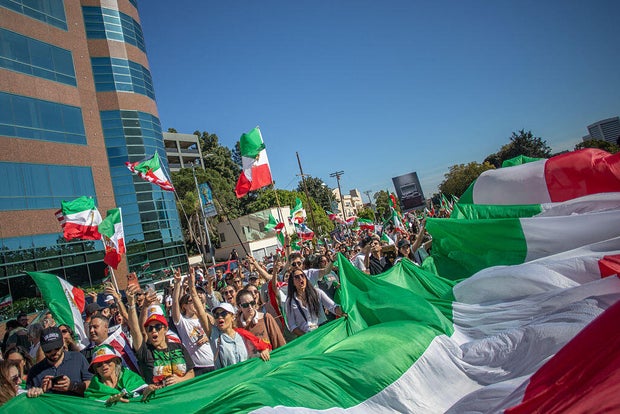
"We all want to say thank you to President Trump," said Saghar Fanisalek, owner and chef of Taste of Tehran in L.A. "This is the only person who supports us in the last 50 years. Every single person in Iran knew that the only way that this regime was going to go away is to attack them."
Mohamed Ghafarian of Shater Abbass Bakery & Market, left Iran more than 50 years ago and told CBS News that he expects regime change and is hopeful about it.
"United States and Israel; they are there to change the regime," said George Geoula, owner of Stansbury Dry Cleaners.
Iranian state media reports Khamenei is dead
Iranian state media reported early Sunday local time that Iranian Supreme Leader Ayatollah Ali Khamenei is dead. State media in Tehran had not previously confirmed his death, nor did Iran's Foreign Ministry.
The state-run IRNA news agency said Khamenei died but did not elaborate on his cause of death. It also reported that the government announced 40 days of public mourning.
Tasmin, a semi-official news agency that is associated with Iran's Islamic Revolutionary Guard Corps, also reported that Khamenei had died in the attack.
President Trump said earlier that Khamenei was killed. Israeli Prime Minister Benjamin Netanyahu had also said there were "growing signs" that Khamenei is "gone."
The 86-year-old took power in 1989 and had an iron grip over the country.
H.R. McMaster says there was "a window of opportunity" for U.S. strikes
Retired Lt. Gen. H.R. McMaster told "CBS Evening News" anchor Tony Dokoupil that he believes the U.S. chose to strike on Saturday because there was a "window of opportunity."
"I think [President Trump] was thinking about this 47-year-long proxy war that Iran has waged against the United States," McMaster said. "The second reason is, Iran has been scrambling since 'Operation Midnight Hammer,' the strikes we joined the Israelis on in June of last year, to rebuild their capability, so there is a window of opportunity here."
McMaster, a CBS News contributor who served as national security adviser to Mr. Trump from 2017 to 2018, said the "initial strikes were very effective at reducing Iran's ability to respond."
"Right now, the regime is fragmented, it's probably incoherent, so we will see what other kinds of capabilities that they can generate, but maybe some terrorist attacks, maybe actions in the Strait of Hormuz, although we sank the Iranian Navy, or the [Islamic Revolutionary Guard Corps] Navy," McMaster said. "So, it will not be over until there is a change in the nature of that government."
U.S., Israel launch another round of strikes on Iran, officials say
The U.S. and Israel have launched yet another volley of strikes on Iran, two U.S. officials confirmed to CBS News Saturday night.
Israel Defense Forces said in a social media post just after 3 a.m. local time Sunday that they had "launched another wave of strikes against the Iranian terror regime's ballistic missile array and air defense systems."
The sources confirmed that the U.S. was involved in those ongoing strikes. The scope of the strikes and the areas being targeted were unclear.
Witnesses told CBS News there were strikes in Tehran on the office of the president and on Iran's National Security Council building. Explosions were heard elsewhere in the city, witnesses said.
Witnesses said there was also heavy bombing in the city of Qom, which is located about 90 miles south of Tehran.
There were also strikes reported on Kish International Airport, which is located on Kish Island in the Persian Gulf, off Iran's southern coast, witnesses said.
Iran likely intended to use missiles in Middle East before U.S. strike, White House officials say
Senior Trump administration officials told CBS News that Iran likely intended to use conventional missiles against the U.S. and allies in the region during negotiations, perhaps preemptively before a U.S. strike.
They said if President Trump had waited any longer, American casualties would be substantially higher.
Democratic Rep. Seth Moulton of Massachusetts, who served four tours in Iraq, criticized the White House for not seeking congressional approval before attacking Iran.
"He has started a war, and it has eerie similarities to the way Iraq began," Moulton told CBS News Saturday. "…You have to obey the Constitution, and that means going before Congress, and asking Congress to decide, is it worth putting young American lives on the line to achieve these goals."
No known credible domestic threats to U.S. after Iran strikes, federal officials say
On a call Saturday afternoon with state and local law enforcement agencies, federal officials stressed that there are no known credible domestic threats at this time following the strikes on Iran, two federal law enforcement officials on the briefing and an industry partner confirmed to CBS News.
The FBI and the Department of Homeland Security convened the national call, which underscored heightened concerns about cyber vulnerabilities affecting critical infrastructure — particularly power and water systems.
The call was led by the FBI's Counterintelligence Division and DHS's Office of Intelligence and Analysis, with support from the Cybersecurity and Infrastructure Security Agency.
The briefing focused heavily on cyber posture and defensive preparedness.
About 40 Iranian officials killed in strikes, sources say
About 40 Iranian officials have been killed in the U.S. and Israeli strikes, an intelligence source and a military source told CBS News Saturday evening.
It was not clear whether these officials were in one location or multiple locations.
President Trump said Supreme Leader Ayatollah Ali Khamenei was killed in the strike.
Iranian defense minister Amir Nasirzadeh and Iranian Revolutionary Guard commander Mohammed Pakpour are believed to have also been killed, two U.S. officials speaking to CBS News under the condition of anonymity to discuss national security issues told CBS News.
Trump says there are some "good candidates" to lead Iran following Khamenei's killing
President Trump told CBS News in a phone interview Saturday night that he has an idea of who he would like to see lead Iran following the killing of Supreme Leader Ayatollah Ali Khamenei in the U.S. and Israeli airstrikes.
Asked who he thinks is calling the shots in the wake of Khamenei's death, Mr. Trump responded, "I know exactly who, but I can't tell you."
When pressed on whether there was someone in Iran he would like to see lead the country, Mr. Trump said, "Yes, I think so. There are some good candidates."
One killed, 121 hurt in Iran's retaliatory strikes on Israel, officials say
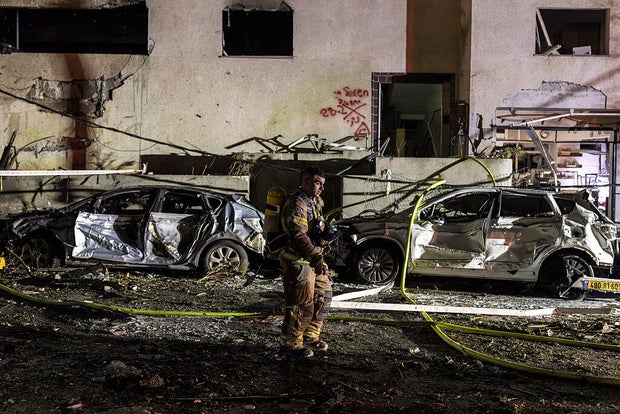
A woman in her fifties was killed and 121 others were injured across Israel in Iran's retaliatory strikes, Magen David Adom, Israel's national emergency rescue services reported early Sunday local time.
The injuries occurred at dozens of scenes across Israel after "various missile strike incidents," MDA said.
A missile strike in the Tel Aviv area accounted for the fatality and 27 injuries, according to the agency.
Of those injured, two people were in moderate condition and 119 were in mild condition, MDA reported.
Iran's ambassador to the U.N. calls strikes on Iran "a crime against humanity"
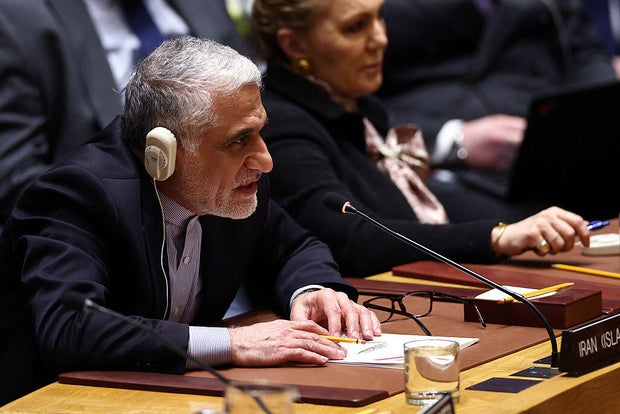
Iran's Ambassador to the U.N. Amir-Saeid Iravani told an emergency U.N. Security Council meeting that hundreds of civilians have been killed or injured in the U.S. and Israeli strikes on Iran, accusing the two countries of deliberately attacking civilian neighborhoods in multiple cities.
"This is not only an act of aggression; it is a war crime and a crime against humanity," he said.
Israel's U.N. Ambassador Danny Danon said at the meeting that Iranian chants of "Death to Israel, Death to America" and the burning of both countries' flags were acts of "state-sanctioned hatred" and indicated a preparation for action on Iran's part.
Danon said that Israel acted to stop "an existential threat before it became irreversible."
"We acted out of necessity," he said.
Addressing the Iranian people, Danon said the operation is directed "at a regime that has silenced you," and Israel stands "with you."
Secretary-General Antonio Guterres said at the emergency meeting that "everything must be done to prevent a further escalation."
"The alternative," he warned, "is a potential wider conflict with grave consequences for civilians and regional stability."
CBS/AP
Iran's exiled crown prince says Khamenei "has been erased from the face of history"
Reza Pahlavi, Iran's exiled crown prince, praised the killing of Iranian Supreme Leader Ayatollah Ali Khamenei in the U.S. and Israeli strikes, saying in a statement that "the bloodthirsty despot of our time…has been erased from the face of history."
Pahlavi called on Iran's military forces to avoid efforts to "preserve a collapsing regime," but instead to "help ensure Iran's stable transition to a free and prosperous future."
"This may be the beginning of our great national celebration, but it is not the end of the road," he said.
Pahlavi has lived in exile since his father, Mohammad Reza Pahlavi, the last shah of Iran, was overthrown in the 1979 Islamic Revolution that brought the current clerical regime to power.
In an interview with CBS News last month, Pahlavi said that that "best way to ensure that there will be less people killed in Iran is to intervene sooner, so this regime finally collapses and puts an end to all the problems that we are facing."
Rubio cancels trip to Israel following strikes
Secretary of State Marco Rubio has canceled his trip to Israel scheduled for next week in the wake of the U.S. and Israeli strikes on Iran and the killing of Iranian Supreme Leader Ayatollah Ali Khamenei, a senior State Department official said.
"Due to current circumstances, Secretary Rubio will no longer travel to Israel on March 2," Dylan Johnson, assistant secretary of State for Global Public Affairs, said in a post on X.
Rubio was scheduled to travel to Israel from March 2-3 to discuss a range of regional priorities, including Iran, Lebanon and ongoing efforts to implement President Trump's 20-Point peace plan for Gaza.
Trump administration says U.S. wanted diplomatic solution, but it was ultimately "not a tangible and realistic option"
Senior administration officials on Saturday briefed reporters on the runup to the U.S. strikes against Iran, said the U.S. had sought a diplomatic solution to its impasse with Iran, but it ended up as "not a tangible and realistic option."
They said that the factors in President Trump's decision to strike were the long-term threat of Tehran's ambitions to acquire nuclear weapons and the short-term threat posed by its conventional missile capability. In the negotiations, the Iranians "refused at every instance to address ballistic missiles," the officials said. They added that Iran refused to address proxies, which Mr. Trump "thought was a critical issue that needed to be addressed in any deal"
After last year's U.S. strikes against Iran's nuclear program, the U.S. determined that if Iran began to rebuild, "we'll have to address it," the officials said.
According to one senior administration official, they "had indicators" that Iran could potentially use conventional missiles "preemptively, but if not, simultaneous" to any actions against them by the U.S.
The president "was not going to sit back and wait to get hit first" and if he had, the "amount of casualties and damages would be substantially higher" than if the U.S. acted preemptively, they said.
In negotiations, Mr. Trump pushed for a deal that would prevent Iran from ever developing a nuclear weapon and felt that in the talks, "there was no seriousness to achieve a real deal." U.S. negotiators offered to provide Iran with "free nuclear fuel forever" for a safe civil nuclear program, but the Iranians insisted on maintaining the ability to enrich their own nuclear fuel, according to the officials.
Initially Iran agreed "for a short period of time not to do enrichment" but then retracted its agreement, the officials said, which the U.S. interpreted as "a big tell to us that they were looking to buy time."
"It was clear to us that they were in the throes of rebuilding all that had been destroyed in Midnight Hammer," they added.
The senior officials said it was "very clear" that Iran's intent "was to preserve their ability to do enrichment, so that over time, they could use it for a nuclear bomb." They said Iran was offered "many, many ways" to have a civil, peaceful nuclear program, "but instead that was met with games, tricks, stall tactics." They concluded that Mr. Trump "frankly had no choice" but to act.
When U.S. negotiators asked Iran for its enrichment requirements for material and capabilities, Tehran presented them with a 7-page plan that the IAEA estimated would provide Iran with an enrichment capability that was roughly five times greater than the one from the previous Iran nuclear deal. Mr. Trump withdrew from that deal during his first administration.
The senior administration officials said that Iran had developed the ability to construct their own centrifuges – IR-6 centrifuges, which they said were "the fastest ones out there" – and had built up manufacturing capacity since the U.S. strikes on their nuclear facilities.
The strikes last year did not target the Tehran Research Reactor, which requires 20% enrichment protocols to build radio isotopes to produce medicine and conduct agricultural research, the officials said. But the IAEA said Iran did not use fissionable material to produce any medicine, and was instead stockpiling it.
Tehran had about 450 kg of 60% enriched uranium and was technically one week from 90% weapons grade uranium, the officials said.
Iran's Supreme Leader Ayatollah Ali Khamenei killed in strikes, Trump says
Iran's Supreme Leader Ayatollah Ali Khamenei "is dead," President Trump wrote in a Truth Social post late Saturday afternoon.
Calling him "one of the most evil people in History," Mr. Trump said Khamenei was "unable to avoid our Intelligence and Highly Sophisticated Tracking Systems and, working closely with Israel, there was not a thing he, or the other leaders that have been killed along with him, could do."
The president also said that "heavy and pinpoint bombing" would "continue, uninterrupted throughout the week or, as long as necessary to achieve our objective of PEACE THROUGHOUT THE MIDDLE EAST AND, INDEED, THE WORLD!"
The U.S. was also "hearing" that many officials in the Iranian Revolutionary Guards, Iran's military and its security and police forces no longer want to fight, and are looking for Immunity from us," the president said.
"This is the single greatest chance for the Iranian people to take back their Country," Mr. Trump wrote.
In a phone interview with ABC News, Mr. Trump said that the military operation will continue "as long as we want it to" but that Iran is essentially "incapacitated."
Trump says most of Iran's leadership that "make all the decisions" are gone
President Trump on Saturday addressed reports that Iran's supreme leader was presumed dead, telling NBC News: "We feel that that is a correct story."
"The people that make all the decisions, most of them are gone," Mr. Trump said.
The president oversaw the military operation in Iran from Mar-a-Lago, and he released an eight-minute video to social media announcing it in the early morning hours Saturday.
Celebrations heard in Tehran after reports of Khamenei's presumed death
The sounds of celebration filled the streets of Tehran Saturday night after reports of the presumed death of Iranian Supreme Leader Ayatollah Ali Khamenei.
Videos posted to social media showed parts of Tehran where residents could be heard clapping, whistling and cheering following the news reports.
The 86-year-old Khamenei has had an iron grip over Iran since he took power in 1989.
An Israeli broadcaster said Saturday that Israeli Prime Minister Benjamin Netanyahu had been shown a photo of Khamenei's body.
Reporting contributed by Margaret Brennan
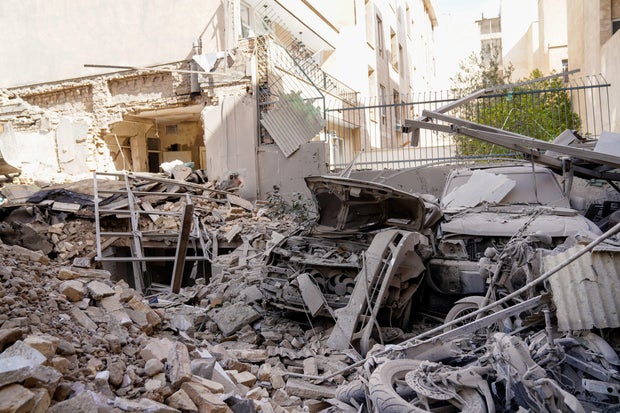
Satellite images show Iran supreme leader compound heavily damaged
The compound of Iran's Supreme Leader Ali Khamenei in the heart of Tehran was heavily damaged in the U.S.-Israeli strikes, satellite photos show.
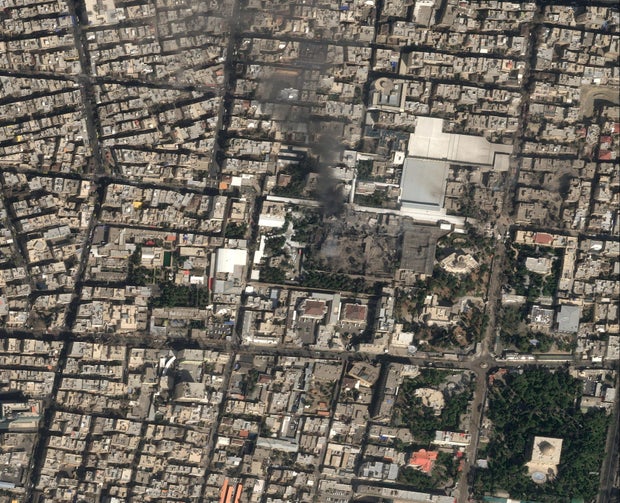
One image shows black smoke rising from the palace, which appears to have been reduced to a pile of rubble.
Israeli Prime Minister Benjamin Netanyahu said Israel struck the compound early Saturday. He later said there were "growing signs" that Khamenei had been killed in the strike.
The Israeli military also said Saturday that it had killed much of Iran's leadership, including Secretary of the Iranian Security Council Ali Shamkhani and Defense Minister Aziz Nasirzadeh.
CBS/AP
U.S. did not brief its allies on details of planned military action
The U.S. government did not brief allies on the details of the planned American and Israeli military action, multiple diplomatic sources told CBS News.
Yet this is now fast moving toward a regional war.
"If common sense and sound judgment do not prevail, and if space is not opened for diplomacy, our region faces the risk of being dragged into a ring of fire," Turkish Prime Minister Recep Tayyip Erdoğan said in a statement.
Turkey — a NATO ally — has not yet been a target of Iranian operations and had been trying to help broker a diplomatic accord prior to the U.S. strikes.
Saudi Arabia intercepted Iranian missiles that were aimed at the major city of Riyadh, as well as Dammam. Before the U.S. and Israeli strikes, the Kingdom had said it would not allow its airspace to be used, but now Iran has changed that dynamic by firing into Saudi cities. The official statement from the Kingdom says Iran targeted the Riyadh region and eastern province, and that as a result Saudi Arabia is "considering responding to the aggression."
Unlike other regional allies, Saudi Arabia does not have U.S. bases, but it does have U.S. military assets on its soil. In recent weeks, the U.S. pre-positioned additional THAAD and PATRIOT systems in a defensive posture. In targeting Saudi Arabia, Iran has brought in the diplomatic heft that comes with an attack on a regional leader. In light of the targeting of Saudi cities, the Kingdom may decide to allow the U.S. to use its territory or airspace.
The Emirates are also signaling deep concern. According to a regional official, there was at least one casualty in the United Arab Emirates.
Bahrain confirmed the U.S. Navy's Fifth Fleet was targeted by a missile attack. Bahrain says it also intercepted a number of rockets from Iran. On Friday, the U.S. drew down some of the staff on its base. Attacks continued throughout the day on Saturday.
Jordan houses U.S. intelligence and military personnel, and it condemned Iran's attack on what appears to have been the U.S. airbase there. At this point, the missiles appear to have been intercepted, and debris fell in the capital. There are no known casualties.
Vice President JD Vance met with Oman's top diplomat Friday, in Washington. Secretary of State Marco Rubio and special envoy Steve Witkoff were not present. There has been no contact since the strikes to revive the diplomatic track.
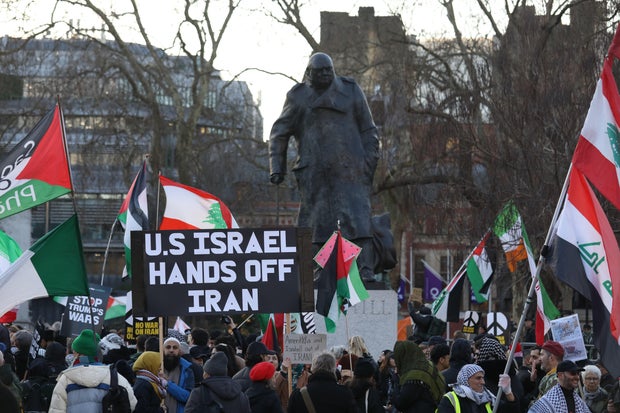
Photos show divided protesters around the world after military strikes in Iran
Demonstrators took to the streets on Saturday to voice their opinions about the Iranian regime following deadly U.S. and Israeli strikes in Iran.
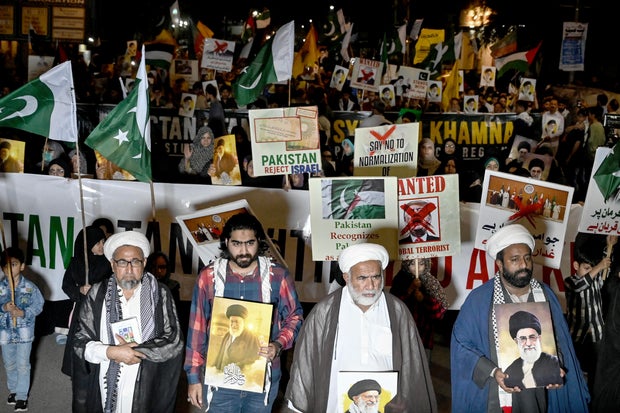
Many rallies voiced strong support for the military action, while opposing protests condemned the attacks and warned of wider regional consequences.
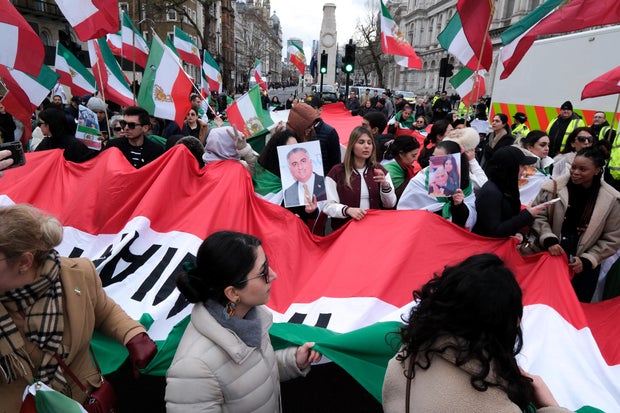
As Iran's Supreme Leader Ayatollah Ali Khamenei is presumed dead, according to multiple Israeli official sources, some demonstrators carry his portrait as they march against the attacks.
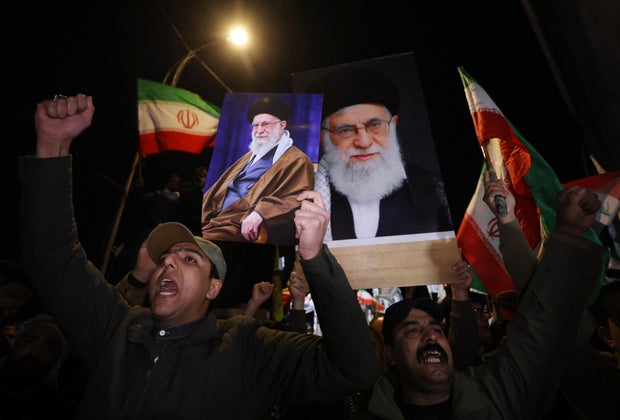
Many of those who oppose Khamenei's regime were seen carrying images of Reza Pahlavi, Iran's exiled crown prince, who last month called on President Trump to take action against the Iranian regime amid a deadly crackdown on protesters.
Iran's Supreme Leader is presumed dead after U.S.-Israel strikes, sources say
Iranian Supreme Leader Ayatollah Ali Khamenei is presumed dead after a massive U.S. and Israeli military operation on Saturday, multiple Israeli official sources confirmed to CBS News.
A senior American intelligence official says the supreme leader is dead.
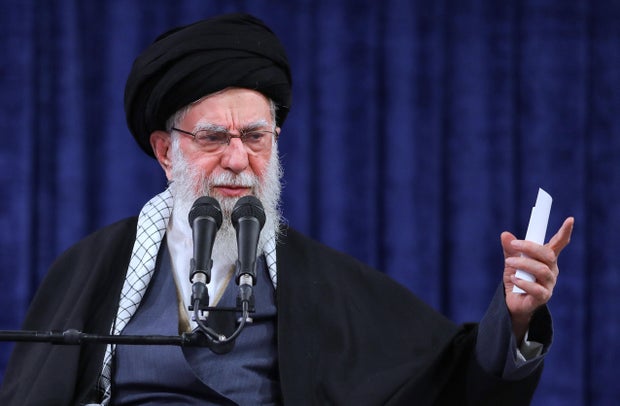
Israeli Prime Minister Benjamin Netanyahu said earlier Saturday that there are "growing signs" that Khamenei is "gone" after the mission.
U.S. State Dept issues worldwide caution for Americans
The U.S. State Department issued a worldwide caution for Americans on Saturday after U.S.-Israeli strikes on Iran.
"Following the launch of U.S. combat operations in Iran, Americans worldwide and especially in the Middle East should follow the guidance in the latest security alerts issued by the nearest U.S. embassy or consulate. They may experience travel disruptions due to periodic airspace closures," the alert says.
Harris on Iran strikes: "Trump is dragging the United States into a war the American people do not want"
Former Vice President Kamala Harris condemned the U.S.-Israeli strike on Iran, saying in a statement that President Trump is "dragging the United States into a war the American people do not want."
"I am opposed to a regime-change war in Iran, and our troops are being put in harm's way for the sake of Trump's war of choice," she said.
She referred to the U.S. offensive as "a dangerous and unnecessary gamble with American lives that also jeopardizes stability in the region and our standing in the world."
Harris, who lost the 2024 presidential election to Mr. Trump, pointed out that he had promised during his presidential campaign to end wars, not to start them.
"That was a lie," she wrote. "He said 'we obliterated' Iran's nuclear program. That, too, was a lie," Harris said.
And she called on Congress to "use all available power to prevent him from further committing us to this conflict."
CBS News
McMaster says U.S. and Israeli strikes in Iran aim to "decapitate the regime"
H.R. McMaster, former National Security Advisor under President Trump's first term and CBS News contributor, says U.S. and Israeli strikes in Iran are aimed "to essentially decapitate the regime."
Reviewing a new video posted by CENTCOM of the strikes, McMaster said the U.S. and Israel are going "after the arms of oppression to create more space for the Iranian people to determine their own fate."
As officials work to assess the damage, the video shows strikes against anything the Iranians could use to retaliate, McMaster said, including solid fuel missiles, liquid fuel missiles and the missile launchers themselves.
There are "many signs" Iran Supreme Leader Khamenei is "gone," Netanyahu says
Israeli Prime Minister Benjamin Netanyahu said Iran's Supreme Leader Ali Khamenei's compound had been destroyed, and that there "are many signs that this dictator is gone too."
Netanyahu called on the Iranian people to seize the "once-in-a-generation opportunity" to "take to the streets en masse, to complete the task of overthrowing the regime that is making your lives miserable."
"This is your time to join forces to overthrow the regime, to secure your future," Netanyahu said.
CBS News has not independently confirmed that Khamenei is dead.
Video from CENTCOM shows U.S.-Israel missile strikes on Iran
U.S. Central Command released a new video that shows the U.S.-Israel missile strikes on Iran.
"As the President stated, our objective is to defend the American people by eliminating imminent threats from the Iranian regime," said in a post on X with the video. "The President ordered bold action. CENTCOM forces are delivering an overwhelming and unrelenting blow."
Attack on Iran will last "as long as necessary," Netanyahu says
The U.S. and Israeli attack on Iran will "continue as long as necessary," Israeli Prime Minister Benjamin Netanyahu said in a statement issued Saturday.
"This war will lead to peace, true peace," Netanyahu said.
Trump has spoken with regional allies, NATO secretary general, Leavitt says
President Trump has spoken with the leaders of Saudi Arabia, Qatar and the United Arab Emirates and NATO Secretary General Mark Rutte, White House press secretary Karoline Leavitt said in a short post on X.
Bahrain says U.S. Navy base struck by Iranian missile
Bahrain publicly confirmed the U.S. Navy's 5th Fleet was subject to a missile attack. Bahrain says it also intercepted a number of rockets from Iran.
U.S. officials told CBS News that they are conducting a battle damage assessment.
Cotton says U.S. looking at "weeks, not days of joint efforts" in Iran
Sen. Tom Cotton, the GOP chairman of the Senate Intelligence Committee, told CBS News' Major Garrett on Saturday that the mission in Iran needs to not only curb Iran's nuclear program but also to "dismantle their terror support network."
"To do all that is going to take longer than the strikes on their nuclear program last summer," Cotton said. "We're probably looking at weeks, not days, of joint efforts by the United States, Israel and our Arab partners, who have also been attacked this morning."
Cotton, who is one of the "Gang of Eight," added that the "upshot of it will be, after 47 years of waging war against the United States and the civilized world, the ayatollahs are finally going to face justice."
Cotton said that there's "no question" that Iran is "at one of its weakest points since the revolution in 1979," but the threat from their missiles "genuinely is imminent."
"As I said, they have thousands and thousands of missiles," Cotton said. "That's what they're using to attack us, our Arab friends and Israel today. They have many more missiles than we have missile defenses. And the balance only gets worse. Every single month."
Iran state TV reports more than 200 people killed in strikes
Iran's Red Crescent says the Israeli-U.S. airstrikes across Iran have killed at least 201 people and injured 747, according to comments on Iranian state TV.
The spokesperson for the Red Crescent said the strikes have hit 24 of Iran's 31 provinces. The spokesperson said relief operations are on going, and that 220 teams were deployed to different sites to respond to the strikes.
New Jersey Rep. Gottheimer says "what's key now is making sure the president briefs the Congress immediately"
Democratic Rep. Josh Gottheimer, a moderate from New Jersey, told CBS News' Major Garrett that while he believes "Iran poses an existential threat" to the U.S., President Trump needs to brief Congress on further action given the threat of a regional conflict breaking out.
"As far as I'm concerned, the key here is making sure that this is executed the right way," Gottheimer said. "We see what's happened overnight — what's happened is not just in Iran, but with our allies in Qatar, Bahrain and other attacks. So as far as I'm concerned, what's key now is making sure that the president briefs the Congress immediately."
Gottheimer, who is on the House Intelligence Committee, said he had asked for that briefing, especially since this has triggered a war powers resolution.
Gottheimer added that in Iran, "this is not a leadership there that has sought to do anything except destruction and through their terror proxies and their ballistics programs and their nuclear programs to attack our way of life, of course, and our allies and Americans."
He added that "we can't lose sight of that," and that he hoped the maximum pressure that the U.S. has applied "hopefully will result in a change."
No reports of U.S. casualties, minimal damage, CENTCOM says
There have been no reports of U.S. deaths or injuries amid the operation in Iran, U.S. Central Command said.
"Following the initial wave of U.S. and partner strikes, CENTCOM forces successfully defended against hundreds of Iranian missile and drone attacks," the command said on social media, alongside photos of U.S. aircraft taking off.
It said damage to U.S. facilities was "minimal and has not impacted operations.
CENTCOM said that U.S. and partner forces struck IRGC command and control facilities, Iranian air defense capabilities, missile and drone launch sites and military airfields.
"The President ordered bold action, and our brave Soldiers, Airmen, Marines, Guardians and Coast Guardsmen are answering the call," said CENTCOM commander Adm. Brad Cooper.
Vance monitored Iran operation from Situation Room, source says
Vice President JD Vance monitored the military operation in Iran from the Situation Room at the White House, a source familiar told CBS News. President Trump was at Mar-a-Lago.
Vance was with Energy Secretary Chris Wright, Transportation Secretary Scott Bessent and Director of National Intelligence Tulsi Gabbard, the source said. The group was connected with Mr. Trump and his team via conference line.
Johnson says "Iran is facing the severe consequences of its evil actions"
As members of Congress indicated Saturday that they will force a war powers vote, House Speaker Mike Johnson posted on social media on Saturday morning that "Iran is facing the severe consequences of its evil actions."
"For decades, Iran has defiantly maintained its nuclear program while arming and funding Hamas, Hezbollah, and other internationally recognized terrorist organizations," Johnson wrote on X. "Iran and its proxies have menaced America and American lives, undermined our core national interests, systematically destabilized the Middle East, and threatened the security of the entire West."
Johnson confirmed that the Gang of 8 had been briefed earlier in the week that action in Iran might be necessary. Reps. Thomas Massie and Ro Khanna said Saturday that they would be forcing a vote on a war powers resolution to limit military action in Iran.
The Constitution grants Congress the sole power to declare war, and the extent of the president's authority to wade into conflict abroad without the approval of the legislative branch has been challenged in recent years. After strikes in Venezuela to remove then-President Nicolas Maduro, five Republican lawmakers broke with the party to advance a measure to limit further military action there.
Reza Pahlavi, the former shah's son, may be a strong contender as Iran's new leader, an analyst says
Behnam Ben Taleblu, a senior director of the Foundation for the Defense of Democracy's Iran program said Reza Pahlavi, the son of the deposed Shah of Iran, may be a strong contender to be the new leader of Iran if regime change is successful.
Taleblu said Pahlavi has support among Iran's youth, an ability to draw crowds and has drawn a sharp contrast between himself and the existing regime.
"As the debate has moved away from what can civil society do to what can mass protests do to what kind of foreign potential support can these mass protests receive, he has become increasingly popular," Taleblu said, referencing when Pahlavi called for mass turnout on Valentine's Day and protests across the country drew millions.
However, it may not be as simple, warned Douglas Murray, a British author and political commentator.
"I think that this is a very tricky corner. There are many people in Iran and in the diaspora who do not simply want a return of the Pahlavis," Murray said. Still, he said it's "important to take seriously" Pahlavi's proposal "to be an interim leader who could cohere the various factions inside the country and out."
"That's why I do think Pahlavi's most important role is if he could act as that convening figure. It's about the best thing I've seen on the table this year," Murray said.
Taleblu said leaders cannot make "the perfect the enemy of the good," and said that Pahlavi's installation is, in his view, "the best short-to-medium-term vehicle to get to a post-Islamic Republic in Iran."
Both Murray and Taleblu agreed that Pahlavi could be a bridge to elections in Iran.
"From there, the Iranian people decide," Taleblu said. "From there, it is all about the Iranian people deciding this 100+ year struggle for representative government is not going to be turned off the moment someone comes in who reminds them of the past."
CENTCOM says it is investigating reports of civilian casualties in Iran
CENTCOM spokesperson Captain Tim Hawkins told CBS News that the agency was aware of reports "concerning civilian harm from ongoing military operation" and was investigating.
"The protection of civilians is of utmost importance, and we will continue to take all precautions available to minimize the risk of unintended harm," Hawkins siad. "Unlike Iran, we have never – and never will – target civilians."
Hawkins' remarks came after Iran's foreign minister claimed a girls' school in Southern Iran was struck during the U.S.-Israel attack.
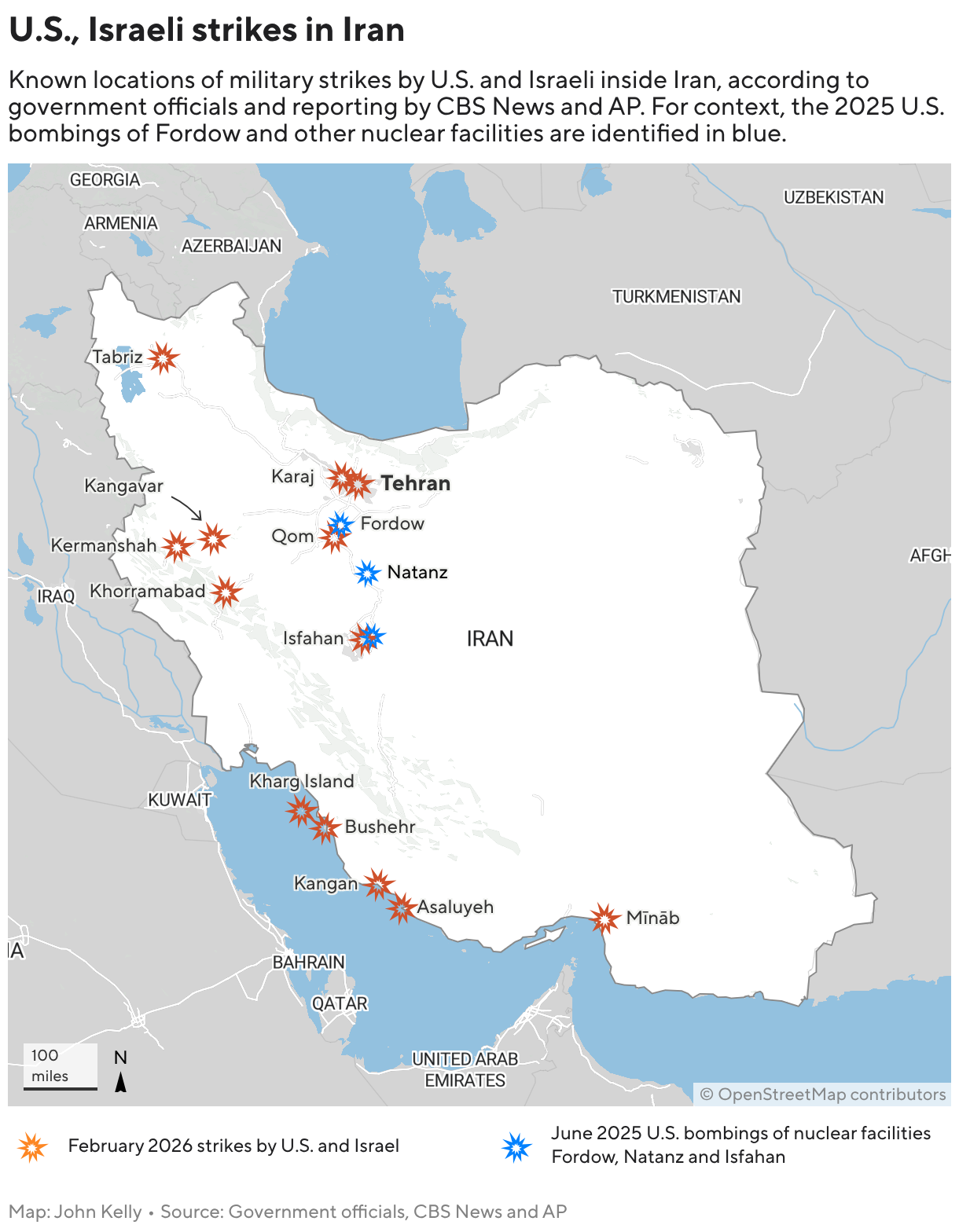
Map shows strike locations across Iran
A map created by the CBS News data team shows the strike locations across Iran, based on government officials' statements and reporting by CBS News and the Associated Press.
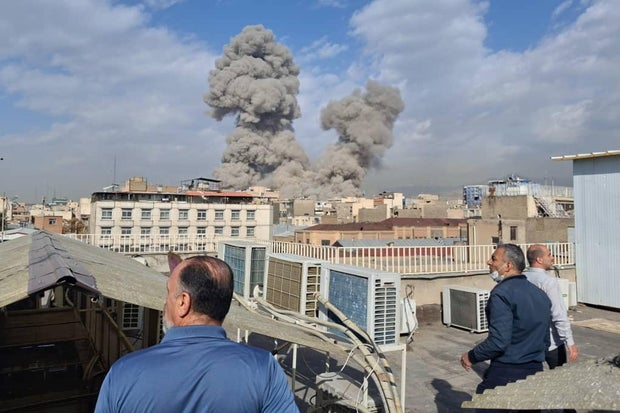
A source involved in the Israeli strikes on Iran told CBS News that Iran's supreme leader, Ayatollah Ali Khamenei, and its president, Masoud Pezeshkian, were among the targets of the first round of strikes.
In a video statement, Israeli Prime Minister Benjamin Netanyahu said Israel was targeting military sites, including missile installations.
Security ramps up in locations across U.S. amid Iran attacks, law enforcement says
Security has been ramped up in locations across America after the U.S.-Israel attacks on Iran and the regime's retaliatory strikes. Law enforcement agencies across the country have increased patrols at synagogues and U.S. government facilities.
The Chicago Police Department told CBS News that law enforcement is monitoring the situation in Iran, but there is no "actionable intelligence" at this time. Miami Police told CBS News they increased their uniformed presence at synagogues, schools, and other key locations citywide.
"We remain in close coordination with our law enforcement partners and leaders within the faith-based community," Miami police said in a statement. The Los Angeles Police Department said they are closely monitoring today's escalation in Iran and developments across the Middle East.
The NYPD's senior leadership and counterterrorism division are monitoring intelligence in real time, according to former NYPD Deputy Commissioner and CBS News law enforcement contributor Richard Esposito.
The NYPD said out of an abundance of caution, the department is enhancing patrols to sensitive locations throughout the city, including diplomatic, cultural, religious, and other relevant sites.
John Chell, the NYPD's former chief of department, explained that the NYPD is putting patrols at high-value targets around the city, especially Jewish and Iranian locations.
"The NYPD does both directed patrols, where a team will drive by a location at regular intervals, and/or a fixed patrol that stays put at a location depending on the location," Chell said, and that the NYPD typically sends heavy weapons teams to locations throughout the city, such as consulates and high-profile synagogues and mosques and Iranian, Muslim, and Jewish cultural centers.
Federal law enforcement sources tell CBS News there are no specific credible threats to the homeland at this time
The IDF says hundreds of jets targeted Iranian sites simultaneously
The Israel Defense Forces completed "an extensive attack" against Iran's missile and defense systems, using approximately 200 fighter jets, which it said was the largest ever military flyover in the history of the Israeli Air Force.
"The IAF's fighter jets dropped hundreds of munitions targeting approximately 500 objectives, including aerial defense systems and missile launchers, in several locations in Iran, simultaneously," the IDF said in a statement. "The strikes on the defense systems allowed the expansion of the IAF's aerial superiority over Iranian aerial territory, and severely degraded the offensive capabilities of the Iranian regime."
One targeted site was in Tabriz, in Western Iran. The IDF said the site was used by the Iranian Surface-to-Surface Missiles Unit, and that the unit had planned to launch "dozens of missiles toward Israeli civilians."
Analyst says U.S. should attempt full regime change in Iran: "Go big or go home."
Behnam Ben Taleblu, a senior director of the Foundation for the Defense of Democracy's Iran program, said that Iran has been conducting a "war of choice" against the United States and its interests, leaving the West with "no way out but through."
"That war has been slow. It has ebbs, it has flows … The diplomatic track record of America in the Middle East for the past 47 years is littered with attempts to do anything to not have to get to this moment," said Tabelu, who studies Iranian security and political issues.
Tabelu said the U.S. should attempt to ensure full regime change, instead of ending up in a situation like in Venezuela, where the same government is being led by a different leader.
"It really is go big or go home," Tabelu said. "If Washington actually goes and tries to do, not regime change but a regime evolution from within the political elite, the political elite have cut their teeth on these exact same issues that Khameni has. … That makes them anti-American and anti-Israeli."
Tomahawk missiles used to suppress Iranian air defenses, U.S. officials say
The U.S. military used Tomahawk Land Attack Missiles, known as TLAMs, to suppress Iranian air defenses, two U.S officials told CBS News.
One-way attack drones were also used.
Former Israeli ambassador says there "is not much choice" but to support regime change
Former Israeli ambassador to the United States and Free Press contributor Michael Oren said that there "is not much choice" but to support regime change in Iran.
Oren, a former member of Israel's Knesset and the founder of the Israel Advocacy Group, said that Iran would have never agreed to American demands to cease uranium enrichment and stop supporting proxy terror organizations.
"That was basically a demand for the Iranian regime to self-destruct," Oren said. "It is literally what they're about. It was regime suicide, not regime change."
"It's very similar to Hamas. Hamas is not going to change its DNA. The hatred of America, hatred of Israel is what they are about," Oren said.
Feds say there are no specific credible threats to homeland at this time
Federal law enforcement sources tell CBS News there are no specific credible threats to the homeland at this time.
The FBI is concerned about sympathizers and supporters aligned with Iran who may act independently — or at the direction of Iran — to commit acts of terrorism in the U.S. or against American targets abroad.
The FBI Joint Terrorism Task Force is aware of individuals who have affiliation with the Lebanon-based terrorist group Hezbollah and are living in the United States, sources said.
Authorities are monitoring for any threat indicators from those individuals, according to sources.
Investigators are using tools ranging from electronic surveillance — which includes the internet — undercover operations and informants to monitor any potential threat of attack from terrorist groups Hezbollah, al Qaeda, and ISIS. They are also monitoring any potential threats posed by so-called lone wolves who could be inspired to act, either by being recruited or self-radicalized, according to sources. These lone wolves are known as homegrown violent extremists, or HVE.
Law enforcement across the country has increased patrols at synagogues and U.S. government facilities.
Middle East analyst on "psychological impact" of Iran strikes
Haviv Retting Gur, the Middle East analyst for the Free Press based in Jerusalem, said that there is fear in Israel as Iran retaliates but the country sees the operation as a point of pride.
"All these important leaders and advisors … were all in the room," Gur said. "And what that means is the Israelis know when the top-most secretive meetings happen, the most important leadership, the most sensitive leadership, and they know when the meeting is going to happen and where it's going to happen in real time."
Gur said the operation shows that Israeli and U.S. intelligence agencies have highly-placed sources within the Iranian government, which will have a "psychological impact" on the regime.
"I think the Iranians themselves, Iranian generals, people very high up in the IRGC, are not willing to keep this regime afloat," Gur said.
Jordan's army says it intercepted 13 ballistic missiles
Jordan's armed forces said they had successfully intercepted 13 ballistic missiles since Saturday morning amid U.S.-Israel attacks on Iran. Damages were reported, but no casualties were reported.
"The armed forces engaged 49 drones and ballistic missiles targeting Jordanian territory today," a military source said in a statement.
The statement said "13 ballistic missiles were successfully intercepted by Jordanian air defence systems, while drones were shot down".
After the U.S.-Israel strikes, Iran retaliated with assaults on the United Arab Emirates, Bahrain, Qatar, Kuwait and Jordan.
U.S. embassies or consulates in Qatar, the United Arab Emirates and Israel said staffers were told to shelter in place and recommended all Americans "do the same until further notice."
CBS/AFP
In CBS News poll prior to conflict, Americans weighed in on US military action against Iran and what Congress should do
In CBS News polling completed just before news of the U.S. airstrikes on Iran, most Americans thought the U.S. should be at least pressuring or engaging the Iranian leadership in some form.
And in the days before the strikes began, there was movement toward approval of a U.S. military action specifically to stop them from making nuclear weapons; that change came after President Trump's State of the Union address earlier this week, on Feb. 24.
The effect of that was that the nation went into the start of the conflict split about it.
The public had voiced a collective uncertainty about how long a conflict with Iran would last. More thought it would last months or even years, rather than just days or weeks. Supporters tended to think it would be short.
That sets some context as it now unfolds.
National security analyst: Iran "playing for all the marbles this time"
Aaron McLean, a national security and defense fellow at the Hudson Institute and podcast host, told the Free Press that he believes Iran's retaliatory response shows that the regime believes "they're playing for all the marbles this time."
Iran has targeted sites in Bahrain, Kuwait, Qatar and the United Arab Emirates since the U.S. and Israel launched "Operation Epic Fury."
McLean said previous skirmishes between the U.S. and Iran "have tended to end in" actions that "were, on some level, symbolic."
"This time you basically saw them pull the trigger with their ballistic missile capacity and their drones," McLean said.
"They are hitting to cause damage and they're hitting to cause harm," McLean continued. "They are certainly looking to cause casualties here."
U.S. and Iran negotiations were likely "basically stuck," analyst says
Free Press contributor Jay Solomon said that negotiations between the United States and Iran were likely "basically stuck" ahead of today's strikes.
"I don't think that diplomacy was really going to go anywhere," said Solomon, the former chief foreign affairs correspondent at the Wall Street Journal and the author of "The Iran Wars."
He said that he believed Iran engaged in the negotiations to give itself time to consolidate power and stabilize their economy after mass protests in January. Solomon said that Iran's position on developing its nuclear program has "never really changed."
"I don't think anyone seriously thought there would be some huge diplomatic breakthrough that would change the calculation much," Solomon said.
U.N. nuclear watchdog calls for "restraint" in Iran amid U.S.-Israel strikes
The International Atomic Energy Agency, a United Nations nuclear watchdog, called for "restraint to avoid any nuclear safety risks to people" in the Middle East.
The IAEA said on social media that it is "closely monitoring developments" in the Middle East. The watchdog said there has been no evidence of any radiological impact.
Rafael Grossi, the head of the agency, warned earlier this month of the need to find a diplomatic agreement between the U.S. and Iran. Grossi cited the risk presented by Iran's enriched nuclear material, which he said remained largely intact despite U.S. strikes on three major facilities in 2025.
Netanyahu and Trump speak by phone
President Trump and Israeli Prime Minister Netanyahu spoke by phone on Saturday, the prime minister's office and White House press secretary Karoline Leavitt confirmed.
Leavitt said that Mr. Trump spoke with Netanyahu and had monitored the situation in the Middle East overnight from Mar-a-Lago.
The prime minister's office shared a photo of Netanyahu on the phone with Tim Bouverie's book "Allies At War," about how the Allied Powers defeated the Axis during World War II, prominently displayed on his desk.
House Democrats will discuss Iran strikes on call tomorrow, sources say
House Democrats will convene tomorrow evening for a virtual caucus call to discuss the strikes on Iran, two sources familiar with the matter told CBS News.
Democrats have largely criticized the decision to strike Iran, and are calling on the Trump administration to brief Congress.
Iranian foreign minister says that Iran has "every right" to defend itself amid attack
Iranian foreign minister Abbas Araghchi told NBC News that Iran has "every right" to defend itself against what he called "an act of aggression" by the United States. He said Iran had "learned lots of lessons" from its 12-day war with Israel last summer.
Araghchi said in an interview Saturday that Iranian forces "may have lost one or two commanders, but that is not a big problem."
He criticized the U.S. for attacking while negotiations were underway, and said the Iranians had recently "had a very good meeting" in Geneva with Steve Witkoff and Jared Kushner.
"I don't know why, while we were progressing in our talks and we had made good, you know, achievement and a deal was at our reach, why they decided to attack us?" Araghchi said.
Araghchi also dismissed President Trump's calls for regime change, saying that would be impossible "while millions of people are supporting the so-called regime." He dismissed recent protests against the regime, which saw thousands of protesters in the streets before a government crackdown.
Mr. Trump said the Iranian government's crackdown killed at least 32,000 people.
Saudi Arabia says it repelled "blatant and cowardly" attack by Iran
Saudi Arabia said Iran targeted its capital and its eastern region in an attack.
The government reported the attack in an announcement on its state-run Saudi Press Agency. It called the attack "blatant and cowardly" and said it was repelled.
Saudi Arabia and Iran are longstanding rivals, but they reached a Chinese-mediated detente in 2023.
Saudi Arabia condemned Iran's attacks earlier Saturday, saying they "cannot be justified under any pretext or in any form and came despite the Iranian authorities' knowledge that the Kingdom had affirmed it would not allow its airspace or territory to be used to target Iran."
CBS/AP
FBI teams were put on elevated alert last night, source says
A source with direct knowledge of FBI Director Kash Patel's directive tells CBS News that Patel directed his agency's counterterrorism and counterintelligence teams to be on elevated alert last night and will remain that way as this situation unfolds.
France, Germany, U.K. urge Iran to end its nuclear program and seek a "negotiated solution"
The governments of France, Germany and the United Kingdom are urging Iran to end its nuclear program and to seek "a negotiated solution."
The three countries known as the "E3' said in a statement Saturday that they did not "participate in these strikes," but are in close contact with international partners and partners in the region.
They called for negotiations to resume and said Iran needs to curb violence and repression against its people.
"Ultimately, the Iranian people must be allowed to determine their future," the statement said.
U.N. chief condemns Iran operation as emergency Security Council meeting set
United Nations Secretary-General António Guterres condemned the "military escalation in the Middle East" as an emergency U.N. Security Council meeting is set to convene today.
"I call for an immediate cessation of hostilities and de-escalation," Guterres said. "Failing to do so risks a wider regional conflict with grave consequences for civilians and regional stability. I strongly encourage all parties to return immediately to the negotiating table."
Guterres also emphasized that members of the United Nations "must respect their obligations under international law," including the U.N. charter, which prohibits "the threat of the use of force against the territorial integrity or political independence of any state, or in any other manner inconsistent with the Purposes of the United Nations."
The U.N. Security Council is set to convene at 4 p.m. Saturday at its New York City headquarters for an emergency session.
Sirens and cellphone alerts sound in Israel as people shelter
All U.S. Embassy employees and their family members are being directed to shelter in place, according to a statement from the U.S. Embassy in Jerusalem.
Around the country, sirens wailed and people received cellphone alerts as Iran launched retaliatory strikes, which the Israeli military says have been intercepted by their missile defense system.
William Schecter, the father of this reporter and a retired surgeon who is visiting Israel, said he heard sirens in Jerusalem and got an alert on his phone at about 8 a.m.
"My cellphone sent me an alert saying: The Iran military is shooting missiles, be prepared to enter a shelter in a couple of minutes. And sure enough, two minutes later you hear loud booms," he said.
The airspace above Israel is closed to all civilian flights. Commercial flights to and from Ben Gurion Airport have been canceled.
Ukraine's Zelenskyy says Iranian people have opportunity to oust "terrorist regime" in Tehran
Ukrainian President Volodymyr Zelenskyy said the U.S.-Israel strikes on Iran have created an opportunity for the Iranian people to oust the "terrorist regime" in Tehran.
"It is only fair to give the Iranian people a chance to get rid of the terrorist regime, to get rid of it and guarantee the safety of all nations that have suffered from terror originating in Iran," Zelenskyy said Saturday in a statement on social media. "It is important that the United States is determined. And whenever America is determined, global criminals weaken."
Ukraine, which has been fighting off Russia's invasion since 2022, has repeatedly accused Iran of providing Russia with weapons for its offensive.
The Ukrainian leader said that "although Ukrainians have never threatened Iran, the Iranian regime chose to be Putin's accomplice." He claimed Russia has used more than 57,000 Shahed-type strikes, which are Iranian drones, against Ukraine.
Canada P.M. said he supports the U.S. acting to prevent Iran from obtaining a nuclear weapon
Canadian Prime Minister Mark Carney said Saturday Canada was supporting the United States' actions "to prevent Iran from obtaining a nuclear weapon and to prevent its regime from further threatening international peace and security."
Carney said in a statement that the Canadian government is closely following developments in the region and urged all citizens in Iran to shelter in place.
"Canada's position remains clear: the Islamic Republic of Iran is the principal source of instability and terror throughout the Middle East, has one of the world's worst human rights records, and must never be allowed to obtain or develop nuclear weapons," Carney said.
World leaders responded Saturday to the joint attacks launched by the U.S. and Israel on Iran. Read more here.
U.K. government official says amid strikes: "Iran must never be allowed to develop a nuclear weapon."
A U.K. government official said Saturday that "Iran must never be allowed to develop a nuclear weapon," amid U.S.-Israel strikes.
The official said in a statement to CBS News that the U.K. does not want to see further escalation into a wider regional conflict. The official added that as part of the United Kingdom's long-standing commitment to partners in the region, they recently bolstered their range of defensive capabilities.
"We stand ready to protect our interests," the U.K. official said.
NYPD to increase security at "sensitive locations"
The New York City Police Department announced it is enhancing boots on the ground presence at sensitive locations today.
The department said it is "closely" monitoring events in Iran and the Middle East and coordinating with our federal and international partners."
"As is our protocol and out of an abundance of caution, we will be enhancing patrols to sensitive locations throughout the city, including diplomatic, cultural, religious, and other relevant sites," the NYPD said.
U.S. Embassy in Bahrain to close due to "ongoing missile strikes"
The U.S. Embassy in Bahrain said it would close Sunday after Iranian missiles targeted parts of the country's capital, Manama, including strikes targeting the headquarters of the U.S. Navy's Fifth Fleet.
"In light of ongoing missile strikes against Bahrain on February 28, the US Embassy in Bahrain will be closed on Sunday, March 1, 2026," the embassy said in a statement on X. "We have cancelled all regular and emergency consular appointments for Sunday, March 1, 2026. We will communicate when the embassy returns to normal operations."
Earlier Saturday, Bahrain's state media and a CBS News source confirmed a missile attack had targeted the Fifth Fleet headquarters.
Eyewitnesses told CBS News that at least three missiles targeted the fleet's headquarters, but there was no immediate confirmation of missiles impacting the base, or of any damage inflicted.
Macron says conflict sparked by U.S.-Israel attacks carries "grave consequences"
French President Emmanuel Macron said Saturday that the conflict sparked by the joint U.S.-Israeli attacks on Iran carried "grave consequences" for international peace and security.
"The ongoing escalation is dangerous for all. It must stop," he wrote in a social media post. Macron said the Iranian regime must understand that there are no other options but to engage in good-faith negotiations to end its nuclear and ballistic programs.
"This is absolutely essential to the security of all in the Middle East," Macron said, adding that the Iranian people must be able to build their future freely.
Marcon said France stood ready to deploy resources to its closest Middle East partners as needed.
Video shows air defenses launching in northern Iraq amid attacks on U.S. bases
Video obtained by CBS News showed interceptor rockets being fired from an installation near a U.S. military base at northern Iraq's Erbil Airport on Saturday, as Iran launched ballistic missiles at American bases across the region.
Erbil International Airport is used as a base by the U.S. military and its partners in the international coalition fighting ISIS in the region. According to local security sources in Erbil, anti-air defenses intercepted incoming rockets and drones on Saturday targeting both the base and the newly built U.S. consulate in the city.
It was unclear if the base in Erbil faced incoming fire from Iran or from Iranian-backed proxy militias in Iraq.
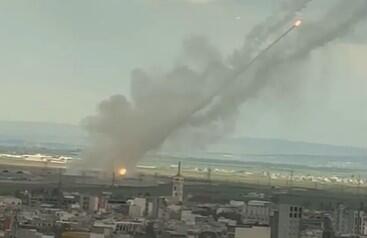
Iran claims U.S. or Israeli strike hit girls school, killing dozens
Iranian officials and its state-run media claimed Saturday that a U.S. or Israeli strike hit a girls elementary school in the country's far south, killing dozens of students. The school week begins on Saturday in Iran.
"The destroyed building is a primary school for girls in the south of Iran. It was bombed in broad daylight, when packed with young pupils," Iranian Foreign Minister Abbas Araghchi said in a social media post, sharing an image he said was of the aftermath of the alleged strike. "Dozens of innocent children have been murdered at this site alone. These crimes against the Iranian People will not go unanswered."
Iranian state news agency IRNA cited a spokesperson for Iran's Ministry of Education as saying at least 53 students were killed in the strike on the girls elementary school in the city of Minab, in Iran's Hormozgan province.
The semi-official Fars news agency, affiliated with Iran's Revolutionary Guard Corps, posted a video on social media showing people screaming amid debris around a heavily damaged building said to be the school.
CBS News has not yet been able to verify the reports or the video posted by Fars. A representative at the U.S. military's Central Command, which is responsible for the Middle East, told CBS News on Saturday that it had no statement to share regarding the alleged strike on the school. CBS News was also seeking comment from the Israeli military.
The Associated Press said the White House did not immediately respond to a request for comment on the reported strike on the school in Minab.
In a statement posted on social media, Iranian Foreign Ministry spokesman Esmaeil Baqaei accused the U.S. and Israel of "an egregious, unwarranted act of aggression against Iran by indiscriminately targeting Iranian cities," calling the alleged attack on the Minab school "a blatant crime" and urging the world and the United Nations Security Council to "stand up to this grave injustice."
Russia calls U.S.-Israel attack on Iran an "unprovoked act of armed aggression"
Russia's Foreign Ministry called the joint U.S.-Israeli attacks on Iran an "unprovoked act of armed aggression against a sovereign and independent U.N. member state."
In its statement on Saturday, the ministry demanded an immediate halt to the bombings, accusing the U.S. and Israel of "hiding behind" concerns about Iran's nuclear program while actually pursuing regime change.
The Russian foreign ministry said the country had stood ready to help broker a "peaceful resolution," accusing the U.S. and Israel of plunging the Middle East into "an abyss of uncontrolled escalation."
CBS/AP
Omani foreign minister who brokered U.S.-Iran talks "dismayed," says strikes will not serve U.S.
The foreign minister of Oman, who was brokering the indirect negotiations between the Trump administration and Tehran over Iran's nuclear program up until late this week, chided the U.S. on Saturday for going on the attack amid the diplomacy.
"I am dismayed," Foreign Minister Badr Albusaidi said in a social media post. "Active and serious negotiations have yet again been undermined. Neither the interests of the United States nor the cause of global peace are well served by this. And I pray for the innocents who will suffer. I urge the United States not to get sucked in further. This is not your war."
On Friday, just hours before the strikes, Albusaidi old CBS News that negotiators had made "substantial progress" toward a deal to curb Iran's nuclear program, telling "Face the Nation" moderator Margaret Brennan that a "peace deal is within our reach."
He said Iran had agreed that it will "never, ever have … nuclear material that will create a bomb," which he called a "big achievement."
Bahrain evacuating area home to U.S. Navy's Fifth Fleet after missile attack
The Bahrain Ministry of the Interior said Saturday that residents of a neighborhood that houses the U.S. Navy's Fifth Fleet headquarters would be evacuated following a targeted missile attack by Iran.
"The Ministry of Interior has begun evacuating citizens and residents in the Juffair area," the ministry said in a social media post. "We urge your cooperation with the relevant authorities."
Earlier Saturday, Bahrain's state media and a CBS News source confirmed the U.S. Navy's Fifth Fleet headquarters was targeted by a missile attack.
Eyewitnesses told CBS News that the fleet's headquarters was targeted by at least three missiles, but there was no immediate confirmation of missiles impacting the base, or of any damage inflicted.
Iran's semi-official Tasnim news agency, which is associated with Iran's Revolutionary Guards, said the Bahrain base was targeted by Iranian attacks.
Lebanon's prime minister vows country will not be drawn into war
Lebanese Prime Minister Nawaf Salam on Saturday vowed that Lebanon would not be drawn into a regional conflict.
In a social media post, Salam urged the Lebanese people "to exercise wisdom and patriotism."
"We will not accept anyone dragging the country into adventures that threaten its security and unity," he said.
The Iranian-backed militant group Hezbollah is based in Lebanon. In 2024, Israel and Hezbollah were engaged in violent conflict that ended with a U.S.-brokered ceasefire.
Rubio alerted some members of the "Gang of Eight" before Iran strikes
Secretary of State Marco Rubio spoke to at least some members of the U.S. Congress' "Gang of Eight" to alert them before the strikes on Iran got underway, CBS News confirmed.
A source familiar with the matter told CBS News that Sen. Mark Warner, vice chair of the Senate Intelligence Committee, was one of lawmakers briefed ahead of the action. It was not clear whether Rubio was able to get in touch with all eight.
The Gang of Eight consists of the top four leaders in the House and Senate, along with top Democrats and Republicans on the House and Senate intelligence committees.
European Union calls for "maximum restraint"
The European Union called for "maximum restraint" on Saturday as the joint U.S-Israeli military attack on Iran sparked retaliatory strikes targeting American bases in the Middle East.
European Commission President Ursula von der Leyen called the developments "greatly concerning," as the 27-nation EU moved to withdraw non-essential personnel from the region.
"We reaffirm our steadfast commitment to safeguarding regional security and stability," she said in a joint statement with European Council President Antonio Costa. "Ensuring nuclear safety and preventing any actions that could further escalate tensions or undermine the global non-proliferation regime is of critical importance."
"We call on all parties to exercise maximum restraint, to protect civilians, and to fully respect international law," the EU statement said.
The EU's Aspides naval mission in the Red Sea remained "on high alert" and stood ready to help keep the maritime corridor open, the bloc's top diplomat Kaja Kallas said, adding that she had spoken to Israeli Foreign Minister Gideon Saar and "other ministers in the region."
"Our consular network is fully engaged in facilitating departures for EU citizens. Non-essential EU personnel are being withdrawn from the region," Kallas said on social media. "The latest developments across the Middle East are perilous. Iran's regime has killed thousands. Its ballistic missile and nuclear programmes, along with support for terror groups, pose a serious threat to global security."
Pro-Iran group in Iraq says it will attack U.S. bases after airstrike kills fighters
A militant pro-Iran group based in Iraq warned Saturday that it would start attacking U.S. bases in the Middle East in retaliation for an airstrike that it said hit one of its own bases earlier in the day, amid U.S. and Israeli strikes on Iran.
The Iraqi Hezbollah Brigades, which is separate from the major Iranian proxy group Hezbollah, based in Lebanon, said it would "soon begin attacking American bases in response to their aggression," in a statement shared on social media.
The Iraqi group said two of its fighters were killed Saturday in airstrikes that hit one of its bases in southern Iraq.
The Iraqi Hezbollah Brigades, or Kata'ib Hezbollah, is designated a terrorist organization by the U.S., as is the larger pro-Iranian Hezbollah group in Lebanon.
Iran's foreign ministry condemns U.S.-Israel strikes during "diplomatic process"
Iran's foreign ministry condemned the military strikes launched Saturday by the U.S. and Israel, calling them a "gross violation of Iran's territorial integrity and national sovereignty."
In a statement posted on X, the ministry claimed the strikes had targeted defense infrastructure and civilian sites across the country and said they were carried out "while Iran and the United States were in the midst of a diplomatic process."
"Now is the time to defend the homeland and confront the enemy's military aggression. Just as we were ready for negotiations, we have been more prepared than ever for defense," the statement said. "The armed forces of the Islamic Republic of Iran will respond to the aggressors with authority."
"History testifies that Iranians have never surrendered to foreign aggression and hegemony; this time too, the response of the Iranian nation will be decisive and determining and will make the aggressors regret their criminal act," the statement said.
Israeli military official says strikes a response to Iran bolstering ballistic missiles
An Israel military official told journalists Saturday that it was working with the U.S. to carry out dozens of strikes across Iran. The official said that the choice was made to act now after intelligence indicated an acceleration of Iran's ballistic missile program.
The official also said Iran's government was operating, as well as acting to conceal and fortify, its nuclear program to continue to advance it, and that the objective of the offensive was to significantly reduce the capabilities of the Iranian's regime.
In an interview with French network TF1 posted online 10 days ago, Rafael Grossi, the director general of the U.N.'s International Atomic Energy Agency, said most of Iran's enriched uranium remained intact after the U.S. strikes on nuclear facilities in June 2025, but he said there was no indication Iran was working to develop a nuclear weapons capacity.
"No," he told TF1 when asked if the IAEA saw evidence of Iran trying to work toward a weapon, adding: "On the contrary, I see, today, a willingness on both sides to reach an agreement."
"Most of the material that Iran had accumulated up until June of last year, despite the [U.S.] bombings and the attacks, is still there, in large quantities, where it was at the time of the strikes," Grossi told the French network. "Some of it may be less accessible, but the material is still there. From a non-proliferation standpoint, the material remains. That is why there is so much interest — I would say urgency — in reaching an agreement that would prevent new military action in the region."
Grossi was directly involved in the latest rounds of indirect talks between U.S. and Iranian delegations in Geneva, Switzerland, last week.
The Israeli military official said Saturday that there were a variety of initial targets in the opening strikes, from practical ones that would create more freedom of operation to "essential personnel," though the official declined to comment on who may have been targeted when asked by journalists.
Israeli military official says operation planned in unprecedented coordination with U.S.
An Israeli military official told reporters that Saturday's joint strikes with the U.S. followed weeks of extensive planning and coordination between the two countries at a level that had never been seen before.
The official would not put a timetable on the estimated length of the operation, saying only that it would take as long as necessary to cripple the Iranian regime's capabilities.
The latest assessments of Iran's ballistic missile arsenal ranged from the high hundreds to low thousands, the official said.
The official said, to their knowledge, Iran's counterattack on Israel had not resulted in any significant hits thus far.
Israel is prepared for any scenario to play out in response to the attack on Iran, including retaliation from Iran's proxies in Iraq and Syria, along with Hezbollah in Lebanon and Hamas in Gaza, the official added.
In the past year, Iran is estimated to have spent between $700 million and $900 million on its proxies, mainly Hezbollah, the official said, adding that both Israel and the U.S. determined the cost of inaction was too heavy as the threat posed by Iran and its allied groups could have increased.
Fatality reported in Iran counterattack on Abu Dhabi
A person was killed by shrapnel from an Iranian missile attack on Abu Dhabi, the capital of the United Arab Emirates, The Associated Press reported, citing the country's state media.
The fatality reported by the UAE's state-run WAM news agency was the first attributed to Iranian missile launches carried out in response to U.S. and Israeli strikes on the Islamic Republic.
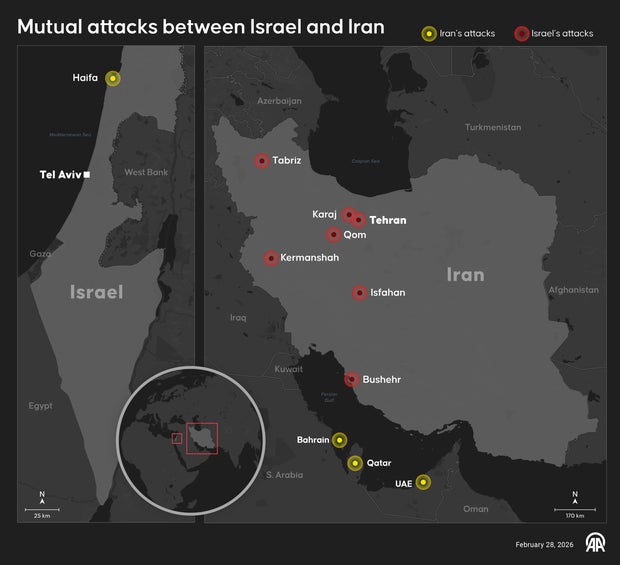
Trump says he wants "freedom for the people' in Iran
The Washington Post reports that in a brief phone interview overnight, President Trump said he wants Iran to be a "safe nation."
"All I want is freedom for the people," he told the paper. "I want a safe nation, and that's what we're going to have."
Iran's supreme leader, president were targeted in Israeli strikes, source says
A source involved in the Israeli strikes on Iran told CBS News that Iran's supreme leader, Ayatollah Ali Khamenei, and its President Masoud Pezeshkian, were among the targets of the first round of strikes.
According to The Associated Press, the first strikes of the joint U.S.-Israeli attack appeared to target Khamenei's home in downtown Tehran. It wasn't immediately clear if he was there at the time, but Iranian media reports claimed both the president and Khamenei were safe.
By Michal Ben-Gal