Why the Guadalupe River rises so fast and what makes the Texas Hill Country so vulnerable to deadly flash floods
As Central and South Texas face a new round of life-threatening flooding, many Texans are possibly asking the same question they did a year ago: How can the Guadalupe River rise so quickly?
The answer is a combination of weather, geography and geology that makes the Texas Hill Country one of the most flash-flood-prone regions in the United States. When those factors come together, especially after days of rain, rivers can rise dozens of feet in less than an hour, leaving little time for people to escape.
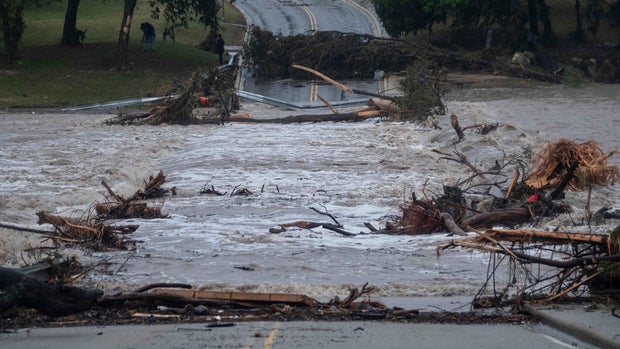
Why this week's flooding happened
According to CBS Texas meteorologist Nelly Carreño, several ingredients have combined to produce the current flooding emergency.
Several weather conditions came together at the same time. A slow-moving storm system lingered over Texas while warm, moisture-rich air from the Gulf fueled repeated rounds of heavy rain. Instead of moving away, thunderstorms kept developing over the same communities, dumping inches of rain in a short period of time.
Those repeated downpours have fallen onto ground that was already saturated from previous rains. Once the soil can no longer absorb additional water, nearly every inch of new rainfall runs directly into nearby creeks and rivers.
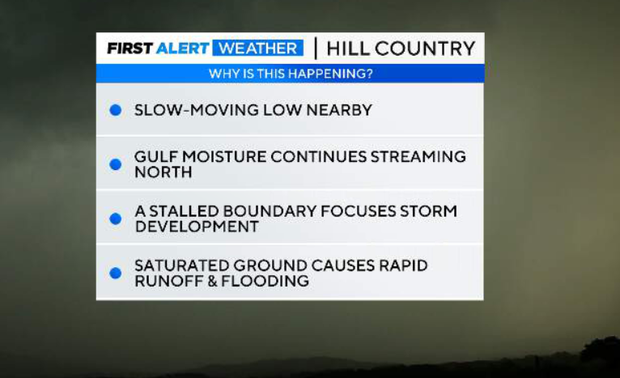
Those same ingredients have fueled widespread flooding, water rescues and evacuations across the Hill Country and South Texas this week.
Why the Hill Country is called "Flash Flood Alley"
Even during ordinary heavy rain, the Texas Hill Country reacts differently than much of the state.
Unlike flatter regions where water spreads out gradually, the Hill Country is filled with steep terrain that funnels rainfall downhill into narrow creeks. Those creeks quickly empty into the Guadalupe River and its tributaries.
The region's geology makes matters even worse.
Much of the Hill Country sits atop limestone covered by only a thin layer of rocky soil. Instead of soaking into the ground, rainfall rapidly runs across the surface.
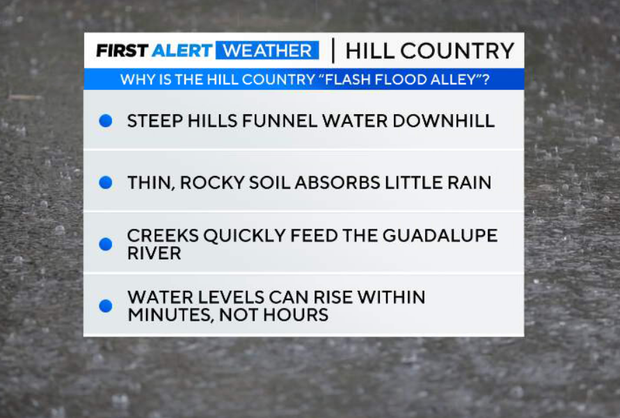
The result is an extremely fast response whenever intense rainfall develops. A creek that appears nearly dry can become a raging torrent in a matter of minutes, and rivers downstream can surge before residents fully realize the danger.
The lesson from the July 4, 2025 disaster
The danger became tragically clear during the catastrophic July 4, 2025 floods.
Before dawn, torrential rain fell over the Guadalupe River watershed, sending a massive wall of water racing downstream. In the Hunt area, the river rose roughly 30 feet in about an hour, with some gauges recording rises of more than 26 feet in just 45 minutes before failing. Entire communities were overwhelmed before many people could evacuate.
Among the hardest-hit locations was Camp Mystic, the historic girls' summer camp along the Guadalupe River in Kerr County. Floodwaters swept through the camp before sunrise, killing more than two dozen campers and counselors in one of the deadliest tragedies of the disaster.
Overall, more than 100 people died across Central Texas during the flooding, making it one of the state's deadliest flood events in decades.
Now, just one year later, another major flooding event has once again forced rescues, evacuations and urgent warnings across many of the same communities.


