U.S. conducts "self-defense" strikes, CENTCOM says, insists ceasefire still in place amid negotiations
Follow updates on the war in the Middle East for Tuesday, May 26, here. See earlier developments below.
What to know about the Iran war:
- President Trump has said a deal with Iran is "largely negotiated" and that he will either sign "a great and meaningful" pact with Tehran "or there will be no deal." Secretary of State Marco Rubio said an agreement to reopen the Strait of Hormuz could be announced as soon as Monday.
- Iran acknowledged agreement with the U.S. on many points but said the signing of a deal is not imminent. It stressed that the proposal under discussion does not include immediate concessions on the "nuclear issue."
- The Iranian regime tempered expectations Monday, arguing that "frequent changes" and contradictions by the U.S. side present "problems and obstacles" as final details are haggled over.
- The U.S. Central Command said Monday that U.S. forces launched "self-defense strikes," saying it continues to "defend our forces while using restraint during the ongoing ceasefire."
Iran's Revolutionary Guard says it downed U.S. drone over country's airspace
Iran's Islamic Revolutionary Guard said Tuesday that it had downed a U.S. drone and shot at other aircraft entering the country's airspace.
US military aircraft "entered Iranian airspace in the Persian Gulf region, and air defense units of the Islamic Revolutionary Guard Corps ... identified and shot down an MQ-9 drone," the Guard said in a statement on its Sepah News website.
The Guards forces "also fired upon an RQ-4 drone and an intruding F-35 fighter jet," the statement said, without specifying when the incidents took place.
Iran's supreme leader says region's nations will "no longer serve as shields" for U.S. bases
Iran Supreme Leader Mojtaba Khamenei said Tuesday that countries in the region would no longer be "shields" for U.S. bases, in a written statement carried by state television.
"What is certain in this regard is that the hands of time will not turn backwards, and the nations and lands of the region will no longer serve as shields for American bases," said Khamenei, who has not appeared in public since he took office in March, in a message marking the Eid al-Adha holiday.
He said the United States was losing influence in the region, "moving further and further away from its former status with each passing day."
The remarks come as Iran and the United States continued exchanges aimed at reaching a deal to end the war that began on February 28 and spread across the region
U.S. intelligence shows that Khamenei is effectively holed up in an undisclosed location with little access to the outside world and is only reached by a labyrinth of couriers, according to U.S. officials with knowledge of the matter.
He was injured in initial U.S. and Israeli strikes in the Mideast war, U.S. intelligence has said.
CBS/AFP
Israeli strike on village in eastern Lebanon kills 12, state-run news agency says
An Israeli airstrike on a village in eastern Lebanon killed 12 people, the country's state-run National News Agency said Tuesday.
The strike late Monday in Lebanon's Bekaa Valley area came after Israeli Prime Minister Benjamin Netanyahu said that he had authorized more intense strikes targeting the Hezbollah militant group across Lebanon. The Israeli military didn't comment on this particular strike but said Monday that it was targeting Hezbollah infrastructure in eastern Lebanon.
Rescue workers say a dozen bodies were pulled out of rubble following an intense wave of overnight strikes targeting swaths of southern and eastern Lebanon.
The intensified attacks come three days before Lebanese and Israeli military delegations are set to meet in Washington for direct talks.
Hezbollah is attacking Israeli troops in southern Lebanon and northern Israeli towns and has vowed to continue fighting until Israel stops its daily airstrikes and withdraws its troops from the country.
The Lebanese government hopes that the direct talks with Israel, opposed by Hezbollah, will lead to a ceasefire.
Over one million people in Lebanon have been displaced in the war, which was sparked by Hezbollah firing rockets into northern Israel on March 2 in solidarity with Iran.
Rubio says Strait of Hormuz strait will reopen "one way or the other"
Secretary of State Marco Rubio insisted Tuesday that the blockaded Strait of Hormuz will reopen "one way or the other," after fresh U.S. strikes on Iran cast doubt on an accord to end the Mideast war.
"The straits have to be open. They're going to be open one way or the other, so they need to be open," Rubio told reporters in the city of Jaipur, during an official visit to India.
"What's happening there is unlawful, it's illegal, it's unsustainable for the world, it's unacceptable," he said.
Rubio says Iran deal still possible within days despite U.S. strikes
Secretary of State Marco Rubio said early Tuesday that a deal with Iran was still possible despite new American strikes that cast doubt on their fragile ceasefire.
"There were some talks going on in Qatar today, so we'll see if we can make progress. I think it's a lot of talking back and forth going on about specific language in the initial document, so it'll take a few days," Rubio told reporters in Jaipur during an official visit to India.
"The president's expressed his desire to make it. He's either going to make a good deal or no deal," he said.
U.S. carries out "self-defense" strikes, CENTCOM says
U.S. forces on Monday launched "self-defense strikes" in southern Iran, U.S. Central Command said.
"U.S. forces conducted self-defense strikes in southern Iran today to protect our troops from threats posed by Iranian forces," CENTCOM spokesperson Capt. Tim Hawkins said in a statement. "Targets included missile launch sites and Iranian boats attempting to emplace mines. U.S. Central Command continues to defend our forces while using restraint during the ongoing ceasefire."
The strikes follow Hezbollah saying it staged several attacks on Monday on three barracks and a military post in northern Israel "in response to the violation of the ceasefire" by the Jewish state.
CBS/AFP
Trump says Iran should destroy enriched uranium under international oversight
President Trump said in a Truth Social post Monday that he wants the International Atomic Energy Agency to be present if Iran disposes of its highly-enriched uranium inside the country or "at another acceptable location."
"The Enriched Uranium (Nuclear Dust!) will either be immediately turned over to the United States to be brought home and destroyed or, preferably, in conjunction and coordination with the Islamic Republic of Iran, destroyed in place or, at another acceptable location, with the Atomic Energy Commission, or its equivalent, being witness to this process and event," the president said in a post.
A senior Trump administration official said over the weekend that Iran agreed in principle to dispose of highly-enriched uranium in negotiations with the U.S. and that officials were still working through details of the mechanism for the disposal.
Israel steps up Lebanon strikes as Netanyahu escalates offensive
The Israeli army intensified strikes in southern Lebanon on Monday, as Israeli Prime Minister Benjamin Netanyahu said he had ordered the military to escalate its offensive in Lebanon in an effort to "crush" Hezbollah.
Despite a ceasefire that came into effect on April 17, Israel and Iran-backed Hezbollah have continued to exchange fire on a near-daily basis.
"I have ordered an even greater acceleration of our operations," Netanyahu said in a video statement posted on his Telegram channel.
"It is true that they are attacking us with drones, including fiber-optic drones, but we have teams working on countermeasures and we will solve this issue... We will intensify our blows, increase our firepower, and we will crush them."
Following the call for escalation, an AFP correspondent saw residents fleeing the southern suburbs of Beirut, a Hezbollah stronghold.
The Israeli air force carried out successive strikes in the Bekaa Valley in eastern Lebanon on Monday evening, according to Lebanon's National News Agency.
Dozens of Israeli strikes earlier targeted several towns and villages in southern Lebanon in the early hours, killing three people in two cars and on a motorcycle, NNA reported.
Israeli airstrikes then targeted several towns near the ancient city of Tyre, according to the state-run agency.
Those strikes came after Israel issued evacuation orders for 10 villages, accusing Hezbollah of breaching the truce.
Oil prices drop nearly 7% as possible deal looms
Oil prices dropped significantly on Monday amid optimism that the U.S. and Iran might be getting closer to reaching a peace deal that would reopen the Stright of Hormuz.
Brent crude futures tumbled nearly 7%, at $96.30 a barrel by mid-afternoon Monday, a little more than three weeks after oil prices spiked to a four-year high
A draft proposal for an agreement stipulates that Iran would immediately reopen the vital waterway and take steps to ensure traffic returns to pre‑war conditions within 30 days, two regional officials with knowledge of the ongoing diplomacy told CBS News.
Still, Iran's semi-official Fars News Agency said Saturday that even "in the event of a possible agreement, the Strait of Hormuz will still be under Iranian management."
Top Iranian officials in Qatar for talks, sources say
Iranian foreign minister Abbas Araghchi and Iranian parliamentary speaker Mohammed Bagher Ghalibaf are in Doha, Qatar for peace talks, a diplomat briefed on the visit and a source familiar with the matter told CBS News.
Their visit comes as CBS News previously reported the details of a draft memorandum for Iran to review.
Iran reopening international internet access, state media reports
Iran is reopening international internet access, Iranian state media reported Monday, after a nearly three-month blackout
President Masoud Pezeshkian issued the order to restore connections on Monday, state media reported, citing Iran's Communications Ministry.
"The decree aimed at restoring internet access to its pre-January state was communicated to the Ministry of Communications by the president," Iranian news agencies Tasnim and Fars reported.
Most Iranians have been unable to access the web for 87 days, the internet observatory NetBlocks said on Monday.
"The measure has eliminated any transparency around executions, adding to the inhumane conditions and daily uncertainty faced by jailed critics, dissidents and tourists," the group said.
Iranian authorities initially cut off internet access in January amid mass protests against the government. After connections were gradually restored, Tehran imposed a new blackout following the start of U.S. and Israeli strikes against Iran on February 28.
Iran says "there will be no retreat"
Iran's secretary of the Supreme National Security Council issued a statement to the public Monday, saying "there will be no retreat," state media reported.
In a brief statement addressed to the "dear people of Iran," the council called for national unity, the Tsanim News agency reported, as Tehran and the U.S continued negotiating a potential peace deal.
In its message to the public, the security council said the nation's strength "was demonstrated by the military arena, the diplomatic arena, and the people's representatives present in the streets with their valiant resistance, pinning down the enemy."
President Trump said a deal with Iran is "largely negotiated" and Tehran acknowledged progress but said the signing of an agreement is not imminent.
Iran says FIFA promised players will get World Cup visas
Iran's sports minister said FIFA has promised the country's men's football team will receive visas to play in the United States at the World Cup this summer despite the ongoing Middle East war, local media reported on Monday.
Iran's participation at the global spectacle has been in question for months because it is being co-hosted by the U.S., which along with Israel began bombing Iran on February 28, sparking a wider regional war.
"The FIFA president promised us that all our players would receive visas. There is no reason why our players should not receive visas," said minister Ahmad Donyamali, quoted by local news agency ISNA.
"I hope that all the conditions will be met so that the national team can participate in the tournament in a calm and orderly manner."
The Iranian squad will now be based in Tijuana on the Mexican border with the United States during the tournament, according to the Islamic republic's football federation.
AFP
Iran hangs another protester, rights groups says
Iran on Monday executed a man on charges related to widespread protests earlier this year, the latest in a spree of hangings on political or security accusations since the start of the U.S.-Israeli war, with dozens more still risking execution, rights groups said.
Some three dozen men have been hanged on charges related to protests, membership of banned opposition groups or espionage since wartime executions resumed in March, according to rights groups.
The latest man to be hanged was Abbas Akbari, who was accused of attacking an official building in Nain in the central province of Isfahan during the peak of the protest movement in January.
"The primary purpose of these executions is to instill fear in society and prevent future protests," said the director of Norway-based NGO Iran Human Rights (IHR) Mahmood Amiry Moghaddam.
Amnesty International said Thursday that at least 78 "protesters, dissidents and others with real or perceived links to banned opposition groups" are under sentence of death and at risk of execution.
A doubling of Iranian executions contributed to the world reaching a high for death penalties in 2025 not seen since 1981, an Amnesty report published earlier this month found.
CBS/AFP
Iranian forces ready to deliver "decisive and deterrent response" to any attack, warns commander
A senior commander of Iran's powerful Islamic Revolutionary Guard Gorps (IRGC) warned Monday that the paramilitary forces were ready to deal a "decisive and deterrent response" to any new attack.
Much like the Trump administration, Iranian authorities have acknowledged progress in negotiations toward a peace agreement with the U.S. - but also continued issuing military threats they say will be carried out if no deal is reached.
President Trump, in his latest social media post, said Monday that indirect talks with Iran were "proceeding nicely," but he warned that if no agreement is reached, the U.S. would return to "shooting, but bigger and stronger than ever before — And nobody wants that!"
Visiting military positions along Iran's Persian Gulf coast, Brig. Gen. Mohammad Hadi Sefidchian, a senior IRGC ground force commander, said Monday in remarks carried by state media that "the enemies must know that the security of the Persian Gulf is a red line for the Islamic Republic of Iran, and this region is not a field for trial and error by any aggressor."
"We have full situational awareness of enemy movements and possess the capability to deliver a decisive and deterrent response at any level," he claimed.
Iran's sports minister confident national soccer team will be issued visas for World Cup
Iran's minister of sport said Monday that all members of the country's national soccer team should be granted visas to participate in the upcoming World Cup, being hosted jointly by the U.S., Canada and Mexico, stressing that host countries are obligated to facilitate entry for all delegations.
"The host country of the World Cup has commitments and must issue visas without exception" to all players, coaching staff, management, and media teams, Ahmad Donyamali said Monday. "I don't think there will be any problem with visas for the national team."
Earlier in May, the head of Iran's soccer association said players were still waiting on visas for the tournament, which begins on June 11.
Iran has issued FIFA, soccer's governing body, with a list of 10 conditions for their participation in the World Cup. They include allowing players who served previously in Iran's paramilitary Islamic Revolutionary Guard Corps (IRGC) to get visas.
Secretary of State Marco Rubio has said that Iranian players with links to the IRGC could face entry restrictions.
Mexican President Claudia Scheinbaum said Monday that her government had agreed to host the Iranian team during the World Cup, according to the Reuters news agency, adding that the U.S. had not wanted to host them.
Iran says it has permitted 32 more vessels to transit Strait of Hormuz
Iranian state media claimed Monday that 32 more commercial vessels had been granted permission to transit the Strait of Hormuz over the past 24 hours in coordination with the country's naval forces.
Permission was granted for the ships to travel in and out of the vital waterway, according to an IRIB state TV correspondent.
"Five large oil tankers that required expedited passage also crossed the strait" with authorization from the country's powerful Islamic Revolutionary Guard Corps, he said.
The remaining vessels were expected to pass through the strait by Monday evening, local time, he added.
The announcement came after two officials with knowledge of the ongoing diplomacy told CBS News a draft peace deal between the U.S. and Iran includes a provision for Iran to immediately reopen the strategic waterway and to take steps to ensure traffic returns to pre-war conditions within 30 days.
Israeli opposition leader Lapid says emerging U.S.-Iran deal "bad for the region"
The deal being discussed between the U.S. and Iran fails to achieve any of Israel's goals for the war, Israel's opposition leader Yair Lapid said Monday, accusing Prime Minister Benjamin Netanyahu of failing to wield influence to achieve a better agreement.
Lapid, who is part of an alliance attempting to unseat Netanyahu in elections this year, called the details emerging of the potential deal "disturbing."
"The deal is bad for Israel, bad for the region, bad for the citizens of Iran," Lapid told reporters in Jerusalem.
Israel and the U.S. launched their joint war on Iran on Feb. 28, vowing to destroy Iran's ballistic missile program, end its support for proxy militant groups across the region and end Iran's ability to pursue a nuclear bomb. Both Netanyahu and President Trump also indicated hope that conditions could be created for Iranians to topple their repressive government.
According to regional officials, under the current deal being discussed, Iran would agree to eventually give up its stockpile of highly enriched uranium and to reopen the strategic Strait of Hormuz in exchange for the U.S. ending its blockade of Iranian ports and the lifting of sanctions against Iran. Key details on Iran's nuclear program would then be negotiated during a 60-day period. It is unclear if the deal will address Iran's missiles or support for regional militant groups.
Lapid expressed gratitude to Mr. Trump for pursuing the war alongside Israel, but criticized Netanyahu for allowing Washington to negotiate a potential peace deal with little coordination with Israel.
"The Israeli government is at an all-time low in its ability to influence decisions in Washington," he said, noting that Mr. Trump said last week: "Netanyahu will do whatever I want him to do."
Israeli military issues new evacuation order for 10 Lebanon villages
Israel's military warned residents in 10 villages, most of them in southern Lebanon, to evacuate their homes Monday ahead of expected strikes against alleged Hezbollah targets.
"In light of Hezbollah's violation of the ceasefire agreement, the Israel Defense Forces are compelled to operate against it with force," IDF spokesman Colonel Avichay Adraee said in a social media post, listing the names of the villages.
"For your safety, you must evacuate your homes immediately and move at least 1,000 metres away from these towns and villages to open areas."
Adraee issued another evacuation warning later Monday to residents of a building in Rashidiyeh and two buildings in Burj al-Shamali, near the city of Tyre.
"We urge residents of the building marked in red on the attached map, as well as nearby buildings: you are located near a facility used by the Hezbollah terrorist organisation," he wrote on X. "For your safety, you must evacuate immediately and move at least 300 metres away."
Israel has repeatedly targeted what it says are Hezbollah-linked sites in Tyre, causing extensive damage in several areas and prompting many residents to flee the city.
Despite a ceasefire that came into effect on April 17, Israel and Hezbollah have continued to exchange fire on a near-daily basis, accusing each other of violating the U.S.-brokered truce.
According to Lebanese authorities, Israeli strikes since early March have killed more than 3,100 people.
The Israeli military said Monday that a soldier was killed the previous day in southern Lebanon. That brings the number of Israeli soldiers killed since the outbreak of hostilities with Hezbollah to 23. One civilian contractor has also been killed.
Iran claims new air defense system shot down "hostile drone" over Strait of Hormuz
Iranian forces have used a new air defense system to shoot down a "hostile drone" over the Strait of Hormuz, according to state media.
The semi-official Fars news agency reported that Iran used a new air defense system called "Arash the archer" to shoot down the drone. The interception was carried out using a system with "stealth capabilities," according to the report.
"This is a signal from us so that no stealth drone can penetrate the skies of the Persian Gulf again," an Iranian official told Fars.
Local residents reported hearing what sounded like air defense activity near Qeshm Island, in the strategic waterway, on Monday evening local time, according to the semi-official Mehr news agency.
Top Iranian negotiators reportedly in Qatari capital for talks on "resolving outstanding issues" with U.S.
Iran's top negotiator Mohammed Qalibaf and the country's Foreign Minister Abbas Araghchi were both in Qatar's capital Doha on Monday to meet with the small Gulf nation's leader in a bid to find solutions to the last issues standing in the way of a U.S.-Iran deal, according to multiple reports.
The Qatari government-owned Al Jazeera network reported the visit by the senior Iranian officials, saying it was "aimed at resolving outstanding issues" between Washington and Tehran.
The Reuters news agency also said Qalibaf and Araghchi were in Doha, for discussions primarily focused on reopening the Strait of Hormuz to shipping and securing Iran's stockpile of about 900 pounds of highly enriched uranium.
Iran's central bank governor was part of the country's delegation, as the potential release of frozen Iranian financial assets as part of an agreement with the U.S. would also be discussed.
Al Jazeera quoted an Iranian official as saying the discussions in Doha would focus "primarily on Iran's frozen assets — including the amount to be released and the timeline for their release," and that Qatar could also host a future direct meeting between Iranian and U.S. delegations.
Iranian state media did not immediately confirm the senior officials' trip to Doha, but state-run news agency IRNA republished the Reuters report.
Potential deal includes 60-day ceasefire extension, halt of fighting on all fronts, including Lebanon, sources say
Two regional officials with knowledge of the ongoing diplomacy have confirmed to CBS News that, pending Iran's approval, the terms in the draft memorandum of understanding include:
- A 60-day extension of the current ceasefire.
- Iran immediately reopening the Strait of Hormuz and taking steps to ensure traffic returns to pre‑war conditions within 30 days.
- Iran and the U.S., together with their allies, declaring that all military operations on every front, including Lebanon, end immediately and permanently. They also commit not to start any war against each other and to refrain from threatening or using force.
- Iran reaffirming that it will never develop nuclear weapons.
- Iran agreeing that its stockpile of enriched uranium will be disposed of under a mechanism that both sides will agree on.
- Issues of Iran's frozen financial assets and sanctions against the regime will be dealt with based on Iran's compliance with the former points.
A U.S. senior administration official essentially confirmed all of those points to CBS News on Sunday, except for the declaration to the end of all military operations on every front, including Lebanon, and the 60-day extension of the ceasefire.
Trump says talks "proceeding nicely," and Iran deal should see other Gulf allies sign Abraham Accords
President Trump said Monday that negotiations with Iran toward a deal to end the war were "proceeding nicely," but using what has become his go-to tactic, he added a warning that if no agreement was reached, the U.S. would be, "Back to the Battlefront and shooting, but bigger and stronger than ever before — And nobody wants that!"
Mr. Trump said in his Monday morning Truth Social post that following discussions over the weekend with Persian Gulf and other regional leaders, "it should be mandatory that all of these Countries, at a minimum, simultaneously, sign onto the Abraham Accords" agreement that has already normalized relations between Israel and several majority Muslim nations.
"Most should be ready, willing, and able to make this Settlement with Iran a far more Historic Event than it would, otherwise, be," Mr. Trump said, linking what is still an emerging potential peace deal with Iran to a wider regional embrace of the U.S.-brokered Abraham Accords.
"It should start with the immediate signing by Saudi Arabia and Qatar, and everybody else should follow suit. If they don't, they should not be part of this Deal in that it shows bad intention," he said.
"In speaking to numerous of the Great Leaders mentioned above, they would be honored, as soon as our Document is signed, to have the Islamic Republic of Iran as part of the Abraham Accords. Wow, now that would be something special! This will be the most important Deal that any of these Great, but always in Conflict Countries, will ever sign," Mr. Trump said.
"Therefore, I am mandatorily requesting that all Countries immediately sign the Abraham Accords, and that, if Iran signs its Agreement with me, as President of the United States of America, it would be an Honor to have them also be part of this unparalleled World Coalition," said the president.
Republican Sen. Lindsey Graham, in a post on X Sunday, called on Mr. Trump Sunday to "stick to your guns in getting a good deal with Iran," adding: "Equally important, stick to your guns in insisting Saudi Arabia and others join the Abraham Accords as part of these negotiations."
Amid hope for U.S.-Iran deal, Israeli cabinet member demands Netanyahu return to "intense war" in Lebanon
Israel's national security minister Itamar Ben-Gvir — a far-right cabinet member who has threatened previously to pull his party out of Prime Minister Benjamin Netanyahu's coalition government — demanded Monday that the premier "return to an intense war" in Lebanon.
Ben-Gvir has used the leverage lent by his party's lynchpin position in the coalition to push his hard line against Iran and its proxy group in Lebanon, Hezbollah. He and other far-right leaders have pushed Netanyahu to reject any agreement with Iran or Lebanon that includes a definitive end to Israel's fight against either entity.
Netanyahu, after speaking Saturday night with Mr. Trump about a deal taking shape between the U.S. and Iran, said in a post on X that Mr. Trump had "reaffirmed Israel's right to defend itself against threats on every front, including Lebanon."
"It is forbidden to normalize the reality of explosive drones; it is time for the prime minister to bang on Trump's table and inform him that we are returning to war in Lebanon," said Ben-Gvir, who sparked controversy last week by mocking European humanitarian activists detained by Israeli forces as they tried to breach Israel's blockade of the Gaza Strip.
"We need to cut off the electricity in Lebanon, conquer the Dahiyeh, and return to an intense war," Ben-Gvir said, calling for Israel to permanently occupy a vast swath of southern Lebanon.
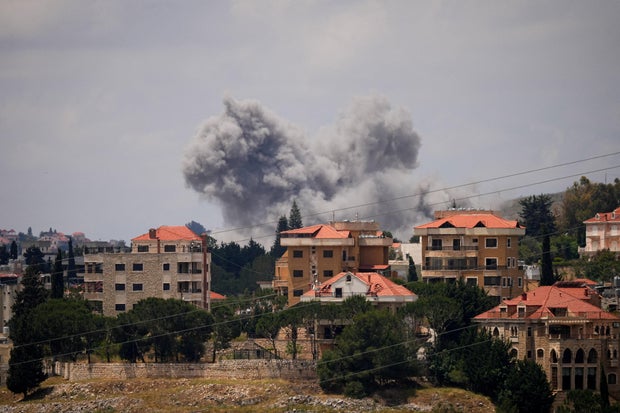
Israel and Hezbollah's continued fighting in Lebanon, despite a U.S.-brokered ceasefire between the Israeli and Lebanese governments, has been one of the complications for negotiators trying to get Tehran and Washington to agree to a wider peace deal. Iran insists that any peace deal include a halt to fighting on all fronts, including in Lebanon.
Iran says "not seeking to collect tolls" in Strait of Hormuz, but its new system with Oman will "require costs"
Iran's foreign ministry insisted Monday that the country is "not seeking to collect tolls" for ships to transit the Strait of Hormuz, a vital shipping passage that had been free and open to all vessels prior to the U.S. and Israel launching their joint war on Iran, but that a new system it's creating with Oman will have costs to cover.
Iranian Foreign Ministry spokesman Esmail Baqaei told reporters Monday that Tehran continued working with its neighbor Oman — the two countries with coastlines in the strait — "to draft a protocol or mechanism to ensure the safe passage of ships through the Strait of Hormuz."
"Iran does not charge tolls. There is no toll," Baqaei insisted. "I think we should be careful with the use of words. We are not seeking to collect tolls."
But he said "both for the national interests and security of Iran and Oman as coastal states, and for the broader benefit of the international community," vessels using the shipping lanes of the strait will require that "services are provided — navigation services, as well as necessary measures for protecting the environment of the Strait of Hormuz, the Persian Gulf, and the Sea of Oman."
"These require costs," said Baqaei "Therefore, this should not be referred to as a toll. Iran and Oman are working responsibly in this direction, and we hope to reach a final outcome as soon as possible."
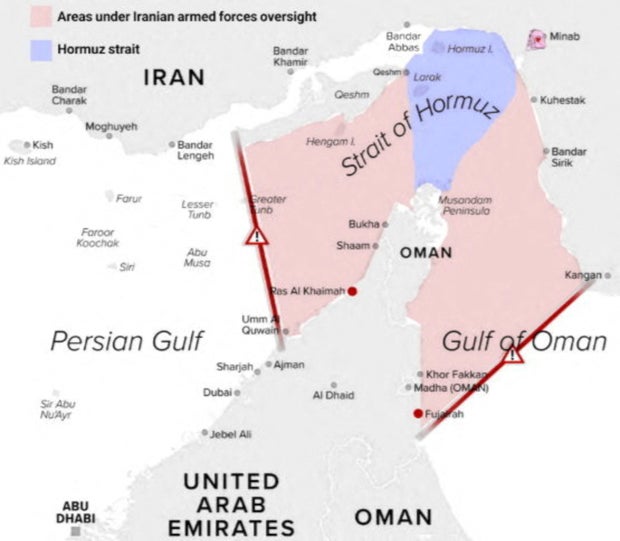
The Trump administration has ruled out allowing Iran to impose tolls as part of any deal to reopen the strait, with Secretary of State Marco Rubio saying last week "there is not a country in the world that should accept" such a system.
Rubio accused Iran of "trying to convince Oman" to join "in this tolling system in an international waterway."
"That's just not acceptable. It can't happen," Rubio said.
Iran says U.S. blockade "must be stopped" in the "very early stages" of any deal reached
Iranian Foreign Ministry spokesman Esmaeil Baqaei said the deal under discussion with the U.S. "is focused on ending the war. It includes provisions related to the Strait of Hormuz and the lifting or termination of what is described as U.S. maritime interference against Iranian shipping."
"Certainly, in the very early stages, U.S. actions described as a maritime blockade must be stopped, and at the same time the Islamic Republic of Iran will take the necessary measures to ensure safe passage in the Strait of Hormuz. How exactly this will be implemented is a matter for us as a coastal state."
Trump says he's either make "a great and meaningful" deal with Iran, "or there will be no deal"
President Trump said in an early Memorial Day morning post on Truth Social that his administration will either reach "a great and meaningful" deal with Iran to end the war, "or there will be no deal."
His post appeared largely addressed at rebutting criticism that he could agree to a pact with Iran that includes less restriction of the Islamic Republic's nuclear program than did the 2015 nuclear deal negotiated by the Obama administration.
Mr. Trump unilaterally pulled the U.S. out of that international agreement, known as the JCPOA, in 2018, during his first administration, prompting Iran to increase its uranium enrichment to near weapons-grade.
"It will be the exact opposite of the JCPOA disaster negotiated by the failed Obama Administration, which was a direct and open path to a Nuclear Weapon for Iran," insisted Mr. Trump on Monday.
Iran has said the agreement currently under negotiation does not include any immediate concessions on its nuclear program, only a commitment to discuss the matter during a 60-day period that would begin under the deal, which it says is focused on ending the war and implementing a staged reopening of the Strait of Hormuz.
Iran says negotiations continue despite "obstacles" created by "frequent changes" in U.S. positions
Iranian Foreign Ministry spokesman Esmaeil Baqaei said Monday that while there remain "some issues that we have not yet finalized," talks with the U.S. continue.
He cautioned, however, that diplomacy aimed at resolving the conflict was up against "problems and obstacles" caused by "frequent changes in positions and contradictions" by the Trump administration.
"The frequent changes in positions and contradictions, which do not really need me to explain and which you can simply observe by looking at tweets issued by U.S. officials, show what situation we are dealing with and under what conditions we must pursue a diplomatic process with such a counterpart," said Baqaei. "This naturally creates its own problems and obstacles."
Iran says talks on "nuclear issue" would start "within 60 days" if deal with U.S. is reached
Iranian Foreign Ministry spokesman Esmaeil Baqaei, who's also the spokesman for Iran's negotiating team, stressed Monday that an agreement taking shape with the U.S. to end the war and reopen the Strait of Hormuz would not involve any immediate concessions on Iran's nuclear program.
He said Iran was nearing agreement with the U.S. on a memorandum of understanding that would include a 60-day period during which the strait would reopen as each side ends its respective shipping restrictions, and "naturally, one of the topics that will be discussed during this 60-day period will be nuclear-related issues."
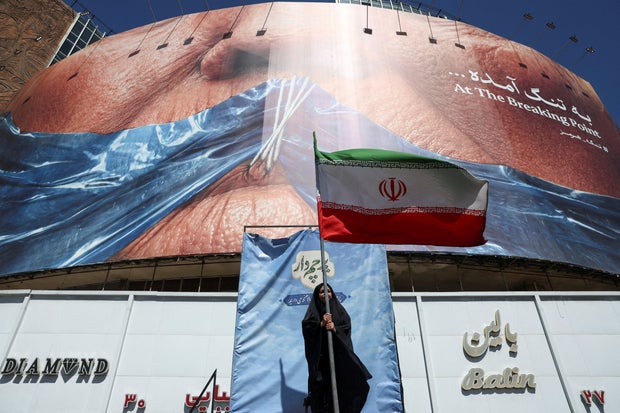
"This 14-point memorandum is focused on ending the war," he said. "If this happens, then within a 60-day period, discussions on nuclear-related issues will take place."
Iran says progress made on many issues with U.S., but signing a deal is not imminent
Iran said Monday that Tehran and Washington had reached understandings on many issues in exchanges over a deal for ending the war, but warned an agreement was not imminent.
"It is correct to say that we have reached a conclusion on a large portion of the issues under discussion," foreign ministry spokesman Esmaeil Baqaei said during a weekly news briefing.
"But to say that this means the signing of an agreement is imminent - no one can make such a claim," he said, accusing Washington of shifting its positions.
Baqaei added that Tehran has "not set any timeline or specific time for finalizing" a deal to end the war.
Pakistan's prime minister meets with Xi in China after Beijing promises "positive contributions" to Mideast peace
Pakistan's key mediator between the United States and Iran, army chief Asim Munir, is in Beijing alongside his country's Prime Minister Shehbaz Sharif for talks with Chinese leaders, Pakistan television showed on Monday.
China President Xi Jinping met with Sharif on Monday, Chinese state media reported, according to the Reuters News service.
Munir was in Tehran on Friday and Saturday alongside Pakistan's Interior Minister Mohsin Naqvi as part of ongoing mediation efforts to formally end the Iran war.
China has said it would work with Pakistan to "make positive contributions to the early restoration of peace and stability in the Middle East."
CBS/AFP
Rubio says Iran deal still possible Monday
Secretary of State Marco Rubio said Monday that a deal to end the war with Iran could materialize "today," adding that Israel had the right to defend itself against attack.
"We thought we might have some news last night, maybe today; I wouldn't read too much into it," Rubio said in New Delhi, referring to the potential agreement.
"We have what I think is a pretty solid thing on the table in terms of their ability to open up the straits, get the straits open," he told reporters as he departed the Indian capital, where he has been on an official visit.
"It has a lot of support in the Gulf. ... Every country that we've walked through it (with) understands it's not just very reasonable, but it's the right thing for the world to get done."
Rubio also voiced confidence that Iran would "enter into a very real, significant, time-limited negotiation on the nuclear matter."
But, he said the U.S. will either have a good accord with Iran or deal with the country "another way," according to the Reuters news agency.
The U.S. will give diplomacy every chance to succeed before exploring the "alternatives," Rubio added.
CBS/AFP
Israel's military issues new evacuation warning to 10 Lebanon villages
Israel's military on Monday warned residents of 10 villages, most of them in southern Lebanon, to evacuate their homes ahead of expected strikes against alleged Hezbollah targets.
"In light of Hezbollah's violation of the ceasefire agreement, the Israel Defense Forces are compelled to operate against it with force," the military's Arabic-language spokesman, Colonel Avichay Adraee, said in a social media post, listing the names of the villages.
"For your safety, you must evacuate your homes immediately and move at least 1,000 meters (six-tenths-of-a-mile) away from these towns and villages to open areas."
Trump says if he makes a deal with Iran, it will be "good and proper"
President Trump said if he makes a deal with Iran, it will be a "good and proper one," criticizing the Obama administration's record with Iran and accusing the former president of giving Iran "massive amounts of CASH, and a clear and open path to a Nuclear Weapon."
"Our deal is the exact opposite, but nobody has seen it, or knows what it is," Mr. Trump said on Truth Social. "It isn't even fully negotiated yet. So don't listen to the losers, who are critical about something they know nothing about."
Negotiators are working toward a final resolution on details of latest U.S.-Iran deal, senior Trump official says
The Iranians have agreed in principle to a deal that would include the disposal of highly enriched uranium, a senior administration official said Sunday, but efforts are still underway to finalize the agreement.
A finalized agreement would also include Iran reopening the Strait of Hormuz in exchange for the U.S. lifting its blockades of the waterway, and the U.S. making accommodations on sanctions relief if Iran makes accommodations on the question of nuclear enrichment.
There is broad commitment on the principles, the official said, and the Trump administration feels positive about where things stand even as efforts to finalize the details continue, the official said. The official indicated that Iran appears more willing to compromise than before the military campaign.
The administration wants to see a substantial commitment to forgo enrichment, the official said, arguing that the difference between a 20 or 30 year commitment is meaningless and the most important question is the enforcement mechanism. The official said they believe the deal will go further than the 2015 nuclear deal under former President Barack Obama, which allowed enrichment up to a certain level.
The deal would not include any sort of regime change, the official said, noting that the administration will deal with the existing Iranian government.
The official said there are lots of players passing paper around and there is a lot of inaccurate information, noting that various parties are using selective leaks to push their preferred narratives or to try to derail things.
Iran-U.S. negotiators have agreed broad principles of a deal, official says
A senior Trump administration official told CBS News that the U.S. and Iran are working toward finalizing an agreement and that the Iranians have, in principle, agreed to a deal that would include the disposal of the regime's highly enriched uranium stockpile.
President Trump said on TruthSocial that negotiations between the U.S. and Iran continue, and that he has instructed the U.S. team "not to rush into a deal" and "that time is on our side."
After a call with Middle Eastern leaders, Mr. Trump said a peace deal with Iran had been "largely negotiated" but that final details were still being discussed. Both he and Secretary of State Marco Rubio indicated that further details would be announced shortly.
Sources told CBS News on Saturday that the latest proposal included a process to reopen the Strait of Hormuz, the unfreezing of some Iranian assets held in foreign banks, and a continuation of negotiations. Iran's semi-official Fars News Agency said Saturday that even "in the event of a possible agreement, the Strait of Hormuz will still be under Iranian management."