Trump says Netanyahu will do "whatever I want" on Iran, and he's "in no hurry" to make a deal
Follow updates on the war in the Middle East for Thursday, May 21, here. See earlier developments below.
What to know about the Iran war:
- President Trump said Wednesday that Israeli Prime Minister Benjamin Netanyahu will do "whatever I want him to do" on Iran. Mr. Trump also said he's "in no hurry" to make a deal to end the war.
- Iran's Islamic Revolutionary Guard Corps has threatened to push the war "beyond the region" if the U.S. or Israel resume attacks, promising "crushing blows … in places you cannot even imagine."
- The threat comes after President Trump said he had been "an hour away" from ordering new strikes on Iran Monday evening before Persian Gulf allies asked him not to go ahead with the plans, citing progress in peace talks.
Iran looking over latest U.S. peace proposals, state media say
Iran said it is reviewing the latest proposals sent by the United States aimed at ending the war, with Pakistani Army Chief Field Marshal Asim Munir expected in Tehran on Thursday.
Nour News, which is close to Iran's Supreme National Security Council quoted Foreign Ministry spokesman Esmaeil Baqaei as saying, "We have received the views of the American side and are currently reviewing them."
Baqaei added that the current Pakistan-mediated exchanges between the U.S. and Iran are based on Iran's initial 14-point framework proposal, which called for "a definitive end to the war on all fronts, including Lebanon," the release of frozen Iranian assets, and an end to what he described as "piracy" against Iranian commercial vessels.
Iranian lawmaker Fada Hossein Maleki said in remarks aired on state TV that the Pakistani Army chief would arrive in Tehran carrying a new message from the U.S.
By Khaled Wassef
Pakistan army chief heading to Tehran to continue mediation efforts between U.S. and Iran
Pakistan's Army Chief Asim Munir will travel to Tehran on Thursday to continue his nation's efforts to help Iran and the U.S. reach a deal to end the Mideast war, Iran's ISNA news agency said.
"The visit comes amid continued regional diplomatic activity aimed at easing tensions and advancing negotiations," ISNA said.
Pakistan has been the leading mediator between the U.S. and Iran, conveying messages as the sides continue their indirect talks.
Hardline Iranian general emerges as major player in peace talks with U.S.
As negotiations with the United States hang in the balance, a hard-line Iranian general linked to notorious attacks at home and abroad over the past decades is believed to have seized a place near the center of power.
Brig. Gen. Ahmad Vahidi, who heads Iran's paramilitary Revolutionary Guard, has become a major player in formulating Iran's tough stance in negotiating a possible end to the war with the United States, experts say. He is believed to be part of a small clique in direct contact with Iran's Supreme Leader Ayatollah Mojtaba Khameini, who remains in hiding after being reportedly wounded in the Feb. 28 Israeli strikes that killed his father, Ayatollah Ali Khamenei.
Like everything in Iran since the war began, who ultimately controls decision-making remains uncertain. As people within the upper ranks of Iran's theocracy vie for power, they can gain or lose favor quickly. Vahidi himself hasn't been seen publicly since Feb. 8, weeks before the war began.
A longtime veteran of the ruling system, Vahidi helped shape Iran's support of militant groups across the region, is accused of a role in the 1994 bombing of a Jewish center in Argentina, and in 2022 led domestic security forces in a bloody crackdown on protesters.
Elevated to Guard commander this year after his predecessor was killed early in the war, he leads the most powerful force in Iran, with its arsenal of ballistic missiles and its fleet of small boats threatening Persian Gulf shipping.
"Vahidi and members of his inner circle have likely consolidated control over not only Iran's military response in the conflict but also Iran's negotiations policy," the Washington-based Institute for the Study of War said.
Iranian Revolutionary Guard members regularly brandishing weapons in Tehran
Iranian Revolutionary Guard members now regularly show the public in Tehran how to handle Kalashnikov-style assault rifles. Parades through the capital feature military vehicles mounted with belt-fed Soviet-era machine guns. And at one mass wedding, a ballistic missile, like the one that rained down cluster munitions on Israel, adorned the stage.
Weapons are now regularly brandished in Tehran, an increasing show of defiance as U.S. President Donald Trump threatens he could restart the war with Iran should negotiations break down and the Islamic Republic refuses to release its grip on the Strait of Hormuz.
The weapons displays reflect the genuine threat Iran faces: Trump has suggested American forces could seize Iran's stockpile of highly enriched uranium by force and previously said that he sent arms to Kurdish fighters to pass onto anti-government protesters.
But they also offer reassurance and motivation to hard-liners and provide rare entertainment at a time of great uncertainty, when Iranians are facing mass layoffs, business closures and spiraling prices for food, medicine and other goods.
Suggesting more hard-liners will be armed could also help suppress any new demonstrations against Iran's theocracy, which violently put down nationwide protests in January in a crackdown that activists say killed over 7,000 people and saw tens of thousands detained.
"This is necessary for all our people to get trained because we are in a war situation these days," said Ali Mofidi, a 47-year-old Tehran resident at a weapons training Tuesday night. "If necessary, everyone should be available and know how to use a gun."
Iran releases map of its "controlled maritime zone" in the Strait of Hormuz
Iran's newly-created Persian Gulf Strait Authority on Wednesday released a map of what it claims is its "controlled maritime zone" in the Strait of Hormuz.
In a post to X, the PGSA defined the zone as the "line connecting Kuh Mobarak in Iran and the south of Fujairah in the UAE in the east of the strait to the line connecting the end of Qeshm Island in Iran and Umm al-Qaiwain in the UAE in the west of the strait."
Anyone transiting through the area for the purpose of passing through the strait "requires coordination with, and authorization from" the PGSA, the post said.
Tehran earlier this month rolled out the new domestic PGSA, which it says will be responsible for coordinating with shipping companies to collect fees for passage. It has also threatened to attack any ships transiting the strait without its permission.
On its social media account, which went live Monday, the PSGA defined itself as the "legal entity and representative authority of the Islamic Republic of Iran for managing the passage and transit through the Strait of Hormuz."
Trump says he's willing to wait for Iranians to respond, but not for long
President Trump said he's willing to wait for Iran's latest response in the negotiations between Washington and Tehran, but not for long.
"If I can save war by waiting a couple of days, if I can save people being killed by waiting a couple of days, I think it's a great thing to do," the president told reporters at Joint Base Andrews on Wednesday afternoon.
On Monday, Mr. Trump called off what he said was a scheduled attack on the country that was supposed to happen Tuesday.
"If we don't get the right answers, it goes very quickly," the president said Wednesday. "We're all ready to go. We have to get the right answers. It would have to be a complete 100% good answers, and if we do, we save a lot of time, energy and lives, most importantly."
Mr. Trump said U.S. officials were impressed by the Iranians who were negotiating with his administration.
"We're dealing with people that are, I think, far more reasonable than the people that are really no longer with us," the president said. "We're dealing with some people with talent, with good brain power, and we're pretty impressed by it, so hopefully those people will make a deal that's going to be great for everybody."
GOP senator calls effort to limit Trump's war powers a mistake: "We're in this now"
A Republican senator told reporters Wednesday that it would be a mistake to limit President Trump's war powers in the Iran conflict a day after a Senate resolution that aims to do so advanced for the first time.
"I think that it's a mistake to limit his powers," Sen. Cynthia Lummis, a Republican from Wyoming, told reporters on Capitol Hill. "We're in this now, and if there had been some indication that this was going to be a forever war — which there is no indication that it's going to be a forever war — I could understand the position that some of my colleagues are taking. But this is an effort that is going to have an end."
Four of Lummis' fellow Republicans joined a majority of Democrats in advancing the measure Tuesday.
Lummis said the war would go on until there were assurances about Iran's nuclear capabilities.
"We know what it's going to take to have an end," Lummis said. "We know that if we don't get what we want, which is the absolute assurance that there will be no nuclear weapon capability in Iran, that this will not be over, but that if that occurs, this will be over."
Iran examining new U.S. proposal, Foreign Ministry spokesman says
Iranian Foreign Ministry spokesman Esmaeil Baqaei said on Wednesday that the Islamic Republic had received a new U.S. proposal and was currently examining it, as a minister from mediator Pakistan visited Tehran.
"We received the points of view of the American side and we are currently examining them. The presence of Pakistan's interior minister is aimed at facilitating the exchange of messages," Baqaei told state television.
He reiterated Iran's demands in talks to end the war include the release of Iranian assets frozen abroad and an end to the U.S. blockade on Iranian ports.
U.N. warns of possible food price crisis
The U.N. Food and Agriculture Organization warned that the blockage of the Strait of Hormuz could "trigger a severe global food price crisis" in the coming months.
Hormuz accounted for a fifth of global oil shipping before the U.S. and Israel launched strikes against Iran, which prompted Tehran to effectively shut down the strait to tanker and cargo traffic.
A third of the world's fertilizer supply also passed through the strait before the war, and officials have warned that farmers could face shortages during the summer growing season.
U.S. Marines board, search Iranian-flagged tanker, CENTCOM says
U.S. Marines on Wednesday boarded and searched an Iranian-flagged oil tanker that was suspected of trying to violate the U.S. blockade of Iranian ports, U.S. Central Command said on X.
The tanker, M/T Celestial Sea, was heading toward an Iranian port.
U.S. forces later released the vessel and told the crew to alter their course, according to CENTCOM.
"U.S. forces continue to fully enforce the blockade and have now redirected 91 commercial ships to ensure compliance," CENTCOM posted.
Oil prices plunge 5% on U.S.-Iran deal hopes
Global oil prices fell more than 5% on Wednesday after President Trump told reporters the U.S. is in "final stages of Iran."
International benchmark, Brent North Sea crude, shed 5.2% to $105.47 a barrel.
The main U.S. contract, West Texas Intermediate, tumbled 5.0% to $98.94 a barrel.
Mr. Trump had said, "We'll see what happens. We'll either have a deal or we're going to do some things that are a little bit nasty, but hopefully that won't happen."
Trump: "We're in final stages of Iran"
President Trump said Wednesday — before boarding Air Force One to deliver a commencement address at the U.S. Coast Guard Academy in Connecticut — that, "We're in final stages of Iran."
"We'll see what happens," he said. "We'll either have a deal or we're going to do some things that are a little bit nasty, but hopefully that won't happen."
Iran jails ex-national soccer team goalkeeper after anti-Khamenei post, says wife
Iran has jailed a former goalkeeper for the national men's soccer team after he published earlier this year a post deeply critical of then-supreme leader Ali Khamenei, his wife said Tuesday.
The Iranian judiciary's Mizan news agency confirmed that Mohammad Rashid Mazaheri was under arrest but said he was detained after trying to cross the border illegally.
Mazaheri won a handful of caps for his country and was in the Iranian squad for the 2018 World Cup in Russia, but spent most of his international career in the shadow of Iran's undisputed No. 1 goalie in the last years, Alireza Beiranvand.
In February, Mazaheri, who also kept goal for top domestic teams, published a since-deleted Instagram post in which he described Khamenei as "only a dark and passing chapter" in Iran's history. The post came after January mass protests but before the start of the U.S.-Israeli war against Iran, in which Ali Khamenei was killed on the first day.
The Persian-language news site IranWire, based outside Iran, said Mazaheri's home was raided on Feb.25.
His wife Maryam Abdollahi wrote on Instagram Tuesday that her husband was being held "in very harsh solitary confinement" in Urmia in northwestern Iran.
"Rashid always stood up for what he believed was right, and now he is paying the price for that courage with imprisonment in solitary confinement," she said.
Iran parliament speaker warns of possible escalation in war, says "we are in a war of wills"
The speaker of Iran's parliament, Mohammad Bagher Qalibaf, warned Iranians Wednesday about the possibility of facing new attacks and said "we are in a war of wills."
In a recorded address published by the semi-official Tasnim news agency, Qalibaf said: "The overt and covert movements of the enemy show that, alongside economic and political pressure, it has not abandoned its military objectives and is seeking a new round of adventurism and war."
Iran "must strengthen our readiness for a decisive and effective response to potential attacks and increase economic resilience," he said, adding that Iran must "deprive the enemy of hope for Iran's surrender."
In an effort to reassure the public, Qalibaf said the armed forces had significantly strengthened in recent weeks.
"Our powerful armed forces have made the best use of the ceasefire period to rebuild our military capabilities… and they will undoubtedly regret any renewed aggression against Iran," he said.
Qalibaf also acknowledged growing economic pressures and rising prices for essential goods, and announced the creation of a new parliamentary oversight mechanism to address economic challenges, including a special committee involving key commissions and oversight bodies to monitor supply chains and inflation.
Qalibaf concluded by framing the current period as a broader test of national endurance.
"We are in a war of wills," he said. "Whoever wins this war will write Iran's history and determine its future."
Trump says Netanyahu will do "whatever I want him to do" on Iran
President Trump said Wednesday that Israeli Prime Minister Benjamin Netanyahu will do "whatever I want him to do" on Iran.
When asked by reporters what he said to Netanyahu about Iran and holding off on potential strikes, Mr. Trump replied: "He's fine, he'll do whatever I want him to do."
"He's a very- very good man. He'll do whatever I want him to do. And he's a great guy," Mr. Trump said.
The president also said he's "in no hurry" to make a deal to end the conflict.
"You know, everybody's saying, 'Oh, the midterms, I'm in a hurry.' I'm in no hurry," Mr. Trump said. "I just- ideally I'd like to see few people killed as opposed to a lot. We could do it either way, but I'd like to see few people killed."
Israel army chief says military "on highest alert" as threats over Iran war escalate
Israel's army chief Lt. Col. Eyal Zamir on Wednesday said the military was at its highest alert level, as Tehran and Washington traded threats.
"At this moment, the IDF [military] is on the highest level of alert and prepared for any development," Zamir said at a meeting of all division commanders, according to a statement issued by the military.
Iran's Revolutionary Guard Corps had earlier warned that the war would expand beyond the region if the U.S. and Israel resumed attacks, after President Trump said he would strike again unless Tehran agreed to a peace deal.
Over 3,070 people killed in Israeli attacks, Lebanon's health ministry says
The number of people killed in Israeli attacks in Lebanon has climbed to 3,073, Lebanon's health ministry said Wednesday.
Another 9,362 people have been wounded in the attacks since March 2.
The latest fighting between Israel and Hezbollah started two days after the U.S. and Israel attacked Iran on Feb. 28. A U.S.-brokered ceasefire between Israel and Lebanon went into effect on April 17, although attacks by both Israel and Hezbollah have continued.
U.S. military redirected 90 ships under blockade, CENTCOM says
The U.S. military has redirected 90 ships under its blockade of Iranian ports, U.S. Central Command said on X Wednesday.
U.S. forces have "disabled" another four vessels "to ensure compliance," it said.
The number of redirected vessels has ticked up since the blockade was imposed in mid-April.
Italy summons Israeli ambassador over video showing senior Israeli official mock flotilla activists in custody
Italy summoned the Israeli ambassador in Rome after videos emerged showing degrading treatment of pro-Palestinian flotilla activists. The clip, posted online by Israel's far-right national security minister Itamar Ben-Gvir shows him mocking activists as they're corralled in the custody of Israeli security personnel.
Ben-Gvir, who has been sanctioned by U.S. allies for inciting violence against Palestinians, is seen in one clip walking among some of the approximately 430 detained Sumud Global Flotilla activists with police and soldiers. The government minister waves a large Israeli flag and tells some of the activists: "Welcome to Israel, we are the landlords."
One handcuffed activist seen in a video shouting "Free Palestine" as Ben-Gvir walks past is immediately pushed to the ground by security personnel.
The video shows activists with their hands tied behind their back, kneeling with their heads touching the floor, in what appears to be a makeshift detention area at Israel's Ashdod port and on the deck of a ship.
In another video, Ben-Gvir says the activists "came here all full of pride like big heroes. Look at them now."
After the video emerged, Israeli Foreign Minister Gideon Saar rebuked Ben-Gvir on X: "You deliberately caused damage to the state in this disgraceful performance, and not for the first time… No you are not the face of Israel."
Ben-Gvir responded on X that Saar should "understand that Israel has stopped being a pushover. Anyone who comes to our territory to support terrorism … will get slapped."
Italian Prime Minister Georgia Meloni, in her own X post, called the video of Ben-Gvir "unacceptable," and said her country "demands an apology for the treatment" of the activists. She said Italy had summoned the Israeli ambassador in Rome.
Israeli forces on Tuesday boarded the last of the flotilla boats trying to challenge Israel's decades-long blockade of Gaza — the latest effort aimed at highlighting dire conditions for nearly 2 million Palestinians in the war-torn enclave.
CBS/AP
Iran says 26 vessels have transited the Strait of Hormuz in the past 24 hours
Iran's powerful Islamic Revolutionary Guard (IRGC) claimed Wednesday that 26 commercial vessels had passed through the Strait of Hormuz in coordination with Iranian authorities over the past 24 hours, amid an ongoing U.S. blockade of Iranian ports.
The vessels included oil tankers, container ships and other commercial vessels, the IRGC Navy said in a statement, which added that transit through the waterway was "ongoing with permits obtained and in coordination with the IRGC Navy."
Iran has effectively blocked shipping in the strait since early April, accusing the U.S. of violating an ongoing ceasefire agreement. The strait is a crucial transit route for around a fifth of the world's crude oil supplies.
Iran insists it is in control over traffic in the strait, and it has announced a new mechanism for international shippers to coordinate with its authorities to ensure safe passage - often for hefty fees.
It imposed the restrictions in response to the U.S. military blockading Iranian ports and associated vessels in the area.
On Wednesday, South Korea's government confirmed the passage of one of its vessels, a tanker it said was carrying around 2 million barrels of oil. Tracking data show the ship left a Kuwaiti port before transiting the strait.
Iranian news site pushes back on report claiming Trump had hoped to install ex-president Ahmadinejad as leader
An Iranian news website aligned with the regime on Wednesday disputed a report by The New York Times claiming the U.S. and Israel had hoped to install former Iranian President Mahmoud Ahmadinejad as a new post-war leader of the country.
The Times article said an Israeli strike on Feb. 28, the first day of the war, had been aimed at freeing the hardliner from house arrest, with a view to having him take over the country following an anticipated toppling of the Islamic Republic regime - despite his history of fiery anti-Israel and anti-American rhetoric.
The Times, citing anonymous officials, said Ahmadinejad was wounded in the strike but that he "became disillusioned with the regime change plan," which he had been aware of.
Disputing the U.S. newspaper's reporting Wednesday, state-aligned news website Khabar Online said the strike in question hit a house several buildings away from Ahmedinejad's home, and that he was never under house arrest, noting at least a couple trips he had made abroad in recent years.
Ahmadinejad served as Iran's president from 2005 until 2013, but like all other Iranian presidents since 1979, he answered directly to the country's real authority, then-Supreme Leader Ayatollah Ali Khamenei.
Statement attributed to supreme leader lauds Iranians' "heroic actions" against "terrorist global armies"
A statement attributed to Iran's Supreme Leader, Ayatollah Mojtaba Khamenei, piled praise on the Iranian peoples' "heroic action" in the face of two "terrorist global armies."
Iranian state media outlets delivered the message said to be from Khamenei to mark two years since the death of the nation's former President Ebrahim Raisi, who died in a May 2024 helicopter crash.
"Today, we are facing the heroic actions of the Iranian nation in a unique historical resistance against two 'terrorist global armies,'" said the statement.
Khamenei was announced as Iran's new supreme leader after his father, who ruled over Iran for 36 years, was killed in a U.S. or Israeli airstrike on Feb. 28, the first day of the war. The younger Khamenei has not been seen or heard from directly since then. U.S. officials say he's believed to be alive, but that he was severely wounded in the same strike that killed his father.
Several statements attributed to the new supreme leader have been read out by presenters on Iranian state media during the war.
Israeli military "surprised" by Trump saying he was "hour away" from decision on bombing Iran, newspaper reports
Israel's military was taken by surprise when President Trump said Tuesday that he had been just "an hour away" from deciding whether to order new strikes on Iran the previous night, according to a report by the Israeli news outlet Haaretz.
The newspaper reported, citing anonymous sources, that Israel Defense Forces commanders had thought the timing of any resumption of hostilities "would be closely coordinated in advance with Israel."
The outlet said Israeli officials believed any renewal of U.S. strikes on Iran "could lead almost immediately to direct Israeli involvement in the fighting," adding that it was possible some high-ranking politicians were informed, but the message was not conveyed to the military.
The IDF didn't respond immediately to a CBS News request for comment on the story.
Mr. Trump said in a social media post on Monday evening that he had decided to cancel strikes on Iran planned for Tuesday on a request from U.S. allies in the Gulf, who he said had informed him "serious" negotiations were underway toward a peace deal.
Senior Pakistani official visits Tehran as Islamabad doubles down on peace efforts
Pakistani Interior Minister and Senator Syed Mohsin Reza Naqvi arrived in Tehran Wednesday for meetings as Islamabad continues pushing for a peace deal to end the U.S.-Israeli war with Iran, Iran's state news outlets said.
The reports did not say which Iranian officials Naqvi would meet in Tehran, but diplomatic sources told CBS News his visit – the second in less than a week – was part of intensified efforts by Pakistan to broker a peace agreement as tension between the U.S. and Iran rises.
"Pakistan has doubled its efforts to find a solution," a senior Pakistani diplomat told CBS News, adding that Islamabad understood frustrations, "but restarting war would be a total disaster for everyone."
President Trump said Monday that he had called off plans to launch new strikes on Iran at the request of several Persian Gulf allies, which he said had informed him "serious negotiations are now taking place" toward a deal to end the war.
On Tuesday, Pakistan's Foreign Ministry said the country's ambassador-designate to Iran, Imran Ahmed Siddiqui, met with Foreign Minister Mohammad Ishaq Dar ahead of Siddiqui's departure to Tehran to take up his post.
Dar "highlighted Pakistan's constructive and responsible role in promoting regional peace, dialogue, and stability, and expressed confidence that the Ambassador-designate would make a valuable contribution towards further strengthening the enduring partnership between the two brotherly countries," the ministry said in its statement.
South Korean oil tanker transits Strait of Hormuz in coordination with Iranian authorities, official says
A South Korean oil tanker transited the Strait of Hormuz on Wednesday, the country's top diplomat said, marking the first such passage by a South Korean vessel through the waterway since the Iran war began.
"At this very moment, our oil tanker is passing through the Strait of Hormuz," Foreign Minister Cho Hyun told lawmakers at the National Assembly in Seoul earlier. "We completed consultations with the Iranian authorities, and the vessel began sailing yesterday, proceeding very cautiously."
He said it was carrying "2 million barrels" of oil.
"It is the first South Korea-flagged ship to pass through the Strait of Hormuz since the Iran war began," a foreign ministry official told AFP.
Ship-tracking site MarineTraffic showed the South Korea-flagged tanker Universal Winner on the eastern side of the Strait of Hormuz near the entrance to the Gulf of Oman, bound for the southeastern South Korean city of Ulsan after departing Kuwait's Mina Al Ahmadi port.
The passage comes weeks after a South Korean-operated vessel was hit by airborne objects near the Strait of Hormuz, heightening concerns in Seoul over the safety of South Korean shipping in the region.
HMM Namu was struck by "two unidentified aircraft" on May 4, hitting the outer plate of the vessel's port-side ballast tank near the stern and causing a fire in the engine room. Tehran denied responsibility, with its embassy in Seoul posting a statement on its website in the days following the attack, saying it "firmly rejects and categorically denies any allegations regarding the involvement" of its forces.
Seoul strongly condemned the attack and said it hoped to identify those behind it through a thorough investigation.
Iran's paramilitary Revolutionary Guard warns it will take war "beyond the region" if U.S.-Israel strike the country again
Iran's powerful Islamic Revolutionary Guard Corps warned Wednesday that any renewed U.S. or Israeli attacks would be met with retaliation "beyond the region."
In a statement, the IRGC said it still had not brought "all the capacities" of the country "into action."
"But if aggression against Iran is repeated, the regional war that had been warned of will this time spread beyond the region, and our crushing blows will bring you to ruin in places you cannot even imagine," the statement said.
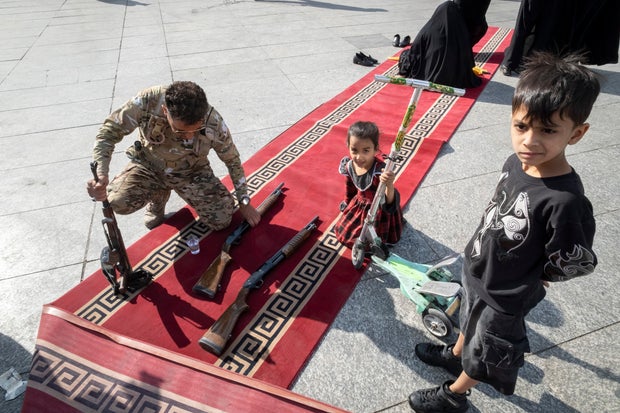
"We are men of war, and you will witness our power on the battlefield," the IRGC added, "not in hollow statements or on social media pages."
President Trump told reporters on Tuesday that he had been just "an hour away" from ordering new strikes on Iran Monday evening, but that he decided against it after a request from several Persian Gulf allies, who he said were voicing optimism that a peace deal could be reached.
Mr. Trump warned, however, that if an agreement isn't made, he could order a major wave of new strikes "on a moment's notice."
China and Russia condemn U.S.-Israeli attacks on Iran, Xi tells Putin return to hostilities would be "inadvisable"
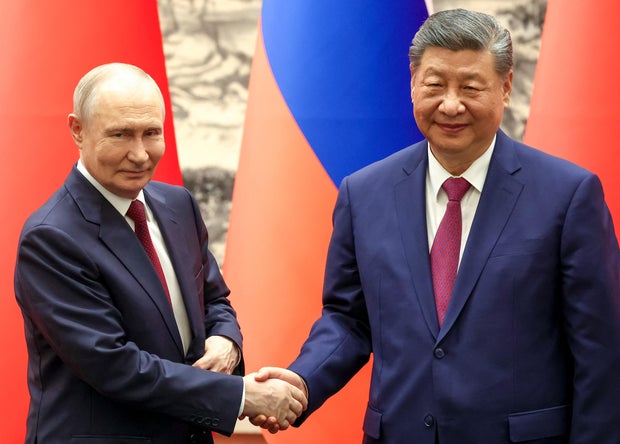
Chinese President Xi Jinping said further hostilities in the Middle East would be "inadvisable" and called for a "comprehensive" ceasefire as he spoke with his Russian counterpart Vladimir Putin in Beijing on Wednesday, state media reported.
"A comprehensive ceasefire is of utmost urgency, resuming hostilities is even more inadvisable and maintaining negotiations is particularly important," Xi told Putin, according to Xinhua news agency.
Russia's TASS state news agency Wednesday reported that the country stands ready to help end the war in Iran.
Speaking to TASS, Deputy Foreign Minister Sergei Ryabkov said, "Russia is ready to provide all possible assistance in resolving this conflict, and the parties involved are well aware of this."
In a joint statement after the leaders' meeting, China and Russia both condemned the U.S. and Israeli strikes on Iran as illegal and said they had undermined stability in the Middle East.
CBS/AFP
Iran calls U.S. claim that girls school where 165 were killed was within missile facility a "appalling lie"
Iran has called the claim that a girls elementary school bombed on the first day of the war was located within a missile facility an "appalling lie."
The head of U.S. Central Command Adm. Brad Cooper told the House Armed Services Committee Tuesday that the strike, which killed more than 165 people on the first day of the war, was still under investigation. He said it was complex as the school was on a missile site operated by Iran's paramilitary Revolutionary Guard.
But on Wednesday, Iran's Foreign Ministry spokesperson Esmaeil Beqaei called that assertion "a baseless fabrication and an appalling lie" in a post on X.
"This shameless distortion is a clear attempt to obscure the severe reality of the 28 February missile attacks," he said, describing it as a "clear war crime."
"The military commanders and United States authorities responsible for ordering and executing this catastrophic assault must be held fully accountable under international law," he added.

Adm. Cooper said Tuesday that he's committed to transparency once the investigation is complete. But Democratic Rep. Adam Smith of Washington said, "I do not trust that answer."
Smith said he respects Cooper, but accused Defense Secretary Pete Hegseth of showing a "callous disregard" for protecting civilian life.
An early American assessment of the strike suggested that the U.S. was "likely" responsible for the strike, CBS News reported early March.
CBS/AP
Senate advances resolution to limit Trump's Iran war powers for first time
The Senate advanced a resolution to limit President Trump's war powers in Iran on Tuesday, marking a breakthrough for Democrats after seven failed attempts.
Senators approved a motion to discharge the resolution from committee in a 50 to 47 vote. Four Republicans — Sens. Susan Collins of Maine, Lisa Murkowski of Alaska, Rand Paul of Kentucky and Bill Cassidy of Louisiana — joined the bulk of Democrats in favor of advancing the resolution. Sen. John Fetterman of Pennsylvania was the sole Democrat to oppose.
The vote marked the first time Cassidy supported advancing a war powers resolution. It came days after he failed to win enough support to advance to a runoff in the Louisiana GOP Senate primary, where Mr. Trump endorsed one of his opponents.
And three Republicans — Sens. John Cornyn of Texas, Tommy Tuberville of Alabama and Thom Tillis of North Carolina — did not vote, tipping the scales in Democrats' favor for the first time since they began bringing war powers resolutions related to Iran.
The vote marked only a first step in the Senate. And even if both chambers approved the resolution, the president would be expected to veto it. But Democrats say the move would carry significance and have the potential to change the president's thinking in the war.
Trump says he was "an hour away" from decision to strike Iran
President Trump told reporters Tuesday he was "an hour away" from making the decision to strike Iran on Monday, but that U.S. allies in the Persian Gulf requested he not go ahead with the plan. Mr. Trump made the comments to reporters while offering them a tour of the White House ballroom construction site.
The president said he would allow a "limited period of time" — two or three days, at least — for talks to continue, saying several Gulf states had told him there was progress in negotiations brokered by Pakistan toward a peace deal.
Mr. Trump said Monday that he was holding off on a strike on Iran that had been scheduled for Tuesday — plans that had not been mentioned by U.S. officials until the president made his announcement in a Truth Social post.