NYC Mayor Mamdani, law enforcement officials outline U.N. General Assembly security measures

New York City Mayor Zohran Mamdani and NYPD Commissioner Jessica Tisch on Thursday unveiled the security plan for next week's United Nations General Assembly.
The conference takes place from Monday to Friday at the U.N. headquarters in Midtown Manhattan's Turtle Bay. Presidents, prime ministers and diplomats from around the world will be in town, making it a very high-profile event.
"In the coming days, thousands of global heads of state, diplomats, advocates and civil society representatives will arrive here in New York City," Mamdani said. "What an honor it is for New York City, a city that so proudly reflects the world through the languages we speak, the food we eat, and the people who call it home, to serve as the backdrop of this work."
Mamdani turned his attention to the security challenges that presents.
"And yet, we know that New York City is always a target, and especially so when thousands of international representatives are present. That is why City Hall and the NYPD have been working closely with our federal partners for the past few months to prepare for this event and to ensure the safety and security of foreign visitors, of New Yorkers and of our city," Mamdani said. "I want to be clear. There are no known specific or credible threats against the United Nations General Assembly or our city at this time. However, our security posture will be elevated out of an abundance of caution. This is standard procedure."
Mamdani said New Yorkers can expect to see more police officers on the streets, and more officers around the U.N. building and on the East Side in particular.
"This is one of the most complex security operations that we carry out, and it involves every aspect of our department. Thousands of uniformed NYPD officers will be posted at and around U.N. headquarters all week, supported by heavy weapons teams, our aviation and harbor units, K-9, the bomb squad, NYPD's drone team, counterterrorism officers and other specialized units," Tisch said.
It is expected to be an intense week of protests in the city, motivated, in part, by the mayor's repeated attacks on Israeli Prime Minster Benjamin Netanyahu. Pro-Palestinian demonstrators are expected to be out in force as Netanyahu is expected to speak to U.N. delegates on Thursday. In addition, Jewish organizations are planning to mount vocal counter-demonstrations.
The police commissioner said she is "expecting multiple protests every day," but added, "As always, the NYPD will facilitate First Amendment activity. At the same time, there will be no tolerance for violence or destruction of property."
The General Assembly has been designated a National Special Security Event by the Department of Homeland Security, said Matt McCool, U.S. Secret Service special agent in charge of the New York field office.
The all-hands-on-deck security plan will also involve frozen zones on the East River, enforced by the Coast Guard, and flight restrictions for two nautical miles around the U.N.
"Those restrictions also apply to drones. Do not fly a drone in the restricted airspace without authorization. Violations may result in an investigation, seizure of the drones, or criminal charges," McCool said.
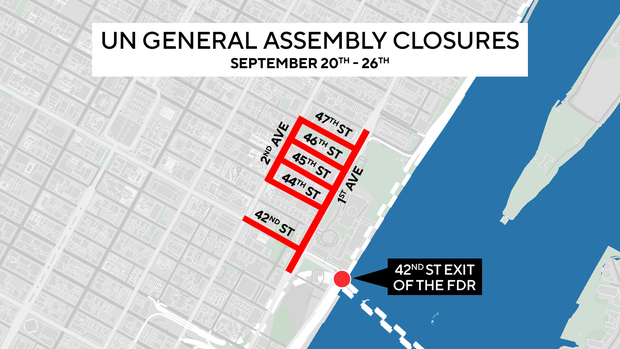
There will be numerous street closures from Sunday to next Saturday.
- First Avenue will be closed from 41st to 48th streets
- 44th to 47th streets will be closed between First and Second avenues daily
- Each day until about 9 p.m., 42nd Street will close from First to Second avenue and the 42nd Street exit of the FDR will be blocked off
- Vehicles requiring access to Tudor City can enter via 41st and 43rd streets
The city's Department of Transportation announced the week will be full of Gridlock Alert Days. Drivers should expect extensive street closures and delays across Manhattan.
"There will be rolling pedestrian and vehicle closures, both surrounding the U.N. building and across the city as delegations travel. At certain times, portions of the FDR will be closed," Mamdani said.
He urged people to use mass transit.
"NYC DOT traffic data shows that average motor vehicle speeds in Midtown during U.N. General Assembly week are historically their slowest of the year: less than four miles per hour, whereas Midtown traffic normally averages between four and six miles per hour," a news release stated.
Transportation officials encourage people to use the bike lane tunnel to bypass busy intersections around the United Nations headquarters. They also advise using regional rail lines, the subway, bus system, ferries, and walking.


