NYC to begin enforcing obscure storefront gate transparency law on July 1

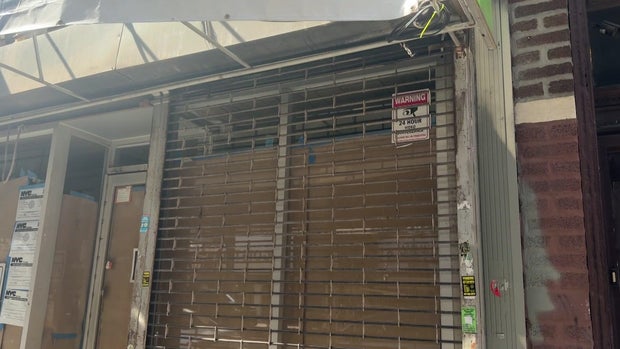
Enforcement will soon begin on an obscure New York City law passed in 2009 that requires most businesses to replace traditional solid roll-down security gates with versions that are at least 70% transparent.
The July 1, 2026, deadline was written into the law when it passed with the goal of phasing out noncompliant gates gradually over many years.
The measure, known as Local Law 75, requires most storefront security gates to allow visibility into businesses after hours.
Business owners say city didn't do enough outreach
As the July 1 deadline approaches, some business owners in southern Brooklyn say they are only now learning about the mandate and worry they will not have enough time or money to comply.
Randy Goldstein opened the Compact Disk Shoppe in 1992 and later expanded to house his insurance brokerage next door. That was the last time he says he replaced his metal roll-down gate.
"Everybody that has regular gates has to change the gates in two months? Hello?!" Goldstein said.
Yelena Makhnin, executive director of the Brighton Beach Business Improvement District, said the city has not done enough outreach to notify owners.
"Even before coming here, I asked six businesses, have you ever seen any flyers? No," Makhnin said.
She estimated only 12-15% of businesses in the area are currently compliant.
Randy Peers, president of the Brooklyn Chamber of Commerce, said that trend extends beyond Brighton Beach.
"I think that's absolutely reflective of what you're going to find in Brooklyn and in most of the outer boroughs," he said.
Cost is prohibitive, business owners say
Some merchants who already have compliant gates say they still have concerns. Eric Piker, owner of Eric's Health Food Shoppe, said he worries exposed glass storefronts could be more vulnerable.
"I'm afraid for my glass, actually. I'm afraid that somebody is going to just, like, poke something into it and just break it," Piker said.
Goldstein, who said he has six gates across his businesses, said the cost is prohibitive, estimating it will cost him a minimum of $10,000.
"We're talking a lot of expense. And this is on top of increasing expenses that has led to more business closures in 2025 than business startups for the first time since COVID," Peers said.
Peers said the law was intended as an aesthetic and anti-graffiti measure. Last month, he wrote a letter to elected officials asking them to delay or repeal it.
A spokesperson for the city Department of Buildings says in a statement, in part, "The law gave property owners 17 years to comply with these requirements. The Department of Buildings does not have the legal authority to change the law unilaterally. Only the City Council has that authority. If changes are proposed, we would be ready to collaborate with them, and we stand ready to implement any potential changes to the law that they approve."
Lawmakers are considering drafting legislation that could make changes before enforcement begins, though no bill has yet been introduced.
Have a story idea or tip in Brooklyn? Email Hannah by CLICKING HERE.


