31 buildings linked to Legionnaires' disease on Upper East Side, NYC health officials say. See the list.


New York City's Health Department has identified 31 buildings on the Upper East Side where it says Legionella bacteria was detected.
Of the 31 buildings, 19 have already drained, cleaned and disinfected their cooling tower, health officials said. The rest are expected to have remediation complete by the end of the day on Saturday.
As of July 10, there have been at least 54 cases of Legionnaires' disease connected to Upper East Side buildings since the cluster was first identified last week, New York City Health Department officials said.
Of those patients diagnosed with Legionnaires', 18 were currently hospitalized, the department said Friday. The health department previously reported as many as 22 hospitalizations. No deaths have been reported.
The source of the outbreak has not yet been identified.
"We're still avidly conducting a thorough investigation to confirm which exact location is harboring the live Legionella bacteria which is causing people to get sick," NYC Health Commissioner Dr. Alister Martin said.
List of buildings impacted
The Guggenheim Museum is among the affected buildings. Others include a Whole Foods location, a summer day camp, doctors' offices and residential buildings.
The city says a positive test result does not confirm that a building's cooling tower is a source of the outbreak, and more testing is in the works to determine the source or sources.
While they wait for those results, the health department says out of an abundance of caution, all of the buildings were ordered to drain, clean and disinfect their cooling towers.
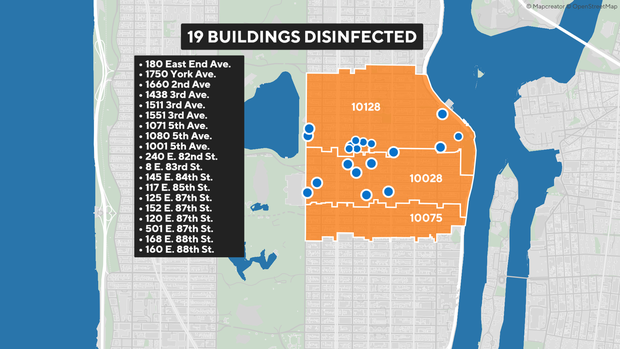
The following buildings have already completed full remediation, city officials said:
- 180 East End Ave.
- 1750 York Ave.
- 1660 Second Ave
- 1438 Third Ave.
- 1511 Third Ave.
- 1551 Third Ave.
- 1071 Fifth Ave.
- 1080 Fifth Ave.
- 1001 Fifth Ave.
- 240 E. 82nd St.
- 8 E. 83rd St.
- 145 E. 84th St.
- 117 E. 85th St.
- 125 E. 87th St.
- 152 E. 87th St.
- 120 E. 87th St.
- 501 E. 87th St.
- 168 E. 88th St.
- 160 E. 88th St.
In a statement, the Guggenheim New York said they conduct regularly monthly testing and treating of their cooling tower using third-party expert companies to comply with city requirements, and they took immediate steps for remediation after receiving test results.
"The city has confirmed that there is no additional action needed at this time, and this poses no risk to anyone inside the building," the statement said, in part. "The safety of our staff and the public are the utmost priority, and we are continuing to follow all city guidelines."
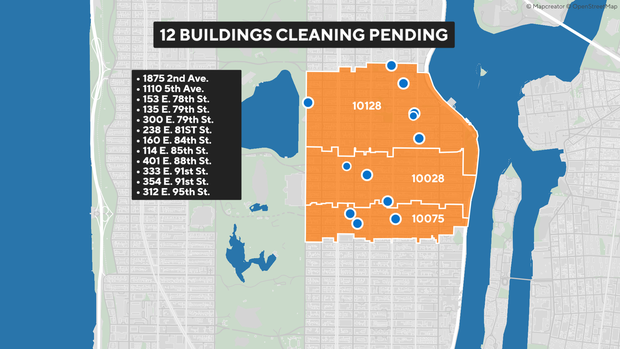
The following buildings have been ordered to have their remediation efforts completed by Saturday:
- 1875 Second Ave.
- 1110 Fifth Ave.
- 153 E. 78th St.
- 135 E. 79th St.
- 300 E. 79th St.
- 238 E. 81st St.
- 160 E. 84th St.
- 114 E. 85th St.
- 401 E. 88th St.
- 333 E. 91st St.
- 354 E. 91st St.
- 312 E. 95th St.
The city health department said they're waiting for more test results, which means the list could get longer.
The health department says it doesn't actually matter if you live in one of the buildings or not, because they believe the bacteria spread from the cooling towers into open air. People have been infected by inhaling mist coming from the cooling towers, though the vast majority of people who breathe Legionella-tainted mist do not get sick.
There is no health risk associated with the water within the buildings containing the cooling towers, health officials said, adding it is safe for drinking, showering and cooking.
Legionella bacteria is quite common in the environment. It tends to grow in watery areas.
Masks are not considered effective when it comes to limiting exposure to Legionella, since it is not spread person-to-person.
NYC has taken "an aggressive posture"
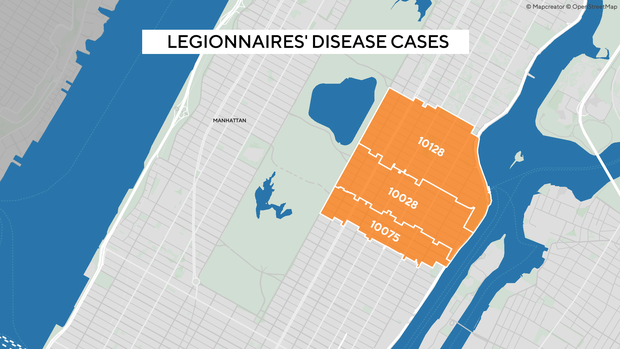
The Legionnaires' cluster has been linked to Manhattan zip codes 10075, 10028 and 10128.
About 183 cooling tower systems on the Upper East Side between 76th and 97th streets have been tested to identify areas of concern.
"We have completed sampling and testing every single one of the cooling towers in the affected area, and that is alongside taking an aggressive posture where we have ordered those buildings to clean and disinfect their cooling towers on the basis of initial testing results," New York City Mayor Zohran Mamdani said.
"We identified cluster early. We acted quickly. We have not stopped since," Martin said.
What is Legionnaires' disease?
Legionnaires' is a form of pneumonia with flu-like symptoms and can be life-threatening. The Health Department says it's not an issue with any building's plumbing, so residents can continue to drink tap water, bathe and use air conditioning.
Health officials say the outbreak in this case is because people are being exposed by breathing mist in the air produced by cooling towers on top of buildings. It does not spread person-to-person.
You can find more information about Legionnaires' disease from New York City here.