Author Emma Straub on boy bands and reinvention in her new novel "American Fantasy"
Please consider joining our Facebook group by CLICKING HERE.
Find out more about the books below.
Listen to the Club Calvi podcast by CLICKING HERE.
"American Fantasy," a recent Club Calvi Top 3 FicPick, takes readers on a cruise with members of a famous 1990s boyband and thousands of their middle-aged female fans.
CBS News New York's Mary Calvi talked to author Emma Straub to learn what inspired her to write the book. You can listen to their entire conversation on the Club Calvi podcast.
Straub says she conducted research by going on a cruise, by herself, that featured the group "New Kids on the Block" in 2023.
"They were my number one loves of my childhood," Straub told Calvi. "Their posters covering the room. The poster even covering the underside of my canopy bed so that I could just lie in bed and stare at their beautiful faces. I went on their cruise and was absolutely blown away in so many different directions, I think, which really informed both the humor of this book and also, if I may be so bold, the transcendence. It's not just silliness. What the women, the fans, get out of this experience is profound."
Mary noted that, like Straub, Annie, the main character in "American Fantasy," also goes on the cruise by herself.
"Annie is 50. She is newly divorced. She is empty-nested, and she's having trouble at work. Every woman I know right now is 'perimenopause this,' 'menopause that.' I loved having a character where I could explore some of those changes. What does it feel like to be in your body now? What does it feel like to be in your brain now? What does it feel like to be a middle-aged woman now and realize that things are still changing? I think we are sold a bill of goods when we are young and perky, that you check these boxes, that you get this great job, you get a spouse, maybe you have children, and then you are done making choices. Of course, that's not true. We are always growing, always evolving. Nothing is ever fixed. That's what Annie really discovers on this cruise."
Mary remarked that she thought of "American Fantasy" as a coming-of-age story for Annie. Straub agreed, saying Annie is being brave.
"That's something I've recognized in myself. The older I get, I'm 46 now, the braver I feel. The more confident I feel in my own choices and decisions, and I wanted that for Annie."
Straub says she decided to write "American Fantasy" to find joy after the death of her father, the writer Peter Straub. Listen to the Club Calvi podcast for more.
Club Calvi books may contain adult themes.
________________________________________________________________________________________________________
"American Fantasy" by Emma Straub
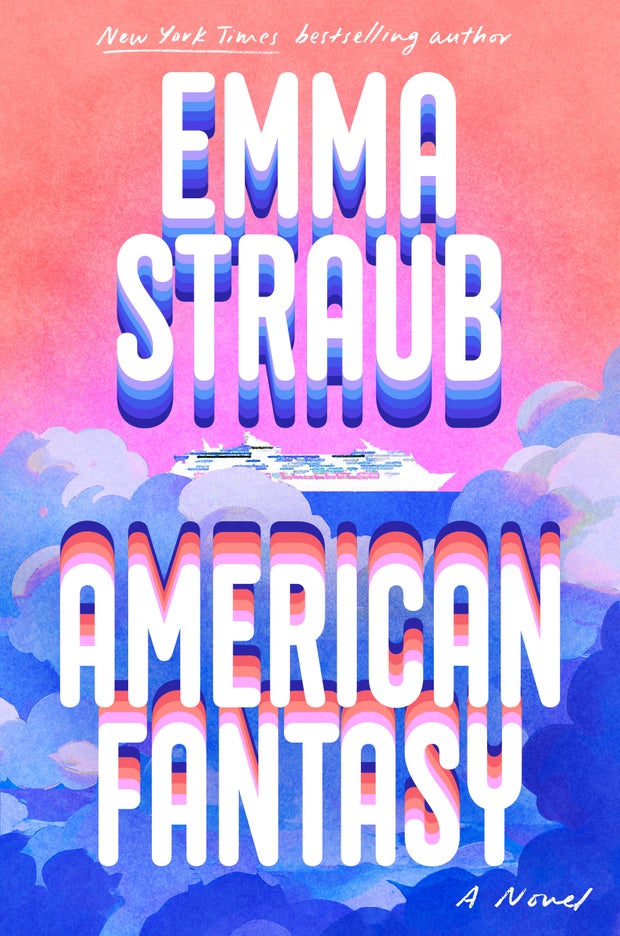
From the publisher: When the American Fantasy cruise ship sets sail for a four-day themed voyage, aboard are all five members of a famous, nineties-era boy band and three thousand screaming women who have worshipped them since childhood.
Feeling slightly out of place amid this crowd is Annie, here on a lark to appease her sister. Yet when the lights come up and the idols of her youth begin to sing, something is unlocked. Call it memory. Call it nostalgia. Call it the chemical reaction of hormones, hope, and sexual reawakening. Between the slushy alcoholic drinks, the familiar music, and the throngs of middle-aged women acting like lovesick teenagers, Annie finally reconnects to a long-submerged part of herself. By the time she meets one of the band members—not just a celebrity but someone in need of a friend—she has accessed a new sense of possibility.
Emma Straub lives in Brooklyn.
"American Fantasy" by Emma Straub (ThriftBooks) $23
Excerpt: "American Fantasy" by Emma Straub
The music cut off, and Shawn's voice came through the speakers. "All right, all right. It's game time!"
The Talkers roared.
Boy Talk appeared one at a time in the same spot on the balcony, each guy in turn blown up on the screen above his own head. Terrence was dressed in a giant yellow onesie—a Pokémon. Pikachu! Annie rescued its name from the depths. Annie remembered one staging of Puccini's Turandot where the emperor had been lowered from the ceiling. This was like that, but furrier. Scotty came out next in a similar suit but bluish‑green. "Snorlax!" a younger Talker shouted from over Annie's shoulder. Keith and Corey came out together, dressed in matching white pants and T‑shirts with giant red R's on their chests, Keith in a purple wig and Corey in a pink one.
"Who are they?" Annie asked.
"They're the bad guys!" Maira shouted. She knew everything and was willing to share her knowledge. Maira's purple and blue streaks twinkled in the lights from the tiki bar, and Annie was glad that women her age had started dyeing their hair funky colors again instead of just coloring the grays, and she was about to say so when Annie realized that she was already drunk, and so she probably shouldn't say everything that crossed her mind.
Keith moved into the center of the balcony, posing and laughing. Whose job was it to come up with their costumes? Shawn jumped in behind Keith and Corey dressed as a shirtless Ash Ketchum, a child. Shawn flexed, and at the foot of the stairs, two women dressed like sexy Ash Ketchums, their costumes even skimpier than Shawn's, jumped up and down, and then Shawn rushed down the stairs to greet them and pulled them onto the small stage with him. DJ Pancake played Madonna's "Like a Prayer," and all three Ashes jumped up and down, mouthing the words. Shawn's showmanship was unmatched. The boys at her high school who had had big personalities had always seemed too scary, too popular for her to have a crush on, but Shawn was far enough away that she could pretend.
Keith seemed to be enjoying his purple wig, which was long and fluffy like a guitar player in a different kind of '80s band. Keith twirled the edges in his fingers and flipped the long part back and forth over his shoulder. He was laughing with Scotty and with Shawn. It was funny to think about them as adult men who had actual relationships with each other, relationships that existed in private and not printed on the side of a lunch box. Most of the guys had cups in their hand—the idea, according to Katherine, was that the guys were all somewhere on the tipsy‑to‑wasted continuum at these parties, but Annie didn't buy it, not looking at them. They were working, and on these nights, their job was to look like they were having the best time they'd ever had so the women would think that they were having the best time they'd ever had. After all, it was what Shawn had promised them.
Keith turned toward Annie—toward her section—and waved. Without even meaning to, Annie waved back. She was surrounded by other people who were waving back, of course, everyone was waving and screaming, their hands in the air, but still, she was embarrassed. It felt like too much, like stalkerish behavior, even though they were literally all waving back, the entire audience, they could not leave unless they jumped off the ship and started to swim back toward Florida. Keith, of course, wasn't actually paying attention to her. He was dancing goofily to Madonna, pointing his fingers in the air like a real middle‑aged dad. He had never been a good dancer—that was ammunition for sisterly arguments for years, that Shawn was a better dancer than Keith, and it was obviously still true. He was rocking his hips side to side, almost like bouncing a baby to sleep. Keith pointed kindly at a woman's home-made sign and smiled. He seemed like a nice man. Annie took out her phone and snapped a few pictures for Katherine.
So often, the word nostalgia felt coated in bile—a nostalgia act. Annie understood and she didn't. Nostalgia was for the Smurfs, for erasers that smelled like strawberries. Maybe that was what the costumes were about, the goofy T‑shirts, but inside her head, which is where she heard the music, it had touched some lever so deep that it couldn't be reversed, as much as she'd chosen to ignore it. Maybe that was nostalgia after all, that the music was a direct vein to her own childhood, the least complicated part of her life. What had the research shown? A shortcut to happiness. Music made plants grow faster; it made cows give more milk. They meant Mozart and Puccini, sure, but why couldn't it also mean this?
There were so many people crammed into such a tight space. Shawn twirled around, hooking his arm around his brother's waist, and then they spun in circles, laughing, a square dance for two. All around Annie, women were dancing and singing, and for a second, she closed her eyes and thought, No one else will ever understand this, except of course everyone standing beside her, who all understood it perfectly. This was why people turned to religion or watched the Super Bowl at a sports bar instead of alone in their living room. It felt good to be a part of something where your passion was celebrated instead of mocked. They were all in this together, the men and the women, a symbiotic organism. Annie was tired, but she knew that there was no going to bed, not yet.
Excerpted from American Fantasy by Emma Straub. Copyright © 2026 by Emma Straub. Excerpted by permission of Riverhead, an imprint and division of Penguin Random House LLC, New York. All rights reserved. No part of this excerpt may be reproduced or reprinted without permission in writing from the publisher.