Former Gov. George Pataki looks back at 9/11 attacks and the critical decisions he had to make

As governor of New York on Sept. 11, 2001, George Pataki was responsible for many of the decisions being made at the highest level of state government, including activating the National Guard, coordinating with New York City Mayor Rudy Giuliani, and later spearheading the rebuilding of Ground Zero into the version of Lower Manhattan we know today.
CBS News New York's Jessica Moore recently sat down with Pataki and he reflected on that somber day and spoke about what he wants future generations to know about New Yorkers.
"Seamless response" key to immediate aftermath of 9/11 attacks
Pataki, now 81, said the first thing he remembers about 9/11 is one that has been seared into his memories for the last 25 years.
"I can see an image of the towers on fire and it just breaks my heart to think of that, and it gets me angry to think of the people we lost that day," Pataki said.
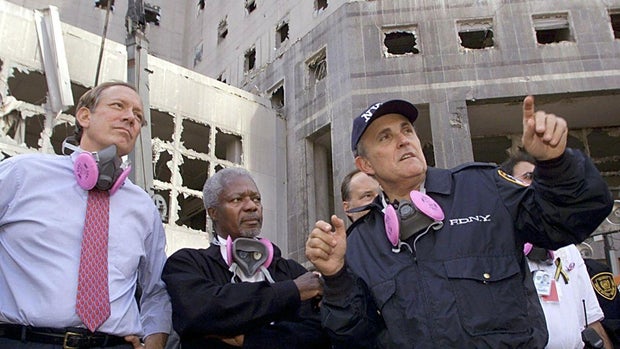
He said perhaps the most difficult emotional moment was when, "I walked the streets of Lower Manhattan and I went to a hospital near Ground Zero, where there were gurneys lined up outside with doctors waiting to treat the injured, and there weren't any injured."
Pataki, who served as the state's chief executive from 1995-2007, said the most important decision he made that day was to combine the state and city responses and to stay in Manhattan despite orders to evacuate to the emergency bunker upstate.
"I had police outside saying you have to leave. We're going to get a helicopter to fly to Albany to the bunker. I said, 'I can't do this,'" Pataki said.
When asked why, he said, "It was to make clear that if the governor is fleeing from city to the underground bunker in Albany, what message does that send? Are we to live in fear?
"From that afternoon on, we were in the same room at the same table. The city on one side, the state on the other side, and that evening, FEMA, the feds came in and they were at the end of the table, so there was never any miscommunication. We had a seamless response at all three levels of government," Pataki said.
Pataki led charge to rebuild Lower Manhattan after 9/11 attacks
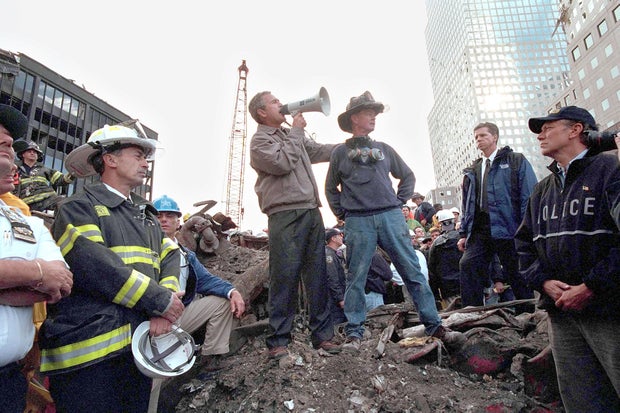
Soon, Pataki would be photographed on the pile at Ground Zero with then-President George W. Bush, captured in one of the most iconic images from that day. He said he had no idea how consequential that image would be.
"You know, I don't think any of us really knew the consequences other than we were not going to let the terrorists get away with that," Pataki said.
He is perhaps best known for his commitment to rebuilding Ground Zero into the version we know today, collaborating with architect Daniel Libeskind to create a lasting legacy.
"I wanted future generations to be able go there and have a sense of the magnitude of these attacks," Pataki said. "It's one thing to see something on television. It's another thing to stand at the sites of the footprints and see how large those towers were, and see the voids where they had soared [as] the tallest buildings in America. And then to see the names of every single person who died that day, tells you about the humanity of the loss.
"But then right next to it is the Freedom Tower. There were those who were saying we can't build tall, and early on I thought we weren't just going to go back to where we were. We're going to want to show the world that we're New Yorkers, we're Americans. We're going to rise to new heights," Pataki added.
How Pataki hopes Americans view 9/11 in another 25 years
The former governor said it's still difficult emotionally to make the trek to Lower Manhattan.
"Twenty-five years later, it's very hard for me and I dread being there. What I feel is nothing like the pain of someone who lost their son or daughter. I just think of myself as someone who was fortunate enough to have the opportunity to lead on that day and has the ongoing obligation to try to respect the suffering that those who lost a loved on that day still feel," Pataki said.
In 2051, it will be half a century since that awful day. Most of the people who experienced it will be gone. Pataki said he's hopeful Americans will still view it as they have for the last 25 years.
"I hope they appreciate the courage with which New Yorkers responded," Pataki said. "The horror will never go away, but what people might forget are those 343 firefighters who ran into the towers, the construction workers who left their jobs and went to Ground Zero, not because someone told them to but they thought they could help cut through the rubble and save lives. People will understand the terrible loss, but they might forget the tremendous courage and strength with which we responded as New Yorkers and Americans that day."
Pataki said educating future generations on 9/11 is vitally important, not only to understand the loss to but to appreciate the value and fragility of the freedoms we enjoy.


