How much snow did Minnesota get during latest storm? See totals from Minneapolis and across the state.
A winter storm that moved into Minnesota on Tuesday is wrapping up Wednesday morning after dropping several inches of snow on parts of the state.
According to the National Weather Service, 4.1 inches fell at Minneapolis-St. Paul International Airport during the storm. Chanhassen saw 3.5 inches, while St. Cloud got 5.9 inches. Residents of Eau Claire, Wisconsin, are shoveling out from under 5.6 inches.
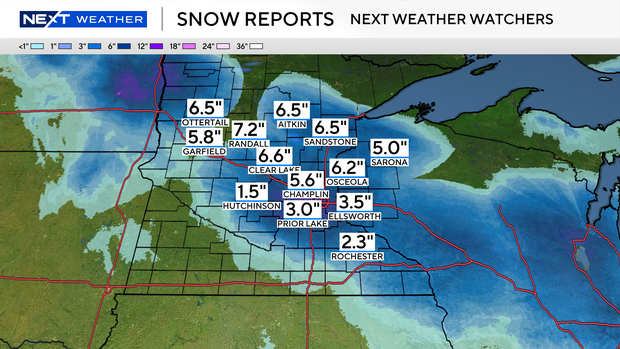
WCCO's Weather Watcher Network reported some impressive totals, too. Here are some measurements from around the state:
- Rock Creek: 8 inches
- Nevis: 7.5 inches
- River Falls: 7 inches
- Shafer: 6.5 inches
- Sandstone: 6.5 inches
- Bertha: 6.4 inches
- Osceola: 6.2 inches
- Foley: 6 inches
- Champlin: 5.6 inches
The storm caused dozens of Minnesota schools to close or delay their start on Wednesday. It also slowed and snarled the morning commute and prompted snow emergencies in several cities.
After the snow moves out, colder air will move in. By Thursday, highs will be in the teens, and over the weekend, the Twin Cities will top out near zero, with wind chills well below that.
There's hope on the horizon, though, as temperatures are expected to warm back above normal early next week.
A very snowy start to the season
Tuesday's storm was one of the bigger systems Minnesota has seen so far this season, and is on par with the active pattern the metro has been seeing since Thanksgiving.
The metro has had at least flurries on eight of 10 days so far in December, and 12 out of the last 16 days going back to the end of November.
Through midnight Wednesday, the metro snowfall total is 14.6 inches for the season. That's 3.7 inches above average to date.
It's about half of what the metro received all season last year and the year before, which were 29.4 inches and 29.5 inches, respectively. The average snowfall in a season is 51.2 inches.
And it's not just Minnesota and Wisconsin that are dealing with all this snow. It's all across the northern tier of the United States. In fact, 27% of the country, in terms of area, now has at least some amount of snow coverage — the most snow coverage in the U.S. on this date since 2022.


