National Recording Registry adds Taylor Swift, Beyoncé, Ray Charles and more. See the 2026 list.
The Taylor Swift album "1989," and Beyonce's "Single Ladies (Put A Ring On It)," along with music by Ray Charles, Gladys Knight and the Pips, Paul Anka, and the original cast album of "Chicago" are just some of the latest recordings to be added to the Library of Congress' National Recording Registry.
On Thursday, the Library announced 25 recordings are being added to the Registry, its collection of audio to be preserved for future generations. This year's inductees, which represent our nation's artistic, cultural and historic heritage, span such genres as jazz, rock, pop, country, R&B and Broadway, as well as radio and video games.
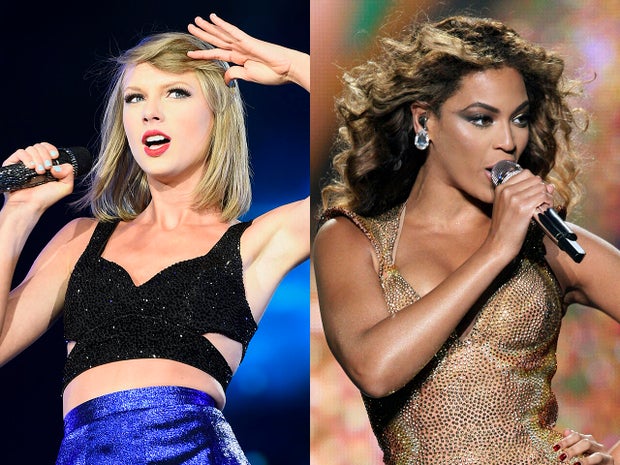
The most recent recording on this year's list is Taylor Swift's 2014 album "1989," the pop icon's fifth studio album, which won album of the year and best pop vocal album at the Grammys. The only other selection from the 21st century is Beyoncé's 2008 hit "Single Ladies (Put a Ring on It)."
This year's additions include works by country music legends The Charlie Daniels Band, Vince Gill, Reba McEntire and Rosanne Cash; R&B star Chaka Khan; the groundbreaking '80s band The Go-Go's; and jazz musician Oliver Nelson. Also among the picks: José Feliciano's holiday classic "Feliz Navidad;" Weezer's debut album; and The Byrds' classic "Turn! Turn! Turn! (To Everything There Is a Season)."
Broadway is represented by the original cast album of the long-running musical "Chicago," and video games by the soundtrack of the demonic role-playing game "Doom."
The recordings added this year bring the number of titles on the Registry to 700 — just a portion of Library of Congress' recorded sound collection of nearly 4 million items.
Read about this year's 25 additions and listen to audio samples below — and find out how you can nominate titles to be added in the future.
2026 National Recording Registry additions (in alphabetical order)
"1989" – Taylor Swift (2014) (album)
Taylor Swift surprised many with this album as she shifted away from the country genre. While some working with Swift suggested she include a few country songs on her fifth studio album, she was against it. "A big goal of mine was to make this album very sonically cohesive," Swift told "CBS This Morning" in 2014. "So, if I were to put a fiddle on a version of 'Shake It Off' and service it to country radio, that would've completely shattered the entire idea I had that this album was going to have its own sound."
"1989" had three #1 songs ("Shake It Off," "Blank Space," and "Bad Blood") as well as the hits "Wildest Dreams," "Style," "Out of the Woods" and "Wildest Dreams." Rolling Stone described the album as "deeply weird, feverishly emotional, [and] wildly enthusiastic."
"1989" was one of the albums for which Swift acquired rights to the master recordings from music executive Scooter Braun. It was re-recorded and released in 2023 as "1989 (Taylor's Version)."
PLAY: "Shake It Off" from "1989" by Taylor Swift
"Amen, Brother" – The Winstons (1969)
Hailing from Washington, D.C., the funk/soul group The Winstons had a Top 10 hit with their 45 rpm release of "Color Him Father," which would win a Grammy for best rhythm and blues song. But the song on the B side, "Amen, Brother," made the Registry thanks to a seven-second drum solo by Gregory Coleman. It would be a frequently sampled musical riff in recordings by N.W.A. ("Straight Outta Compton") Salt-N-Pepa, Aphex Twin and Oasis.
PLAY: "Amen, Brother" by The Winstons
"Beauty and the Beat" – The Go-Go's (1981) (album)
"Beauty and the Beat" was the debut album of The Go-Go's, one of the most successful all-female bands in rock 'n' roll history. The group had formed in 1978. "We came from the punk rock scene in L.A., where anything went and you could learn as you went along," Belinda Carlisle told "Sunday Morning" in 2018. "And we had no idea how to play our instruments or do anything."
She joined forces with guitarist Jane Wiedlin, drummer Gina Shock, bassist Kathy Valentine, and guitarist Charlotte Caffey, who was trained in classical piano. Caffey said, "I was in awe, I was a little scared of them. But it was kind of exciting! They were the cool girls that were punky. And I was kind of more, like, you know, reserved and straight. Kind of."
According to Carlisle, record executives wouldn't sign them "because we were women, or girls."
But the "girls" made it happen. Written, arranged and performed by women, "We Got the Beat" became The Go-Go's first hit in England and then in the U.S. It reached #1 on the Billboard chart and spawned the hits "We Got the Beat" and Our Lips Are Sealed."
PLAY: "We Got The Beat" by The Go-Go's
"The Blues and the Abstract Truth" – Oliver Nelson (1961) (album)
Jazz musician Oliver Nelson was inspired by concert composers Aaron Copland and George Gershwin for his landmark 1961 album, which is today considered an essential post-bop recording.
PLAY: "Stolen Moments," from "The Blues and the Abstract Truth" by Oliver Nelson
"Chicago" Original Cast Album (1975)
Composer John Kander and lyricist Fred Ebb had collaborated on several shows, and had won Tony Awards for their 1966 musical "Cabaret," before they teamed up with director Bob Fosse on the 1975 production "Chicago." Set in the jazz age, and based on a story about women accused of murder, it starred Gwen Verdon, Chita Rivera and Jerry Orbach, and featured such songs as "All That Jazz," "Cell Block Tango," "Roxie," "When You're Good to Mama," "Razzle Dazzle," and "We Both Reached For the Gun."
Critics were dismissive of "Chicago" when it opened in 1975. Nominated for 11 Tonys, it won zero. But a 1996 revival is still running three decades later — the longest-running show currently on Broadway — and led to an Oscar-winning film adaptation.
John Kander talked with "Sunday Morning" in 2015 about the most satisfying part of songwriting: "I think the moment when the musical moment is finished, when something in you says, 'That's true,' that's the big one for me," he said. "It doesn't happen all that often."
PLAY: "All That Jazz," from the original cast album of "Chicago"
"Cocktails for Two" – Spike Jones and His City Slickers (1944)
In the 1940s and '50s Spike Jones recorded a slew of novelty songs, from "My Old Flame," "Hawaiian War Chant," "All I Want for Christmas (Is My Two Front Teeth)" and "Der Fuhrer's Face" (a slap in the face to fascism), to "Cocktails for Two," which was originally written in the '30s following the repeal of Prohibition. Spike Jones and His City Slickers recorded their version with a flurry of wacky sound effects that made the inebriation seem even more soused.
PLAY: "Cocktails for Two" by Spike Jones and His City Slickers
"The Devil Went Down to Georgia" – The Charlie Daniels Band (1979)
The Charlie Daniels Band's album "Million Mile Reflections" had many things, but Daniels realized late in the game it did not have a fiddle. So, he quickly penned this devilish ditty about the Devil looking for a soul to steal. Daniels himself played the satanic fiddle solo.
Daniels donated one of the fiddles he used to perform "The Devil Went Down to Georgia" to the Country Music Hall of Fame. At least Ol' Scratch didn't get his claws on it.
PLAY: "The Devil Went Down to Georgia" by The Charlie Daniels Band
"Doom" Soundtrack – Bobby Prince, composer (1993)
Three years ago, the theme music from the Nintendo video game Super Mario Bros. was inducted to the National Recording Registry. Last year, composer and sound designer Daniel Rosenfeld's synthesizer for "Minecraft — Volume Alpha" joined the list. This year comes Bobby Prince's music for the RPG blockbuster "Doom," which used MIDI technology to craft a soundtrack inspired by heavy metal bands like Metallica and Alice in Chains.
PLAY: "The Imp's Song" from "Doom" by Bobby Prince
"Feliz Navidad" – José Feliciano (1970)
José Feliciano's "Feliz Navidad," which debuted in 1970, has become part of the pantheon of Christmas ballads:
Feliz Navidad
Feliz Navidad
Feliz Navidad
Próspero año y Felicidad
I wanna wish you a merry Christmas
I wanna wish you a merry Christmas
I wanna wish you a merry Christmas
From the bottom of my heart
He told "Sunday Morning" in 2020 that he'd set out to make a Christmas song that was bilingual: "We thought there's gotta be a way of teaching the American people Spanish," he said, "and I decided, let's see if we could cross that bridge. And we did."
But it wasn't a hit right away. Feliciano said, "First, people had to get used to it. Then the year after, it caught on big." It has since been inducted in the Grammy Hall of Fame.
PLAY: "Feliz Navidad" by José Feliciano
"The Fight of the Century: Ali vs. Frazier" (March 8, 1971) (broadcast)
Boxing announcers Van Patrick and Charles King pulled no punches when they broadcast round-by-round coverage of the "Fight of the Century," the Muhammad Ali-Joe Frazier title match in 1971. Fight organizers had blocked live radio coverage from Madison Square Garden — it was to be broadcast by satellite to venues for paying customers — but the Mutual Broadcasting System successfully brought Patrick and King, who offered summaries of each round, not from ringside, but from their base camp at a nearby hotel. (Spoiler alert: After 15 rounds, Smokin' Joe defeated The Greatest in a unanimous decision.)
PLAY: Excerpt from the Frazier-Ali fight radio broadcast
"Fly Me to the Moon (In Other Words)" – Kaye Ballard (1954)
The Bart Howard standard "Fly Me To The Moon" would become indelibly linked with Frank Sinatra. But its first recording in 1954, with the original title "In Other Words," was by cabaret singer and comedian Kay Ballard. It would later be covered by Connie Francis, Peggy Lee, and instrumentalist Joe Harnell.
PLAY: "In Other Words" by Kaye Ballard
"Go Rest High On That Mountain" – Vince Gill (1994)
Virtually self-taught, Oklahoman Vince Gill mastered the guitar while he was still in high school. He told "Sunday Morning" in 2003 that, even from a young age, he never worried about making a living: "I played well enough so that I can do a little bit of everything. And I'll always have the ability to work."
He started in bluegrass and country, then moved to California to join a rock group called Pure Prairie League. But he quit because he disliked touring, and moved to Nashville. After a few false starts, he hit #1 on the country chart in 1990 with "When I Call Your Name."
To date, Gill has won 22 Grammy Awards, including two for "Go Rest High On That Mountain." He told "Sunday Morning" that the song is precious to him because he wrote it for his older brother, Bob, who died of a heart attack. The song has since become common at memorial services.
I know your life on earth was troubled
And only you could know the pain
You weren't afraid to face the devil
You were no stranger to the rain
So go rest high on that mountain
Son, your work on earth is done
Go to heaven a-shoutin'
Love for the Father and the Son
PLAY: "Go Rest High On That Mountain" by Vince Gill
"I Feel For You" – Chaka Khan (1984)
Chaka Khan's 1984 cover of the Prince song "I Feel For You" opened with rapper Melle Mel chanting the name of the song's lead singer:
Chaka Khan, let me rock you
Let me rock you, Chaka Khan
Let me rock you, that's all I wanna do
Khan told "Sunday Morning" in 2023 that the opening embarrassed her: "I didn't like anybody saying my name over. I said, 'I gotta live with this.'" She did, and so did the world; "I Feel For You" was on the Billboard Hot 100 chart for 26 weeks, peaking at #3. It won two Grammys, for best R&B song and best female R&B vocal performance.
PLAY: "I Feel For You" by Chaka Khan (feat. Melle Mel)
"Mambo No. 5" – Pérez Prado (1950)
The popularization of the mambo outside Cuba can be attributed to bandleader Pérez Prado, who earned the nickname "King of the Mambo." His original recording of "Mambo #5" for RCA Victor began a successful career that included his #1 hit "Cherry Pink (and Apple Blossom White)."
PLAY: "Mambo No. 5" by Pérez Prado
"Midnight Train to Georgia" – Gladys Knight and the Pips (1973)
The R&B/soul act Gladys Knight & the Pips recorded several hits for Motown, including "I Heard It Through the Grapevine," "Everybody Needs Love," and "Neither One of Us (Wants to Be the First to Say Goodbye)"), before moving to Buddah Records. Their 1973 hit "Midnight Train to Georgia," from the album "Imagination," won the group a Grammy for best R&B vocal performance by a duo, group or chorus.
PLAY: "Midnight Train to Georgia" by Gladys Knight and the Pips
"Modern Sounds in Country and Western Music" – Ray Charles (1962) (album)
Singer and pianist Ray Charles showed evidence of his musical gifts as a child, before he lost his sight. He learned Chopin and started off in a hillbilly band, and would become an icon of blues in the latter half of the 20th century.
"There's only two kinds of music as far as I'm concerned: good and bad," Charles told "Sunday Morning" in 2003. "I just sit there and get into the groove of what the music is dictating. If it's dictating country sounds, that's where I go. If it's dictating jazz, that's where I go. If it's dictating the blues, that's where I go. In other words, I follow where the music leads me."
That catholic taste in music is what led to his 1962 studio album, "Modern Sounds in Country and Western Music." Eschewing the R&B, jazz and blues he'd recorded prior, Charles channeled country hits by the likes of Hank Williams, Don Gibson, Eddy Arnold and the Everly Brothers. It featured such tracks as "I Can't Stop Loving You," "You Don't Know Me," "Careless Love" and "Born to Lose." The album went gold, hitting #1 on the Billboard charts, and gave birth to a sequel, "Modern Sounds in Country and Western Music Volume Two."
PLAY: "I Can't Stop Loving You" by Ray Charles
"Put Your Head On My Shoulder" – Paul Anka (1959)
Beginning in show business at the age of 10, singer and songwriter Paul Anka has landed on Billboard's Hot 100 Chart seven straight decades. "Put Your Head On My Shoulder" was one of Anka's three Top 5 hits in 1959, when he was one of the most popular teen idols on the jukebox.
He made the leap from teeny bopper to crooner, and performed regularly with such stars as Dean Martin, Sammy Davis Jr., and Frank Sinatra, for whom Anka wrote what might be his most famous song, "My Way."
Anka talked about his endurance earlier this year with "Sunday Morning": "When you started as I did as a kid with a squeaky little voice, not knowing what's gonna happen when it changes, I couldn't envision me being around for all these decades, you know?"
PLAY: "Put Your Head On My Shoulder" by Paul Anka
"Rumor Has It" – Reba McEntire (1990)
"Rumor Has It" has been recognized as an artistic triumph for country artist Reba McEntire. Working with producer Tony Brown, the Country Music Hall of Fame singer-songwriter's 16th album featured the hits "Fallin' Out of Love, "You Lie," and "Fancy," a reworking of Bobbie Gentry's 1969 classic.
PLAY: "Fancy" by Reba McEntire
"Single Ladies (Put a Ring on It)" – Beyoncé (2008)
She became Billboard magazine's Female Artist of the Decade. But Beyoncé, formerly a member of Destiny's Child before becoming a singularly historic solo artist, told "The Early Show" in 2010 that her success — from the concert stage to the Grammy stage to placing #4 on the Forbes list of entertainers — was hard earned. "I didn't wake up and become famous," she said. "I started out without a tour bus, having the seat in the back of the awards show, at the Grammys. And every year, gradually we had to work and we became stronger and more people acknowledged us. But it was a lot of tears, a lot of sacrifice, a lot of hard work that went into my career."
Her 2008 double album "I Am … Sasha Fierce" molded together R&B and pop with electropop. It debuted at #1 on the Billboard chart, selling 10 million copies worldwide, and won five Grammys. The #1 hit "Single Ladies (Put A Ring On It)" won song of the year.
Don't treat me to these things of the world
I'm not that kind of girl
Your love is what I prefer, what I deserve
Here's a man that makes me then takes me
And delivers me to a destiny
To infinity and beyond
Pull me into your arms
Say I'm the one you want
If you don't, you'll be alone
And like a ghost, I'll be gone
PLAY: "Single Ladies (Put A Ring On It)" by Beyoncé
"Teardrops From My Eyes" – Ruth Brown (1950)
As a teenager, R&B singer Ruth Brown was a winner of Amateur Night at Harlem's Apollo Theater before she was signed by Atlantic Records. Her first hit was this Rudy Toombs song. Brown initially was reluctant to stray from her more familiar ballads, but this up-tempo piece ended up #1 on Billboard's R&B charts for 11 weeks
PLAY: "Teardrops From My Eyes" by Ruth Brown
"Texas Flood" – Stevie Ray Vaughan and Double Trouble (1983) (album)
Guitarist Stevie Ray Vaughan had already made a name for himself in the Texas blues/rock scene when he and his backing band Double Trouble unleashed their first album, "Texas Flood." In addition to the title track, the songs include "Love Struck Baby," "Pride and Joy," "Testify," "Rude Mood," "Dirty Pool," and "Lenny."
Vaughan, who died in a 1990 helicopter crash at age 35, was ranked among the greatest guitarists of all time, and was posthumously inducted into the Rock and Roll Hall of Fame.
PLAY: "Texas Flood" by Stevie Ray Vaughan and Double Trouble
"Turn! Turn! Turn! (To Everything There Is a Season)" – The Byrds (1965)
In 1959 folk singer Pete Seeger adapted the Book of Ecclesiastes into a musical cry for peace in "Turn! Turn! Turn!," which was recorded by both Seeger and The Limeliters. But it became a chart-topper when the folk-rock group The Byrds released their version in 1965. It was a song about seasonal changes that fit with the counter-cultural anti-war movement, hitting #1 on the Billboard chart, and it has since become a shorthand musical background for films and TV shows about the 1960s.
PLAY: "Turn! Turn! Turn! (To Everything There Is a Season)" by The Byrds
"Weezer (The Blue Album)" – Weezer (1994) (album)
The band Weezer (whose named was derived from a "cool" Little Rascals character) purposely did not fit the mold of other rockers in the early 1990s. "Rock bands were getting more and more outrageous with tattoos and piercings," singer Rivers Cuomo told "CBS Mornings" in 2024. "We came out completely clean-cut, four guys standing in a line, singing songs in major keys, about girls or whatever. It didn't quite make sense how that was the next step for rock and roll."
Weezer's breakout came with the release of the music video for "Buddy Holly." Directed by Spike Jonze, it helped catapult the band into the mainstream. "Coming out of grunge, which was pretty heavy and a little dark, it maybe was kind of refreshing for people at the time," Wilson said.
In addition to "Buddy Holly," Weezer's debut album (familiarly known as "The Blue Album" because of its blue cover) also featured "Undone – The Sweater Song," "Say It Ain't So," "My Name Is Joans," and "Only In Dreams."
PLAY: "Buddy Holly," from "Weezer (The Blue Album)" by Weezer
"The Wheel" – Rosanne Cash (1993) (album)
Rosanne Cash's 1993 album "The Wheel" was written in the space between the end of her marriage to singer Rodney Crowell and her relationship with her future husband, music producer John Leventhal. Songs included "Seventh Avenue," "Change Partners," "From The Ashes," "The Truth About You," "Tears Falling Down," "If There's a God On My Side," and the title track.
Rolling Stone praised the album's themes of "going through hell to emerge fundamentally changed."
PLAY: "Seventh Avenue" from "The Wheel" by Rosanne Cash
"Your Love" – Jamie Principle (1986); "Your Love" – Jamie/Frankie Knuckles (1987)
An infectious house song from Chicago artist Jamie Principle and DJ Louise Gomez, "Your Love" was later revised by Frankie Knuckles, with vocals by Adrienne Jett, producing a groundbreaking electronica dance track.
PLAY: "Your Love" by Jamie Principle
Visit the Library of Congress website for more information about the National Recording Registry, and find out how you can nominate recordings.