Can meteorites be recovered from Cape Cod Bay? Harvard professor says "it's just like a fishing expedition"

The Big Bang may have started the universe, but the big boom off the coast of Massachusetts has started a viral tsunami. A meteor exploded over the Cape Cod Bay causing a sonic boom that could be heard and felt from states away.
"It was moving at 100 times the speed of sound when it exploded as a result of friction on air," said Avi Loeb, a Harvard professor and an astrophysicist and theorist.
Loeb said the meteor exploded at an altitude approaching 40 miles in the air. NASA says it was five feet in diameter and was traveling 42,000 miles per hour.
"The explosion released 300 tons of a TNT equivalent amount of energy which amounts to 2% of the Hiroshima atomic bomb energy," said Loeb.
NASA said meteorites landed in Cape Cod Bay, and radar data predominantly shows they ranged from 40g to multiple kilograms. Believe it or not, meteorite landings are common, but the odds of being struck by a fragment on land are slim.
"Such explosions happen every couple of weeks on the entire earth," Loeb said. "There's an impact of a 1-meter scale rock every couple of weeks. Most of earth, 71%, is covered with oceans, so we don't hear about it."
The Dolan family in Gloucester, Massachusetts is the exception. They spoke to WBZ last year, when an object struck the side of their home and shattered into pieces. The rocky material smelled of sulfur.
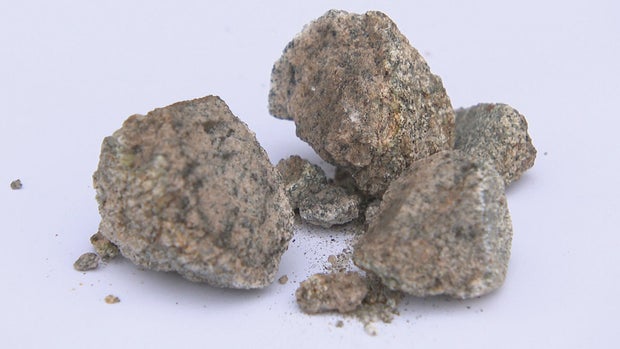
"I am picking them up and I am looking around and I'm like there is nobody here," said Sue Dolan during an interview last year.
A geophysicist analyzed photos and accounts of the incident and told WBZ that it is a meteorite. The Dolan's also heard this weekend's sonic boom noise, but they say it was nothing like the boom from the meteorite that struck their home. They are still looking for a university or organization to analyze it.
There may also be people looking to get their hands on the meteorite that landed in the bay. It is possible to pull up a fragment using a magnet, but hunters are going to have to be extremely lucky. Loeb searched in the Pacific for the remains of an interstellar meteor. It took a team of scientists two weeks using a sled of magnets to come up with tiny metallic spherules from the meteor.
"It needs to be quite an extensive operation; however one can be lucky. It's just like a fishing expedition," said Loeb. "The most abundant fragments are less than a millimeter in size."
Here's to happy hunting.


