Meteorite heard in Massachusetts landed "right in the middle of Cape Cod Bay," NASA says
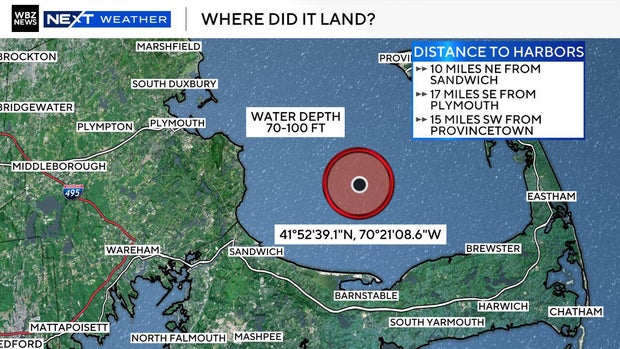
The meteorite that caused a sonic boom heard throughout Massachusetts on Saturday landed "right in the middle of Cape Cod Bay," NASA researchers say.
Initially reported as a meteor that exploded about 40 miles over New England, the space rock is now being classified as a meteorite because it reached the ground.
NASA said Monday the meteorite was about 5 feet in diameter and traveling about 42,000 mph. It's estimated to have weighed about 5.6 metric tons.
"The meteor traveled through the atmosphere from northwest to southeast for 26 miles before breaking up at an altitude of 31 miles and producing a meteorite fall into Cape Cod Bay," NASA said.
Weather radar out of Taunton detected debris over Cape Cod Bay at 64,000 feet, 49,000 feet and 4,000 feet. NASA was able to use that data to pinpoint the location of the meteorite in the water.
The likely debris field is about 10 miles northeast of Sandwich harbor, 17 miles southeast of Plymouth and 15 miles southwest of Provincetown. NASA says "most meteorites are strongly attracted to a magnet," raising the possibility that fragments could be retrieved from the bottom of the ocean.
"If you are a fisherman and you have a very strong magnet, it's likely sitting at about 70 to 100 feet deep in Cape Cod Bay," WBZ-TV meteorologist Jacob Wycoff said.
The fireball was seen and heard just after 2 p.m. on Saturday, releasing the energy equivalent of 230 tons of TNT as it entered Earth's atmosphere.
Shauna Edson, an astronomy educator for the Smithsonian National Air and Space Museum, told WBZ it's unlikely that anyone will find pieces of the meteorite because it landed in the water, but said they carry valuable clues about space.
"Meteors are the time capsules that carry information, so when we find pieces of them, each one is a treasure trove of information about the solar system," she said.
This story has been updated to reflect the latest information from NASA.


