How did the Blizzard of 2026 compare to the Blizzard of '78 in Massachusetts? Here's what the data shows.
During the Blizzard of 2026 in Massachusetts Monday, snow totals topped three feet and some were comparing this snowstorm to the historic Blizzard of '78.
If you look at the statistics, the comparison is still not even close. Here's the data showing how the two blizzards stack up against each other.
Blizzard of 2026 vs Blizzard of 1978
Let's start with snowfall.
Both storms had jackpots in parts of Rhode Island and southeastern Massachusetts. The snow jackpot zone in 2026 was located a tad farther south, but with similar numbers.
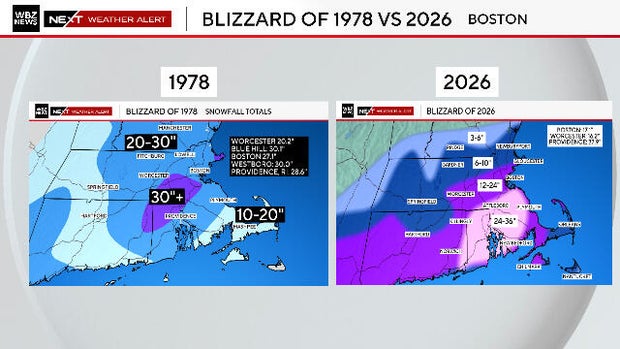
The Blizzard of 1978 dropped more snow over a wider area including in Boston, Worcester and areas well north and west.
For that reason, the Blizzard of '78 gets the checkmark.
Now to the wind.
At the storm's peak, winds gusted between 70-to-83 miles per hour in Massachusetts on Monday.
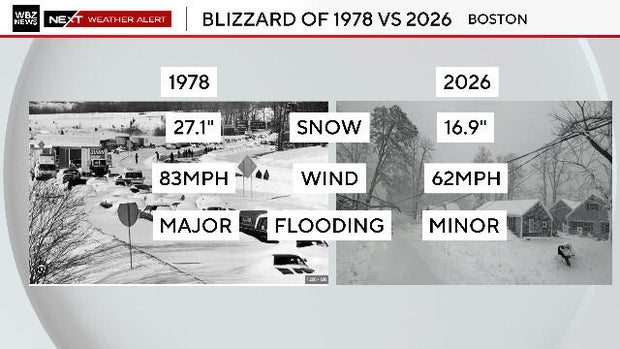
During the Blizzard of '78, peak gusts toped out at 110 mph in Scituate and 100 mph at Plum Island. Boston's winds peaked at 83 mph in 1978. They only reached 62 mph in the Blizzard of 2026.
The winds roared for nearly two full days back in 1978. On Monday, the peak lasted between 6 and 10 hours.
The Blizzard of '78 wins again.
Finally, we often measure our biggest nor'easters by the coastline destruction.
Monday's storm peaked at low tide and also moved very quickly only impacting one or two high tide cycles. Those impacts were largely classified as "minor" with pockets of moderate flooding.
In 1978, the coastal flooding was massive. The storm occurred during a supermoon with extremely high astronomical tides. Winds battered the coastline over four consecutive high tide cycles. Many coastal homes were either destroyed or washed away. The Atlantic Ocean literally poured onto the coastal roads and many residents had to resort to traveling by canoe down their main streets.
No comparison here, the Blizzard of '78 wins this in a landslide.
The weather forecast difference
Perhaps the biggest difference between 2026 and 1978 was the weather forecast.
Back in 1978, meteorologists had very little data to work with and therefore, the forecast for the storm wasn't great. Most folks went about their day going to school and work and then became stranded in the snow that came down at a rate of four inches per hour.

Flash ahead 48 years. We started alerting you to a possible nor'easter about a week in advance. Our first snowfall accumulation forecast map came out Friday evening and basically never changed. Schools began closing two days in advance and just about everyone worked from home, something else that didn't exist in 1978.
The bottom line is the blizzard of 2026 was a major blow to Massachusetts, one of the biggest and most powerful storms to impact southern New England in years.
However, it will largely remain out of the Massachusetts record books. Will we remember this storm in 10, 20, or 50 years?
Boston winter 2014-2015 vs. Boston winter 2025-2026
What about this winter? Will it be lodged in our brains like the winter of 2014-2015 in Boston? I'm not sure about that.
Here's a look at how that currently compares to this winter in Boston.
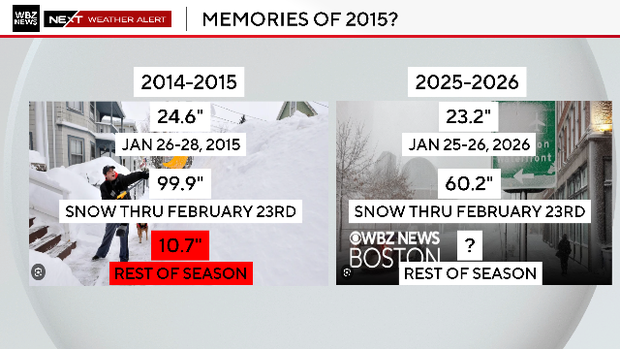
Both winters were frigid. The average winter temperature through February 23 this year is 29.1 degrees. It was 28.6 in 2014-2015, nearly identical.
Both winters had their first major snowstorm in late January.
Here's the difference. Boston had four major snowstorms in January and February of 2015, all with more than a foot of snow.
This winter we have had just two, but of course, we may not be done yet.