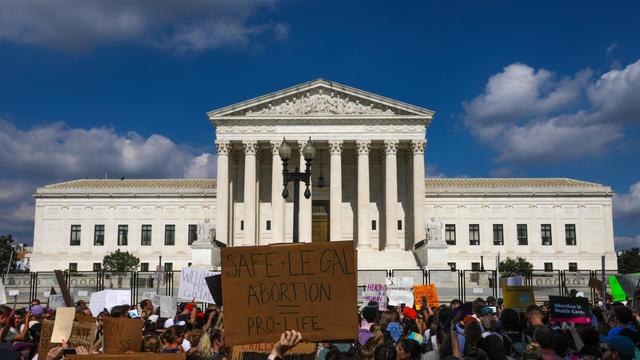
Focus shifts to "trigger laws" and state courts after Roe v. Wade is overturned
Judges in Louisiana and Utah temporarily blocked enforcement of trigger-law bans on abortion following the Supreme Courts' overturning of Roe v. Wade.
Watch CBS News
Judges in Louisiana and Utah temporarily blocked enforcement of trigger-law bans on abortion following the Supreme Courts' overturning of Roe v. Wade.

Chip Reid looks at what issues the Supreme Court could consider in the coming months, following the death of Justice Ruth Bader Ginsburg. Legal experts Kimberly Wehle and Jonathan Turley also join "CBS This Morning" to discuss the long-term implications of Ginsburg's death.
Experts say outcome of White House efforts to prevent its release could set tone for future attempts by former government employees to publish tell-alls.

Jonathan Turley, a CBS News legal analyst and George Washington University law professor, diverged from his fellow witnesses when he testified in front of the House Judiciary Committee on Wednesday. Turley, who was invited by Republican committee members, said that the Constitution does not allow a "boundless interpretation" of bribery and accused pro-impeachment lawmakers, including House Intelligence Committee Chairman Adam Schiff, of using a liberal definition of bribery that includes the exchange of meetings for political gain. Turley referenced the 1948 Supreme Court case McDonald v. United States in making his point. "You cannot take the bribery crime and use what they called a 'boundless interpretation,'" he said. "... You can't accuse a president of bribery and then ... say, 'Well, it's just impeachment. We really don't have to prove the elements.' … This isn't improvisational jazz. Close enough is not good enough."

Jonathan Turley, a CBS News legal analyst and George Washington University law professor, testified in front of the House Judiciary Committee on Wednesday that he strongly disagrees with one of the articles of impeachment against President Richard Nixon and, in turn, disagrees with its use as a basis for the impeachment inquiry into President Trump. "Citations have been made to the third article of the Nixon impeachment. First of all, I want to confess, I've been a critic of the third article of the Nixon impeachment my whole life. My hair catches on fire every time someone mentions the third article," Turley said. "Why? Because you would be replicating one of the worst articles written on impeachment." Turley added that, in order to give the impeachment process legitimacy, Mr. Trump should be allowed to fight requests from Congress in the courts. "In Nixon, it did go to the courts, and Nixon lost. And that was the reason Nixon resigned," Turley said.

After much discussion over bribery at Wednesday's House Judiciary Committee impeachment hearing, Michael Gerhardt of the University of North Carolina Law School testified that bribery is defined by Congress, not the courts. Congressman Cedric Richmond (D-LA) asked the witnesses to comment on testimony from another witness, Jonathan Turley, a CBS News legal analyst and George Washington University law professor, who asserted that using public office for personal gain is a "viable impeachable offense." After all three remaining witnesses affirmed Turley's statement, Gerhardt said, "Much talk has been made here about the term bribery ... It's your job, it's the House's job, to define bribery, not the courts. You follow your judgement on that."

Highlights and analysis of the impeachment inquiry against President Trump

Now that the special counsel's probe has ended, congressional and state investigations into the president's administration and business are expected to ramp up
Whatever Rudy Giuliani might say on Trump's behalf, it's still a question that divides legal scholars

"I happen to believe that the president can be indicted while in office," GWU law professor Jonathan Turley told "Face the Nation"
George Washington University constitutional law professor Jonathan Turley appeared on "Face the Nation" on Sunday, May 6, 2018

Lies and slander about public figures are nothing new, but social media make untruths and conspiracy theories more toxic and destabilizing than ever before