Tiffany L. Warren's new novel "A Harlem Wedding" reimagines the life of the 'princess' of the Harlem Renaissance
Please consider joining our Facebook group by CLICKING HERE.
Find out more about the books below.
Listen to the Club Calvi podcast by CLICKING HERE
Club Calvi has a bonus book, focusing on the little-known story of the 'princess' of the Harlem Renaissance during the 1920s. Yolande Du Bois grew up in a life of priviledge and pain as the daughter of civil rights icon W.E.B Du Bois. In "A Harlem Wedding," author Tiffany L. Warren reimagines Yolande's life leading up to, and after, her marriage. You can listen to the entire conversation on the THE CLUB CALVI PODCAST.
Warren says Du Bois's wedding was the event of the Harlem Renaissance.
"Three thousand people were in attendance, right here in New York City, in Harlem, at Salem United Methodist Church," Warren told Mary. "It was a historic moment in time. Du Bois married poet Countee Cullen, who was a prodigy. It was an amazing day. But it didn't go so well after the 'I Do's."
Warren's stories of her research fascinated Mary. She asked Warren about the one 'gem' that she discovered.
"It's amazing," Mary said.
"I had been reading Yolande's correspondence, and she had a very swirly script that she wrote her letters in," Warren explained. "When I Googled, I would see images of things she had written and I saw a scrapbook page. It was on eBay. Someone had gotten a storage locker where all of the papers were saved. I couldn't get it, of course. They were trying to sell it to an institution. The University of Massachusetts acquired the scrapbook. I was able to go and look through the pages of her life. There was one page that really stood out to me. It was a picture of her father, W.E.B. Du Bois. And she had written next to it, 'let me be worthy.' And that really is the story of her life, the conflict of her life, being worthy of her father's huge legacy that he planned out for her from the day she was born."
Warren says those words stuck with her.
"It was such confirmation that I captured the spirit of what Yolande was all about," Warren said. "She wanted to be worthy of her father, but she wanted also to chase her own dreams and her heart's desire. To see the love of her life, Jimmie Lunceford, pictures of him with little hearts underneath, it just made me feel so close to her even though she lived 100 years ago."
Mary noted that the love of Yolande's life was not the man she married.
"That's one of the conflict's of the book," Warren emphasized. "The love of her life was a jazz great, Jimmie Lunceford, who she met right before she went to Fisk University. They went to college together and they have such an amazing love story. But he was not the man that her father wanted for her. And is often the case with young women, they don't always stick to their father's plans."
Mary said that there was such drama in the story that she could understand why Warren wanted to write about Yolande Du Bois. Warren says she calls Du Bois 'the princess of the Harlem Renaissance.'
"Everything she did was a social moment," Warren said. "Every party. If she went to play bridge, it was in the newspaper."
Warren said she spent time in Harlem, visiting the places she learned about in her reasearch into Yolande's life. "I went to the homes, to the clubs where they dined and danced. I felt immersed in the culture, and I loved that."
You can read an excerpt and get the book below.
Club Calvi books may contain adult themes.
________________________________________________________________________________________________________
"A Harlem Wedding" by Tiffany L. Warren
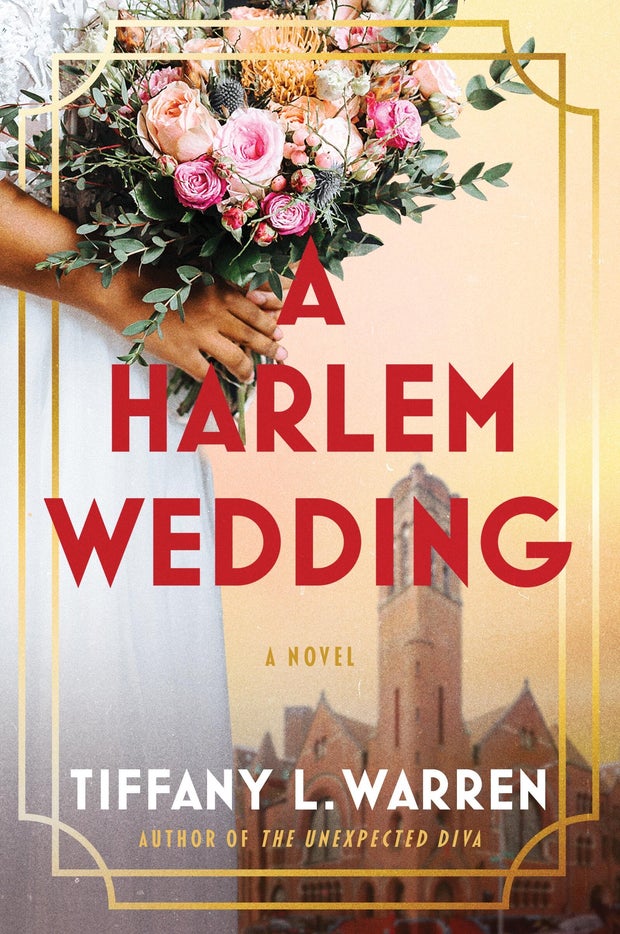
From the publisher: A century ago, Harlem's glittering social scene had a single princess: Yolande Du Bois, the only child of N.A.A.C.P. icon W.E.B. Du Bois. Yolande was bold, vivacious, and beloved of every gossip columnist. A true daddy's girl, Yolande followed her father's advice on everything: from where she went to college (Fisk—Papa's alma mater) to which sorority she joined (Delta Sigma Theta). But in matters of the heart, Yolande and her father did not agree. Dr. Du Bois himself curated a string of handsome suitors from the "Talented Tenth" for her, but Yolande's true love was jazz musician Jimmie Lunceford, son of a working-class family from far-off Denver, Colorado. Their romance was an open secret, and more than a little scandalous.
Despite it all, Yolande wound up marrying her father's choice: famed poet Countee Cullen. Their lavish uptown wedding was the hottest social ticket of 1928. With three thousand attendees, sixteen bridesmaids, and Langston Hughes as a groomsman, it was truly a sight to behold.
But, immediately after the wedding, Yolande's carefully constructed fairy tale begins to crumble. Torn between the expectations of her father and society and her heart's true desire, Yolande is forced to decide whether she must leave Harlem to create a more authentic life on her own terms.
Tiffany L. Warren lives in Maryland
"A Harlem Wedding" by Tiffany L. Warren (ThriftBooks) $17
_________________________________________________________________________________________________________
Excerpt: "A Harlem Wedding" by Tiffany L. Warren
April 1920
Brooklyn, New York
Papa says the only way for colored people to have equality is to agitate for it. Today his agitation includes my senior promenade at the Brooklyn Girl's High School. Since it concerns me, it would be nice if Papa cared about my wishes on these matters.
He. Does. Not.
I have no desire to protest about those white girls banning us from their little old dance. I'm perfectly fine with having our own private celebration, and I told Papa as much when I mentioned that the white students had voted on whether we'd be allowed to attend.
By an overwhelming majority it had been decided that us colored girls would be excluded from the dance. This surprised me, but maybe it shouldn't have, especially since we'd been denied a vote. Papa said we'd been disenfranchised.
As usual, when it comes to color line, I could fall out in the middle of the floor, scream or cry bloody murder, and it would make Papa no difference at all. He and his cronies were going to write their letters. This time to the principal, the superintendent, the mayor, God, and everybody else.
Now, Papa is fully energized after a dinner of roast beef and vegetables as he paces in front of the dining room table where Mama sits quietly. His trudging back and forth makes my insides tumble and my head pound, so I stay a safe distance away on the living room sofa. I wish I hadn't had that second slice of cake as now the entire meal rests too heavily in my stomach.
"I will have Jessie get the addresses of all the families with colored girls graduating," Papa barks in his typical, all-business, gruff way of speaking. "So that I can assure we are all aligned in this conflict." Mama looks up from the letter she's been reading all evening, perhaps annoyed at Papa's interruption, but if she is I cannot tell by her expression. Mama's serene smile is fixed upon her stunningly gorgeous face.
No matter what chaos Papa causes or chicanery I find myself embroiled in, Mama's smile hardly ever changes. It could be that her stoicism is the mark of a dutiful wife and mother. Or it could have something to do with the nerve pills she takes that she doesn't think I know about.
Besides, I don't know why Papa's discussing this with Mama anyway. He's decided the task of finding the parents' addresses is for Miss Jessie Fauset, his literary editor at The Crisis, not Mama. Because he's lumped this affair into the oppression of the people bucket, and Miss Fauset handles these kinds of things for Papa. The struggle things.
"Are you sure the other parents want to make such a big fuss about this, Will?" Mama asks, wringing her hands, already getting worked up about it.
I can see the lines of frustration on Papa's forehead as he furrows his brow, even though I think Mama's question makes plenty good sense. I know for certain that my best friend Margaret's parents aren't agitators. Her father runs a successful business and has both black and tan customers. He may not want to lose any money to one of Papa's protests.
"If they don't then they must be made to understand what's happening here," Papa says, his tone matching the exasperation on his face. "We cannot stand for any discrimination against our daughters. They have toiled at their studies as diligently as the white scholars and have paid their school fees."
I wish I could sink into the couch cushions and disappear. I may or may not have toiled very much. But it isn't my fault.
From A HARLEM WEDDING by Tiffany L Warren. Copyright © 2026 by Tiffany L Warren. Reprinted by permission of William Morrow, an imprint of HarperCollins Publishers.