Nonprofit Sing for Hope, borne out of 9/11, continues to unite people in times of despair, 25 years later

In the days following the Sept. 11, 2001, terror attacks, two Juilliard students felt an overwhelming need to do something to help.
They took their talents to the streets and sang and their voices were considered rays of light on the darkest of days.
This is the origin story of Sing for Hope, a nonprofit that has used art to create a better world for 25 years and counting.
Violinist Ali Bello and pianist Alec Castro recently shared their talents at New York City Health + Hospitals Jacobi North Central Bronx, filling the halls with soothing music. The program was orchestrated by Sing for Hope.
Castro said he first learned of the nonprofit in 2011, when he sat down to play a Sing for Hope piano in Columbus Circle. Years later, he performs with the organization.
"It's an amazing connection," Castro said. "We all deserve music and Sing for Hope brings that to the regular person."
The musicians performed for the very first time in the days following 9/11.
"People were posting about their missing loved ones and that's something I'll never forget because everywhere you looked was a 'missing' poster," said Monica Yunus, co-founder of Sing for Hope.
The role of the musician after 9/11
Yunus and co-founder Camille Zamora said they were both sopranos studying at Juilliard when the towers fell. Engine 40/Ladder 35, the firehouse just around the block, responded and lost 12 men, leaving the musicians to contemplate if they had a role to play.
"What is the role of a musician? What is the point of music at a time when it feels like the world is ending?" Zamora said.
They rallied friends and sang what they call "songs of solace" outside of the firehouse.
"To do something with the deep, deep sorrow that we were feeling and also hopefully to give someone else a feeling that they were not alone in their waiting," Yunus said.
"I think in that moment we realized there really is a role for music in times of crisis," Zamora added.
Sing for Hope became so much more in the years that followed.
"We like to say that Sing for Hope is sort of an arts Peace Corps. We use the arts to drive deliverables of healing and learning and connection," Zamora said.
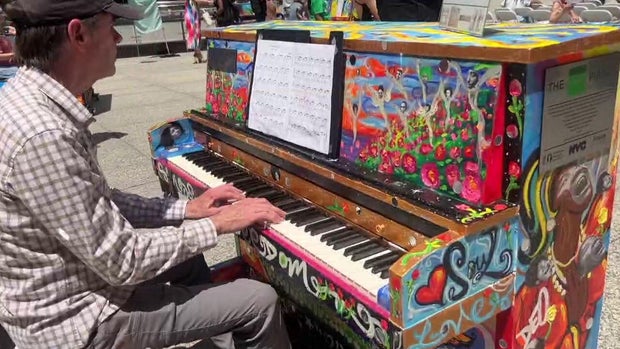
The nonprofit pays professional artists to meet us where we go about our daily lives, including at train stations, schools, and hospitals.
During the COVID-19 pandemic, Sing for Hope sponsored 125 days of programming at the Jacob Javits Center. The music was meant to soothe the thousands who showed up to get vaccinated and those administering the shots. It was a win for the artists, too, with so many out of work for months.
"We were able to meet that need with paid opportunities for them to pick up their instruments," Yunus said.
"We love these tangible playable symbols of what we do," Zamora added.
Sing for Hope pianos are in all 5 boroughs
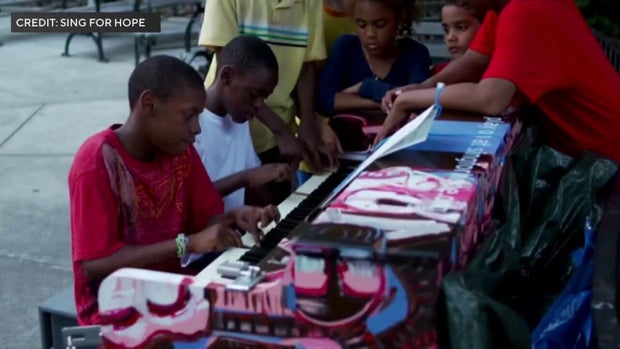
Each Sing for Hope piano, adorned with unique, masterful artwork, has brightened our city scape since 2010. You can spot them in public spaces in all five boroughs and around the world, too. All are invited to play.
Ten-year-old Jacob De Los Reyes did exactly that and wowed.
"It's awesome because you get to share the joy of music," De Los Reyes said.
"One of the proudest things that I think we did was honor the caregiver and that's really the basis of our work with New York City Health + Hospitals," Yunus said.
The long-standing relationship fosters a more holistic approach to healing, and it works, said Alisha Bronne, chief experience officer of Health + Hospitals Jacobi North Central Bronx.
"Music has been proven to reduce anxiety," Bronne said. "For maybe a brief moment, it helps our patients take their mind off what they're actually dealing with."
A piano on wheels means they can meet patients where they are in the hospital, or have it in the lobby for anyone passing through to appreciate.
"I do think, you know, the through line, even now to this moment, is that fact that music connects us," Zamora said.
"Music unites us," Yunus added.
Out of the ashes, the despair of 9/11, something beautiful emerged and continues to enrich the lives of thousands 25 years later.


