Author Sadeqa Johnson reveals little-known history behind "Keeper Of Lost Children," her new novel
Please consider joining our Facebook group by CLICKING HERE.
Find out more about the books below.
A new novel by bestselling author Sadeqa Johnson is shedding light on a little-known story of American history. The book "Keeper of Lost Children" is based on a woman who found homes for abandoned mixed-race children in Germany after World War II.
Mary Calvi asked Johnson about the inspiration for the story.
"Historical fiction is always finding a treasure," Johnson said. "I always say that stories choose me. I was tucked away at a writing retreat in Blue Ridge Mountains in Virginia. I was working on my previous novel 'The House of Eve.' I remember I was going to do a quick research. So I popped into my Google search 'orphans and unwanted children.' And up popped this story of a woman named Mabel Grammer. I was like, who is she? And I discovered that she was a woman who was unable to have children herself. She was a journalist. She went over to Germany with her husband, who was chief warrant officer in the Army. While she was there, she was lonely. She didn't speak the language, but she was a devout Christian. These Catholic nuns took her to an orphanage where she discovered a gaggle of mixed-race children. In that moment, she decided that something needed to be done. These children deserved loving homes, and she was going to be the one to do it."
"Keeper of Lost Children" is Johnson's sixth book, and she says it was her most difficult, with three characters and three different timelines.
"It was just so ambitious on my part," Johnson explained. "When I was writing 'The House of Eve,' I wrote in two different points of views. I thought, 'What's the difference between two POVs and three POVs?' It was a big difference. I often found myself sort of trying to figure out how to tell the story. So what I did was, I would write each character one time for a week or two. I would stick with that one character, then I would put them aside. I did the same thing [with the other characters]. Then I would eventually print all of those pages, sit them on my office floor, and then move them around like a jigsaw puzzle."
Calvi asked Johnson if she found facts that surprised her during the research.
"The thing that I found the most surprising was that it's very easy for us to think that these relationships between the African American soldiers who went over to Germany with these German women who had these children, that they didn't want their children," Johnson explained. "For the African-American soldiers, oftentimes because of Jim Crow laws, because of the Double V Campaign, because of the segregation in the army, when they went to apply with their captains to get a marriage certificate, they were denied. They were often sent off somewhere else in the Germany, and the German women were left with the children. These women loved their children. But because they were illegitimate, because they were mixed race, the German government didn't always support them. So they couldn't afford to keep their children. It wasn't a matter that these parents didn't want their children. It was sort of the circumstance of the time period where they weren't allowed to keep their children."
Johnson graduated from Marymount Manhattan College with the aspirations of becoming an actress. She started working in the publishing industry soon after graduation.
"I think I was always a writer," Johnson told Calvi. "I was always a big reader. When I was in theater, I was writing plays and poetry. My first job was at Scholastic Books. Just being surrounded by those books, I kept thinking to myself myself, you know, I think I can do this."
Johnson started writing contemporary books, and told Calvi that the transition to writing historical fiction happened by accident.
"I really felt like the story chose me," Johnson said. "We had moved to Richmond, Virginia, sort of on a whim. It was this feeling I had that we were supposed to be somewhere else. When we got there, I couldn't figure out what I was supposed to be doing. Nine months later, I was on the Richmond slave trail, and I discovered the story of Mary Lumpkin. I could feel everything in my body saying, this is the story you're supposed to write next. It was my first historical novel."
That novel was "Yellow Wife," published in 2021.
Johnson says that all of her stories are difficult because America's history is dark.
"In order for me to do what needs to be done for these stories, which is entertain but also educate my readers, I have to go deep," she said.
You can read an excerpt from "Keeper of Lost Children," and get the book below.
The CBS New York Book Club focuses on books connected to the Tri-State Area in their plots and/or authors. The books may contain adult themes.
________________________________________________________________________________________________________
"Keeper of Lost Children" by Sadeqa Johnson
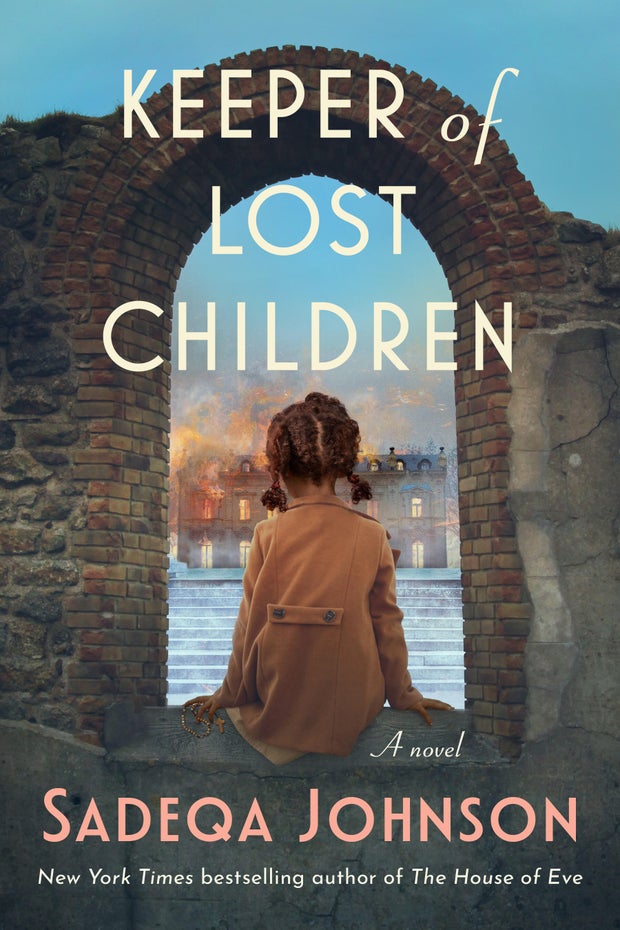
From the publisher: Ethel Gathers, the proud wife of an American Officer, is living in Occupied Germany in the 1950s. After discovering a local orphanage filled with the abandoned mixed-race children of German women and Black American GI's, Ethel feels compelled to help find these children homes.
Philadelphia born Ozzie Phillips volunteers for the recently desegregated army in 1948, eager to make his mark in the world. While serving in Manheim, Germany, he meets a local woman, Jelka, and the two embark on a relationship that will impact their lives forever.
In 1965 Maryland, Sophia Clark is given an opportunity to attend a prestigious all white boarding school and escape her heartless parents. While at the school, she discovers a secret that upends her world and sends her on a quest to unravel her own identity.
Toggling between the lives of these three individuals, Keeper of Lost Children explores how one woman's vision will change the course of countless lives, and demonstrates that love in its myriad of forms—familial, parental, and forbidden, even love of self—can be transcendent.
Sadeqa Johnson lives near Richmond, Virginia.
"Keeper of Lost Children" by Sadeqa Johnson (ThriftBooks) $23
Excerpt: "Keeper of Lost Children" by Sadeqa Johnson
PROLOGUE
Mannheim, Germany, 1946
hand pounded against the front door. Startled from her morning prayers, Sister Proba clutched the cross hanging around her
neck, hoping it was just the wind. But then she heard it again.
Rap, rap, rap.
Wearing only her thin nightgown, she quickly got to her feet and grabbed her robe.
The knocking got louder and more aggressive as she moved down the winding back stairs, draping her veil over her wispy hair and pinning it in place. At the bottom of the steps, Junior Sister was dressed just as haphazardly, brow furrowed with concern. With only a look between them, the two nuns moved down the long hall, passing the dining room, and then through the foyer.
After flipping on the light in the small vestibule, Sister Proba looked through the peephole. She touched her forehead and then made the sign of the cross before unlatching the door.
Under the portico stood a woman with pasty skin and slightly wrinkled clothes. Streaks of dried tears stained her hollow cheeks. A child's legs wrapped around the woman's waist, and tiny arms were tightly fastened against her neck.
"Help me," the woman croaked.
The nun stepped aside and ushered the pair into the parlor, where Junior Sister was already at work starting a fire.
"I cannot keep him." The woman's eyes were filled with shame.
The child stayed fitted around her so tightly, it was hard to see where one began and the other ended. Sister Proba gestured for the woman to take a seat.
"My father banished me from our village." The young woman repositioned the boy in her lap, and when he faced forward, his sweater was a size too small and his thick hair unruly. It was just as the nun had suspected.
Mischlingskinder.
The two nuns exchanged a look but said nothing.
"He threatened to sell him to the traveling human zoo as an exotic for twenty-five deutsche marks. My son would be kept in a cage
and put on display." She wrapped her arms more tightly around the brown-skinned boy. "We ran away to a shelter, but the conditions . . ."
The woman dropped her eyes. "Deplorable."
The billows made a whooshing sound as Junior Sister stoked the fire.
"I have found work as a live-in housekeeper, but I cannot bring a child. You are my last hope. Please, take him."
Sister Proba stood and reached for the boy, who was so sleepy he didn't put up a fuss. "Write down the usual information before
she goes," she directed Junior Sister, then squeezed the frail woman's shoulders. "May God be with you."
The boy grew heavier in Sister Proba's arms as she ascended the steps to the second floor. This child would be number twenty-two at the orphanage. All occupation children, all of mixed-race parentage and a result of war.
The large dormitory room smelled of babies' breath and pillow drool. She lay the sleeping boy down on an empty cot and tucked the
gray wool cover around him. Just as she turned to go, the boy lifted his head and clutched the hem of her robe.
"Mummy?"
"Shh, go back to sleep. You are safe," she cooed.
But the boy wouldn't be mollified. "Mummy. Mummy," he said, louder this time. The child next to him stirred, then the one in front
of him. Harmonious cries of "Mummy. Where's Mummy?" echoed throughout the room.
"Go back to bed, children, it is okay." The nun moved from one child to the next, tucking them back under the covers, rubbing backs,and whispering sweet words of affection.
Still the boy would not be pacified. He pushed off the bed and started running across the floor. "Mummy. Don't go. Please, no!"
Excerpted from KEEPER OF LOST CHILDREN by Sadeqa Johnson. Copyright © 2026 by Sadeqa Johnson. Excerpted by permission of 37INK, an imprint of Simon & Schuster. All rights reserved. No part of this excerpt may be reproduced or reprinted without permission in writing from the publisher.