Bestselling author Jeffery Deaver on his new Lincoln Rhyme novel "The Collateral Heart"
Please consider joining our Facebook group by CLICKING HERE.
Find out more about the books below.
Listen to the Club Calvi Podcast by CLICKING HERE.
If you love mysteries and thrillers, Lincoln Rhyme is back in a new book. This time, New York Times bestselling author Jeffery Deaver has Rhyme and his partner/wife, Amelia Sachs, in a race to solve a series of arsons across New York City. Mary Calvi talked to Deaver about his new novel, "The Collateral Heart," and about his writing career. You can listen to the entire conversation on the Club Calvi podcast.
Deaver has worked as an author for more than 40 years, with more than 50 novels published and 50 million books sold. Mary asked him about his early days as a writer.
"I started writing when I was 11 years old because I was a nerd, with all respect to the nerds out there," Deaver answered. "I was clumsy, socially inept. The girls, the cheerleaders, ignored me. But I found solace in the library and I knew books were very important things. They taught us things. They could bring us comfort, take us away from the daily cares like being ignored by cheerleaders, for instance. And I just decided I'm going to devote my life to telling stories. It took me a while to do it. I was an attorney, a folk singer, and did a few other things. But finally, about 45 years ago, I quit my job and have been writing novels full-time since then."
Mary remarked that many of Deaver's stories come from the world of law.
"Law taught me a couple of interesting things," Deaver said. "You never go into court without knowing exactly what the answer will be. In other words, you plan everything out ahead of time. Well, when I write my books, I spend eight months outlining them."
Deaver said that he uses Post-It notes on a wall to organize his stories.
"They are different colors based on the plots, not the characters," Deaver explained. "It's arbitrary, but the crime is yellow. The romance is pink, somewhat appropriately. And blue is the geopolitical plots. I have those all spread out. Then it goes to my computer and from there I sit down and I start to write, but not until I know where I'm going."
"The Collateral Heart" opens with a harrowing arson in Manhattan. Investigators find a package of clues.
"I love the idea of puzzles, and I try to work them into my books," Deaver explained. "'The Collateral Heart' is a typical Deaver book. It takes place over two days, lots of internal reversals, surprise ending, and then, yes, a surprise ending and after that there's a surprise ending. But the motivating factor is that Lincoln and Amelia have to solve these clues that are based on a podcast. If they can solve the clues, they can prevent the next arson from happening."
You can read an excerpt from "The Collateral Heart" and get the book below.
Club Calvi books may contain adult themes.
________________________________________________________________________________________________________
"The Collateral Heart" by Jeffery Deaver
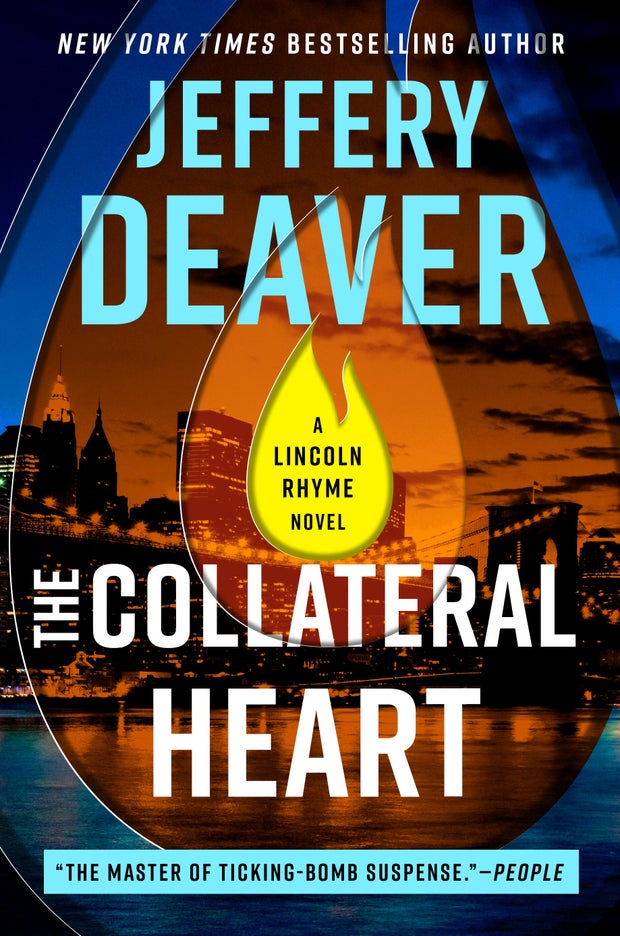
From the publisher: When a harrowing arson in Manhattan burns a building to the ground, Rhyme and Sachs are called to investigate, only to discover in the rubble a package of clues that teases where the perp will strike next. Rhyme and Sachs work feverishly to unravel the mystery, turning to an unlikely source for help: one of the nation's most popular history podcasters. Along the way they cross paths with Desdemona Vale, a determined detective from Long Island who is in search of the killer of a young woman from her neighborhood.
As Rhyme's team digs into both cases, it becomes increasingly clear that their suspect's plot might be more complicated than they initially thought. But can Rhyme and Sachs unpack his vile scheme, and stop the carnage in time?
Jeffery Deaver lives in North Carolina.
"The Collateral Heart" by Jeffery Deaver (ThriftBooks) $25
Excerpt: "The Collateral Heart" by Jeffery Deaver
Chapter 1
Wouldn't you know it? The risk that finally caught up with him wasn't the one he was expecting.
Oh, he knew his life was constantly in danger.
Daily.
Hourly.
Billy Welsh could be moving from car to car during a red light in the middle of Broadway, armed with his squeegee, enduring the wrath of drivers while he hoped for the one, just one, who might nod thanks for the spotless windshield and hand over a single or, man, five dollars . . . when, wham, a texting driver would take him out. Driving at thirty or forty could be plenty lethal.
He could be drawing very bad chalk pictures of cats and superheroes on the sidewalk (that usually got him coins). And some psycho dude would gut him because God had declared Billy was a "Satan-izer." A term a man had actually used during such an encounter on 57th Street.
He could get cut or earn a beatdown simply for selling stuff. The Senegalese bosses could snap because Billy's selling pencils and kitchenware and shoelaces somehow competed with knockoff Kate Spade purses and fake Tommy Bahama shirts. Billy was skinny and had a tricky heart, which could probably be beaten to silence by a few firm blows.
All risks.
And there were others too.
But, stretching, waking up in this deserted building in Spanish Harlem-east-Billy had to take the chance.
Rent didn't pay for itself.
A funny expression he used a lot. Funny, since he was homeless.
On this day, already proving hot, he needed money and not for rent.
Something real.
Something important.
Something for which the risk was worth it.
And that meant leaving the security of his home.
The Abernathy and Ca Building.
The old manufacturing place, where the last letters of the second owner's name, or whatever it might be, had worn away.
Campbell. Canton. California. Carter . . . Cadaver . . . Ha.
Billy liked it here. The crews didn't come around much, at least not to the second floor, up the narrow stairway. The crazies either.
He could stay in bed, unimpeded, and dwell on his finances and his brief marriage that had been doomed to end from the moment it had begun. But also happier memories like his childhood cat, a TV show where he was almost an extra and his two Employee of the Month stars.
Gretta, of course, his ex, showed up in the second category sometimes.
Will always did.
And he wondered yet again how his mind had kind of deflated.
The wiring, some doctor had called it. The diagnosis seemed . . . What was the word? Flipper. Flipping. Flippant. That was it. The city hospital ER medico had sent him to Psych, whispering to the nurse, "He'll be okay, just some f*****up wiring."
He decided to risk the Senegalese today and infringe on their territory and stake out his claim at the Walmart on 125th Street.
Risk . . .
He peed in his bucket. Washed his hands and brushed his teeth with park water from a bottle. Real toothpaste. Then began gathering the merchandise. Statues, a food scale, a set of baby utensils in the shape of SpongeBob (only the unopened ones sold), books, shoe polish, dishes with cartoon characters, dishes with rainbows, dishes with unicorns . . . About twenty-five pounds of merch.
Into the shopping bag they went. Including the gray blanket he had owned for twenty-two years, which he would spread out as his showroom floor.
How much could he make?
His goal was twenty-nine dollars.
Which is what the present cost. The present for his son, whose sixth birthday was on Saturday.
Will lived with his mother. A woman who had not lost her job. And had not gone bankrupt by taking out payday loans. Who had not been evicted in some funky legal maneuver because somebody wanted a five-million-story high-rise on the site of his basement studio.
A pretty woman Gretta was, and one now married to a man with fully functioning wiring.
Ah, his life would change.
Things would change.
He knew it.
He'd fought his way up before and he would do so again.
But first, priorities: a Disney toy purchased from the real Disney Store in Times Square, not dusty and smeared and bought from a guy like himself, off a two-decade-old, gray blanket spread on the sidewalk. A new toy in a new box.
Billy Welsh, who had been valedictorian in a Midwest middle school, where class ranking didn't count, and in the bottom third in high school, where it did, picked up the shopping bag and started toward the stairs.
When the unexpected risk caught up to him.
Not crazies, not crews, not bosses-I got Bahama, I got Dolce, I got Spade . . .
But smoke.
Billy lived up here, higher in the building because it was safer.
But that also meant it would take a few minutes longer to escape.
If there were, for instance, a fire.
He felt heat and saw sparks in the stairwell nearest him.
No!
He grabbed the bag with his money. He grabbed his drawing chalk and his squeegee but left the sales inventory shopping bag and hurried to the stairwell. And blanket? Goodbye!
Smoke was everywhere now.
Out, get out.
Coughing.
Sparks and heat, rising fast.
Fire in his beloved Abernathy and Ca home was not supposed to be a risk.
This was not the way he would die . . .
A cut throat, yeah, or a pounded heart, or the wiring just giving out because it was too much work for his poor, badly wired brain.
But not fire.
Where were the exits?
Only the back door, the one chained but with a gap big enough for an emaciated frame like his to fit through. The front was nailed shut, like the fire exits. One never needed to worry about escaping from a building that no one was supposed to be in, in the first place.
Weird. The smoke didn't move; it was simply just there, filling the hallway and growing thicker and thicker.
Choking hard.
He glanced out a window. The ground-floor ones were boarded over. But here, the second floor? It would mean a thirty-foot jump onto rubble from which rebar rods poked high into the air.
Skewers.
No, he had to get out another way.
Coughing and spitting smoke crud from his mouth. There were flecks of something suspended in the dark cloud. Bits of rubber or plastic. That would be what was burning, he guessed. Some crap on the floor that Mr. Abernathy and Mr. Ca illegally-by today's standards-had constructed their otherwise fine factory with.
He startled as something hit his foot.
Glancing down. A huge rat was fleeing too.
Think, he told himself.
Which was so hard.
Add burning to death to bum wiring, and his brain began to spin wildly. It wanted to shut down.
Control it!
For a moment, at least he did.
Sirens. So people were on their way.
But they wouldn't know anyone was here. Maybe, since it was abandoned, they would just let it burn. Let the flames do the work that was going to get done anyway-the A and C building wouldn't last forever. Time to move on.
Get to the roof!
Yes, fire travels upward, but at least there, there would be some fresh air to gulp. They'd see him. And while he'd be fifty feet in the air, those fire people had hooks and ladders or cranes. And they would lift him and his chalk and present-money and squeegee to safety.
Into the stairwell, coughing, choking, spitting . . .
The smoke was not as thick here and he could see above him the door.
Roof Access
Billy staggered up. And gripped the knob. He pulled.
It was locked. He tugged hard. Didn't budge. He tried again and his sweating hand slipped off the knob. He stumbled and his chalk fell. His bag of money too, mostly coins. They danced and spun down the stairs . . .
No!
His money . . . Will's Disney money . . .
Billy Welsh gripped the only tool he had-the squeegee-and brought it down on the knob.
Nothing happened.
Risk . . .
He began pounding once more.
Excerpted from The Collateral Heart by Jeffrey Deaver. Copyright © 2026 by Jeffrey Deaver. Excerpted by permission of G.P. Putnam's Sons. All rights reserved. No part of this excerpt may be reproduced or reprinted without permission in writing from the publisher.