Club Calvi has three novels about secret societies, the power of AI for your reading list
Please consider joining our Facebook group by CLICKING HERE.
Listen to the Club Calvi Podcast by CLICKING HERE.
Find out more about the books below.
Club Calvi is always on the lookout for books for you to consider for your reading list.
I discussed three recent novels with Mary Calvi:
- "The Hospital at the End of the World" by Justin C. Key is about father and son relationships, self-discovery, and it imagines a world in the not-so-distant future when artificial intelligence controls much of the world.
- "The Found Object Society" by Michelle Maryk is about wealth, power, grief, guilt, and redemption. The book tells the story of a woman who blames herself for her parents' death and who becomes a client of a group that offers the experience of reliving the death of another person.
- "The Society" by Karen Winn is also about wealth, family secrets, and subterfuge. The novel centers around "The Knox," a secret club where membership comes with an astonishing cost.
You can read excerpts, and get the books, below.
The CBS New York Book Club focuses on books connected to the Tri-State Area in their plots and/or authors. The books may contain adult themes.
________________________________________________________________________________________________________
"The Hospital at the End of the World" by Justin C. Key
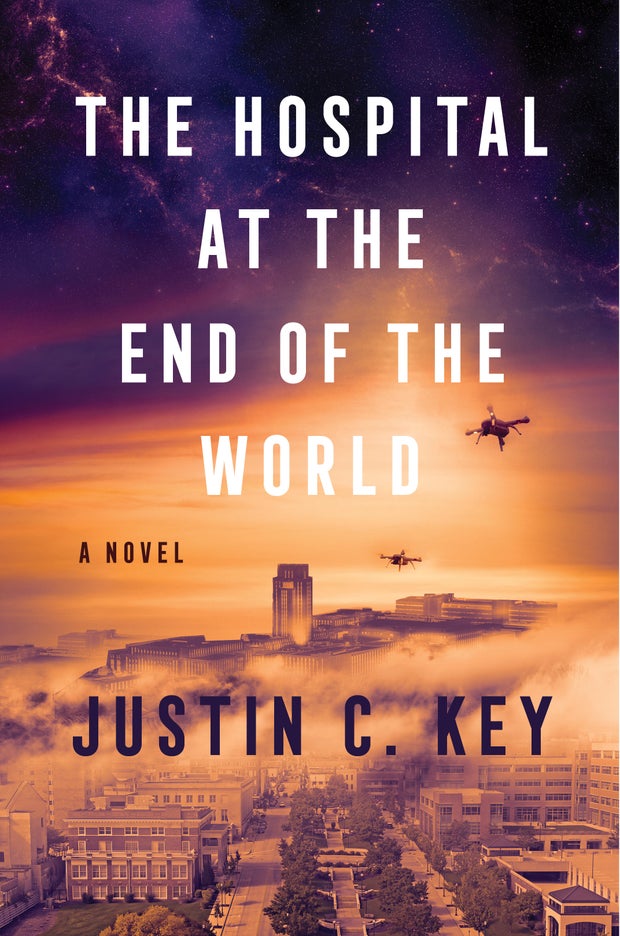
From the publisher: In a time not so far from our own, society is run by a global AI system controlled by an all powerful corporation. The Shepherd Organization oversees every medical school in the country save one in New Orleans, the renegade Hippocrates which still insists on human-led medicine. It is the last choice school for an ambitious young New Yorker named Pok. But after his father—himself a physician—dies under mysterious circumstance that seems connected to "the shepherds" and their megalomaniacal young CEO, Pok finds himself on a quest for answers that leads right to Hippocrates. Once enrolled, he stumbles upon a further mystery: a strange illness is plaguing newcomers to New Orleans who grew up under shepherd rule. What is causing this fatal anomaly? And how does it relate to the mystery of Pok's father's death and his own mysterious past?
Justin C. Key lives in Los Angeles
"The Hospital at the End of the World" by Justin C. Key (ThriftBooks) $22
"The Found Object Society" by Michelle Maryk
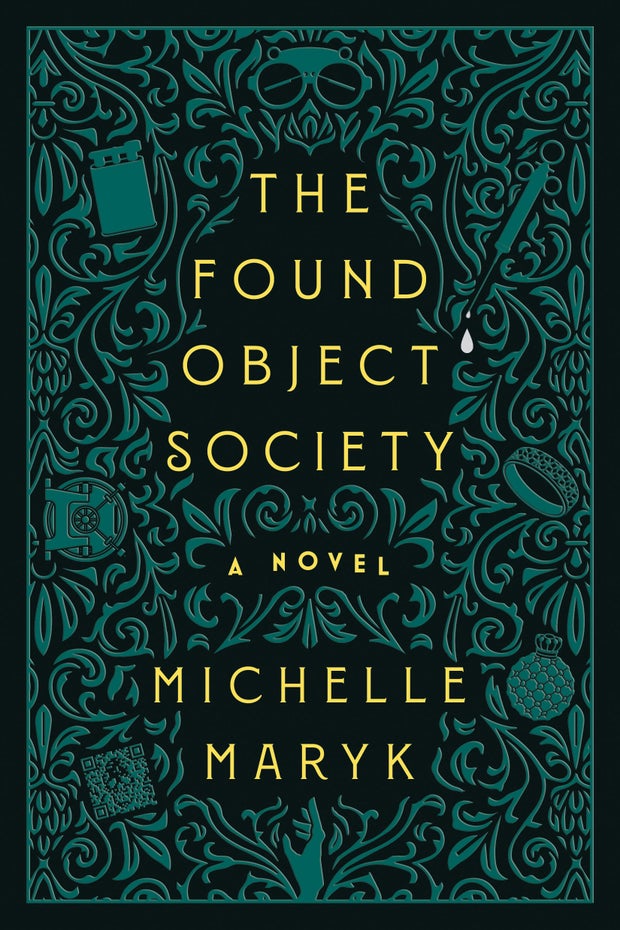
From the publisher: For twenty years, Greta Davenport has lived with the guilt of surviving the accident that killed her parents. She's tested the limits of her own mortality ever since, but little gives her the dopamine rush she craves. Not until the night she almost drunkenly crashes her car into a tree, and a peculiar blank card slides under her front door—an invitation to the Found Object Society. What she discovers there is beyond comprehension: an opulent, subterranean playground filled with aisles of objects from different eras and regions of the world. Pick an object and go on a voyage to relive the final moments of the person who died holding it, along with an unparalleled, irreplicable high. Greta's hooked, but she can't quiet her questions about the society and its enigmatic creators, the answers to which have implications far beyond her growing dependence on the voyages. Death is addictive, and what she uncovers will put her entire life into question.
Michelle Maryk in New York.
"The Found Object Society" by Michelle Maryk (ThriftBooks) $22
"The Society" by Karen Winn
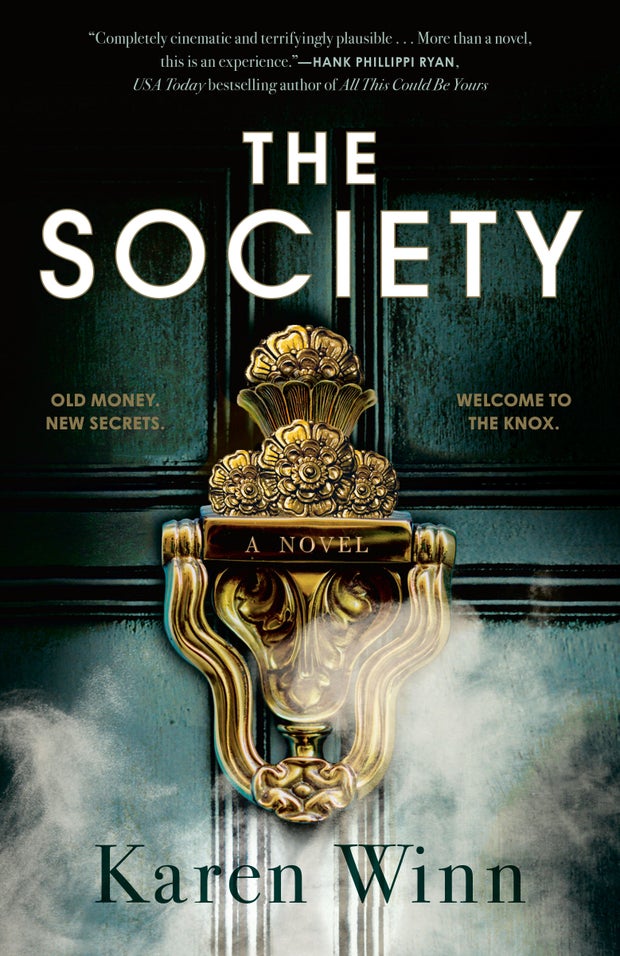
From the publisher: Vivian Lawrence was born into old-money Boston, but when her family fortune vanishes so does her carefully curated life. Desperate, she turns to an old family legend that ties her to the Knox and its inheritance, seeking a way into the exclusive secret society. She doesn't expect that entry to come in the form of Peter, a Knox insider with movie star good looks and just enough roughness to his charm to make Vivian weak in the knees for the first time in her life.
Far from Boston's glittering elite is newcomer Taylor Adams, a young nurse eager to leave her humble past behind. When the effortlessly glamorous Vivian lands in her ER after a suspicious fall, Taylor is instantly captivated. But then Vivian abruptly disappears without a trace, sending Taylor on a search for answers that pulls her into the Knox itself—as their new employee.
The further Taylor ventures into the Knox's world of unimaginable wealth and dark history, the more the mystery surrounding Vivian deepens. As Taylor will soon discover, more so than money or status, secrets are this society's true currency.
Karen Winn lives in Boston
"The Society" by Karen Winn (ThriftBooks) $16
_________________________________________________________________________________________________________
Excerpt: "The Hospital at the End of the World" by Justin C. Key
One
DECISION DAY
The narrow overhang jutting out from the New York City apartment building did little to protect from the downpour. Pok's back pressed against hard brick as he scanned the gray skies, his augmented reality glasses made pedestrian by the weather. The whir of an ambulance rose and dissipated, leaving behind the hum of rolling traffic. Directly above him, solid lines of rain ran from the air-conditioning unit hanging from their third-story window and cascaded off the fire escape. Where is it? The decision drone should have arrived ten minutes ago.
After acquiring twelve of the country's top medical institutions, the Shepherd Organization made clear their confidence in their state-of-the-art AI-centered medical curriculum by waiting until all other schools had sent out decisions before deploying theirs. It was a ballsy move. The stunt had paid off. According to the message boards, hardly anyone had accepted offers from non-shepherd schools even though most semesters started within the next month. Everyone was waiting on "The Prestigious Twelve."
"Decision day?" Skip James called above the rain and traffic as he stepped out of the small shop directly under Pok's apartment. The longtime owner of Park Avenue Market, one of the last human-staffed brick-and-mortar stores in Manhattan, chucked two black bags into the garbage. Rainwater fell in sheets from the lid. "It's all over my feed!"
"They're late," Pok said. "Don't catch a cold, kid."
You can't catch a cold from the rain, Pok thought. He was about to check the message boards when a soft, persistent buzzing drew his attention. He stepped out from under the ledge, instantly drenched, a touch of metal on his tongue. The buzzing grew, steady and direct, and the drone emerged from between city buildings, cut through the rain, and stopped inches from Pok. The drone's indicator blinked red; Pok raised his AR glasses and read- ily offered his irises for scanning. Verification done, its hatch opened and a silver case dropped on a string.
Pok examined his delivery. The metal was warm. The Shepherd Organization's insignia—a shepherd holding a stiffened snake as a staff—was engraved above the fresh stamp: Applicant Pok Morning. Verified at 12:14 p.m. Inside, his unique quick-response code.
Kris Boles popped onto Pok's glass display right as the decision page loaded. His friend's temperament was spirited. His environment was dry. Yellow bordered his display.
"Where'd you get in?" he said. "I haven't checked. You got in?"
"What do you mean you haven't checked? How could you not check?"
"It's still loading." Come on, come on. Every mentor and counselor had assured he'd have beautifully tough decisions to make at the end of this application cycle. Pok, who had applied to all twelve, had his heart set on the Shepherd School of Medicine at MacArthur Hospital, just up the street from his and his father's apartment, where East Harlem met the Upper East Side. Outwardly unimpressive, the interior was intricately designed. The medical school was built atop the busy, three-tier hospital that served all five boroughs. Its website proudly proclaimed its future doctors sat upon the figurative shoulders of the medicine they studied. That was his dream school.
Pok swiped clear his glass; new drops immediately streaked across the silicon display.
Logos for twelve of the country's top medical schools—all now re- branded with the Shepherd Organization's crest—popped onto the page. Adrenaline navigated open veins. Red Xs lined the margins. Beside all twelve schools. Every single one.
"I didn't get in." Speaking the words made them real.
"What?" Kris said.
"I didn't get in. Anywhere. This is bull****."
They were both speechless. A digital delivery scooter honked for Pok to move. It knocked the back of his knee. He could have fallen face down onto the flooding sidewalk, mouth filling with gritty rainwater, and he wouldn't have cared. This was bull****.
"What about that one school?" Kris said. "Gaylen or something? Down south?"
"Hippocrates." Under his father's insistence, he'd applied to the Louisiana-based anti-AI school as a "safety," one he'd never expected to consider. They had fallen far off of TIME magazine's yearly top medical school rankings after essentially eliminating the latest technology from their curriculum. Just the thought of moving to Louisiana—the most backward state in the country—twisted Pok's gut. "I don't understand. How many did you get into?"
"I don't think—"
"How many?" "Eight."
Eight? The New York air somehow grew hotter; Pok could visualize the rain sizzling off his skin. He'd received perfect marks. He'd checked all the boxes. His own father was a physician who'd given fifteen years of his life to MacArthur Hospital. And eight of the Prestigious Twelve wanted Kris and none wanted Pok? He knew Kris's application. Hell, he'd helped with the essays. There was no way Kris would be picked over him. No way. And eight times? No f****** way.
Pok rounded his building's corner, head down, embarrassment pounding at his ears and rain pelting the nape of his neck. He unlocked his apartment door remotely as he took the stairs two at a time—the elevator was broken again—and resented the smell of the city's concrete summer.
"It's got to be a glitch or something," Kris said. "Somebody messed up. You're the smartest kid I know."
The Shepherd Organization's algorithms didn't make mistakes. Not like this. But Kris inadvertently sparked an idea that bloomed into an insatiable urge.
Pok squinted against his bedroom's harsh, swinging light. The building—which housed MacArthur's many medical trainees, physicians, and personnel—offered to install ones that adjusted to pupil dilation. His father, old-fashioned but well-meaning, had refused. Pok cleared a spot on his bed, found his virtual reality gaming headset, and booted up Impact, an open-world, massively online multiplayer game about teamwork and survival.
"I'm coming over," Kris said.
"Don't." Pok took a moment to finger-comb out his shoulder-length locs; water dripped onto his thighs and the edge of his bed.
"What are you up to?"
"Troubleshooting," Pok said.
"Don't do anything stupid."
"You know me. I'll catch you later. And congratulations."
From the book: HOSPITAL AT THE END OF THE WORLD by Justin C. Key. Copyright © 2026 by Justin C. Key Reprinted courtesy of Harper, an imprint of HarperCollins Publishers.
Excerpt: "The Found Object Society" by Michelle Maryk
Rules of the Found Object Society:
1. Interfering or tampering with the vessel of your voyage is strictly prohibited. You are a passenger ONLY. This rule will be enforced to its full extent.
2. Absolutely no photography or cellular or recording devices of any kind are permitted. Cell phones must be handed over and secured before entry.
3. Posting on social media or discussing the Found Object Society with anyone who is not an employee or fellow member is strictly forbidden.
4. Members must wait a minimum of seventy-two hours between voyages.
5. Do not loiter in the waiting area.
6. A member who appears to be intoxicated, high, or otherwise impaired with any controlled substance will be asked to leave.
7. No refunds will be given for any reason.
Vessel? Voyage? Passenger? Rules that will be enforced? Greta's never been good at rules.
"Greta Davenport," the bouncer says.
He's standing behind her, his body emitting heat like a furnace. She turns around, embarrassed at being caught in what feels like a private act of stroking the wallpaper.
"Yes? Sorry, I shouldn't be touching things," she says.
He looks bemused and shakes his head. "Don't be silly. Touching the wallpaper is fine." His face shifts back to serious bouncer face. "Just nothing else beyond this room."
"Oh, um, roger that," she says. Roger that? Big Daniel Craig has her tongue-tied, talking like an idiot. Ha, Big Daniel Craig.
"Your phone, if you please, Miss Davenport." His hand extends toward her, a shovel in the air.
Right, rule number two.
"Sure, of course." She takes the iPhone out of her purse and pauses, rethinking giving up her umbilical lifeline.
He waves his fingers at her. "Miss?"
Greta relents and places it in his palm. Part of her thinks he may crush it into dust in front of her.
"Much obliged," he says. He goes back to the area by the phone and spins a combination lock that's camouflaged within the wallpaper.
He opens the safe and places her phone inside. Greta cranes her neck to see how many other phones are in there, how many other patrons there may be in the Found Object Society tonight. It's hard to see, and he closes the safe quickly, giving the numbers a spin. The safe disappears into the debauchery of the wallpaper.
"Miranda will be out in a moment to take you back for your voyage."
"Voyage. I see that on the sign with the rules. What does that mean? And what's with these rules and the enforcement stuff?" Greta says.
He scratches his cheek with a liverwurst-size index finger. His eyes dart over to a curtained section of the wall. "Yes, Miss Davenport, that's what we call it. A voyage. And, uh, as for the enforcement—"
The drapes part and Big Daniel Craig shifts his body to attention, changing his tone.
"—that's for Miranda to tell you about, miss, not the likes of me."
A woman Greta assumes is Miranda emerges through the oxblood-colored velvet. A jaw-dropping Oaxacan goddess birthed in front of her—the diametric opposite of the bureaucratic and lackluster Eileen.
"At long last, Greta Davenport. I'm Miranda. And yes," she says, giving the bouncer a steely look, "please direct any questions you may have to me." She holds out her hand.
Greta is so flummoxed by this gorgeous creature standing before her that she's tempted to genuflect and kiss her hand instead of shaking it. Reaching for Miranda's hand, Greta is painfully aware of how unmanicured and rough her nails are. Miranda's fingers are elegant, delicate as bird bones. Each digit is adorned with a ring, each one more eye-catching than the one before it; bands of gold and platinum, dolloped with gemstones.
The one on her thumb freezes Greta. It's an elaborate tree, a network of branches woven from gold, a multitude of emeralds for leaves, a snarl of roots that extend past her knuckle, the thickest root in the center, made of saffron-colored topaz and forming an arrow that points toward her wrist.
It's the same design as the foamed milk of her latte.
Greta keeps her grasp and looks up at Miranda's face. Could she be the delivery driver? The profiles are alike, but the similarities end there. Greta's mind is trying to make connections where none exist.
"That's quite a ring." Greta taps the pad of her thumb on top of the bejeweled tree.
"Thank you." Miranda extracts her hand and smiles.
"Have we met before?" Greta says.
Evading the question, Miranda says, "I'm sure you're eager to begin, Greta." She parts the velvet curtain from where she emerged. "Shall we?"
"Enjoy your death, Miss Davenport," Big Daniel Craig says with a smile, and waves.
From The Found Object Society by Michelle Maryk. Reprinted by permission of Hyperion Avenue, an imprint of Disney Publishing. Copyright (c) 2026 by Michelle Maryk.
Excerpt: "The Society by Karen Winn
VIVIAN
Early February
Vivian is standing on the cobblestone sidewalk in front of the Knox. It's a few days after Xavier paid her a visit at the store, a few days since she's concocted this hare-brained endeavor.
She's walked by the Knox countless times throughout her life—it's located mere blocks from her antiques store, after all—but she's never approached. She's never had reason to. Her buyer Michael—the only member she's met, or rather the only member she's met for certain—always comes to her. And unlike her other clients, the Knox prefers to arrange for delivery and pickup on their end.
She eyes the building in front of her. It's stately and tall: four stories, which is one level higher than nearly all the other buildings on the street. She smiles as she thinks of Michael not needing to duck within these entrances—unlike at her own store. But as her eyes sweep down the front bricks and over the double-length drapes covering what is likely their parlor room, a chill travels through her. The drapes are halfway parted, and for the life of her she can't see what's on the inside. Instead, the window glass simply reflects the sidewalk trees behind her. A mirrored film on their windows, likely, but it makes the building feel soulless.
There's an imposing feel to the structure, a do‑you-dare‑to‑enter vibe. Even the metal grilles on the garden-level small windows end in sharp, chiseled points.
It's suiting, she supposes. The Knox is Boston's most elusive secret society.
But then there is the other story about the Knox, the one that belongs only to Vivian's family. The story that has been buried for generations, just like her mother has always wished. But her mother's preferences hardly matter, at least not anymore. She won't know the difference; her mind has deteriorated into nearly a blank slate, the dementia having swiftly wiped her memories like a whiteboard eraser.
Except for that god**** La Mer cream.
Vivian smooths any potential strands that may have escaped from her low bun and then brushes up the steep stone steps to the front door. She never cared about the family lore, either. Not un[1]til a few days ago, when she found her life completely different—something that belonged to someone else: a person who suddenly needs money.
Using the antique brass knocker, adorned with flowers she cannot place, she raps several times on the wooden door. There's no buzzer.
She supposes the Knox doesn't get random visitors.
Staring at the door, she counts to five before she starts knocking again. Finally, a woman, tall—nearly as tall as Vivian—and thin, opens it. "Yes?" the woman says curtly. Her light blue eyes bore, laser-like, into Vivian's.
"I'm looking for Michael," Vivian says.
The woman pauses, runs her tongue over her teeth. She takes so long to respond that Vivian wonders if she's having some sort of mini stroke. She does look like she has a good twenty years on Vivian.
"Who are you?" the woman finally says, almost reluctantly, as if realizing that Vivian is not going away.
"I'm Vivian. I own Storied Antiques, on Pinckney Street. Michael had sent the carousel horse to me for repair a few weeks ago."
Why is Vivian prattling on to this woman? Who is she, anyway? She seems like she works there rather than belonging as a member, given her faded blue jeans and white turtleneck top. She makes Vivian look like she's stepping off the Bergdorf Goodman runway, though to be fair, Vivian always looks that way. Today she is dressed smartly in a navy-blue pantsuit beneath her wool camel-hair coat. A trait she inherited from her mother: the compulsive need to be the best dressed in the room.
"Is it fixed?" the woman bluntly asks.
"It is." Vivian puffs up slightly; even though she didn't like the thing to begin with, she's proud of the masterful repair job she's facilitated.
"I'll let Michael know, and he'll follow up with you."
The woman starts to close the door, but Vivian inserts her foot in it. "Wait!"
Sighing, the woman pulls the door back open. "Yes?"
"Let me give you my card."
Obviously, Michael has her number and knows where the store is; Vivian's stalling for time. She's not ready to be dismissed and is hoping to get a glance inside, hoping for any way into this place that may just be the answer to all of her problems.
She fumbles with her orange Hermès wallet as she extracts a business card, while at the same time trying to peer beyond the woman's shoulder, into the entrance of the Knox. But this woman's got a death grip on the door—she's strong, for being likely in her sixties—and the entrance alcove is small, boxy. Vivian can barely make out the widening of the room behind it: a sliver of a grand winding staircase with a paisley carpet runner. It's dim, too. You'd think they would light up this place like a Christmas tree.
But then, suddenly, a silhouette appears, quickly descending those stairs.
"Rose, do we have a visitor?" a man's voice calls out. He sounds almost amused.
The woman—Rose, apparently—stiffens slightly. "Yes, Mr. Wales. A woman is here about the carousel horse."
Rose opens the door now completely—though a bit reluctantly—as the man approaches. He smiles at Vivian and nods, as if he somehow recognizes her—but she would certainly remember had [1]they previously met. She feels a flush come on as she manages to smile back. He's her age, or slightly older. Ruggedly handsome: salt-and-pepper hair, deep grooves in his face. Eyes colored blue in an easy sort of way, like a cloudless sky.
"Hello, I'm Peter. Peter Wales." He reaches out to shake her hand, and she's glad he does, because she feels a little dizzy.
"Hi, I'm Vivian. I have the antiques store, over on Pinckney Street."
They continue to clasp hands, even though they're done with formalities. Rose has disappeared. But everything has disappeared. Vivian feels like a cartoon character with hearts spilling out of her head.
"Storied Antiques," he says with a nod. She's surprised he knows the name of her store. "You didn't want to ride the horse back to its home?" he asks.
She laughs. "Well, I think that was the original problem."
"True, true."
He releases her hand, and she's acutely aware of how naked it now feels.
"Do you want to come in?" Peter asks, gesturing inside. "I was about to have a cup of tea."
He says this like it's the most ordinary thing in the world.
"Yes. Yes, I do."
She steps over the threshold, into the foyer, where the room opens dramatically, punctuated by a large, hanging gilded chandelier. For a moment she feels like Cinderella entering the ball. But, as she surveys her surroundings, taking in the grand staircase, an old-fashioned mailbox system, and a mahogany drum table—an item Michael purchased a few years back—she reminds herself she's more like Perdita in Shakespeare's The Winter's Tale.
It is in the Knox, after all, that according to family lore, her great-great-grandmother was born, a baby out of wedlock.
From "The Society" by Karen Winn. Copyright © 2026 by Karen Winn. Reprinted courtesy of Dutton, an imprint of Penguin Random House.