Chris Bohjalian discusses his new bestselling book "The Amateur" with Club Calvi
Please consider joining our Facebook group by CLICKING HERE.
Find out more about the books below.
Listen to the Club Calvi podcast by CLICKING HERE
Club Calvi has a new book that's being called a "masterpiece" and one of the top thrillers of the summer. Mary Calvi talked to author Chris Bohjalian about his novel "The Amateur." You can listen to the conversation on the Club Calvi Podcast.
Mary told Bohjalian that she found "The Amateur" impossible to put down. He thanked her and said he found it impossible to put down as he was writing it.
"I wrote it in an alchemic frenzy of 90 days in the summer of 2024," Bohjalian said. "This was my secret novel. I didn't tell my lovely bride what I was writing. I didn't tell my brilliant editor, Jenny Jackson, what I was writing. I didn't tell my agent because of the premise struck me as so wild that the elevator pitch would have been a non-starter: 18-year-old girl kills a classmate and caddy with a golf ball."
Mary asked Bohjalian how he decided on the golf ball being the killing device.
"I used to be a caddy," Bohjalian explains. "I was a caddy for three summers and it was the best summer job in the world. I was so cash-rich, richer than I ever expected to be as a teenager. I was buffed. I was tanned. I am Kenny Foster and I'm Mira Winston. This book is awash in autobiographic minutia."
Kenny Foster is the golf caddy who dies on the course in Westchester County. Mira Winston is the golf prodigy who hit the ball that killed him.
"Mira Winston is a novelist who is just on the far side of 60 who is telling a memoir," Bohjalian explained. "She is recalling the summer of 1978 when she thought the LPGA [Ladies Professional Golf Association} was in her sights, until she accidentally killed Kenny Foster. Actually the New York Times summarized [the book] so beautifully. They said it is a portrait of a girl going off the rails. It's a morality tale, and it's a courtroom drama. Kenny Foster is like me in that he's that kid who moved around a lot. He suddenly goes from Miami, Florida, to Bronxville, New York and he doesn't understand in 1978 why no one wants to see his polyester leisure suits or his silk Huk-A-Poo shirts and his the ultimate fish out of water."
Bohjalian said he originally thought the book was going to be about the class divide in America. He realized that the book was about Mira and the guilt that she lives with.
Mary asked why Bohjalian decided to set his book in the late 1970s.
"I wanted to focus on the diminishment of women, and the diminishment of girls. Mira Winston is ferocious athlete. She's a great athlete. The reason why I chose golf isn't just that I was a caddy. It's that it's a sport where she would regularly play against men and she would beat them. She would beat all the men at at the club. She was great. But because she is great, all of these middle-aged men see two things. First of all, they see an athlete who should be diminished. If she behaved the way she behaved as a male, she would be applauded. But as a girl, no. Secondly, and Mira says this in the novel: 'I won the birth lottery. I was born wealthy, beautiful, smart, and talented. So I was never going to be invisible to a certain kind of man.' And that is where we get to some of the darkest stuff on the book."
Mary said that must have been challenging for Bohjalian to write. He said he is the dad of a daughter and married to a woman who came of age in that era.
"Other than hanging out with my wife, or daughter, or dog, there is nothing I love in the world than writing."
You can read an excerpt from "The Amateur" and get the book below.
Club Calvi books may contain adult themes.
________________________________________________________________________________________________________
"The Amateur" by Chris Bohjalian
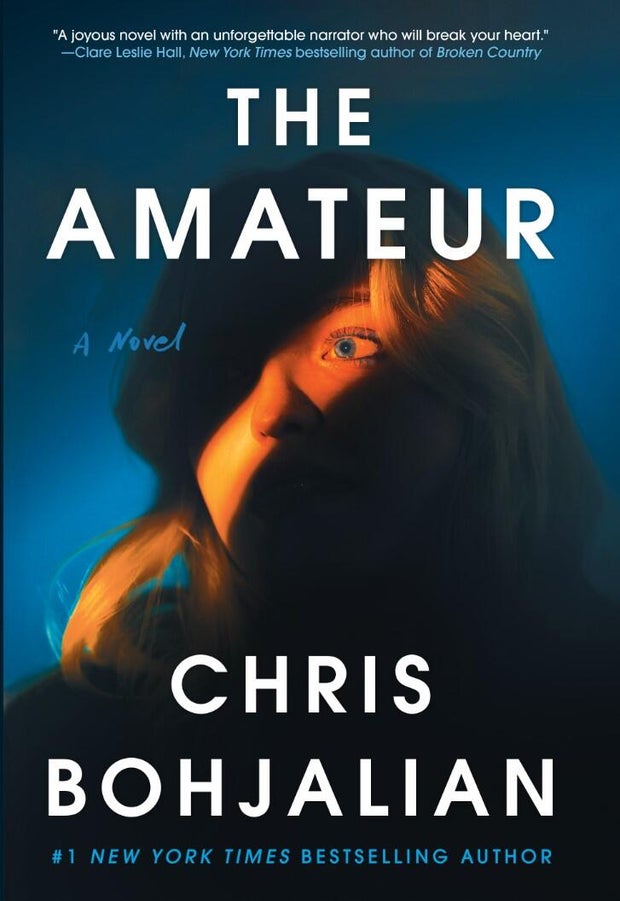
From the publisher:
1978: It is the first Thursday in August and temperatures are flirting with ninety when Mira Winston, eighteen years old, drives a golf ball from her tee toward the practice net near the clubhouse and caddy shack. The golf ball, weighing 1.6 ounces, tears through the net, traveling 150 miles per hour, and slams, with sickening force, into the temple of a high school junior named Kenny Foster, rupturing an artery and unleashing a torrent of blood. Kenny brings his hand to the side of his head, then topples onto his side. He's dead before the ambulance even arrives.
In the wake of this terrible accident—and everyone, at first, agrees it was an accident—Mira looks for comfort in all the wrong places: In her lover, Theo Catton, a married man three decades her senior. In her mother, a well-kept woman with secrets of her own. In the dead caddy's little sisters, girls bewildered by grief. But when the investigators look more closely at the torn net, when a detective recalls Mira's history of recklessness, and when Kenny's father spies Mira with her married lover, the affluent and mannered community turns on this once-promising young woman. A gripping story that takes the reader from the sun-soaked greens of a tony Westchester country club to the fluorescent-lit stand of a county courtroom, The Amateur asks: What happens when one small moment—a swing, a ball, a piece of string—changes the course of an entire life?
Chris Bohjalian lives in Vermont.
"The Amateur" by Chris Bohjalian (ThriftBooks) $25
Excerpt: "The Amateur" by Chris Bohjalian
It wasn't merely the idea that all the other caddies knew more about golf than Kenny did that made him nervous around them, though that was likely a factor. He hadn't played much golf, not even on Mondays, when the course was closed to members for maintenance and caddies were allowed to play for free. (Caddy Day, the club called it, as if it were an august celebration of the help.) It was really only those college kids who took advantage of the program. Nor was it the fact that he was the youngest caddy there, the only high school student in the pool. It was this: he feared that all the other caddies supposed he came from money because his family lived in the neighborhood with many of the club members, and that he didn't need the ten bucks a bag the way they did. Or the forty bucks for a foursome, when you managed four golfers on your own. (Like a one-man band, you carried two bags on your shoulders and a pair of putters in your hands; two of the four golfers rode in a cart, their bags hitched to the back, while two others walked the links beside you. You were expected to follow four balls and give four golfers their clubs. If you were Kenny, you always felt like Lucy Ricardo falling comically behind at the candy factory assembly line.) He suspected the other caddies, whether they were twenty years old or sixty, viewed him as a dilettante, a poseur, a faux-working-class fraud.
Which wasn't the case. Those rare moments they actually thought of him, they probably viewed him as a shy kid who was not a great caddy, but that didn't concern them because he was rarely given loops with members who knew the difference between a good caddy and a bad one, the members who actually benefited from the caddies who knew what they were doing. The caddies who could recommend the right club, weigh in on the speed or contour of the green, find that ball that had sliced deep into the woods along the fifth and fifteenth holes. Kenny usually-again, not always, there were exceptions-got the newbies and the bad tippers, the newlyweds and the retirees who hit the course right after their lesson.
But Kenny did need the money. Maybe not the way the other caddies did, but his family sure as hell couldn't afford to belong to a club like this. He was seventeen, and most of the fifteen hundred bucks he hoped to earn that summer would go into his college fund, and the little that didn't would go for dime bags of weed.
Now, that day-the first Thursday in August-the sun was high, and the temperature was flirting with ninety. Kenny put down his book and bowed his head against the midday sun, staring for a long, languid moment at the grass between his legs, the voices of the dozen or so caddies behind him the burble of a small crowd before the curtain goes up at the theater. Then he closed his eyes. All of the caddies, like him, were waiting for a Thursday afternoon loop, and a second walk around the course. They were in the shade, sitting in folding chairs or on the two wooden benches beneath that pergola where the caddies waited to be summoned by the caddy master. Kenny was sitting on the ground outside the bower, using the pretext of a tan to allow himself the separation necessitated by his fear of them. He was facing that small driving range practice net, unaware—as was everyone—that there was a tear in the netting. It likely was new, the fraying fabric perhaps separating only that morning when years of golf balls slamming hard into that section had, apparently, finally torn two of the thin nylon cords.
The caddy master, a paunchy guy with the thick silver hair of a movie Bolshevik and a nose striated with clusters of spidery red lines, tended to allocate the loops based on seniority, except when a member had a favorite caddy or the member was such a fledgling, loser, or bad tipper that he'd call Kenny's name.
Or, on occasion, when the golfer was the parent of one of his classmates. Sometimes the caddy master would summon Kenny for them, too.
Brendan Bedford and his wife, Jill, were duffers. Perfectly nice people, sanguine about their future, but terrible golfers. Moreover, while Jill's bag was small, even for a woman's bag, Brendan's was a beast, the sort of expensive and needlessly heavy Redwood that a know-nothing neophyte like Brendan could be talked into by an enterprising salesman at the golf store. Brendan took a half day that Thursday, going to morning meetings at the liquor company headquartered on Park Avenue where he worked, but returning to Westchester on a lunchtime train and meeting his wife at the club, which they had joined only that spring, for watercress sandwiches in the dining room and then an afternoon round of golf.
Neither of the Bedfords was mean-spirited or a bad tipper, but they were beginners—one of whom had a leviathan for a bag. And so they were a perfect loop for Kenny Foster. Which was why the caddy master called his name. Or, to be precise, his last name. The caddy master always called the caddies by their last names. And so he yelled the name "Foster," shouting it out across the airless, humid expanse, leading the seventeen-year-old to look up from the grass, a reflex.
Which was a split second after a girl a mere thirteen months older than Kenny, a senior at his high school who was planning to start at Yale in less than a month, one of the only kids at the local high school who played golf, finished her follow-through at the small practice net. She was using a driver. A wood. She was practicing her drives with a tee, and she knew what she was doing. She was good. Very good. Had already met the coach of the women's golf team in New Haven.
There is no record as to how fast that 1.6-ounce golf ball with 336 dimples was traveling when it passed almost untouched through the hole in the netting, but it was likely speeding between 140 and 150 miles per hour. And it had traversed only fifteen yards when it slammed into the right side of Kenny Foster's head, shattering the temporal bone and causing a traumatic rupture of the middle meningeal artery in the brain: an epidural hematoma.
See? It is chance that pulls the strings. A hole in a net, a tee shot that's more line drive than moon shot, a name called into the air. A boy looking up.
Kenny brought his right hand to his head (some witnesses thought he was reaching for his ear, others his cheek), but his upper body was already wobbling like a struck bowling pin before it falls to the floor at the end of the lane. The pupil in his eye on the ipsilateral side-the side where the golf ball had smashed into his skull-was growing dilated. He toppled over into the grass, some of the caddies laughing because they were unaware of the severity of what they had witnessed, but then they would run to him. All of them would: they raced. Even the caddy master.
But already Kenny was losing consciousness, his breathing slowing then ceasing as a tsunami of blood flooded his skull. He was dead before the ambulance arrived.
I know because I was there.
I know because I was the girl who hit the golf ball.
From The Amateur by Chris Bohjalian, published by Doubleday, an imprint of the Knopf Doubleday Publishing Group, a division of Penguin Random House LLC. Copyright © 2026 by Chris Bohjalian.