Bestselling author Harlan Coben shares tips for aspiring authors from "Plot Twist," his memoir on writing
Please consider joining our Facebook group by CLICKING HERE.
Find out more about the books below.
Listen to the Club Calvi Podcast by CLICKING HERE.
Harlan Coben is a New York Times bestselling author of 38 published novels with 100 million books in print. More than a dozen of his books have been adapted for the screen. He talked with Mary Calvi about his new book, "Plot Twist," a memoir on writing, where he takes readers and aspiring writers inside the creation of the books that became bestsellers, the ones that were never published, and his path to success. You can listen to their entire conversation on the Club Calvi Podcast.
"I thought it'd be interesting to try to combine a memoir with writing because you realize how much of your own life applies to what you write," Coben told Mary. "I'm hoping people will be able to read this, learn a little bit about my life if they're interested, but also find the spots in their life that they can use to be more creative in their own."
Coben told Mary that he wrote his first five novels while he worked full-time. He says one of the biggest misconceptions that aspiring writers have is that they think they have to quit working to be a writer.
"No, you don't," Coben said "You have to quit some hobbies, maybe. You have quit watching TV. You have to wake up a little earlier in the morning, whatever that may be. A book that was going to take me, say, 10 months to write, if I'm working full-time, it takes me 12 months to write. But it's not an excuse not to write."
Coben mentioned a few now-bestselling authors who kept their day jobs while their first books were published.
"I was recently with Michael Connelly. He was working as a journalist. I was with John Grisham. He was a working as lawyer. So most of your writers are doing that. They have bills to pay and things to do. So, I don't accept any excuses that you don't have time to write. You just have to carve out that time in other ways."
Mary asked Coben if at the beginning of his career he had the idea that he would find such enormous success in the publishing industry.
"Never," Coben replied. "My dream was just to one day have a novel published. If I could one day go past a bookstore and see my book in that store, I would just have been happy. Then, I'm like, okay, two, just to show it wasn't a fluke, how about if I can do it twice? Okay, just a little career, like maybe, so I can make some money. So it's not embarrassing. And then, maybe I can hit the New York Times list for just one hour, just one day, number 15, one hour. And then you keep moving up. In the book, I call 'incremental ambition,' which I highly recommend."
Coben also has very clear opinions about research. He says writers need to know when to stop and just get to work.
"Writing is kind of hard," he said. "You don't want to do it. You sit there and a blank page is scary. So to avoid the blank page, you say, oh, I should do a little more research on this. I'm gonna write about Fifth Avenue in New York. Oh, but first I better go again, and I better smell those hot dog stands and watch the people walk by and take notes. No, no, no. You know what it's like. Write the scene now, go later. You can do the research if you need it later, though your memory and your imagination are probably better than you think. But don't let anything be an excuse not to write."
Coben says he's working on a new novel that he hopes to finish by early 2027. He's also appearing and producing the second season of the television true-crime series "Harlan Coben's Final Twist," premiering on Monday, October 5, 2026 at 10 PM, on CBS and streaming on Paramount+.
You can read an excerpt from "Plot Twist" and get the book below.
Club Calvi books may contain adult themes.
________________________________________________________________________________________________________
"Plot Twist" by Harlan Coben
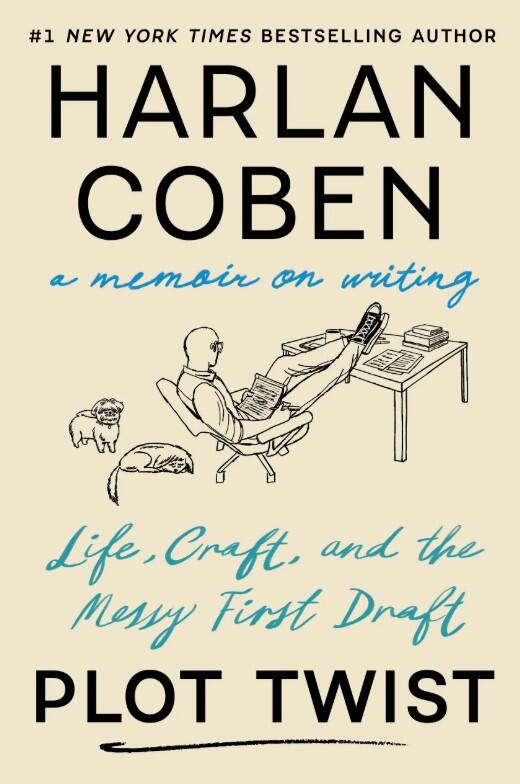
From the publisher: Plumbing memories from his suburban childhood and his early years trying to break into publishing, Coben tells his own story for the first time, revealing the real-world inspirations for some of his most beloved characters as well as the innovative plots that drive his propulsive novels. Filled with useful tips and techniques on the creative process, Coben does away with the traditional "categories" of writing—characters, plot, setting, etc—and looks at the process holistically.
Harlan Coben lives in New Jersey.
"Plot Twist" by Harlan Coben (ThriftBooks) $24
___________________________________________________________________________________________________________
Excerpt: "Plot Twist" by Harlan Coben
Chapter One
Back in 1994, I received an advance of $5,000 for my first Myron Bolitar novel, Deal Breaker, but a mere three years later, when I published Back Spin, my fourth novel in the series— I'm trying hard not to brag here—my advance had risen all the way up from $5,000 to a whopping—drumroll, please . . .
$6,000.
Just like that. An overnight success.
Don't worry. This won't be one of those inspirational "pull up by the bootstraps" self-help, perseverance kind of books. I hate those. I also don't fit the criteria despite what you just read above. I quit plenty of things. Just ask the karate gi in back of my closet. Or my old wooden tennis racket. I had protégé potential as a tennis player when I was ten years old, but I just up and quit. I gave up on plenty of things, and I don't think there are many signs in my childhood of gumption or grit.
This book is mostly a writing guide. I've learned a lot about how to do this over the years. I want to share that with you. It's also a creative guide. I don't like the word "artist"—too pretentious—but if you sculpt or paint or build or, put simply, make something where there was nothing—create—then I hope this will instruct and inspire you.
We humans were designed to create, not just consume. This book also can't help but be a memoir—it's unavoidable, since life experience and creating go hand in hand—but I'll try not to be too self-indulgent. It may also offer some life advice and child-raising tidbits that have come my way over the years. I'll swing at a lot of pitches, to use a baseball analogy, and who knows—maybe I'll connect a few times.
Now that you know what you're in for, let's jump right in by talking about the two biggest mistakes most books on writing make.
One, they divvy up the writing process into separate categories—character, plot, setting, research, whatever—when writing is actually a whole and should be thought of as such. Plot is character. Setting is plot. Every aspect of writing should bleed onto every other. There is too much overlap to be breaking it down into faux groupings—it's harmful even—and yet every writing guide does that. I may slip and do this too, but as long as you know I'm doing it, as long as you realize that I am making a mistake in doing so, I think you'll be okay.
The second big mistake—the one I've been most guilty of buying into until recently—is insisting your life experiences are somewhat irrelevant to the process. I write about murder, I used to surmise with a smug chuckle, but I've never committed one. Over the years, I've written about so many things about which I have no personal knowledge. How? I just make it up. I say this all the time—my books aren't memoir. Harlan Coben the writer has nothing to do with Harlan Coben the man.
Don't worry. That will be the last time I refer to myself in the third person.
But as I get older and start to examine my process, I realize that's nonsense. I'm on every page, like it or not, so yes, you'll learn a little about me and my childhood and my life—at least in terms of how it relates to my being a writer.
But back to the perseverance thing because you will need that to write. If I'm not a man of great tenacity and pluck for most things, why is it different with writing?
I'm not sure. Part of it is that I wanted to be a published novelist so badly—you need that desperation, and we will discuss that in detail throughout this book—but a bigger part of it may be that I never realized, back in those early days, how small-time I was. I had a publishing deal. S*** money, sure. But a legit publishing deal. There was no Amazon back then, barely an internet, so I didn't know what a pimple on the a** of publishing my novel was. I didn't realize it would probably be ranked 2,309,873 or whatever. I still remember the first time I saw Deal Breaker in a store at San Diego's wonderful Mysterious Galaxy bookstore. They had two paperbacks on an upper shelf in the back, and I thought to myself, Man, aren't I the cat's a**?
Naiveté goes a long way. So, first lesson: Try not to get caught up in the comparison game in life or career. Write. Just write. We won't talk much about the business end of writing in this book, but here is the important thing to know about it: You can't control it. You can't control publishing or trends or any of that. The only thing you can control is what you write. Focus on that.
A few caveats before we get started.
The main thrust will be thriller or suspense writing, but I hope the advice is universal. If you're writing a memoir or romance novel or scientific text or an op-ed article—or if you are painting a still life, sculpting a torso, composing a sonata, designing a logo, choreographing a ballet, whatever—my hope is that much of what I tell you will apply.
The second is that I will contradict myself a lot. Do I make up the stories in my novels out of thin air, or are they memoir-based? Yes. Which is more important, character or plot? Yes. Should I do no research and just focus on my writing, or should I make sure I get my facts right? Yes.
One of my favorite quotes on writing comes from Flaubert:
"Be regular and orderly in your life, so that you may be violent and original in your work."
Great, right? And it fits me. I've lived a quiet suburban life with my family. But does that mesh with how much of my real life informs the darkest and grief-stricken sections of my novels? On the surface, not really.
The more relevant caveat—this could really be a separate category—may lie in the insecurity and self-doubt of being a writer. I am going to skip the part where I talk about how presumptuous I feel just writing this book, offering advice, that even while I'm typing this, an inner voice is constantly scolding me, wondering who the hell I think I am, and reminding me that I think most writing advice, including mine, is like your appendix—either superfluous or it hurts you.
Most writers have the now overdiagnosed term "impostor syndrome," but it's still worth noting:
Only bad writers think they're good.
We all worry that our creation is crap and no one will like it and that we have nothing to say, that we are dull and not very smart, and that very soon we will be exposed as talent-less frauds, while AT THE VERY SAME TIME—I'm italicizing, bolding, underlining, CAPITALIZING, and adding these em dashes because this is key—we have the hubris to believe that people will love what we write so much that they will pay us for our words, pay us to hear our stories, pretty big bucks if we're talking a hardcover, and when they walk into a bookshop or library, they'll choose our book out of the thousands available and take it somewhere special and open it and let our words wash over and transport them as we pontificate for hours on end—and they will be grateful for that.
Every word we write sucks donkey a**, and yet you must—must!—read us.
That seems a contradiction. It's not. You'll see a lot of apparent contradictions in this text. Go with them.
In that same vein, if you ask ten writers how they do it, you'll get eleven different answers.
That's how it should be.
Another caveat: I will be using my own books as examples, not because I'm self-involved or think they are brilliant (see above), but because I am the world's leading authority on me. I can't deeply explore how Alexandre Dumas came up with The Count of Monte Cristo or how Jackie Collins came to write Hollywood Wives, but I know in scintillating detail how I came up with the nanny-cam twist in Fool Me Once.
As I've already strongly suggested, this book will also question and even fully dispute many of the sacred cows of writing advice. You may vehemently disagree with a lot of what I espouse here. In fact, you may even be bold enough to do the opposite of what I will preach in your own writing.
And you will be better off for that. That's cool too.
I disagree with many of my favorite books on writing, but I learned the most from those disagreements. Another contradiction? You decide. This isn't a political dissertation or social media platform—I'm not trying to convince you I'm right and you're wrong. I care that you get something out of this book, not that you agree with what I'm gently expounding.
I also won't be all rah-rah or motivational, but here is a quick reminder for those reading this book with the hope of one day getting published or having a career in the creative arts: It's never too late, and no, you're not too old. This is not pro sports. When I was young, I wanted to be an NBA basketball player. That dream is dead and buried. But being a novelist? That heart still beats, dear reader. One of the biggest-selling books of the past decade is Where the Crawdads Sing by Delia Owens. Ms. Owens was seventy years old when the book came out. I know first-time authors who were in their eighties. It's very doable and not all that rare. For years, I had these words taped to my computer:
You only fail when you quit.
Whatever your reason for reading this book, I hope you find it. And I am grateful you are here.
Excerpted from PLOT TWIST: Life, Craft, and the Messy First Draft: A Memoir on Writing by Harlan Coben, published on September 8, 2026. Copyright © 2026 by Harlan Coben. Used by arrangement with Grand Central Publishing, a division of Hachette Book Group. All rights reserved.