Author Amanda Peters discusses her new novel "The Birthing Tree"
Please consider joining our Facebook group by CLICKING HERE.
Find out more about the books below.
Listen to the Club Calvi podcast by CLICKING HERE.
If you loved "The Berry Pickers" by Amanda Peters, then consider putting her second novel "The Birthing Tree" on your reading list. Mary Calvi talked to Peters about her books, Indigenous stories, and her writing process. You can listen to their entire conversation on the Club Calvi podcast.
Peters had breakout success with "The Berry Pickers." It was a best book of the year for about a dozen outlets after its release in 2023. "The Birthing Tree" is about a woman who confronts her family's secret history when she returns to the Indigenous community she left decades ago.
Mary said that the story in "The Birthing Tree" was layered in riveting details, yet is so intimate that it was almost if it was Peters's own story.
"I had a mentor once tell me there's nothing truer than fiction because we put a little bit of ourselves into it," Peters answered. "[The Birthing Tree] is mostly fiction, but I think I put a bit of my personality into a little part of it."
Peters is mixed race of European and Mi'kmaq ancestry. "The Birthing Tree" is a story about her Indigenous culture. She says a tree, as a living thing, would be considered kin, and the women in her story would naturally consider the tree as a grandmother-type figure.
Mary asked Peters about the sentences in the book where the tree speaks to the reader.
"It's such a central figure to the story, and I think she needed a voice," Peter said. "But I didn't want it to come off as comical. I wanted to come of as wise. That was a lot of work, those little tiny one-sentence things, because I was trying so hard to make it sound wise. And I'm not exactly the wisest person. I wanted to make sure that the tree really had a voice and it was saying something important."
Peters described her family lineage.
"The Mi'kmaq stretch to Nova Scotia, New Brunswick, Prince Edward Island, Newfoundland, Labrador, the Gaspe Peninsula of Quebec, and Maine," Peters explained. "I love the fact that my books have shown people that we're here because a lot of people haven't even heard of the Mi'kmaq. When I was starting to write, I didn't really think I had the right to tell these stories because I wasn't raised on my reserve. I don't speak the language, although I'm learning. My mom is non-Indigenous. But when I wrote my first Indigenous story, it just seemed that was where my heart was."
Peters told Mary that she and Aliet, the main character in "The Birthing Tree," have similarities.
"I kind of based her insecurities on my insecurities, as you may have noticed," Peters said. "I did the same thing with Norma in "The Berry Pickers" She's insecure about her very light complexion and her freckles. I have lots of freckle and I have green eyes."
Mary asked Peters about the origin of "The Birthing Tree."
"'The Birthing Tree' was actually a short story in my collection 'Waiting for the Long Night Moon,'" Peters answered. "The short story itself was written around 2017-2018. At the time, I just thought it was a short-story, the same with 'The Berry Pickers.' But once 'The Berry Pickers' was out into the world and I was thinking about what I want to do next, I was like, I feel like there's more to say with that story. So I used that as a foundation to write the book."
You can read an excerpt from "The Birthing Tree" and get the book below.
Club Calvi books may contain adult themes.
________________________________________________________________________________________________________
"The Birthing Tree" by Amanda Peters
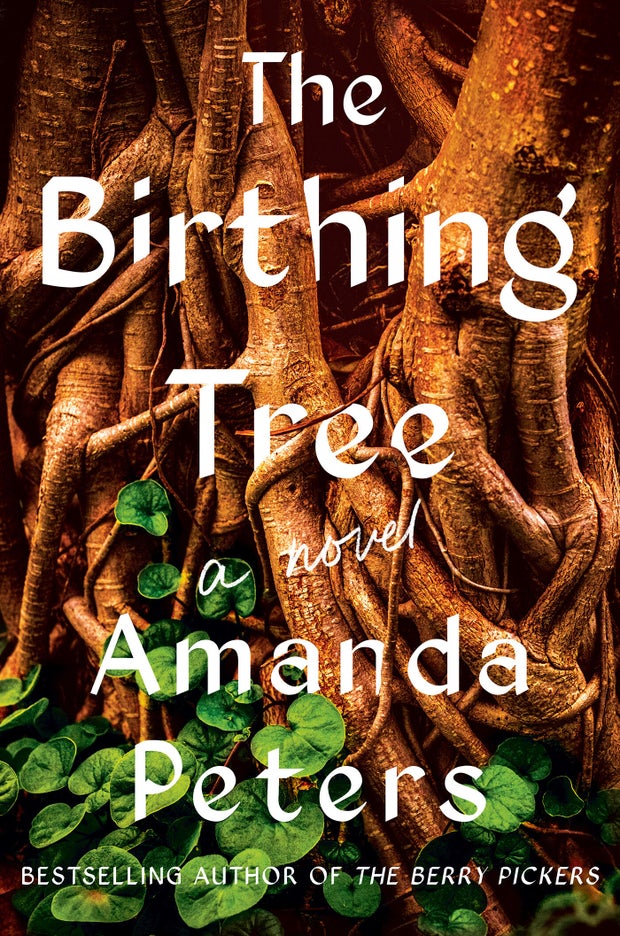
From the publisher: Born under the shadow of a birthing tree sacred to generations of Mi'kmaq women, Aliet Paul grows up outside a small Nova Scotia town with her fierce, loving grandmother Kiju. Her mother died bringing Aliet into the world under that very tree; her father remains a mystery no one will name. Aliet's childhood is shaped by seasonal apple pickers, the medicinal wisdom of the old ways, and the quiet, steadfast presence of John, a boy who becomes her anchor.
But the world beyond their community is changing. Traditional midwifery is condemned, prejudice deepens, and when the wrong person witnesses a birth, the consequences are disastrous. As Aliet comes of age, she navigates love, loss, and a personal tragedy that veers her from the path her grandmother wanted for her. She becomes a nurse trained in modern medicine, yet she carries Kiju's teachings close, tucked beside memories of the tree that once welcomed new life.
Years later, when the call comes that Kiju has died, Aliet returns home to a crumbling house, a community scattered, and a past she thought she'd outrun. As Aliet restores the house room by room, something inside her stirs awake: the threads of her lineage, the old ways of her grandmother, and the mystery of her own bloodline.
As Aliet digs to uncover who her family really is, each revelation pulls her deeper into a web of long-guarded silences, dangerous loyalties, and generational wounds that refuse to stay buried: Someone knew the truth about her mother's final moments. Someone knew what happened in the orchard all those years ago. And someone wants the past to remain undisturbed.
Spanning decades of loss and reclamation, this sweeping yet intimate novel follows one woman's journey to protect the land, the traditions, and the memory of the women who came before her—and to decide which parts of her inheritance she will carry into the future.
Amanda Peters lives in Nova Scotia, Canada
"The Birthing Tree" by Amanda Peters (ThriftBooks) $21
__________________________________________________________________________________________________________
Excerpt: "The Birthing Tree" by Amanda Peters
My mother died pushing me into the world. Her blood, the very blood she had shared with me, spread out on the ground around her, the dirt a coppery red and the smell of lightning on the air. I don't know if I saw her face or if she saw mine. Only that, by the first crack of thunder, she was gone.
"I was angry," my grandmother told me. "The thunder shook, and the lightning flashed across the sky, but it wouldn't rain. The clouds refused to cry for my girl. And I was so angry. She deserved their grief." She saddened each time she told this story, which was every time the sky darkened from May to October.
It isn't a particularly nice tree, the one where my mother died and where I was born. The roots push out of the hard earth before retreating underground, hidden in their dark and damp world. The tree leans and some of its heavier branches graze the top of the pond. There are no golden leaves, no burning red in the autumn. It gives no sap for syrup. But none of that matters, Kiju told me, because this tree holds our stories. This tree presides over our entry into this world. It makes mothers out of women and fathers out of men. And those roots, the ones I once considered so ugly, offer a comfortable place to birth. A cradle for the women to lean into. No one else can see it, but I swear, when the sun is creeping through the branches and kissing the ground, those roots glow red. A monument to the lives begun and occasionally a life lost. It took me over half my life to understand the importance of that tree, of all it holds within its branches. Of all it has seen and all it represents. So much wasted time.
I don't remember my mother, the single most important person in my life, the one who brought me into existence, the one who provided a safe place for me to form. I used to think that I was a simple child, because if I were clever, I would have at least a trace memory of her, a sensation even. A hint of her voice, or her scent. Even the cord, the one that connected her to me, was gone. It's not buried under the apple tree out back where it was meant to be. In her grief, Kiju forgot to save it, to bury it. Sometimes I feel as though nothing grounds me, nothing holds me to this place. And nothing reminds me of my mother except my own prominent nose and her given name, Margaret, Maggie for short, whispered in grief or reverence by my grandmother.
"Aliet, you are not supposed to remember things from the day you were born. Can you imagine how traumatic a trip that is for a new soul?" My grandmother laughed at her little joke. I sat at the table, breaking apart a bread roll. I pulled the soft bits from the inside and left the hard crust on my plate. The animals would enjoy it later, mixed with vegetable peelings and the grease scraped from the bottom of the roaster, all that remained of that evening's roast chicken.
Aliet wasn't meant to be my name. At least, we don't think it was. My mother kept the name she'd chosen a closely guarded secret. Sometimes I got angry with her for her secrets. But it is hard to stay angry at the dead. When she died, my grandmother was left to name me, the only daughter of her only daughter. And she chose her own mother's name, Aliet. I think it's a beautiful name, I love the way it rolls off the tongue, like a waterfall. This is how I know it's not my true name. I am ill-suited to its beauty. I always felt more at home with a name like Gertrude or Constance. Kiju scoffed at those.
"Old white lady names. You can be silly sometimes."
"Aliet is pretty."
"It is. It's my mother's name and she was beautiful. Even after nine children, she still had those dark eyes that shone with such beauty. You sometimes remind me of her."
"My eyes are green." I sighed, my green eyes a constant source of agony.
I don't know what she looked like, my mother. A grainy picture of her as an infant tells me nothing. There is an old black-and-white photo of her before her pregnancy. The edges are tattered and torn, the result of Kiju holding it tight, trying to see her again, and me trying to conjure her for the first time. Kiju said she was around twelve in the photo. But she is turned away from the camera, her arms in front of her face, protecting her image from being captured. Such a cruel thing, not to know your own mother's face. If someone had asked me my greatest wish, aside from having my mother alive and with me, it would have been to have at least one photo, something I could hold on to, something I could look at and find bits of myself. But Kiju told me, each time I asked, that no photo existed. No one has ever told me exactly how dark her hair was and if it went light under the summer sun like mine. If her mouth was small or her smile wide. My grandmother mentioned only the nose and how remarkable it was that I had the same one. I liked to imagine that her eyes were green like mine, with the same gold flecks that everyone admired. The green a result, my grandmother said, of my mysterious father, my mother's other great secret, or maybe an Irishman or a Scotsman, from generations ago. The gold, a gift from the Creator. But Kiju said my mother's eyes were brown, like hers, like everyone else I knew.
Excerpted from THE BIRTHING TREE by Amanda Peters. Published with permission of Catapult. Copyright © 2026 by Amanda Peters.