Bestselling author Ariel Lawhon on her new historical adventure novel "The Pirate Queen"
Please consider joining our Facebook group by CLICKING HERE.
Find out more about the books below.
Listen to the Club Calvi podcast by CLICKING HERE.
Club Calvi is talking with the author of one of the most anticipated books of the year. It's been nearly three years since The New York Times bestselling historical novel "The Frozen River" was published. Now author Ariel Lawhon has a new book out.
She talked with Mary Calvi about "The Pirate Queen." It's based on the life and adventures at sea of Grace O'Malley, the legendary Irish heroine and chieftain of the 16th century. You can listen to Mary and Ariel Lawhon's entire conversation on the Club Calvi podcast.
"She was one of the most extraordinary women I've encountered in my work," Lawhon said. "She was a female chieftain in the 1500s at a time when women were not allowed to lead their clans. She was also a pirate. She was a privateer. She was so good at this work that she ended up having to go to England to meet with Queen Elizabeth the first in person to settle their differences."
However, as Mary said, Grace O'Malley is not mentioned in the official Irish records of the time.
"The official record is called 'The Annals of the Four Masters,'" Lawhon explained. "It's a history of Ireland and it covers thousands of years. These historians were recording history when Grace was alive. She is completely omitted. She exists only in Irish folklore. The more incredible stories of her life were kept alive by her people. But what's more fascinating is that she has a long record in the English state papers. Every letter she sent, every complaint that was sent about her, has been kept there. And the record about her is not flattering. They call her a most notorious traitoress and the leader of all rebellions these last 40 years. One letter says that she thinks herself no small lady. It was really fascinating for me to think, OK, her life story was basically written by her enemies. If you invert that and you add the Irish folklore, what you get is this portrait of truly extraordinary woman"
Mary noted that in "The Pirate Queen," Grace O'Malley was willing to kill if necessary and asked Lawhon her reaction to some of the events taking place in Grace's life.
"The things that she faced were life and death," Lawhon said. "Many times that meant her fighting back physically. She had to prove that she was able and willing to do that if she was going to take the role of chieftain."
Mary said the dialogue in the book is fierce, and asked if that came from Lawhon's research or if she created it.
"There's not much dialogue recorded," Lawhon answered. "We know little of what Grace actually said. She was written out of Irish history. The English history is comprised almost entirely of letters, so you get a little bit of hearsay. Creating her patterns of speech and her personality and the things that she said was more inferred from things that we know happened. There's sort of this moment where I have to go, how ferocious am I going to make her? How savage does this woman get to be? And I thought, she's a pirate. Of course she was savage. Of course she was not polite."
You can read an excerpt from "The Pirate Queen" and get the book below.
Club Calvi books may contain adult themes.
________________________________________________________________________________________________________
"The Pirate Queen" by Ariel Lawhon
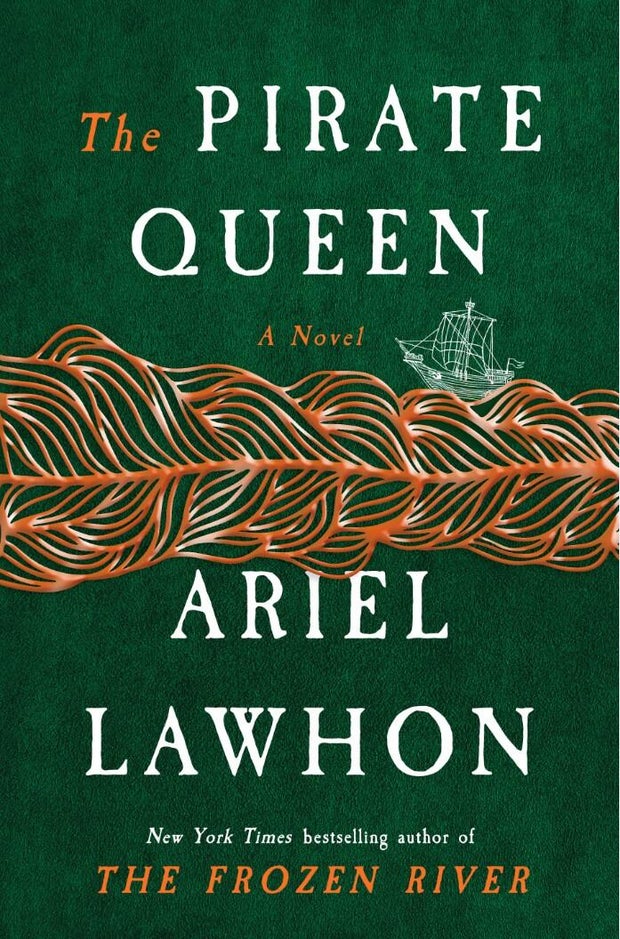
From the publisher: Grace O'Malley was born to be a sea captain. But despite her natural skill on the water, Grace learns early that her dreams of a life at the helm are not compatible with the expectations of her noble family. As the only daughter of a powerful chieftain, her role is to secure a strong alliance and bear children. But when she's sent to foster with a nearby clan, Grace falls for a clever and open-minded second son—a man she cannot have.
Married off against her will to a brutal warrior, Grace performs her duty, all the while gathering followers loyal to her, and consolidating her husband's power, only to be ousted from his lands. But this betrayal offers Grace the opportunity to return to sea, finally leading clan O'Malley's mighty fleet. Just as she finds true independence, Queen Elizabeth's incursions into Ireland grow bolder and Grace must fight to defend her land, her ships, and the people she loves most against the cruel and power-hungry English deputies, who will stop at nothing to check her influence.
Ariel Lawhon lives in Tennessee.
"The Pirate Queen" by Ariel Lawhon (ThriftBooks) $24
Excerpt: "The Pirate Queen" by Ariel Lawhon
Maiden 1535
"Storm Born"
Grace is Five Years Old
The girl lifts a knife and with one trembling swipe severs her braid. In all fairness, the steel is sharp. Cook put it to the whetstone just this morning. But still, it is a shock to see the limp, dead thing in her hand. Like some rock pipit with threadbare wings. Or a clump of wilted flowers. Yet she shakes it in her father's face and hopes that her fear looks like anger instead.
He lurches forward a step. Eyes round and horrified. A hand outstretched as though to stop her. "What have you done, bird?"
"Now my hair won't get caught in the ropes," she says. "Now I'll be going with you."
He shakes his head. "That's not what I meant. That's not what I—"
" 'Tis what you said."
He lied. They both know it. But now she's called him out—in front of his crew, no less—and she can see the storm building in his eyes. To plead with her father in private is one thing. She has done so every day for a year. But to challenge him here, while he has one foot onshore and the other on deck, is a mutinous sin.
"Gráinne," he warns, his voice now clipped and threatening.
Grace shifts back and forth on bare feet. It is summer but the dock is cool and damp, the dark gray stone a balm against the jagged cut on the arch of her left foot—an injury from when she ran through the rock pools at low tide last week looking for anemones. Grace loves the soft red-hued creatures, how they glisten like bloody mushrooms when closed; then, once submerged again, bloom with a tentacled crown. Such a strange child, her mother says, always running barefoot, cursing the rocks. Grace feels the sting of salt water in the cut. Ignores it, afraid to break her father's gaze. Knows that if she blinks, he will send her back to the tower house, to her mother.
The galley bobs beside the quay, sails furled tight against the masts. It looks antsy, like a child bouncing on the balls of its feet, ready to leave. There are ninety men at oars, looking elsewhere, suddenly curious about the sky and the cliffs and the dirt beneath their fingernails. But their ears are tuned to the chieftain and his daughter. Telltale signs. Those bent heads and furrowed brows. The only one who dares to watch the spectacle is a boy of nine. Donal. He is four years older than Grace and dark, like their father. Grace has heard her mother complain that the boy should look more like Aisling, like his own mother, that Eóin O'Malley shouldn't have re-created himself quite so well in the bastard he made with that village girl. Her mother thinks it would be easier to look at Donal if he didn't wear her husband's face. But all Grace sees when she looks at her half brother is a boy who would happily trade places with her. She knows the sea is no friend to Donal, that he returns from every voyage green around the gills. And yet, Eóin tries. With Donal, he tries.
"Take me with you." It's a tiny whisper, nearly lost in the wind and spray rushing into the harbor.
"No," Eóin says, and he is angry now. Or perhaps ashamed. Quite often, there is little difference between the two.
But Grace is angry as well, and her chin wobbles, letting him know.
"You'll be staying with your mother. As is right."
"You said—"
"I made no promises."
She shakes her head. "Isn't fair."
"Fair or not, that's how it's done. The sea is no place for a girl."
Grace has been on Niamh—her father's galley—more times than she can count. The name is carved there on the prow, and she knows what each letter feels like beneath the pad of her fingers though she cannot yet read any of them. The girl loves nothing more than to tuck herself into the prow, her slender arms resting on the gunwale as she traces her hand across those deep, dark grooves. She thinks Niamh is a beautiful name. Wishes it were hers.
Grace knows every island in Clew Bay by name and by sight. Nishoo. Collan Moore. All the Inish: Turlin, Daff, Loy, Muck, Gowla, each with its own rolling hills and beaches and cliffs. Some no bigger than a field, others stretching for miles. But she has never gone far enough into the Atlantic to lose sight of them. Has never been allowed on a trading voyage. Has never been so far from home that the fat, square tower house that looms above them on the cliff fades from view. Home. Where her mother is and where she has been told to stay. Where a girl belongs because the sea is no place for her.
"Please." Begging now. It sounds pathetic even to her small ears. Grace has never heard her mother beg, is ashamed to hear herself do so now.
She waits so long for her father to answer that her feet grow cold and her eyes burn. The braid feels heavy in her hand. This moment, at the age of five—standing in the wind, shorn curls whipping her eyes, cheeks reddening in humiliation—is the first time Grace O'Malley feels hatred. Her father has lied to her, and she hates him for it. It burns worse than the cut on her foot.
"Take me," she demands.
"No."
"You said it was my hair."
He rubs his face. Curses. "Isn't your hair, bird. 'Tis you. Do not ask again."
Decision made, Eóin O'Malley unwinds the mooring lines from the iron crossbar and tosses the sodden rope onto the galley. Then he lifts his foot from the stone and sets it onto the smooth wooden planks of Niamh's polished deck, the boards nearly black, gleaming in the sun.
"Prepare to shove off!"
The call comes from on board, near the prow, and the voice sounds like rocks grinding together. It belongs to Sivney, her father's first mate. He's always been kind to Grace, but he doesn't look at her now.
Donal collects the mooring lines and loops them into a pile on the deck. Steps back. Glances at Grace. Take my place, his eyes implore, but his lips are pressed tight.
"Shove off!" Her father gives the order, and fifteen oars on the port side reach out and rest against the dock. "Push!"
Niamh groans and moves away from the rocky outcropping.
"Again!"
The oarsmen lean to the left, shoving the long wooden blades against the dock, then repeat the process. Now Niamh bobs far enough away for them to row.
"Da." It is no longer a plea, but an accusation, and Grace takes a step forward, reaching for him.
Eóin shakes his head. "I'm sorry, bird."
Furious, Grace throws the braid at his head. The sight seems to startle him and he reaches for it on instinct, but her hair is caught by the wind and whisked away, a red sail flapping in the sun for a moment before it drops to the brackish water, tendrils spreading, soaking, then sinking.
From The Pirate Queen by Ariel Lawhon, published by Doubleday, an imprint of the Knopf Doubleday Publishing Group, a division of Penguin Random House LLC. Copyright © 2026 by Ariel Lawhon.