Novel "A Founding Mother" celebrates the life of Abigail Adams to mark America 250
Please consider joining our Facebook group by CLICKING HERE.
Find out more about the books below.
Listen to Club Calvi's Podcast by CLICKING HERE.
As the U.S celebrates its 250th birthday and its founding fathers, a new book is celebrating a founding mother.
Abigail Adams was the wife of one president, John Adams, and the mother of another, John Quincy Adams. Abigail Adams was more than just an eyewitness to history. She helped shape it.
Mary Calvi talked to authors Stephanie Dray and Laura Kamoie about their novel, "A Founding Mother," which is based on the life of Abigail Adams. You can listen to their entire conversation on the Club Calvi Podcast.
Mary remarked that the Revolutionary period is so often connected to the men fighting the battle and writing the Declaration of Independence, that we often forget about the women.
"We do, and we are trying to change that," Dray responded. "It's time to, in the words of Abigail Adams, 'remember the ladies' because they were half of the population then, and now, and they made significant contributions to the founding of this country."
Mary said she was especially taken with the eyewitness account of Abigail Adams watching the battle for independence unfold before her eyes, with her very young son, John Quincy, by her side.
"Charleston was laid to ash that day," Mary said to Dray and Kamoie. "You write of how [Adams] watched the rising pillars of smoke that blackened the dawn. How it was ablaze in red and yellow, the air tinged with the scent of sulfur, pulsed with a malevolent force. It was such a gripping account for me and for readers."
"I think one of the powerful things about Abigail's story is that she really was on the front lines of the war and she was alone through most of it," Kamoie replied. "She and John had been separated for a total of 10 years of their marriage. She had these little kids right on the front lines and soldiers and refugees were streaming by her house every day."
Dray and Kamoie previously co-authored "America's First Daughter" and "My Dear Hamilton." Mary asked about their research into Abigail Adams's life, considering that she detailed her daily life in letters, which number more than 1,000 between her and her husband John, the future president.
"These letters are one of the things she's best known for," Kamoie said. "It must have been quite difficult for her and John to be separated for so long. But for us today, those thousand-plus letters are a real treasure trove of her thoughts, feelings, beliefs about everything. That's not often something that we have from women of the time. So it's really special."
Mary said she was surprised that Abigail Adams was quite saucy in some of the letters.
"We wanted to allow Abigail to speak for herself whenever possible in the book," Dray added. "We used her own words whenever we could. But I will say that Abigail did surprise us because she was so direct."
Mary said one of the quotes from Abigail Adams' letters to her husband says: "If particular care and attention is not paid to the ladies, we are determined to foment a rebellion." Mary said she thought, 'Go, Abigail!'
"He thought she was kidding," Dray said. "But we do not believe she was kidding and her other letters indicate that she was not. The rest of that quote, she says that women will not consider themselves bound by any laws in which they had no voice or representation. And that is the revolutionary language."
Club Calvi books may contain adult themes.
________________________________________________________________________________________________________
"A Founding Mother" by Stephanie Dray & Laura Kamoie
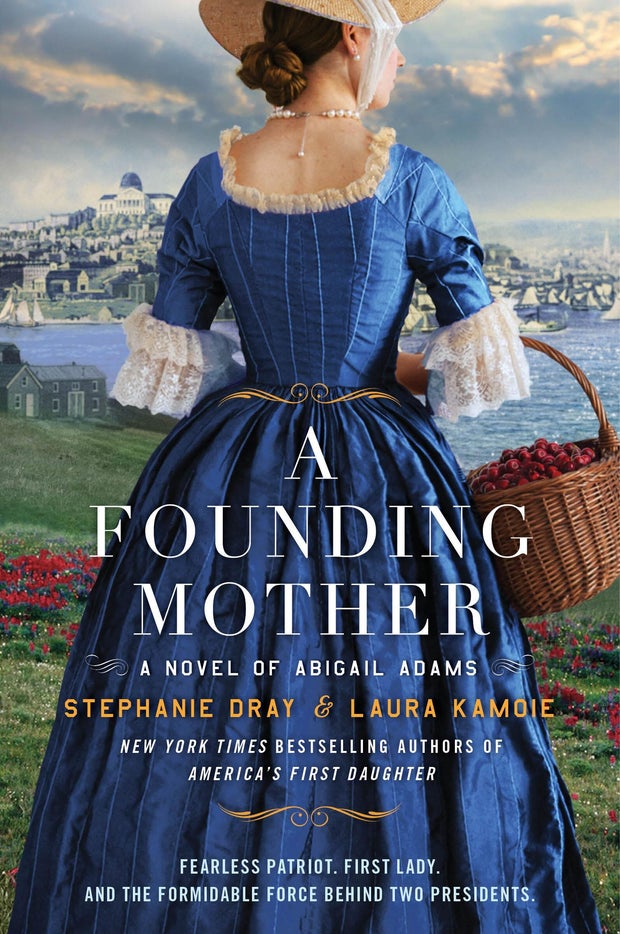
From the publisher: In the heart of revolutionary Boston, Abigail Adams raises her children amid riots, blockades, and the outbreak of war. While her husband, John Adams, rises from country lawyer to nation-builder, often away for years at a time, Abigail builds her own independence—managing their farm, making lucrative investments, amassing savings, battling plague and loss, and defending their home. Unafraid to speak her mind, she famously offers fearless political counsel, urging John to "remember the ladies" in the new government. Through it all, she becomes his most trusted confidante and indispensable ally.
When peace is secured, Abigail steps onto the world stage—exchanging ideas with Thomas Jefferson in the French countryside, navigating court life as the wife of the Minister to Great Britain, and presiding over the parlor politics of the early American republic in New York, Philadelphia, and Washington, DC. Even after her husband's presidential administration, she continues battling political foes and working behind the scenes to advance her family, secure independence for the women in her life, and ensure a better life for the next generation of Americans.
Stephanie Dray and Laura Kamoie both live in Maryland.
"A Founding Mother" by Stephanie Dray & Laura Kamoie (ThriftBooks) $16
Excerpt: "A Founding Mother" by Stephanie Dray & Laura Kamoie
PROLOGUE
QUINCY
Massachusetts
August 1814
Was it all for naught?
Mine has been a life spent bleeding, starving, fighting, and straining to bring six children and a new nation into being. At nearly seventy years of age, I am exhausted by the struggle. My hair is white, my back bent by time, my hands and knees stiff with pain. And as I dig in the dirt to plant a rosemary bush of remembrance by the family tomb, I'm reminded by the mocking song of the cicadas that four of my six children are dead. The other two are lost to me. And our nation's capital is under attack.
For more than four decades—long before we won our independence and long after—the British have menaced our cities, terrorized our coastlines, seized our ships, kidnapped our sailors, and tried to stamp out the flame of our revolution.
Well, this time, they may finally do it.
So I've come to commune with my lost loved ones, fists full of the soil of my country for as long as I may still call it that.
I ignore the approaching carriage on the road—a simple chaise pulled by one horse. I don't wish to be disturbed. I don't wish to put on a brave face as yet another person looks to me for reassurance that this hour is not as dark as it truly is.
But then I hear John call my name and look up with surprise to see my husband in the driver's seat, his aged hands gripping the reins.
At nearly eighty years old, John is still noble in profile. And he still looks the part of the president he once was. But his presidency was more than a decade ago. Now his sight is failing, his teeth are bad, and there is scarcely a hair still left atop his head.
Fortunately, his mind remains active, though that is presently a curse, for he knows that all we have done—and all we have been—stands in peril.
Pulling the carriage to a stop, he motions to me with urgency. He is too frail to get up and down without assistance, so I go to him, brushing dirt and dried grass from my black skirts. Of course, I am also frail, so it takes three tries before I manage to haul my old bones up into the narrow seat beside him. "You have news?" I ask, my voice atremble.
He nods, tears glistening. Then his shoulders slump as he surveys the rolling hills. "Never did our country appear more beautiful than amidst this catastrophe . . ."
I brace for the worst. "Washington has fallen, then? The British have taken it?"
John's mouth flattens to a grim line. "Worse. It is conquered and set ablaze."
I take a pained breath— then another—before I can speak again. "The president's house?"
"Burned," John replies.
I am sent reeling by this news, flooded with memories of those bygone days when I hosted dinners and a grand New Year's party in that lovely white manse as the president's lady. I can still picture the oval room, the red upholstered furniture, the sunny, picturesque view of the Potomac River. I cannot imagine it all devoured by flames at the hand of a tyrant . . .
Nevertheless, John catalogs the destruction. "Both chambers—House and Senate. The Treasury Building. The war department. The naval yard. The Library of Congress. All burned to rubble and ash."
Outrage heats my cheeks. Some would consider it wrong that I grieve more for the books—for all that knowledge lost—than for the mighty edifices so many years' effort took to build. But I do. John once wrote that liberty cannot be preserved without the people desiring and possessing a general knowledge. More than anyone, I know he hasn't been right about everything. But about this, he was correct. "Barbarians," I spit. "This is no superior act of warfare. Just a haughty act of Gothic vandalism. And the British still think themselves our betters . . ."
John is silent.
I go silent, too, until I finally summon the courage to ask, "Is the war lost, then?"
My husband's gnarled hands juggle the reins. "The United States has not yet fallen, but I see nothing to prevent the enemy from victory. President Madison has fled and is in hiding. We have no regular army and cannot get one. The militia fight when they please and run when they please. Our revenue is inadequate, our credit has fallen, our dignity lost." He heaves a sigh. "I'm afraid the English have guillotined us."
My breath goes shallow, my hands and scalp prickle, and my heart thuds with despair.
This is the end, then. The end of the American experiment. The death knell of the United States. The destruction of everything we believed in, everything we struggled to build, everything we sacrificed for. I look to the cemetery where my trowel and gardening gloves still lie and imagine a new headstone standing among the others, this one for the United States of America. Perhaps we ought to bury John's copy of the rough draft of the Declaration of Independence. It would make as good a symbolic corpse as anything else, and burying it might safeguard it against British destruction besides.
John senses the tenor of my thoughts and offers one slim hope. "How many states the British will conquer, I know not: but they will not subdue them all."
Will it matter? With Massachusetts threatening to break away and make a separate peace with Britain, my husband—who has gone from traitor, to patriot hero, to president—would likely be deemed traitor again. And he wouldn't be alone.
All the surviving founders of the Union could face the same fate. Dear God, the fathers who fought and bled, risking life and property to obtain independence and secure a democratic form of government, are surely asking themselves if they fought and bled in vain.
But what of the mothers of this country?
Fathers might drive the ploughs that till the fields of our future, but mothers provide the water, pull the weeds, and nurture the buds. Because men oversee the harvest, they take the credit for the crop. But without mothers, not one sprout would grow—whether the fruit be a child or a nation. It is mothers who nourish and guide each shoot toward the light without knowing what may blossom and what may wither on the vine. Without knowing which children will live or die. And as one of those mothers, I cannot help now but think back upon the acts of my life that may have brought us to this place.
Excerpted from A Founding Mother: A Novel of Abigail Adams, by Stephanie Dray and Laura Kamoie. William Morrow Paperbacks, 2026. Reprinted with permission.